Description
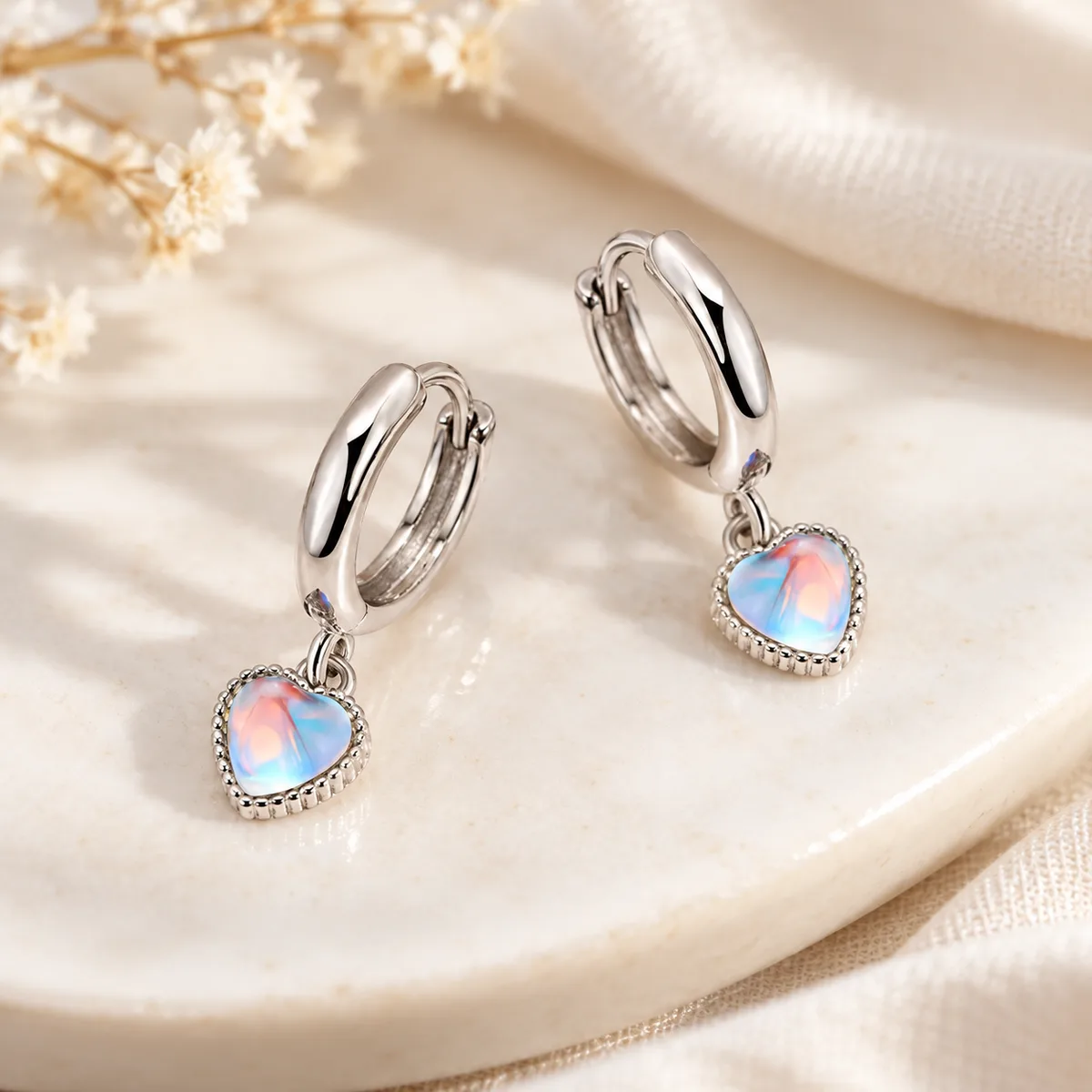
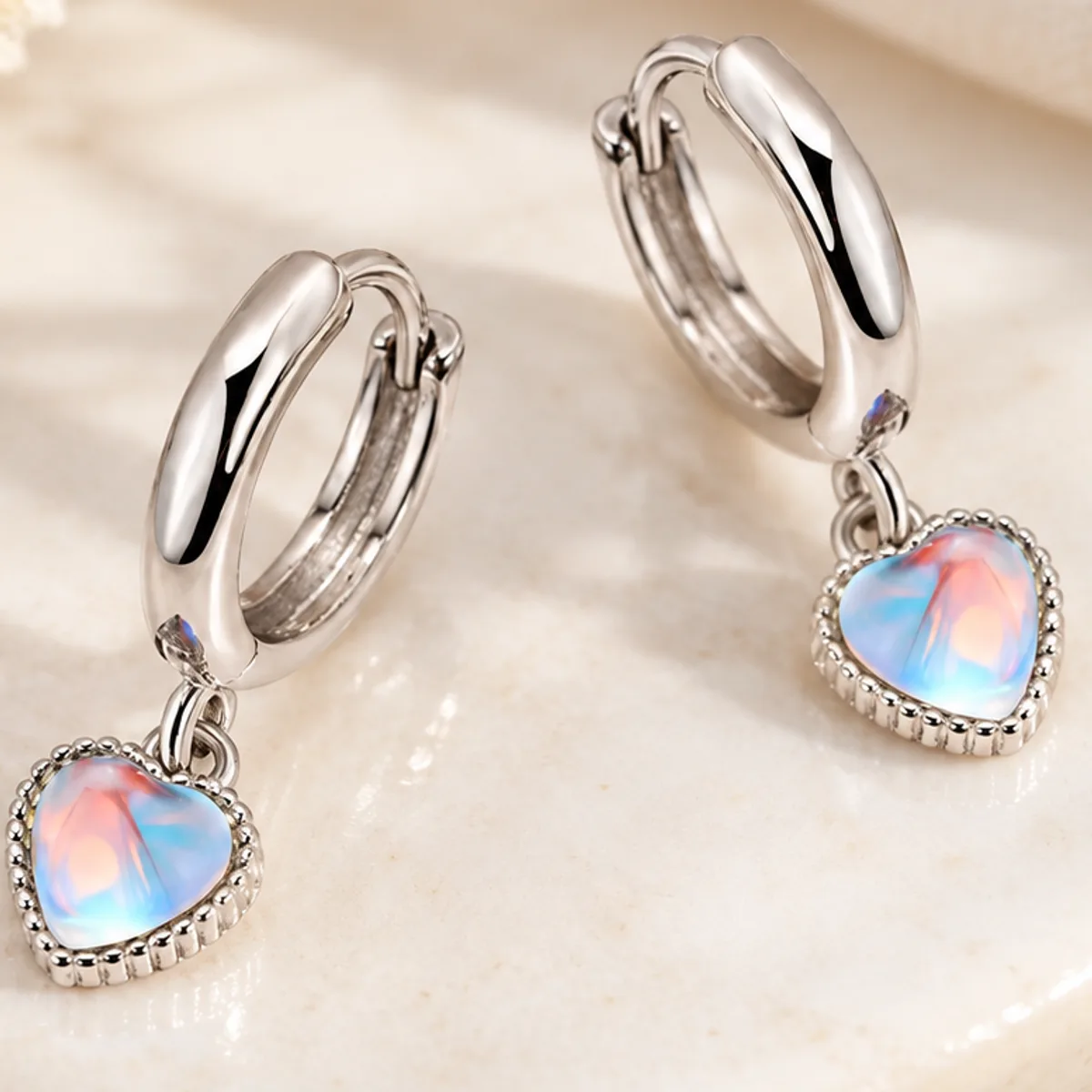
Two fine silver hoops, each carrying an iridescent moonstone heart hanging freely on the ring. The heart slides along the hoop when you move your head.
A mobile pendant on a fixed ring
The heart is not soldered to the hoop: it is threaded onto it, and it can slide a few millimetres and turn on itself. That detail makes all the difference. On a stone with a veil, position determines what you see: a mobile stone sweeps the angles by itself and lights up far more often than a fixed one. As you turn your head the adularescence appears and disappears, and the earring lives instead of sitting still.
The counterpart is that a mobile pendant makes a very light sound against the ring, audible in a quiet room. Some people love it, others do not. I prefer to say so before the purchase: it is the one thing you cannot guess from a photograph.
The heart is cut directly in the stone, not bezel set in a metal frame: it is a moonstone cut to a heart, drilled and polished. That demands a stricter choice of material than a cabochon, because a concave shape is fragile and both lobes must show the same veil. Since moonstone chips on impact, the notch at the top and the point at the bottom are the two zones to watch.
The hoops close with a simple hinged catch. The other earrings are here.
- Two hearts cut directly in real moonstone, iridescent, matched lobe for lobe.
- 925 sterling silver hallmarked S925, fine hoops, hearts threaded free.
- The heart turns and slides: the veil lights up far more often than on a fixed stone.
- It makes a faint sound against the hoop. Said before you buy. Delivered in two weeks.
The specifications
- Stone
- Real moonstone (adularia), two hearts cut and drilled, iridescent
- Origin
- India
- Metal
- 925 sterling silver, S925 hallmark
- Setting
- Hearts threaded on the hoop, free to slide and turn, no glue
- Shape
- Fine hoops with a mobile heart
- Finish
- Polished silver
- Fastening
- Hinged catch
- Gender
- Women
- Brand
- Melissa Moon
Cut shapes cost more than cabochons, and here is why
A cabochon is a dome: the cutter grinds until it is even and there is no shape to get wrong. A heart has two lobes, a notch and a point, and on a mineral with perfect cleavage each of those is a place where the stone can split on the wheel. Add that both hearts of a pair must show the same veil on the same lobe, and you understand why cut shapes in moonstone cost two to three times a cabochon of equal size. It is not the design, it is the breakage.
A cabochon that goes wrong is reground. A heart that goes wrong is gone.
No salt, no ultrasonic tank, no hot water: moonstone is a feldspar, and all three damage it for good. The hole through the heart is its weakest point, so avoid pulling on the stone when putting the earrings on: hold the hoop. Cleaning a moonstone piece and caring for it without harming it cover the rest.
What tradition attributes to moonstone
What follows belongs to the traditions and beliefs attached to this stone. I keep it apart from the rest of the page: none of it is proven, and no piece of jewellery heals anything.
The heart shape
The heart as a symbol of affection is a European convention that took its present form in the late Middle Ages, and it carried unrelated meanings before that.
The hoop
Hoop earrings appear in Nubian, Greek and Roman work and in dozens of unconnected cultures since, for the practical reason that a ring is the easiest form to forge.
Sacral chakra (Svadhisthana)
Traditional correspondences attach moonstone first to the second chakra, the one of emotion and creativity, and secondarily to the third eye. Worn as a ring it stays on the hand, far from both points, and tradition then makes it a matter of looking rather than of placement.
The traveller's talisman
Long before modern crystal healing, this was the stone taken on the road, in India as in Rome, and given to whoever was leaving. It is probably its only genuinely ancient use, and there is nothing therapeutic about it.
Traditions and beliefs, nothing else. None of these associations amounts to medical advice, and no piece of jewellery replaces a treatment or an examination. If you are on medication, pregnant or in a course of care, talk to your doctor rather than to your jeweller. The full disclaimer is here.
How your jewellery reaches you
Nothing is kept in stock. Each piece is ordered from a partner workshop after you place your order, then dispatched to you directly.
- Delivered in two weeks, tracking number provided as soon as it is dispatched
- Free delivery on orders over 47 €
- 14 days to change your mind, with no explanation required
Customs duties are included wherever you are: there is nothing further to pay on delivery. Lead times, zones, exchanges and refunds are detailed on the Delivery and returns page.
Caring for a moonstone
No salt, no ultrasonic tank, no hot water. Moonstone is a feldspar with perfect cleavage: it does not scratch easily, but it chips on impact, and those three damage it for good. Lukewarm water and a soft cloth are enough.
Take the piece off before the shower, the pool, sport and housework. Store it on its own in a pouch rather than loose: what scratches a moonstone is almost always another piece of jewellery.
Crystal healing also likes to cleanse and recharge a stone from time to time. On this one, moonlight suits it very well. Salt does not, and yet it is the method most often recommended online.
Chosen one by one
I do not make these pieces myself: I choose each design from partner workshops, and I drop from the catalogue anything that does not live up to its description.
- Metal, stone and dimensions stated on every listing
- No opalite, no coated quartz sold as rainbow moonstone: both were pulled from the catalogue
- No piece sold for anything it might heal
My story, and what I stopped selling.