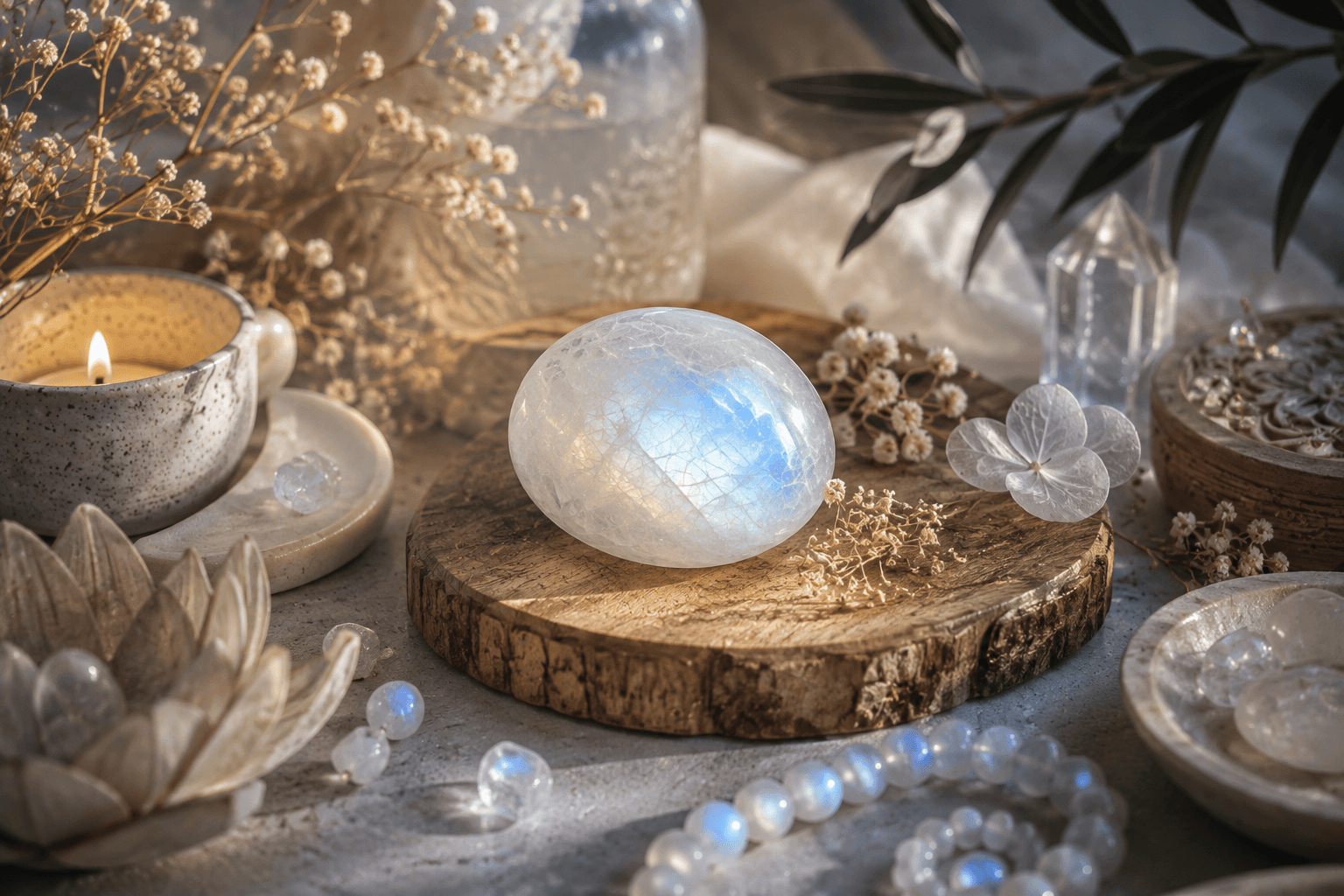
Moonstone benefits and healing properties
Emotional balance, intuition, dreams, cycles, beginnings: here is what tradition attributes to moonstone, domain by domain. With, for each attribution, one thing you will not find anywhere else: where it comes from and since when. You will see that most of it is much more recent than people say.
This is the hardest page to write on this entire site. Repeating the usual list would have taken an hour, and I would have lied by omission. I chose instead to honestly report what is said, date each attribution, and say at the end what research and French law think of it. If you are looking for what the stone means rather than what tradition attributes to it, that is in the meaning of moonstone.
The short version, if you are in a hurry
- A piece of jewellery cures nothing. Everything that follows belongs to a tradition, is written in the conditional, and never replaces medical advice.
- The four most consistent attributions are emotional balance, intuition, cycles and periods of change.
- It is reputed to be a stone of night and dreams, probably the oldest attribution, and the only one that follows directly from its sheen.
- It is also the traveler's stone, by analogy with the Moon governing the tides.
- Most of these benefits are less than forty years old. They come from three English-language books published between 1985 and 2003, not from thousand-year-old wisdom.
- None of it has been demonstrated. A 2001 study compared real crystals to fakes: participants reported the same sensations with both.
- In France, a health claim about a stone is illegal unless it is proven. The DGCCRF found a 28% anomaly rate in an investigation into gemstone jewellery.
How I talk about benefits, and why
Let us start with the framework, because everything else depends on it.
I sell jewellery. I do not sell remedies, medical devices, or supplements. A moonstone ring is an item of adornment, and nothing else. If you only came for that sentence, you can stop here.
So why an entire page about benefits? Because it is the question I get asked most often, and refusing to answer it would leave the field open to sites that are far less careful. So I chose to report what tradition says, presenting it for what it is: beliefs, passed down, never verified.
The rule I hold across the whole site, and that I have posted publicly on the journal page: anything belonging to mineralogy is written in the indicative, because it can be measured. Anything belonging to crystal healing is written in the conditional, and is tied to a tradition, never to proof. The two never share the same paragraph. If you find a sentence on this page that mixes the two, it is a mistake, and I would like to know about it.
A moonstone piece of jewellery has no demonstrated effect on health. It replaces neither a diagnosis, nor a treatment, nor the advice of a health professional. Never interrupt an ongoing treatment and never delay a consultation because of a stone. Read the full disclaimer.
Emotional calming, the most cited attribution
This is the one that comes up everywhere, and by far the top reason people write to me.
Tradition presents moonstone as a stone of emotional balance. It is said to soften strong reactions, help create distance, and calm someone overwhelmed by emotion. Some texts give it the role of a mirror: it would reflect back to the wearer what they feel, rather than change it.
The internal logic is consistent, and it deserves to be laid out rather than just accepted. The Moon governs the tides, tides rise and fall, so do emotions: by analogy, a lunar stone would regulate inner tides. All of crystal healing works this way, through correspondence and resemblance. It is not a scientific line of reasoning, it is an analogical one, and it has its own logic.
It is worth knowing where this specific attribution comes from. It is found stated in English-language crystal healing manuals from 1985 to 2003, and from there in nearly every French-speaking site today. It appears neither in Pliny nor in ancient Indian traditions, which speak of something else. The detail is in the table further down.
Intuition, dreams and the night
Second major domain, and the one that follows most naturally from the stone itself.
Moonstone is said to be linked to intuition, to what one perceives without being able to explain it, and to everything belonging to the night: dreams, remembering them on waking, the states between wakefulness and sleep. In correspondence systems, it is linked to the third eye, sometimes to the sacral chakra. These correspondences are detailed in moonstone and chakras.
Why this stone rather than another? Because its sheen does exactly that: it appears when you are not looking for it, it moves, it disappears when you stare at the stone head-on. A gem whose light slips away is too perfect a metaphor for tradition to have missed. The optical mechanism itself is well understood, and it is described in the article on adularescence.
On the very concrete question of wearing it at night, I would rather point you to can you sleep with a moonstone, because there is a real subject there, and it is not esoteric: a stone with perfect cleavage does not handle being pressed against a mattress for eight hours a night very well.
Cycles, the most delicate ground
Here is the part where I will be more careful than elsewhere, and I would rather say why upfront.
Tradition associates moonstone with the feminine and with cycles. Today it is its most commercial attribution, present on almost every online shop. It rests on a simple chain of analogies: the Moon makes the month, the month makes the cycle, so the Moon's stone would be the cycle's stone.
This chain is appealing and it is recent. It spread mostly starting in the 1990s. You will often see it presented as ancient wisdom: it is not, and saying so takes nothing away from anyone who finds meaning in it.
Two extensions of this attribution exist, fertility and pregnancy, and these are the only subjects on this site where I do not even report the tradition without framing it carefully. They are covered separately, in the strict conditional and without the slightest promise, in moonstone and fertility and which stone for a pregnant woman. The relationship to menstruation is covered in moonstone, periods and the female cycle.
What I want to state clearly here: if you are trying to conceive, pregnant, or if something is off with your cycle, the answer is a health professional, not a stone. A stone can accompany a moment. It cannot decide anything.
One last remark, and it is a freeing one: nothing in this tradition reserves moonstone for women. It was worn by sailors, travelers and sovereigns long before being associated with the feminine. The subject has its own article, moonstone for men.
Beginnings, transitions, travel
Fourth domain, broader, and the one that best explains why this stone gets given as a gift.
It is presented as the stone of new beginnings. Moving house, a career change, a separation, a birth, coming home from a trip: anything that starts. The phrase stone of new beginnings comes from manuals of the 1990s and 2000s, and it is today the most repeated phrase in the crystal world.
It joins a considerably older attribution, that of the traveler's stone: the stone was said to protect while traveling, and especially on water, always through the same analogy with the tides. It was said to be carried by sailors and pilgrims. I have found no primary source for this belief, which does not stop it from being remarkably consistent across centuries and cultures. The full stories are in moonstone myths and legends.
It is also, very concretely, why moonstone makes a gift that lands right at a turning point. Nothing magical about it: giving an object that means "something is starting" is a gesture that stands on its own. What that means is developed in the meaning of moonstone.
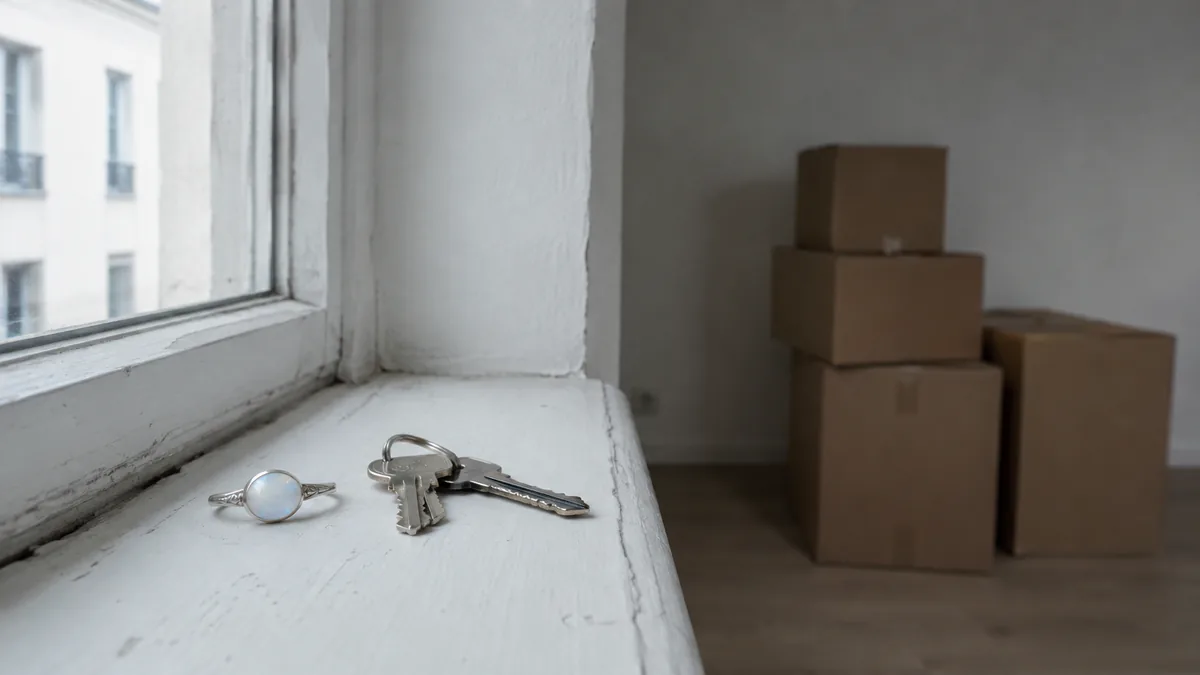
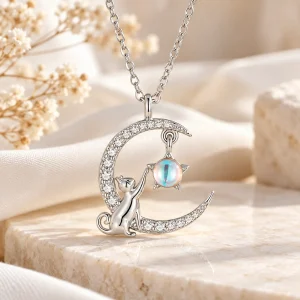
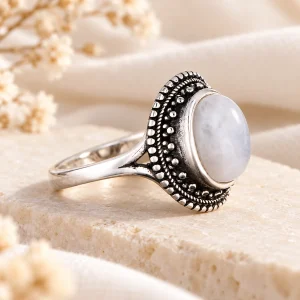
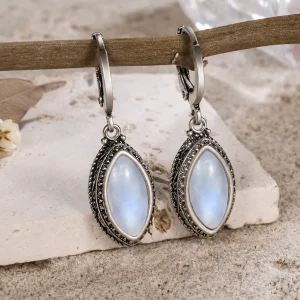
The pieces people buy from me to mark a turning point
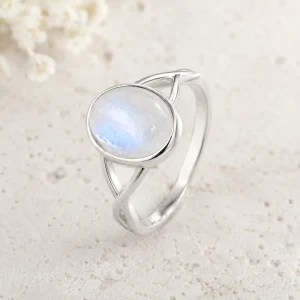
Where each benefit comes from, and since when
Here is the table I wanted to make, and that I could not find anywhere. It does not judge: it dates.
| What is attributed to it | Where it comes from | Since |
|---|---|---|
| Emotional balance | English-language crystal healing manuals | 1985 to 2003 |
| Intuition, third eye | Modern correspondence charts | 20th century |
| Dreams and night life | Same origin, reinforced by the sheen | 20th century |
| New beginnings | English-language manual phrasing | 1990s |
| Feminine and cycles | Moon, month, cycle chain of analogies | 1990s |
| Fertility | Same chain, same period | 1990s |
| Sign of Cancer, water element | Modern astrological constructions | 20th century |
| June birthstone | American jewelers' list | 1912 |
| Travel protection | Repeated everywhere, no primary source | Undatable |
| Wedding gift, India | Attested usage, orally transmitted | Ancient |
| Stone of the god Chandra | Documented Hindu tradition | Ancient |
Three possible readings of this table, and all three are legitimate.
The first: almost all of it is recent. The three books that manufactured contemporary crystal healing are in English and date from 1985, 1991 and 2003. What you read today on a French site descends from them almost every time, often after three or four rounds of copying.
The second: a recent tradition is still a tradition. Forty years is little on the scale of stone history, but it is two generations of people for whom it mattered. I disqualify no one.
The third, and it is the one that bothers me: the phrase "the ancients said," tacked in front of an idea as old as my parents. It is not the belief that is the problem, it is the age invented for it to make it more credible.
One amusing case in the mix, because it shows how a tradition gets manufactured in a single meeting: moonstone became the June birthstone in 1912, when the American jewelers' association standardized the list. Alexandrite was added in 1952. These are trade association decisions, not revelations. The subject is developed in the June birthstone.
How people actually use it
Let us leave theory behind. Here is what people who use moonstone actually do, and what I can say about it without stepping outside my field.
Wearing it. By far the most common, and the simplest. Ring, bracelet, pendant: the question of wrist, hand and skin contact is covered in how to wear moonstone. What I can say with certainty is that a piece worn every day takes knocks, and a feldspar with perfect cleavage does not like that: the bracelet is the least exposed setting, the ring the most exposed.
Placing it somewhere. On a desk, a nightstand, in a pocket. This is the least risky use for the stone and the one that requires the least gear. A tumbled stone or a small cabochon is enough.
Cleansing and recharging it. This gesture is central to the practice, and it follows precise rules, several of which are real material constraints rather than beliefs: never salt, never prolonged water exposure, never ultrasonic cleaning. Everything is detailed in cleansing and recharging your moonstone and in the lunar calendar.
Pairing it with another stone. The most requested duos are amethyst, rose quartz, carnelian and labradorite. The reasoning behind each pairing, and the ones that make no sense, are in which stone to pair with moonstone and which stone not to pair.
If this is your first stone, there is an article made for that, getting started with crystal healing using moonstone. And before any purchase, the reflex that matters most is still checking that it is a real stone: how to recognise a genuine moonstone, and above all not opalite, which is glass.
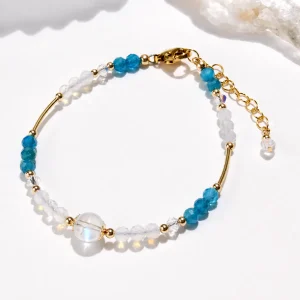
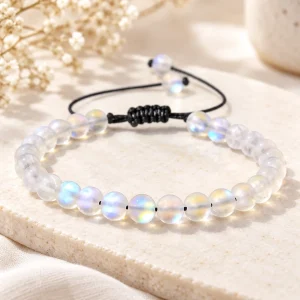
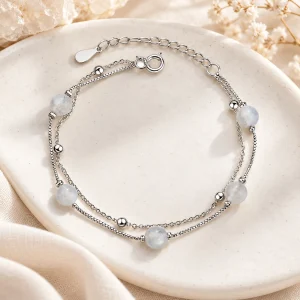
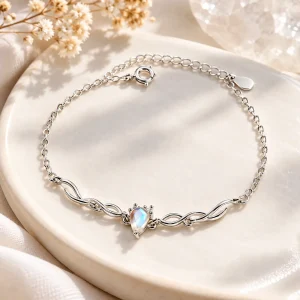
Bracelets, the piece you keep on all day
What research says, and what the law says
This section exists because it would be dishonest of me to leave it out. It will not make you happy if you are already convinced, but you may have come here looking for someone willing to write it.
The reference study dates from 2001. Christopher French, of Goldsmiths, University of London, presented it at the centenary congress of the British Psychological Society. Eighty participants meditated while holding either a real quartz crystal or a fake glass one, after being told the sensations they might expect. Both groups reported those sensations in the same proportions, and no one was able to tell the real one from the fake. The authors' conclusion: nothing beyond a placebo effect.
I do not find this result depressing, and I will say why. The placebo effect is not nothing: it is a real, measurable effect, produced by the attention one pays to oneself. Someone who takes five minutes each morning to turn a stone between their fingers is taking five minutes for themselves. It is the ritual doing the work, not the mineral. There is nothing shameful about that, and above all nothing medical.
On the legal side, France is clear. Any advertising claim must be justified by whoever makes it, including properties attributed to a mineral. Without scientific proof, such a claim can be classified as a misleading commercial practice. That is not an opinion, it is the position of the DGCCRF, France's consumer protection authority.
The same administration ran an investigation into jewellery containing gemstones or pearls, with 790 inspection actions, and found an anomaly rate of 28%. In other words: more than one inspected business in four. It explicitly targets sellers who highlight crystal healing training to lend weight to their claims.
Finally, Miviludes, the French interministerial body that monitors cult-like deviations, regularly lists stone-based care among the practices it is asked to examine, in a field, health and wellbeing, that accounts for the largest share of its reports. The problem it describes is never the piece of jewellery: it is substitution for real treatment.
The five sentences I will not write
Might as well name them, since they are what sells everywhere else.
"This stone heals." Not heals, not relieves, not cures, not soothes a symptom. No verb from that family belongs on a product page.
"It helps you get pregnant." Never, in any phrasing, including indirect ones. This is the refusal I hold most firmly, because it is the one that can do the most harm.
"The ancients used it for…" Not without a dated source. The table above shows just how often this phrase is simply false.
"Testimonial: since I started wearing it, I…" I will not publish any testimonial of that kind. Promising by proxy is still promising.
"Rainbow moonstone, superior-quality adularia." That one is not a health claim, but it is a mineralogical lie, and it is everywhere. Rainbow moonstone is labradorite.
The rest of what I refuse to do, ultrasonic cleaning included, is in the complete guide. The real precautions, the ones about fragility and metals, are in the contraindications.
These correspondences belong to crystal healing, an approach founded on traditions and beliefs. They do not constitute a medical claim and never replace the advice of a health professional. Read the full disclaimer.
Frequently asked questions
What are the benefits of moonstone?
Tradition attributes to it emotional balance, intuition, a link to dreams and the night, the feminine and cycles, and support through periods of change. These are traditional attributions, presented here in the conditional: none of it has been demonstrated and a piece of jewellery cures nothing.
Are these benefits ancient?
Much less than people say. Emotional balance, new beginnings and the link to the female cycle come from manuals published between 1985 and 2003. Only the role of travel talisman, the link to the god Chandra in India, and the wedding gift usage are genuinely ancient.
Has science tested crystal healing?
Yes. The reference study is Christopher French's, presented in 2001 at the congress of the British Psychological Society: eighty participants holding either a real crystal or a fake glass one reported the same sensations. The authors concluded it was a placebo effect, and nothing more.
Can you claim a stone has benefits, in France?
An advertising claim must be justified by whoever makes it. Without proof, the DGCCRF considers it may amount to a misleading commercial practice. That is why this site reports traditions in the conditional rather than asserting effects.
What is the difference between benefits and meaning?
Benefits are what is attributed to the stone, meaning what it is supposed to do. Meaning is what it stands for: its symbolism, its history, the message sent by giving it. The two subjects are kept separate here, and meaning has its own article.
Is moonstone reserved for women?
No. The association with the feminine is recent, dating from the 1990s. Before that, the stone was mostly a travel talisman and a sovereign's stone. The subject is covered in moonstone for men.
Should the stone be worn against bare skin?
Tradition often recommends it. From the jewellery standpoint, skin contact means sweat, creams and perfume, none of which are good for a feldspar with perfect cleavage. A soft-cloth wipe in the evening settles the question.
How do you cleanse a moonstone without damaging it?
Never salt, never prolonged soaking, never ultrasonic cleaning. These are not esoteric rules but material constraints: hardness is 6 to 6.5 and cleavage is perfect. Compatible methods are in cleansing and recharging your moonstone.
Can a moonstone help conceive a child?
No, and I will not write it in any phrasing. Some recent traditions make that link, and I report it as a belief and nothing more. Trying to conceive is a matter for medical follow-up, and for that alone.
Which chakras is it linked to?
Most often the third eye and the sacral chakra, sometimes the heart depending on the author. These correspondence charts are twentieth-century constructions, internally consistent but not ancient. The detail is in moonstone and chakras.
Where to go next
- The counterpart to this page: the meaning of moonstone, its myths and legends.
- The correspondences in detail: the chakras, astrology and Cancer, the June birthstone.
- The sensitive subjects, covered separately: fertility, pregnancy, periods and the cycle, contraindications.
- The practice: getting started with crystal healing, pairings, cleansing and recharging, how to wear it.
- The stone itself: the complete guide, the colours and varieties.
The jewellery is in the shop, and I explain how I work on the workshop page. If an attribution on this page looks misdated to you, or if you know an old source I have not found, write to me: I correct it and I note it.
My sources
For the placebo-effect study: the work of Christopher French and his colleagues at Goldsmiths, University of London, presented in 2001 at the centenary congress of the British Psychological Society. Eighty participants, real quartz versus glass, no reported difference between the two groups.
For the French legal framework: the position of the DGCCRF on advertising claims applied to minerals, and its investigation into the quality and compliance of jewellery containing gemstones or pearls, 790 inspection actions and 28% anomalies. For the risk of substituting for real care, the activity reports of the Miviludes.
For dating the attributions: the three founding books of contemporary crystal healing, Crystal Enlightenment by Katrina Raphaell in 1985, Love Is in the Earth by Melody in 1991 and The Crystal Bible by Judy Hall in 2003. For the birthstone, the standardization of the list by the American jewelers' association in 1912, completed in 1952. For the ancient traditions, Pliny the Elder and the historical data sheets of the GIA.
A limitation I would rather flag than hide: dating an oral belief is an approximate exercise. When I write "1990s," I am describing the moment an idea becomes massively present in written texts, not the day someone first stated it. The three lines marked "ancient" in the table are attested but not precisely datable, and the "undatable" line is so because I found no primary source, despite the attribution being repeated everywhere.
Last updated: August 19, 2026. If you find a mistake in this article, tell me about it: I correct it and I note it.
✦ À porter, à offrir
Découvrez mes créations