Moonstone myths and legends
Solidified moonbeams in India, a stone that waxes and wanes with the moon according to Pliny, a traveler's talisman, a lovers' stone. Here is what has been said about moonstone for two thousand years, what is written in black and white in an ancient text, and what was invented much more recently.
I love these stories, and I gladly tell them. But I draw a line between a legend attested by a text and a sentence copied from shop to shop for thirty years. This page sorts them out, and the last section says plainly what holds up and what does not.
The short version, if you are in a hurry
- The oldest written trace is Roman. Pliny the Elder, around 77 CE, describes a stone that contains the image of the Moon and that waxes and wanes with it.
- In India, it was said to be made of solidified moonbeams, and linked to the moon god Chandra.
- It is a travel stone, reputed to protect on water, because the Moon governs the tides.
- It is a lovers' stone, given as a wedding gift in several traditions.
- Watch out for the Sri Lankan false friend: there, "moonstone" also refers to a carved temple threshold, which has nothing to do with a gem.
- Many "ancient legends" are less than a hundred years old. The last section sorts them out, source by source.
India: solidified moonbeams
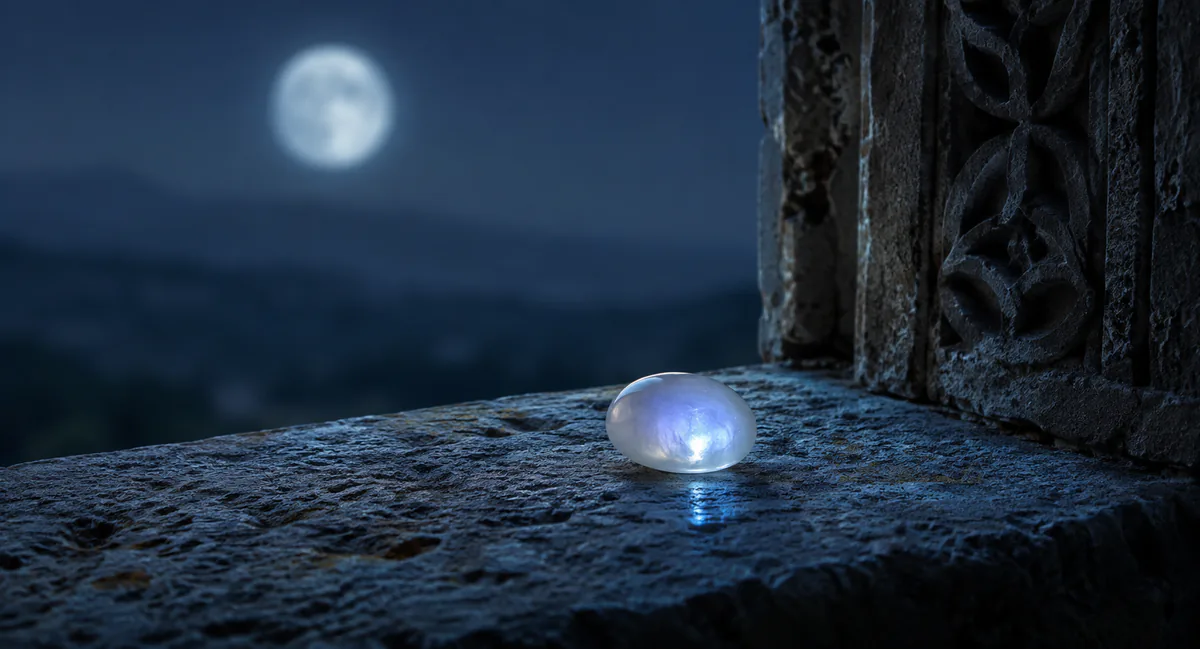
It is the most beautiful image, and the most widespread: moonstone was said to be frozen moonlight, fallen to earth and hardened.
Hindu tradition links it to Chandra, the god of the Moon. His full name, Chandrashekhara, means "the one who bears the Moon." The story goes that a moonstone has been set in his forehead since the beginning, and that it darkens or lightens with the rhythm of the moon.
The stone is sacred there in the strong sense of the word: in certain traditions, it is not sold set down just anywhere, but on a yellow cloth, the sacred colour. It is also one of the traditional wedding gifts, which comes up again in the section on lovers.
A remark that matters for what follows: the image of solidified moonbeams is not a poetic accident. It describes fairly well what one actually sees. The blue veil of an adularia does indeed seem to float beneath the surface, as if caught inside the stone rather than sitting on top of it. The real mechanism is explained in the article on adularescence.
What Pliny actually wrote
Here is the only truly ancient source, and it deserves to be quoted correctly rather than summarized loosely.
Pliny the Elder, in his Natural History completed around the year 77, describes a stone he calls selenites, from the Greek selene, the Moon. He writes that it contains the image of the Moon, and that this image waxes and wanes each day according to the state of the moon.
This is false, obviously. The sheen of a moonstone depends only on the angle of light and the internal structure of the crystal, not on the lunar calendar. But the mistake is understandable: the veil changes intensity with lighting, and an observer looking at their stone at different times of the month will indeed see different things.
Two honest clarifications. First, nothing guarantees that Pliny's selenites is our adularia: the ancients classified stones by appearance, not composition, and the word may have referred to several minerals, including gypsum. Second, this belief dies hard: it is still found today, stated as though it were verified.
The stone of Diana
Rome naturally linked the stone to Diana, goddess of the Moon and the hunt, equivalent to the Greek Artemis and associated with Luna, the personification of the moon.
The reasoning is simple and it holds for nearly every culture: a stone bearing a lunar sheen belongs to the lunar deity. It is not a revelation, it is a logical association each pantheon produced on its own.
The details of these deities, from Selene to Ix Chel to Tsukuyomi, are covered in the gods and goddesses of the Moon. Here, what interests me is what people credited to the stone, not who the gods were.
The travelers' talisman
This is one of the most consistent attributions: moonstone was said to protect while traveling, and especially on water.
The logic fits in one sentence: the Moon governs the tides, so a lunar stone governs water, so it protects those who venture onto it. It was said to be carried by sailors, pilgrims and night travelers, and this reputation earned it the nickname the traveler's stone.
The belief carried through into very concrete uses: it is still recommended today as a departure gift, for a move or a long journey. On what tradition attributes to it more broadly, see the benefits of moonstone.
These correspondences belong to crystal healing and folklore, approaches founded on traditions and beliefs. They are not a medical claim and never replace the advice of a health professional. Read the full disclaimer.
The lovers' stone
A second very consistent attribution, and the one that explains a good share of its sales today: moonstone was said to be the lovers' stone.
In India, it is one of the traditional wedding gifts. Elsewhere, it is said to rekindle a fading feeling, or to bring two people back into tune after life has pulled them apart. This is also why it comes back again and again as an engagement ring, even though its fragility does not particularly suit it for that: the subject is covered in moonstone engagement rings.
It is also one of the three June birthstones, alongside pearl and alexandrite, which makes it a natural birthday gift for that month.
On what the gesture of giving it means, see the meaning of moonstone and giving moonstone as a gift.
The mouth, the full moon and the future
This one is my favorite, because it is dramatic and because it illustrates well how a legend gets made.
The story goes that by placing a moonstone in your mouth on a full moon evening, you would see your future, or at least the future of your love life. The short version circulates everywhere, the long version sometimes specifies that you must be outdoors, or facing the moon.
A variant attributes to magicians the use of the stone according to its phases: on a waxing moon for what one wants to grow, on a waning moon for what one wants to diminish. That logic is consistent with all of European sympathetic magic, which reasons by analogy.
Two remarks. The first, practical: do not put your jewellery in your mouth. Not for occult reasons, but because saliva is acidic and the stone has perfect cleavage, meaning microfractures where everything settles in. The second, more serious: I have not found any ancient source for this story. It appears in twentieth-century works, without a reference.
The false friend of Sri Lankan temples
Here is a point I have not seen anywhere else, and it explains a few confusions found online.
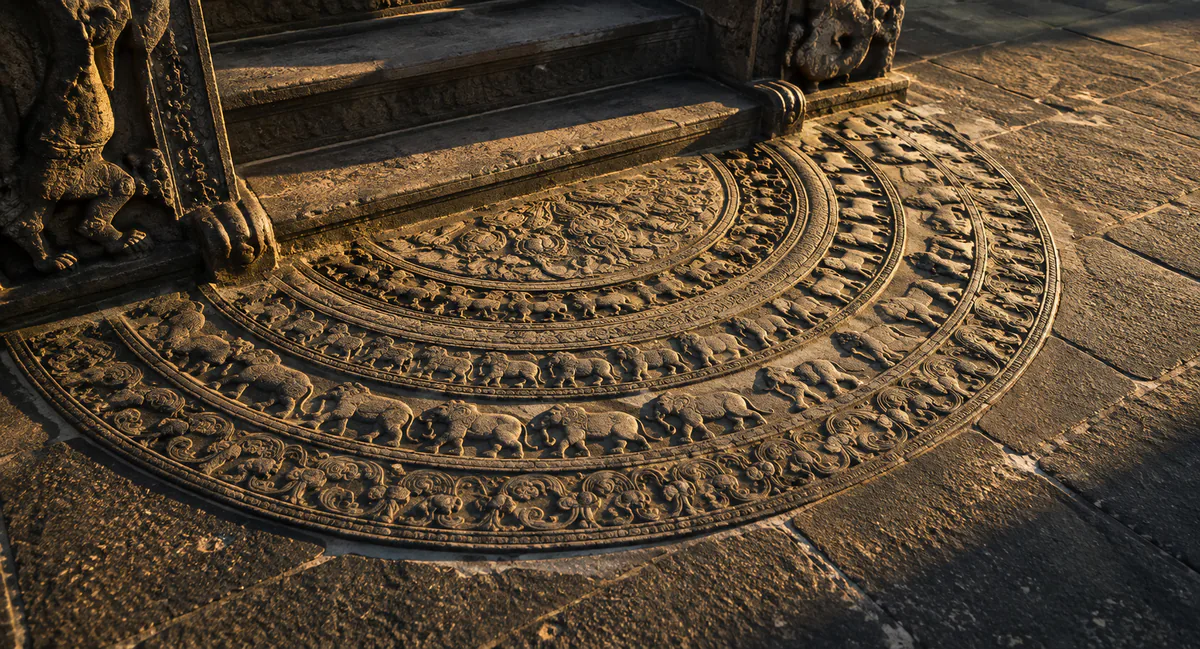
In Sri Lanka, which is the great home of blue moonstone, the expression moonstone also refers to something else entirely: the sandakada pahana, a carved stone slab in a half-moon shape placed at the foot of the stairs of Sinhalese Buddhist temples.
It is an architectural feature, richly decorated with concentric bands, animals and floral motifs, and it has strictly nothing to do with the gem. It owes its name to its shape, not to its material.
The result: search for "moonstone Sri Lanka" and you will find photos of temple thresholds mixed in with photos of cabochons. It is not a mistake on the sites' part, it is two different things sharing the same name.
The gem deposit itself is very real, though: it is covered in moonstone from Sri Lanka.
The legends still being invented
People often assume folklore belongs to the past. For this stone, it is being made right in front of us, and it is worth knowing how to spot it.
The link to the menstrual cycle is very present today, almost standard in online shops. It rests on a chain of analogies, Moon so month so cycle, and not on a documented ancient tradition. It spread mostly starting in the 1990s.
The link to fertility follows the same logic and the same timeline. It is ground I do not touch, and I say so clearly in the complete guide: I promise nothing on this subject.
The correspondence charts, third-eye chakra, water element, planet Moon, sign of Cancer, are twentieth-century constructions. They are internally consistent and have their own logic, but they are not a thousand years old. The detail is in the associated chakras and moonstone in astrology.
None of this is illegitimate. A recent tradition is still a tradition. What bothers me is the phrase "the ancients said" tacked onto an idea that is forty years old.
What is documented, and what is not
Here is the sorting, as honestly as I can do it.
| What is said | What can be verified |
|---|---|
| Pliny describes a stone that waxes and wanes | Existing text, around the year 77. It remains unclear which stone he was describing |
| Solidified moonbeams, India | Attested and ancient tradition, passed down orally |
| Chandra's stone | Documented association, but the story of the stone in his forehead is a late addition |
| Diana's stone, Rome | Logical and consistent association, few direct sources |
| Travelers' talisman | Repeated everywhere, no primary source identified |
| Wedding gift in India | Attested usage |
| The stone in the mouth at the full moon | No ancient source, appears in the twentieth century |
| Link to the cycle and fertility | Recent, spread mostly since the 1990s |
| Chakras, element, planet | Twentieth-century constructions |
This table is not here to spoil the fun. A story does not need to be true to be beautiful, and I sell a stone whose charm is half made up of what is said about it. But a customer who buys believing in a thousand-year-old tradition deserves to know when it is actually a hundred years old.
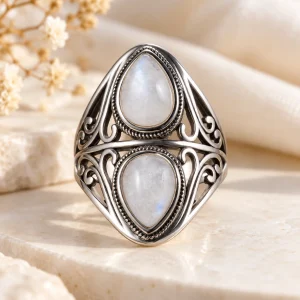
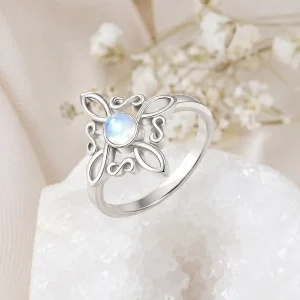
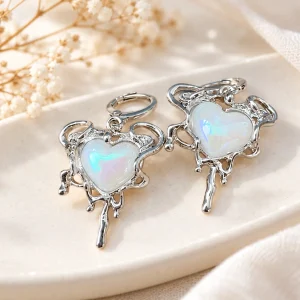
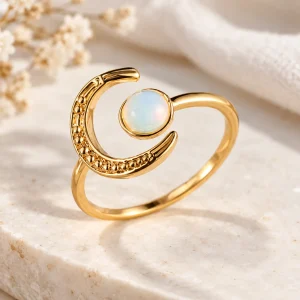
Rings from the workshop




Frequently asked questions
What is the oldest moonstone legend?
The oldest written trace is Pliny the Elder's, around the year 77, describing a stone containing the image of the Moon and waxing with it. Indian traditions are probably just as old, but passed down orally, which makes them harder to date.
Does moonstone actually come from the Moon?
No. It is an earthly feldspar, formed in magmatic and hydrothermal rocks. Its name comes from its sheen, not its origin. The question is covered in detail in moon rock or moonstone.
Does its sheen actually change with the phases of the Moon?
No, and that is precisely Pliny's mistake. The sheen depends on the angle of light and the internal structure of the crystal. It changes from one moment to the next because the lighting changes, not because the Moon has moved.
Why is it called the traveler's stone?
Because the Moon governs the tides: by analogy, a lunar stone was thought to protect on water. It was said to be carried by sailors and night travelers. It is a very widespread attribution, but one for which I have found no ancient primary source.
Do you really have to put it in your mouth at the full moon?
Definitely not, and for a very down-to-earth reason: saliva is acidic, the stone has perfect cleavage, meaning microfractures where everything settles in. As for the legend itself, it does not appear in any ancient text I have been able to identify.
What is the moonstone of Sri Lankan temples?
A sandakada pahana, a carved half-moon slab placed at the bottom of the stairs of Sinhalese Buddhist temples. It is an architectural feature that owes its name to its shape, and it has no connection to the gem. It is a simple homonym that muddies a lot of online research.
Is the link to the female cycle ancient?
No. It rests on a chain of analogies, Moon so month so cycle, and spread mostly starting in the 1990s. It is a recent tradition, which does not disqualify it, but it is better not to present it as a thousand years old.
Where to go next
- The stories: the gods and goddesses of the Moon, moon rock or moonstone, the Sri Lankan deposit.
- What tradition attributes to it: the benefits, the meaning, the June birthstone.
- The stone itself: the mineral data sheet, adularescence, the colours and varieties.
- The bigger picture: the complete guide.
And if one of these stories made you want to wear one, everything is in the shop. If you know a legend I have not mentioned, or a source I have not found, write to me: those are the messages I like receiving most.
My sources
The Pliny the Elder quote comes from his Natural History, completed around the year 77. The Indian traditions and the association with Chandra are reported by the historical data sheets of the GIA, the International Gem Society and the American Gem Society. The sandakada pahana is a documented feature of Sinhalese architecture, unrelated to the gem.
For everything I could not source, I said so: the sorting table states it line by line. A widespread attribution is not an attested attribution, and I prefer to flag my gaps rather than fill them with "the ancients said."
Last updated: August 19, 2026. If you find a mistake in this article, tell me about it: I correct it and I note it.
✦ À porter, à offrir
Découvrez mes créations