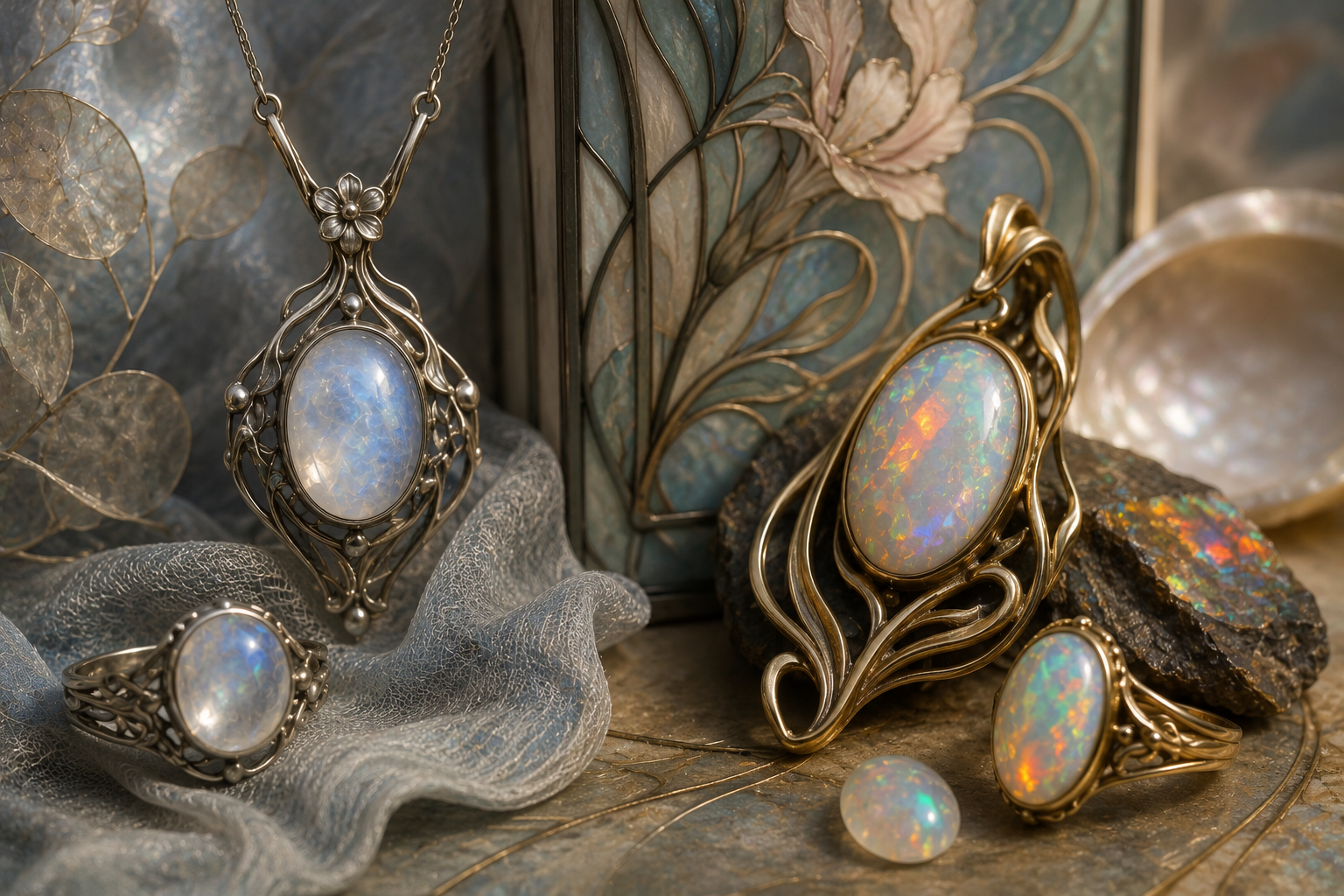
Moonstone or opal: two plays of light
Both stones make the same promise, a light that moves when you move, and they keep it by opposite means. Opal breaks white light into separate colours; moonstone spreads it into a single veil. Once you have seen that, you stop confusing them, and above all you stop caring for them the same way.
This is not a beginner mix-up like the confusion with opalite. It is a legitimate comparison between two real stones, and people often hesitate between them when treating themselves. Here is what settles it.
The short version, if you are in a hurry
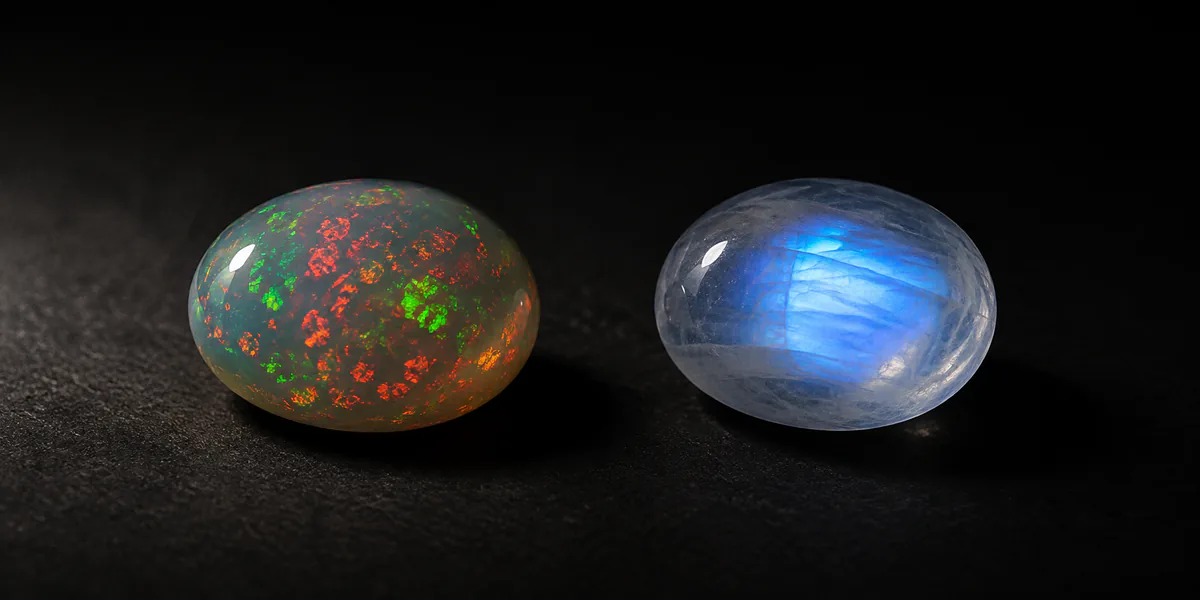
- Opal shows separate colours, red, green, blue, in patches that light up and go out independently of one another.
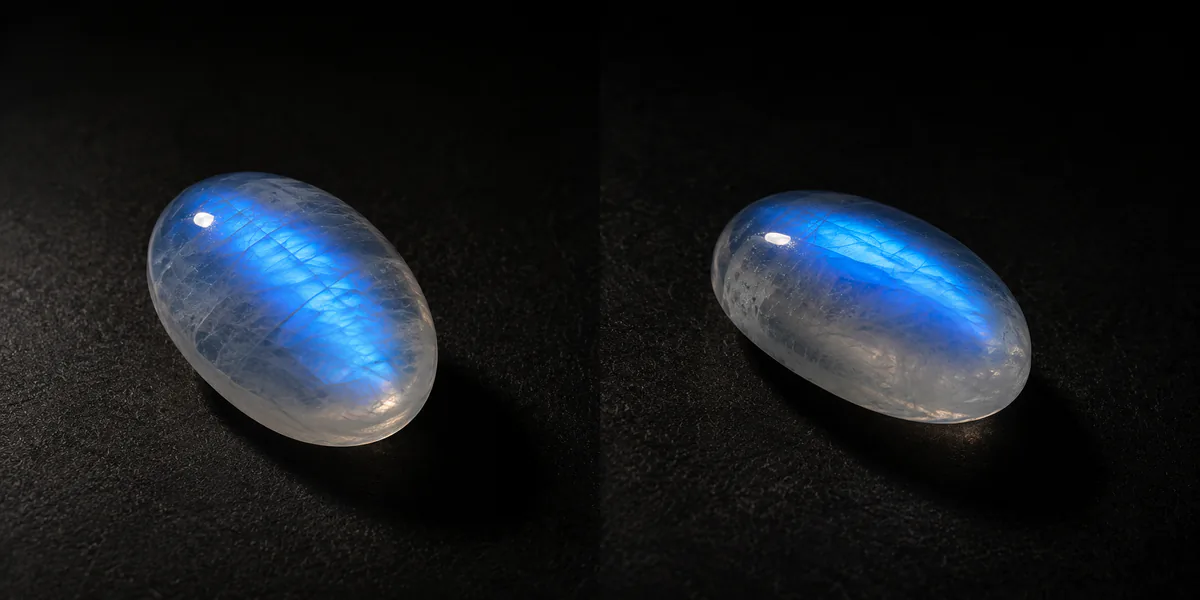
- Moonstone shows a single veil, blue-white, continuous, sliding from one edge to the other.
- Opal is amorphous hydrated silica, with no crystal structure, and it contains water.
- Moonstone is a crystallised feldspar, with no water, whose veil comes from internal lamellae.
- Care differs radically: opal fears dryness and thermal shock, moonstone takes water without any trouble.
- The price is not comparable: a fine opal costs several times a fine moonstone.
- They are two different birthstones: June for moonstone, October for opal.
What the eye sees, in ten seconds
Three questions to put to the stone, and they are enough.
How many colours? A precious opal shows several at once: a green flash here, a red one there, a blue one somewhere else, and they are plainly distinct. A moonstone shows only one, from silvery blue to milky white, depending on quality. If you see red and green in the same stone, it is not a moonstone.
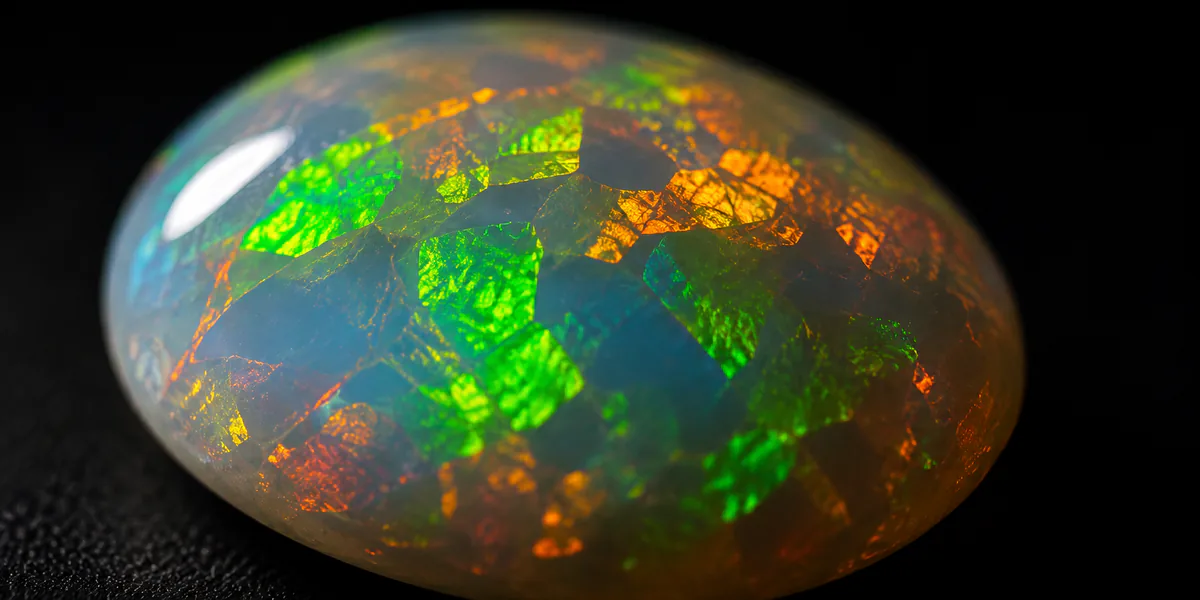
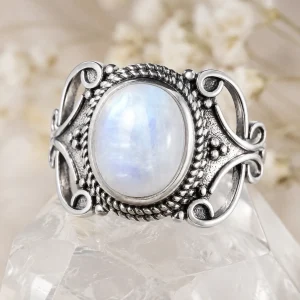
Is it continuous or in patches? This is the surest test. Opal lights up in sharp zones, with edges, almost like a mosaic: the trade calls it play of colour, a play, because those areas light up in turn. The veil of a moonstone is a single sheet, with soft edges, which moves as one block when you tilt the stone.
Where is the light? On an opal it seems to float at varying depths, some areas in front, others behind. On a moonstone it seems to come from a single plane, a little below the surface, as if the stone had a sky inside it. That detail is developed in adularescence.
Two different physical mechanisms
The explanation takes two paragraphs, and it makes everything else obvious.
Opal: stacked spheres. A precious opal is made of tiny beads of silica, all of the same diameter, stacked in a regular network like oranges on a stall. That network behaves like a grating: it diffracts white light and breaks it into colours, exactly as a CD does under a lamp. The colour you get depends on the diameter of the beads, and since that varies from one zone of the deposit to the next, each zone gives its own colour. Hence the patches.
Moonstone: stacked lamellae. An adularia is made of alternating layers of two very close feldspars, separated during a slow cooling. Those layers are so thin that light scatters inside them before coming back out, and since short wavelengths scatter most, what comes back up leans towards blue. There is only one family of lamellae in a stone, so only one colour, and it covers the whole area concerned. Hence the sheet.
The aesthetic consequence follows directly from that: opal is a stone of colour, moonstone a stone of light. One entertains the eye, the other calms it. It is not a matter of quality, it is a matter of nature.
Two materials with nothing in common
Underneath the optical resemblance, these are two mineral worlds.
Opal is not a crystal. It is amorphous hydrated silica, meaning it has no atomic network ordered on a large scale. So it has no cleavage, no crystal form of its own, and none of the optical properties that come with those. And it contains water, in varying proportion, sometimes several percent and a good deal more in certain opals.
Moonstone is a crystal. A feldspar of the monoclinic system, with perfect cleavage in two directions and no water in its structure. Its full data sheet is in the properties of moonstone.
The difference that matters is the water. An opal that loses its water can craze, an irreversible accident: a network of fine cracks appears and the stone is lost. It happens with heat, in full sun, in a car, near a radiator. A moonstone fears none of that: it fears knocks, which is another problem, covered in is moonstone fragile.
The opal families, to find your way
The word opal covers very different things, and the price gap between them is enormous. Four landmarks.
Precious opal is the one that shows the play of colour. You tell them apart by the colour of the body: white on a milky ground, the most common; black on a dark ground, the rarest and by far the dearest, because a dark ground makes the flashes stand out; boulder when it has stayed attached to its host rock, which then forms the ground.
Fire opal is an opal with an orange to red body, often transparent, which may show a play of colour or none at all. The name refers to the colour of the body, not to the flashes, which misleads a great many people.
Common opal, also called potch, has no play of colour at all. It is hydrated silica without the ordered network, so without diffraction. It is cheap and serves mostly as a decorative material.
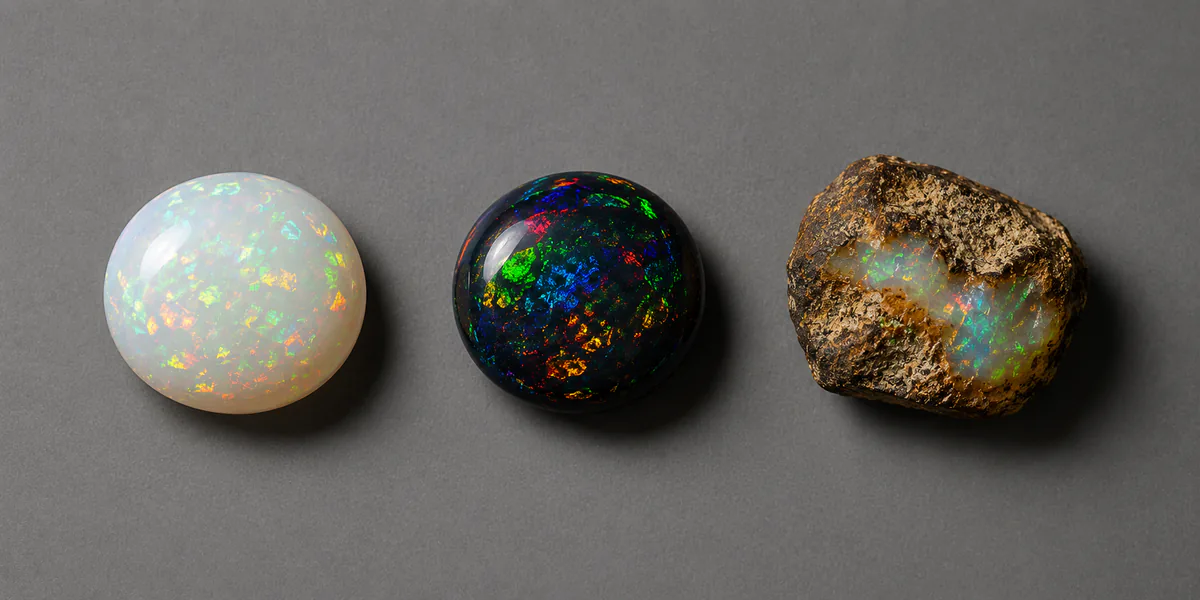
Hydrophane opal, which includes many Ethiopian opals, takes up water and changes appearance as it soaks: it turns more transparent and its play of colour can vanish for a while. That reverses on drying, but it makes these stones particularly delicate.
Careful with the name: neither opalite, which is glass, nor moonstone is an opal. The word travels far too freely in the trade.
Care, where the mistake is expensive
This is the most useful passage on the page, because this is where people damage their stones.
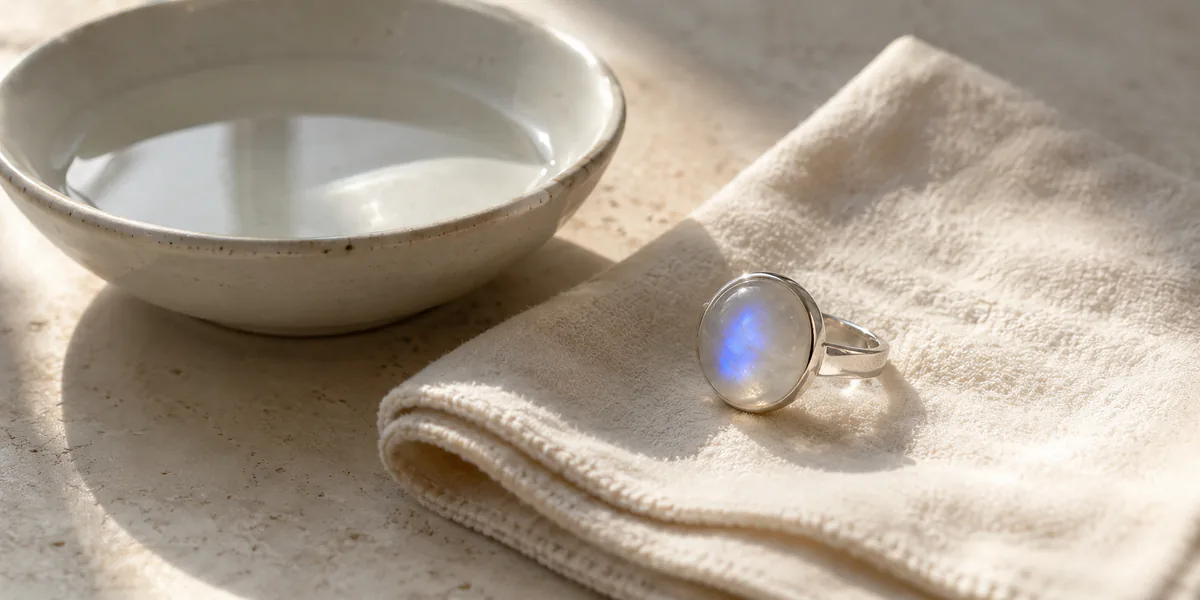
For opal. Avoid heat and dryness, which are its real enemies: no long spells in full sun, no car dashboard, no radiator, no ultrasonic cleaner and no steam. Avoid thermal shock too, an abrupt move from hot to cold. For a hydrophane, avoid any long soak, clear water included, and any contact with oils and creams, which can be absorbed and stain permanently.
For moonstone. Lukewarm water and mild soap will do, the matter is settled in can you put moonstone in water. Its enemies are mechanical: knocks, because of the cleavage, and rubbing against harder materials. The full procedure is in how to clean a moonstone piece.
What to remember: you can wash a moonstone, you should not wash an opal. And the reverse is true for knocks, opal having no cleavage and being less liable to split clean through than a feldspar. Two stones, two opposite reflexes.
Opal and moonstone, line by line
| Criterion | Moonstone | Opal |
|---|---|---|
| Family | Feldspar | Hydrated silica |
| Structure | Crystalline | Amorphous |
| Water | None | Present |
| Phenomenon | Adularescence | Play of colour |
| Look | One continuous veil | Separate patches |
| Colours | Blue to white | The whole spectrum |
| Hardness | 6 to 6.5 | 5.5 to 6.5 |
| Cleavage | Perfect, two directions | None |
| Fears | Knocks | Heat and dryness |
| Water and soap | No problem | To be avoided |
| Birthstone | June | October |
Look at the line marked fears: it sums up everything. These two stones have weak points that do not overlap, which means the very same care gesture can be right for one and wrong for the other.
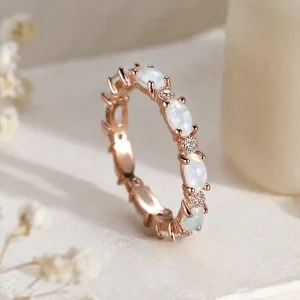
Moonstones with a continuous veil
The price, and the real gap
The two stones are not in the same league, and it is better to know that before comparing two pieces.
Precious opal is expensive, and a fine black opal from Australia ranks among the costliest gems per carat, in orders of magnitude that meet those of high-ranking coloured stones. A common white opal stays affordable, but the gap inside the family itself is dizzying.
Moonstone is modest, except at the very top. A fine transparent blue of good size reaches serious prices, but ones that bear no comparison with an equivalent black opal. The detail is in the price of moonstone.
The practical consequence. For the same budget, you will have a very fine moonstone or an average opal. That is a real argument, and it cuts both ways: if you miss the play of colour, no moonstone will replace it, whatever its price.
What tradition ascribes to each
What follows belongs to tradition and to symbolism. No effect of these stones on health is demonstrated, and nothing here replaces a diagnosis, a treatment or the advice of a health professional. Read the full disclaimer.
Moonstone is associated with the cycle, with intuition, with the feminine and with the night. An old and consistent body of belief, set out in the meaning of moonstone and in the virtues ascribed to it.
Opal drags a double reputation behind it, and that is what makes it interesting. On one side, antiquity held it a stone of great value, said to gather the qualities of all the others since it contains all their colours. On the other, a stubborn superstition made it, in the 19th century, a stone of misfortune, not to be given or worn unless you were born in October.
On the origin of that superstition, a Walter Scott novel published in 1829 is very often cited, in which an opal plays a fatal part. The attribution is repeated everywhere, it is plausible, and it is contested by authors who find it too convenient an explanation. I report it for what it is: a popular hypothesis, not an established fact.
On the birthstone calendar, each has its month, and that is dealt with in the June birthstone.
Which one to go for, depending on what you want
A four-line grid, to stop hesitating.
Choose the opal if what you love is colour that surprises you, if you accept a piece that needs precautions, and if the budget follows. It is better worn as a pendant or as earrings, where it takes few knocks.
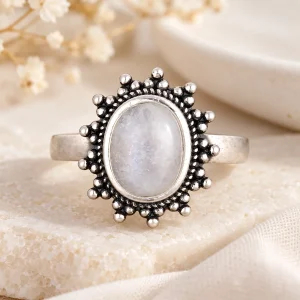
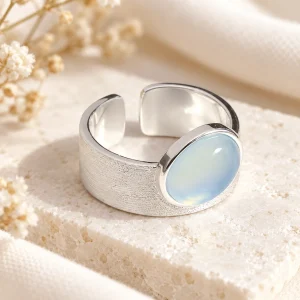
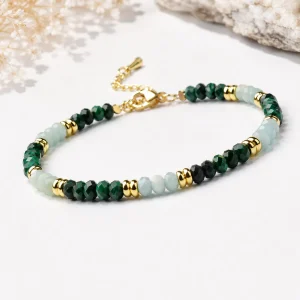
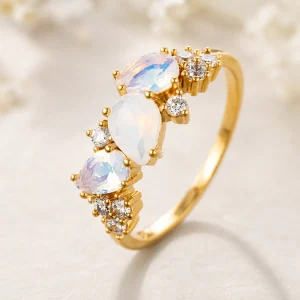
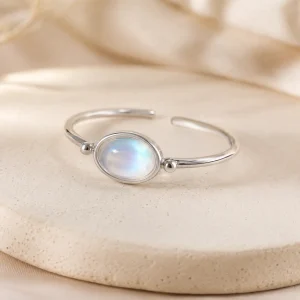
Choose the moonstone if you prefer a calm light that goes with everything, if you want to be able to wash the piece without thinking about it, and if you are after the best look for the money. The models are in the rings and the bracelets.
Take both, seriously: they wear very well together, because their lights do not compete. The veil acts as a calm ground for the flashes of the opal. The rules for pairing are in which stone to pair with moonstone.
Choose neither if the piece is to be worn every day on the right hand and take knocks. Neither is made for that, at 6 on the Mohs scale.
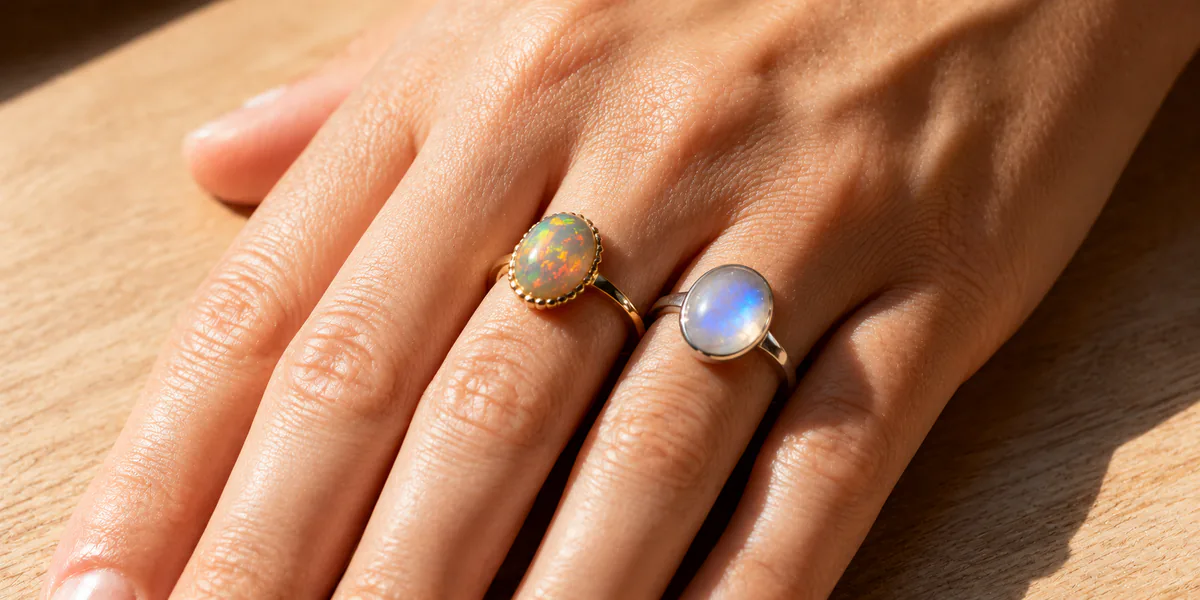
The workshop rings




Frequently asked questions
What is the difference between a moonstone and an opal?
Opal shows several separate colours in patches, produced by diffraction on a network of silica beads. Moonstone shows a single veil, blue to white, produced by scattering on feldspar lamellae. They are two unrelated minerals.
Is moonstone a variety of opal?
No, in no way at all. Moonstone is a crystallised feldspar, opal is amorphous hydrated silica. The fact that both play with light brings them no closer than glass is brought to diamond.
How do you tell one from the other in ten seconds?
Count the colours and look at the edges. Several plain colours in bounded patches: opal. A single bluish sheet with soft edges that slides as one block: moonstone.
Can you put an opal in water?
Better not, especially a hydrophane opal, which takes up water and changes appearance for a while. That is the reverse of moonstone, which takes a wash in lukewarm water and mild soap very well.
Why can an opal craze?
Because it contains water. If it loses some, through heat or a long spell of dryness, a network of fine cracks can appear, and that is irreversible. Moonstone contains no water and does not run that risk.
Which is the more expensive?
Opal, and by a very long way at the top end: a fine black opal from Australia ranks among the costliest gems per carat. For the same budget, you will have a very fine moonstone or an average opal.
Which is the tougher?
They are level on hardness, around 6, but they break differently. Opal has no cleavage but fears heat and thermal shock; moonstone has perfect cleavage and fears mechanical knocks.
What is a fire opal?
An opal with an orange to red body, often transparent, which may show a play of colour or none at all. The name refers to the colour of the body and not to the flashes, which misleads a great many buyers.
Does opal really bring bad luck?
It is a 19th century superstition, often attributed to a Walter Scott novel of 1829, an attribution that is plausible but contested. Antiquity, for its part, held it a stone of very great value.
Can you wear both together?
Yes, and it is even a good combination: their lights do not compete, the veil of the moonstone acting as a calm ground for the flashes of the opal.
Where to go next
- The other comparisons: or opalite, or labradorite, or selenite, or pearl.
- Understanding the veil: adularescence, the mineral file, the colours.
- Care: cleaning a piece, the stone and water, is it fragile.
- Choosing and giving: the price, giving a moonstone, the June birthstone.
- The whole picture: the complete moonstone guide.
All the pieces are in the shop. I do not sell opal, and that is a choice: I would rather do one thing properly. If you are hesitating between the two for a gift, write to me, and I will tell you plainly when moonstone is not the right answer.
My sources
For the structure of opal and the mechanism of diffraction on a network of silica beads, the gemmological files of the GIA and of Mindat, together with the composition and hardness data. For adularescence, the same sources, set out in the article devoted to it.
For the care recommendations on opal, those of the gemmological laboratories and the trade associations, which converge on the same points: heat, dryness, ultrasonics and steam to be avoided.
Two reservations. The water content of an opal varies enormously from one stone to the next, so I give orders of magnitude and no precise figure, because no single figure would be honest. And on the superstition attributed to Walter Scott, I repeat that the attribution is popular but contested: I have found no solid demonstration, only a very wide repetition.
Last updated: 19 August 2026. An error, a clarification? Tell me, and I will correct it.
✦ À porter, à offrir
Découvrez mes créations