

Description
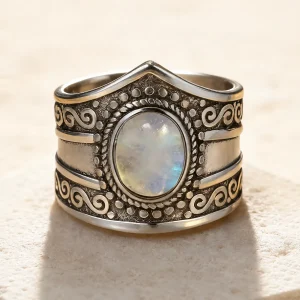
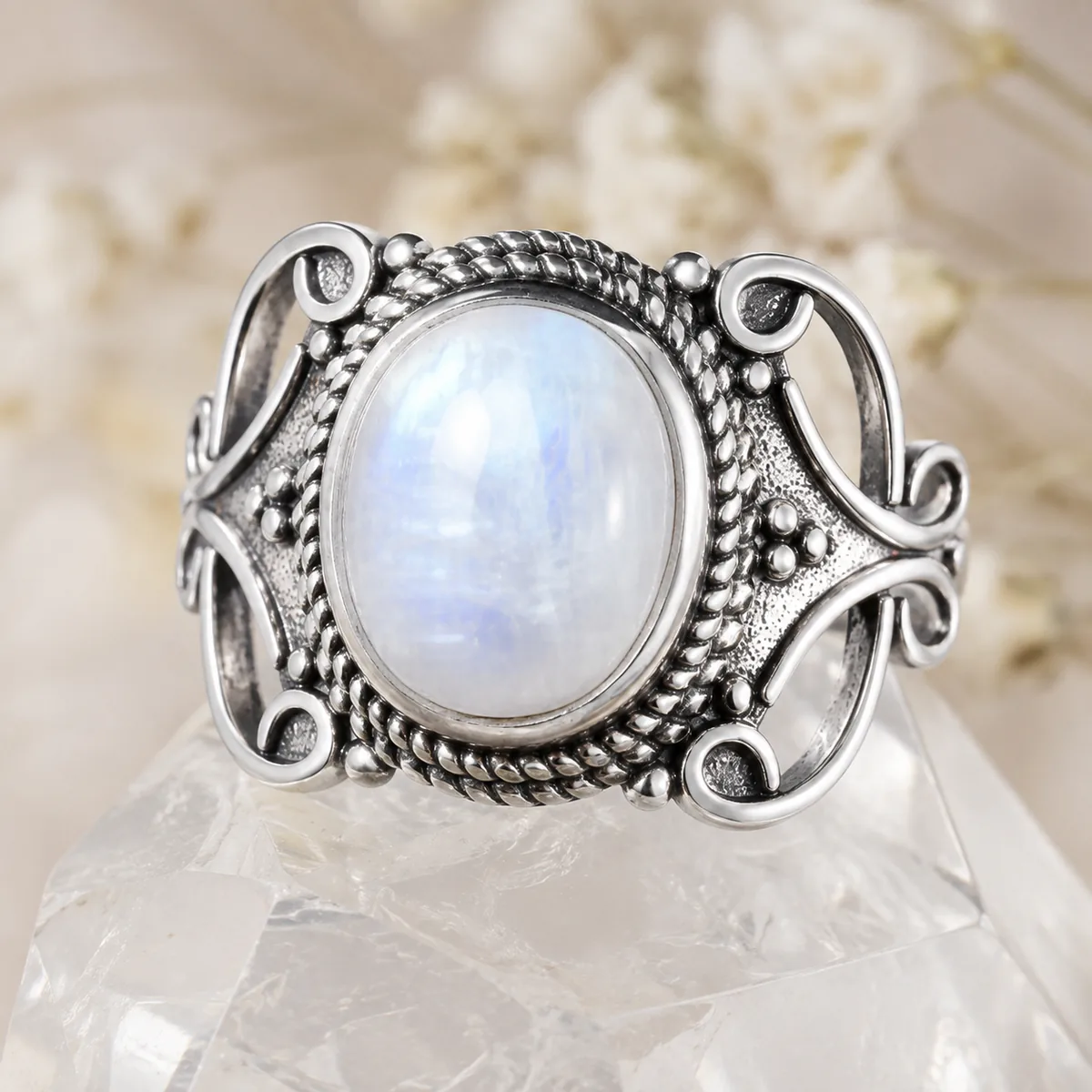
This is the ring that looks oldest in the catalogue, and it is the newest. A large cabochon crossed by a wide, clean blue, a double crown of twisted wire and granulation, and on either side two large openwork scrolls you can look straight through. It is the one you wear when you want people to ask where it comes from.
The stone first, the decoration second
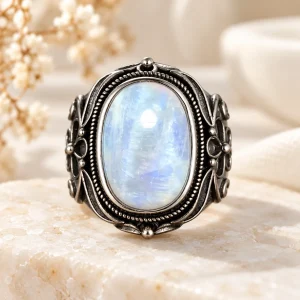
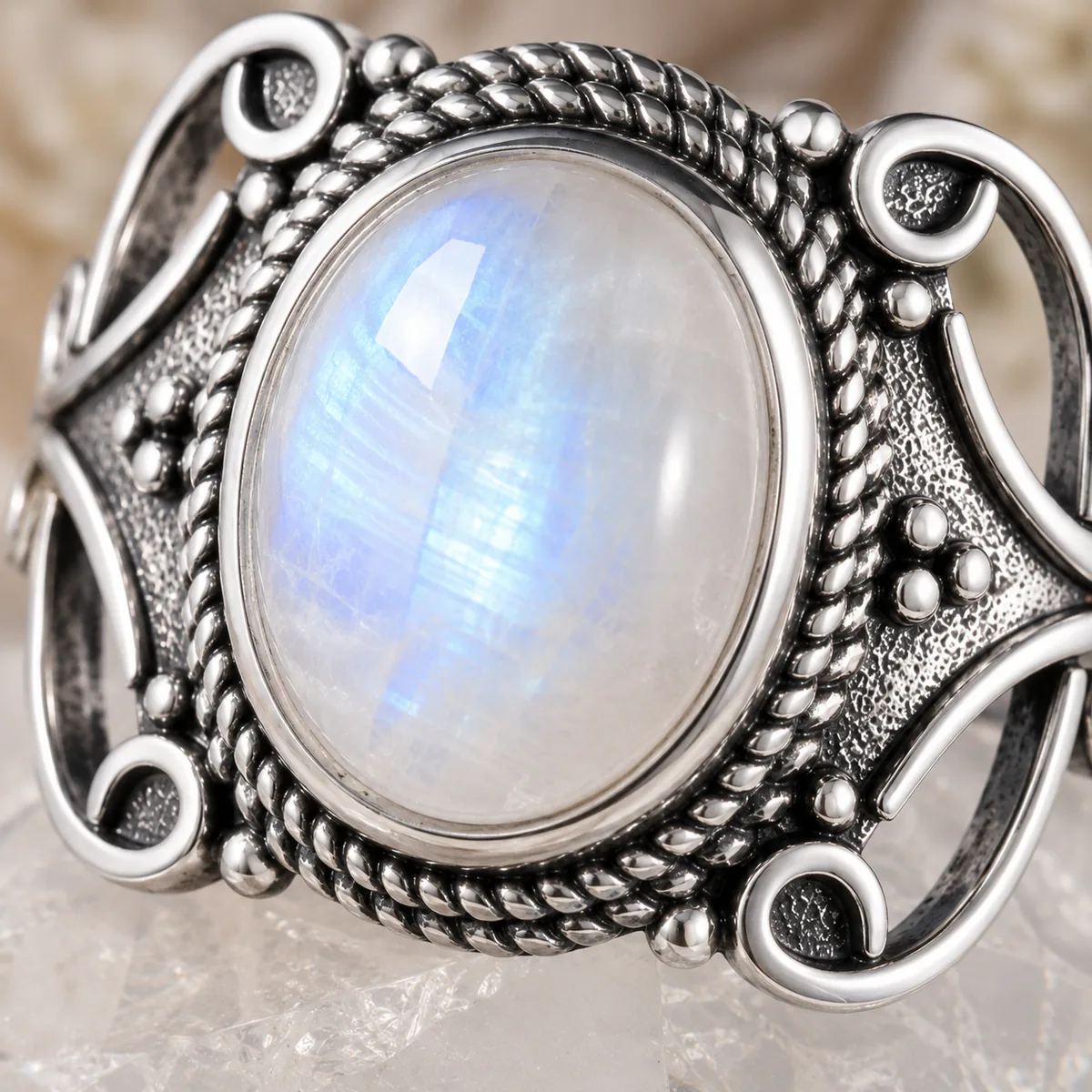
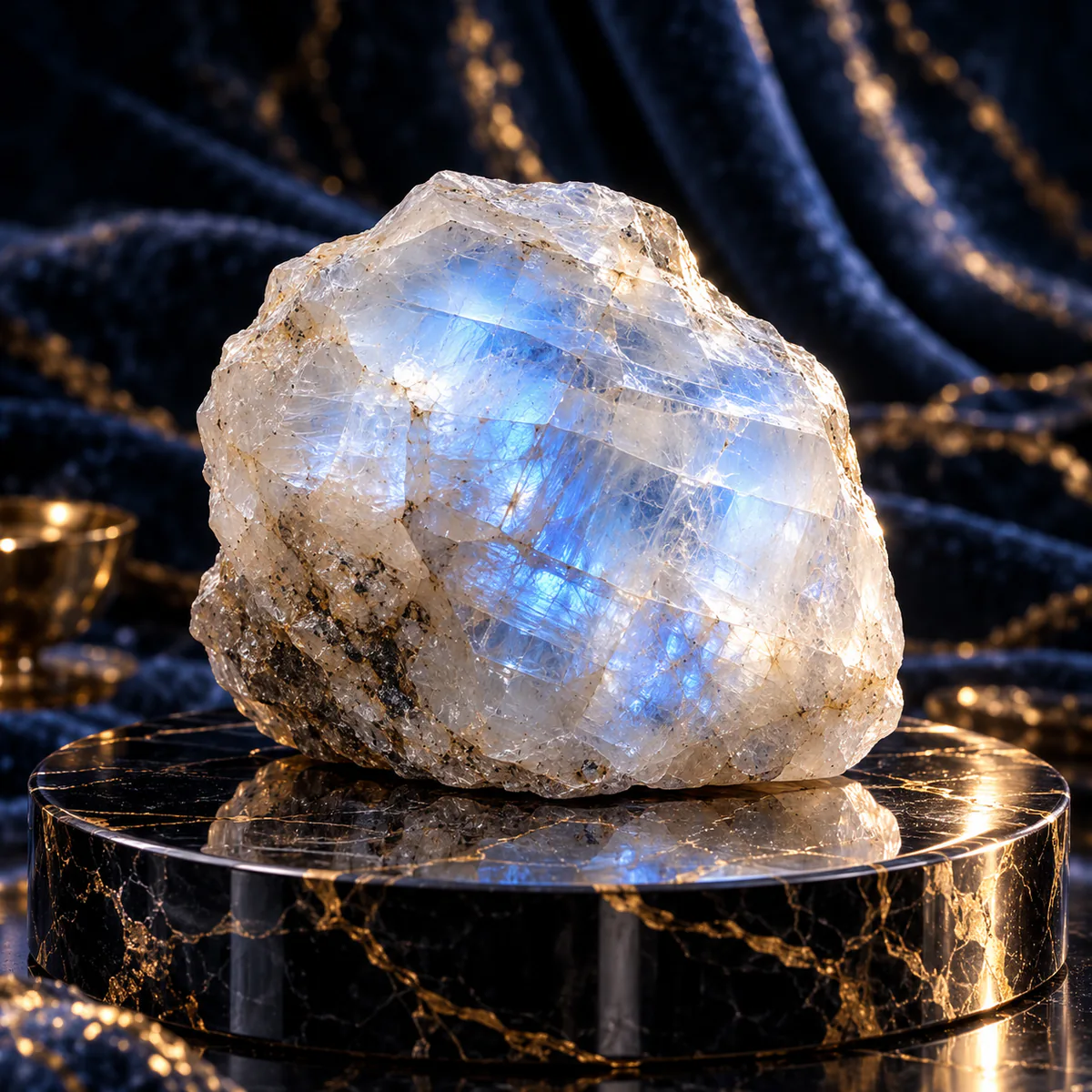
Let us start with the cabochon, because it is the best in the catalogue. The blue veil you see sweeping the dome is called adularescence, and on this one it ticks the two boxes I never negotiate: it moves decisively when the stone turns, and it is centred on the dome rather than pushed to one edge. That second point is what separates a stone that shines at the seller’s from a stone that shines on the finger. I have set out elsewhere the six criteria I judge a moonstone by; this one passes them all.
The decoration holds in three layers. A twisted wire runs around the bezel, a row of granulation doubles it, then the shoulders open into two large S-shaped scrolls, pierced through, set on a blackened, grainy ground. It is that last point that sets it apart from the shop’s other worked pieces: here the sides are hollowed out, you see through them, and the ring weighs far less than it looks. This vocabulary of curves and voids comes straight from Art Nouveau, the period when this stone had its glory, between 1890 and 1910, when Lalique and Tiffany mounted it more than any other gem. The shop’s other rings are here.
Vintage does not mean old
Here is the clarification that gives the word in the title its meaning. This ring is new. Its blackening is not the deposit of time, it is a treatment applied during manufacture to deepen the shadows and bring out the relief. Many shops sell jewellery described as vintage exactly like this one while letting the doubt hang, and I find that dishonest, because the price difference between a period piece and a piece merely inspired by one runs into hundreds. If you are looking for a genuinely old piece, you need an antique dealer or a saleroom, not this shop. What I sell is a drawing that borrows from a period, mounted today, with a stone chosen today.
Two usual reservations, while we are at it. The openwork scrolls catch: this is not the ring for gloves and deep pockets. And moonstone has perfect cleavage, it chips on impact without scratching for all that, and this cabochon is wide and sits proud. The sizing guide will also save you a return: this mounting cannot easily be resized without touching the decoration.
Sizes and what tradition lends this ring
Sizes run from I½ to T½. On a mounting this worked, resizing is not routine, so it is worth measuring properly before ordering. The sizing guide is here.
Crystal healing tradition makes moonstone a stone of cycles, of intuition and of the return to calm; it is said to accompany periods of change rather than to bring them about. I will go no further: none of it is demonstrated and no piece of jewellery heals anything. Separately, I have gathered what tradition lends it and what a moonstone ring is said to mean when it is given.
- Large genuine moonstone cabochon, wide blue centred on the dome.
- Chased 925 sterling silver. Twisted wire, granulation, and two openwork scrolls on the shoulders.
- Art Nouveau inspired. A new ring, blackened during manufacture, not a period piece.
- Sizes I½ to T½. Delivered in two weeks with a cotton pouch, a handwritten note and a care card.
The specifications
- Stone
- Genuine moonstone (adularia), oval cabochon cut
- Metal
- 925 sterling silver
- Setting
- Plain bezel setting, no glue
- Decoration
- Twisted wire, granulation, openwork scrolls on a blackened ground
- Period
- New piece, Art Nouveau inspired, not antique
- Sizes
- I½ to T½
- Gender
- Women
- Brand
- Melissa Moon
The only ageing I can promise you
The black on this ring is laid down during manufacture, uniformly, at the bottom of the hollows. That is not what time does. Time works the other way round: it lightens the reliefs the hand rubs and leaves the hollows alone, so that after a few years the contrast deepens exactly where you touch it most. A factory-oxidised ring carries the same black everywhere; a ring worn for three years carries your way of wearing it. It is the only vintage I can honestly sell you, and it cannot be bought.
I do not claim to set this one myself. The chased, twisted and granulated decoration comes out of specialist workshops, and my part stops at the choice of the stone and the mounting. On this one, choosing the stone took time: on a mounting this present, an ordinary cabochon would have been crushed. The rest of the shop is here.
A piece inspired by the old manner is one thing. A piece you let people believe is old is another, and it is not the same trade.
No salt, no ultrasonic tank, no hot water: moonstone is a feldspar, and all three damage it for good. Lukewarm soapy water, a generous rinse, a complete drying by dabbing. No brush, no paste, no silver product: they remove the black from the bottom of the granulation and would leave you a uniformly grey ring, which is to say one with no relief. If the reliefs tarnish, rub those alone, with a dry fingertip, sparing the hollows. The detail is in cleaning a moonstone piece, and the safe methods for the stone in caring for it without harming it.