


Description
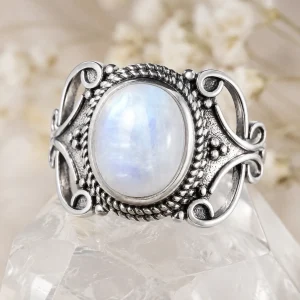
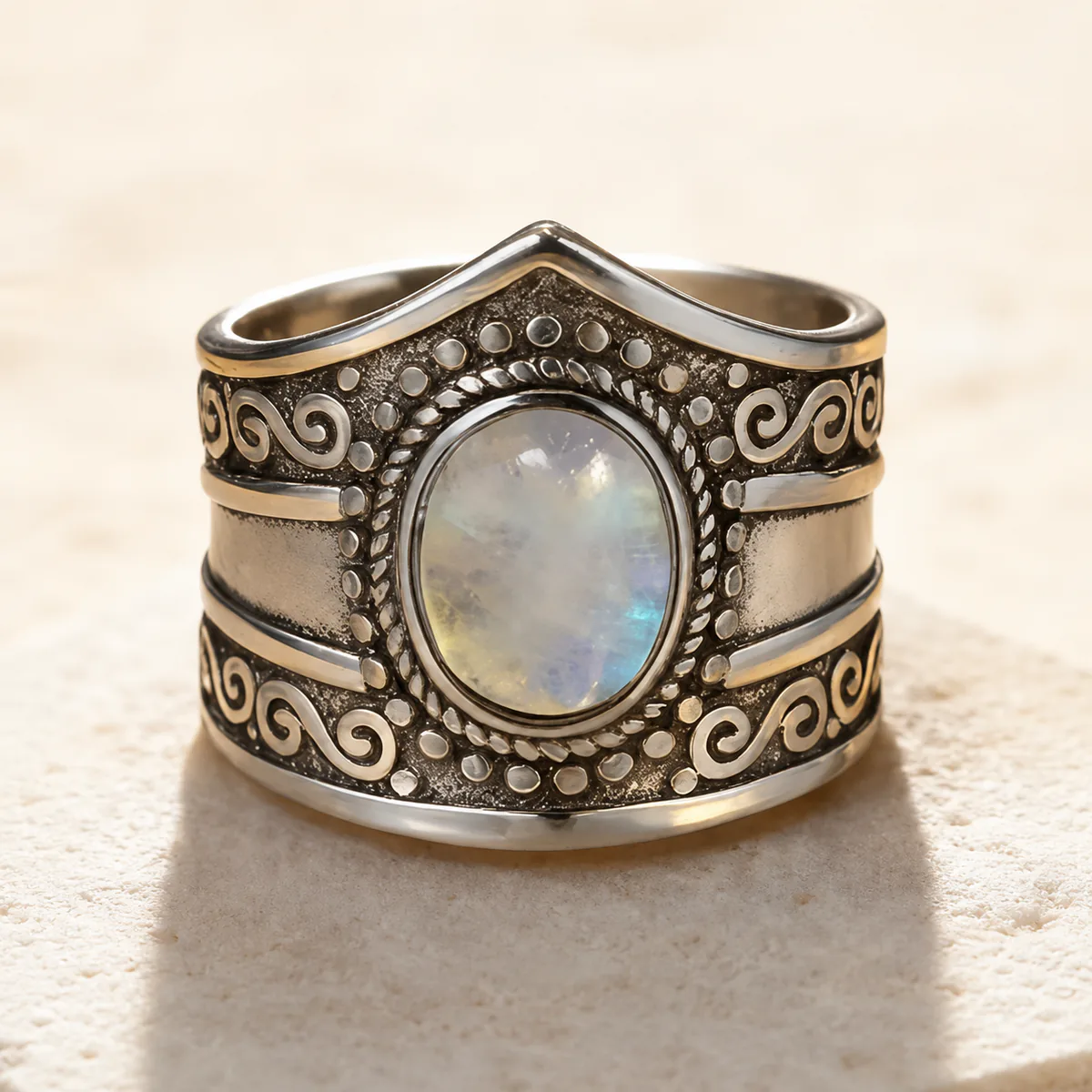
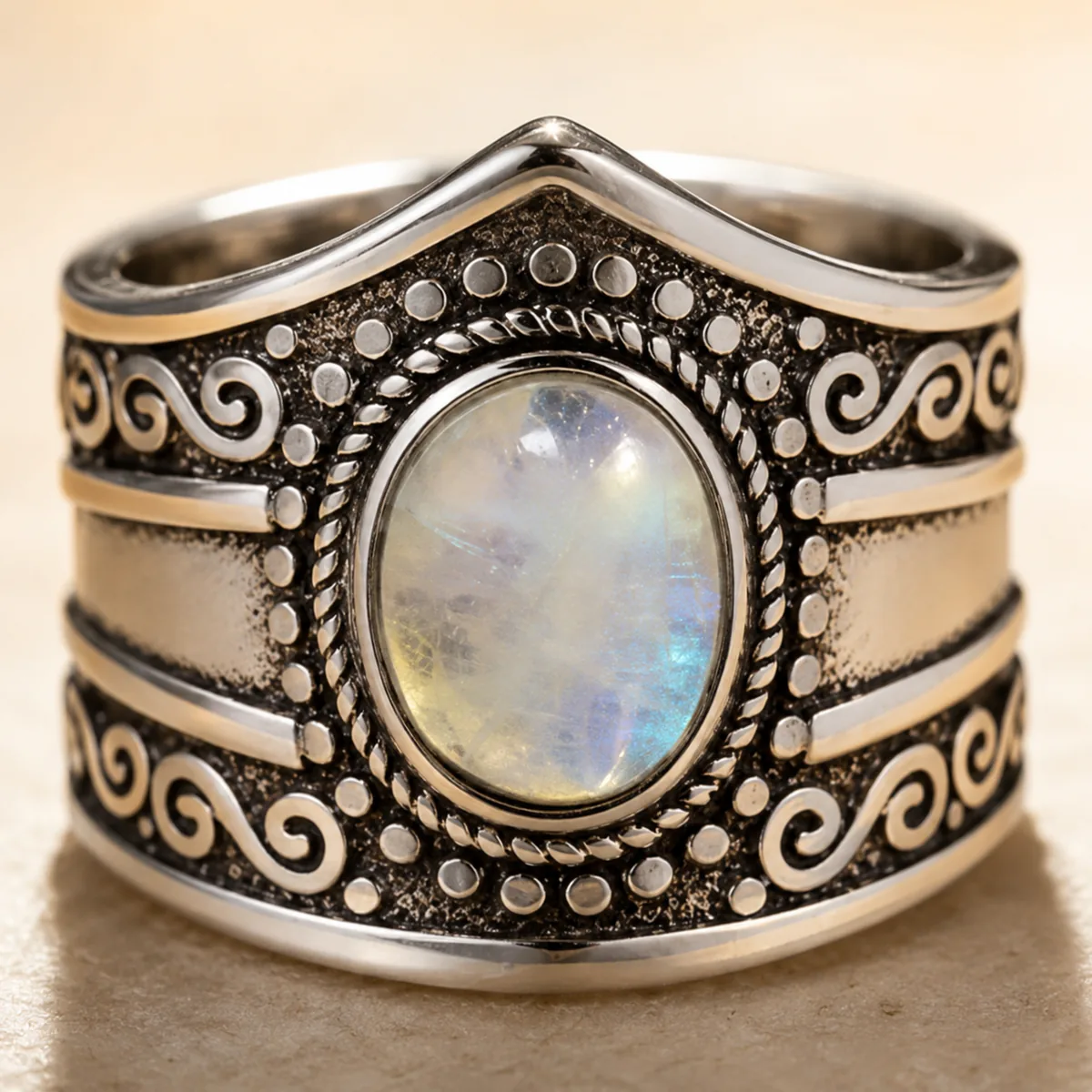
It is the widest ring in the catalogue, and by far the most worked. A solid silver band that rises to a point on top, covered in granulation, scrollwork and twisted wire, with a moonstone cabochon set at the centre as the only smooth surface on the whole object. This is the one you wear when you accept that a ring should be seen.
A wide band, and everything on it
The decoration is not engraved, it is applied. Around the stone, a twisted wire runs the circuit of the bezel, then comes a crown of granulation, those small silver spheres soldered on one by one. On either side, spiral scrolls unfold on a blackened, grainy ground, framed by polished bands that run around the shank. The top of the ring does not close in a circle: it rises to a chevron, which visually lightens a piece that would otherwise read as a block.
The blackening is not ageing suffered, it is the condition for seeing anything at all. On a surface this worked, polished silver would throw light back everywhere at once and the relief would vanish into the glare. By blackening the grounds and leaving the raised parts bright, every granule and every spiral gets its shadow back. It is also what protects this decoration over time: here the black sits at the bottom of the hollows, where the hand does not rub.
In the middle of all that, the stone is left bare in a smooth bezel. That is deliberate: the blue veil you see gliding over the dome, adularescence, is a soft phenomenon, and it loses everything if it has to compete with a worked setting. On this ring, the stone is the only place where the eye rests.
A word about the word “men’s”
This ring sits in the men’s section because that is where people look for it, and because its width matches what most men expect of a ring. But there is nothing masculine about a spiral or about a moonstone, and a good share of the ones I send out go to women who simply wanted something wide.
What the tradition lends this stone is set out on its own further down, and what the tradition attributes to it is gathered here, in the conditional from start to finish. The shop’s other rings are here.
Read this before ordering a wide band
A wide ring is not worn in the same size as a slim one. The greater the contact surface, the tighter the finger feels at equal diameter, and the harder the knuckle is to pass. Count on half a size to a full size more than your usual, and if you hesitate, take the larger: a wide ring that is too tight cannot be worn at all, whereas a wide ring that is slightly loose turns but goes on. The sizing guide details the measurement.
Two other reservations while we are at it: it stacks with nothing, and moonstone has perfect cleavage, it chips on impact. On a ring this size, which inevitably gets knocked more, that deserves saying.
- Oval cabochon of real moonstone, smooth bezel, blue veil left with no competition.
- Solid silver, wide band. Soldered granulation, twisted wire, scrollwork on a blackened ground.
- Sizes I ½ to T ½, to be taken half a size to a full size above your usual.
- Delivered in two weeks with a cotton pouch, a handwritten note and a care card.
The specifications
- Stone
- Real moonstone (adularia), oval cabochon cut
- Metal
- Solid sterling silver
- Setting
- Smooth bezel, no glue
- Band
- Wide, chevron top
- Decoration
- Granulation, twisted wire, scrollwork on a blackened ground
- Sizes
- I ½ to T ½
- Gender
- Men and women
- Brand
- Melissa Moon
Granulation, or why this decoration costs what it costs
Each of those small spheres was formed and then soldered into place. It is a technique more than three thousand years old, and it has never been convincingly mechanised, because the difficulty is not making the beads but fixing them without drowning them: the silver has to be brought exactly to the temperature where the solder takes, and brought back down before the bead slumps. One botched row means the whole piece has to be redone. That is why a decoration like this one is never found on a ten-euro ring, and it is the real content of a wide band.
I do not claim to make this one myself. Granulation work is done in workshops that do nothing else, often for several generations, and my role stops at choosing the stone and the mount. The rest of the shop is here, including what I removed from the catalogue.
People sometimes tell me this ring does not look like the rest of what I sell. True. It is here for those the others are not enough for.
No salt, no ultrasonic tank, no hot water: moonstone is a feldspar, and all three damage it for good. Lukewarm water, a soft cloth. And above all no silver polish: those pastes are made to remove the black, and the black is what makes this decoration exist. If the raised parts look dull, rub them alone, with a fingertip, sparing the hollows. The detail is in cleaning a moonstone piece, and the safe methods in caring for it without harming it.