

Description
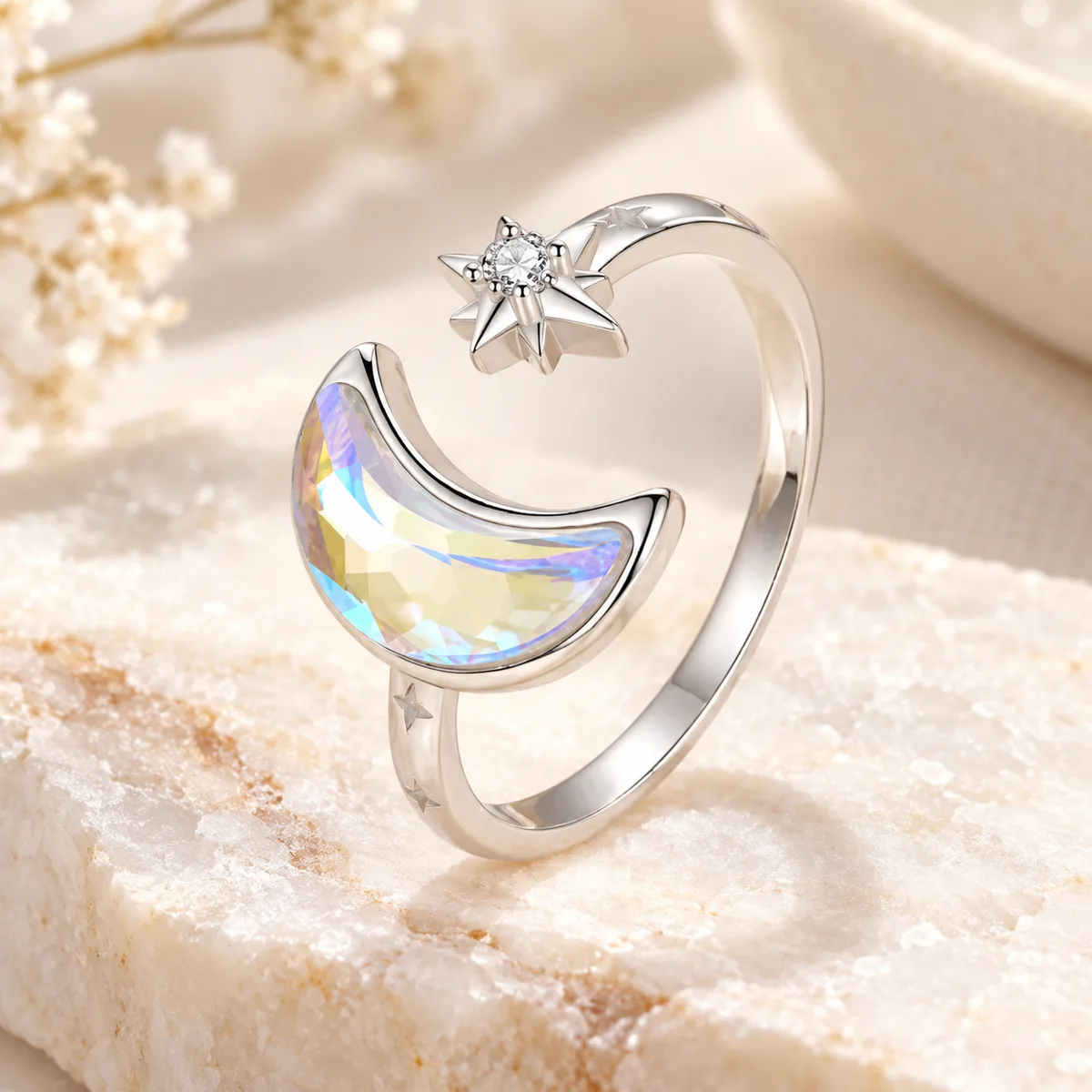
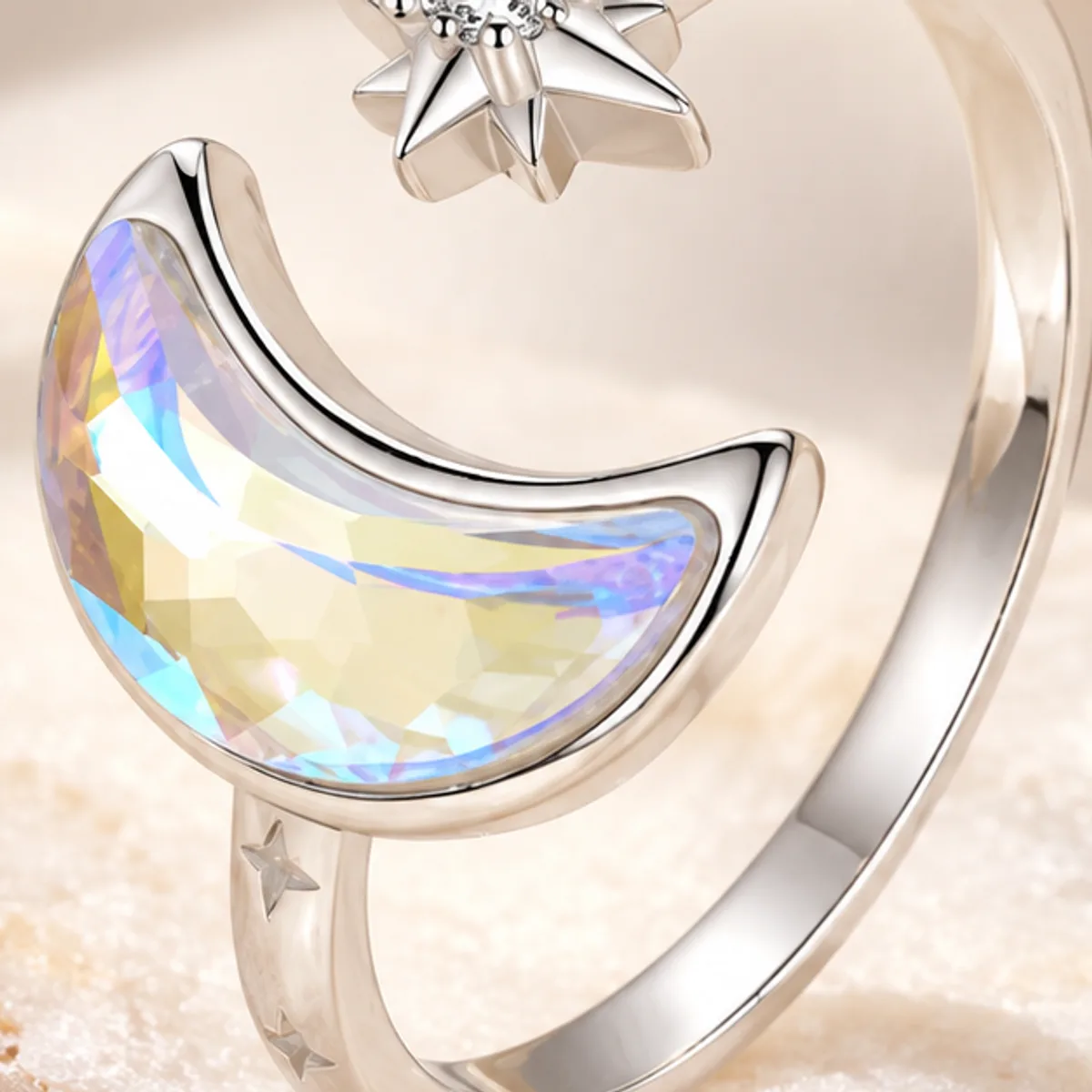
A moon cut directly in the stone, iridescent blue, and at the other end of the open band a small set star. Here it is not the metal that makes the crescent: it is the stone itself.
A crescent cut in the stone
On almost every lunar piece of jewellery, the moon is metal and the stone is round. The reverse is much rarer, for reasons I go into below, and the result is nothing like it. The blue veil of the adularescence then follows the curve of the crescent: it appears as a curved band, travels along the arc as the hand turns, and goes out at the two tips. The shape and the optical effect tell the same story, which is exceedingly rare.
The stone is polished into a dome on its upper face and left flat at the back. Its inner curve, the concave part of the crescent, is the most delicate zone: that is where the metal of the setting is folded highest, and it is also from there that the stone is held. The rest of the setting follows the outer contour without closing right around it, so that the silhouette of the moon stays readable.
At the other end of the open band, a small five pointed star is set with a synthetic zircon at its centre. It works as a visual counterweight: without it the moon would pull the whole ring to one side. Its size is deliberately reduced, about a quarter of the moon, so that the hierarchy stays clear.
Since the band is open, it adjusts by hand and covers about three sizes, with no measurement to take before ordering, though the size guide is there if you want it. Moonstone chips on impact, and on a shape with points that precaution counts double: never adjust the band by bearing on the stone. The other rings are here.
- Real moonstone cut as a crescent, blue veil following the curve of the arc.
- 925 sterling silver hallmarked S925, setting folded highest on the inner curve.
- Small five pointed star set with a synthetic zircon, a quarter the size of the moon.
- Open band, adjusts by hand, covers about three sizes: no measuring needed.
- Delivered in two weeks.
The specifications
- Stone
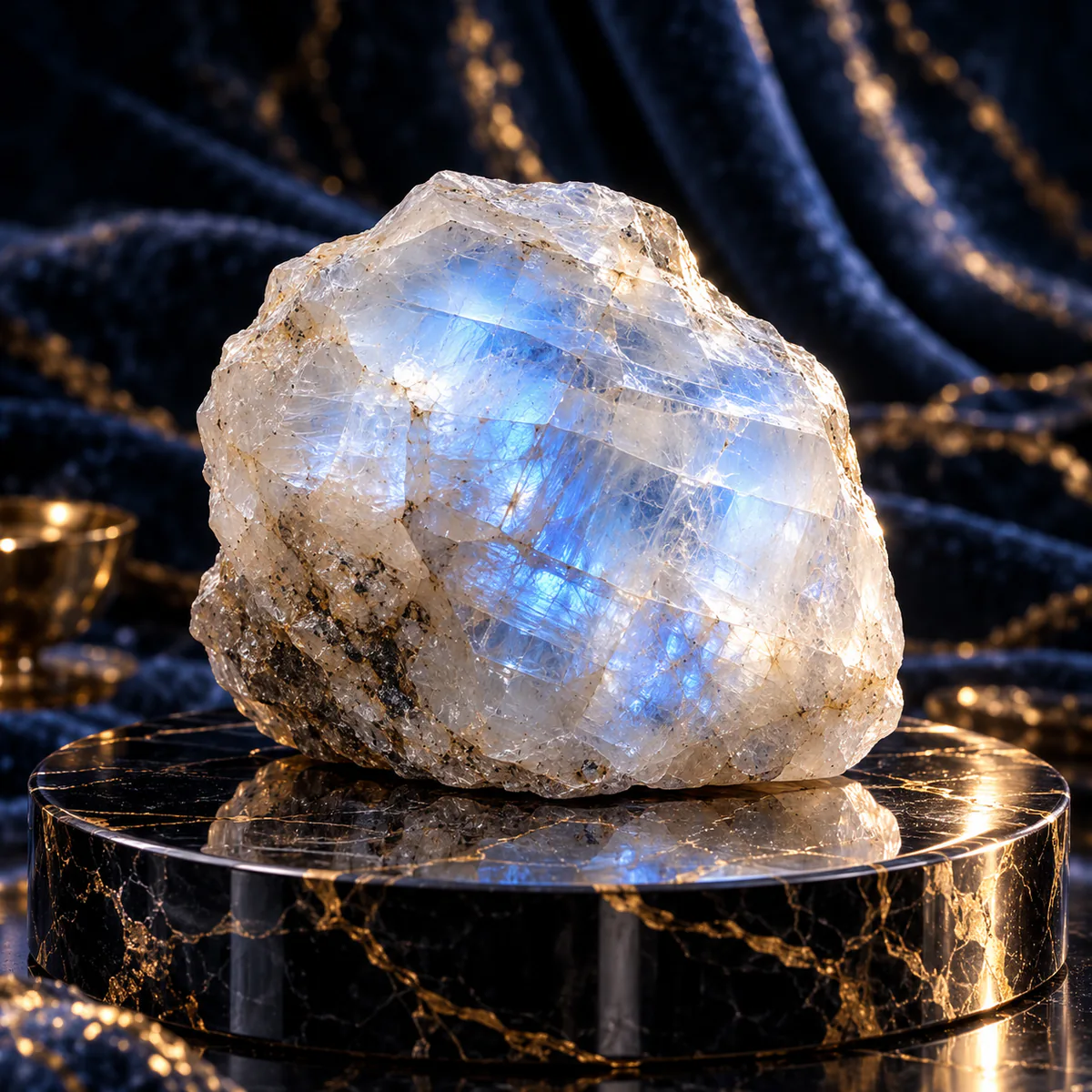
- Real moonstone (adularia), cut as a crescent, domed face and flat back
- Origin
- India
- Metal
- 925 sterling silver, S925 hallmark
- Setting
- Partial bezel held on the inner curve, zircon set in the star, no glue
- Shape
- Open band, crescent at one end and star at the other
- Finish
- Polished silver, hollows lightly oxidised
- Sizes
- Open band, adjustable, covers about three sizes
- Gender
- Women
- Brand
- Melissa Moon
Why cut crescents are rare
Cutting a crescent out of moonstone wastes most of the rough. You start from a block big enough for a large oval and finish with a thin arc, and the two tips are where the stone is likeliest to break on the wheel. The cutters I buy from will do it, they charge for it accordingly, and a proportion never reaches me at all. That is the whole reason the trade prefers a metal moon and a round stone: it is not taste, it is yield.
The part that makes it worth doing anyway is the one you cannot see in a photograph. A round stone shows a disc of light that has nothing to do with the moon drawn beside it. A cut crescent shows a curved band of light inside the crescent, so the ornament and the mineral are saying the same thing at the same time. It is the only piece here where that happens, and it is why I keep making it despite the waste.
A metal moon with a round stone is a picture of the moon. This one is the moon doing it itself.
No salt, no ultrasonic tank, no hot water: moonstone is a feldspar, and all three damage it for good. On this shape, add the obvious one: the two tips are thin, so take the ring off before anything that involves knocking your hand. Cleaning a moonstone piece covers the routine and caring for it without harming it the rest. The partial setting means the risk here is higher than on a closed bezel.