

Description
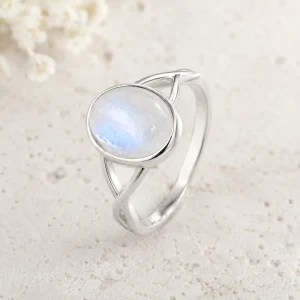
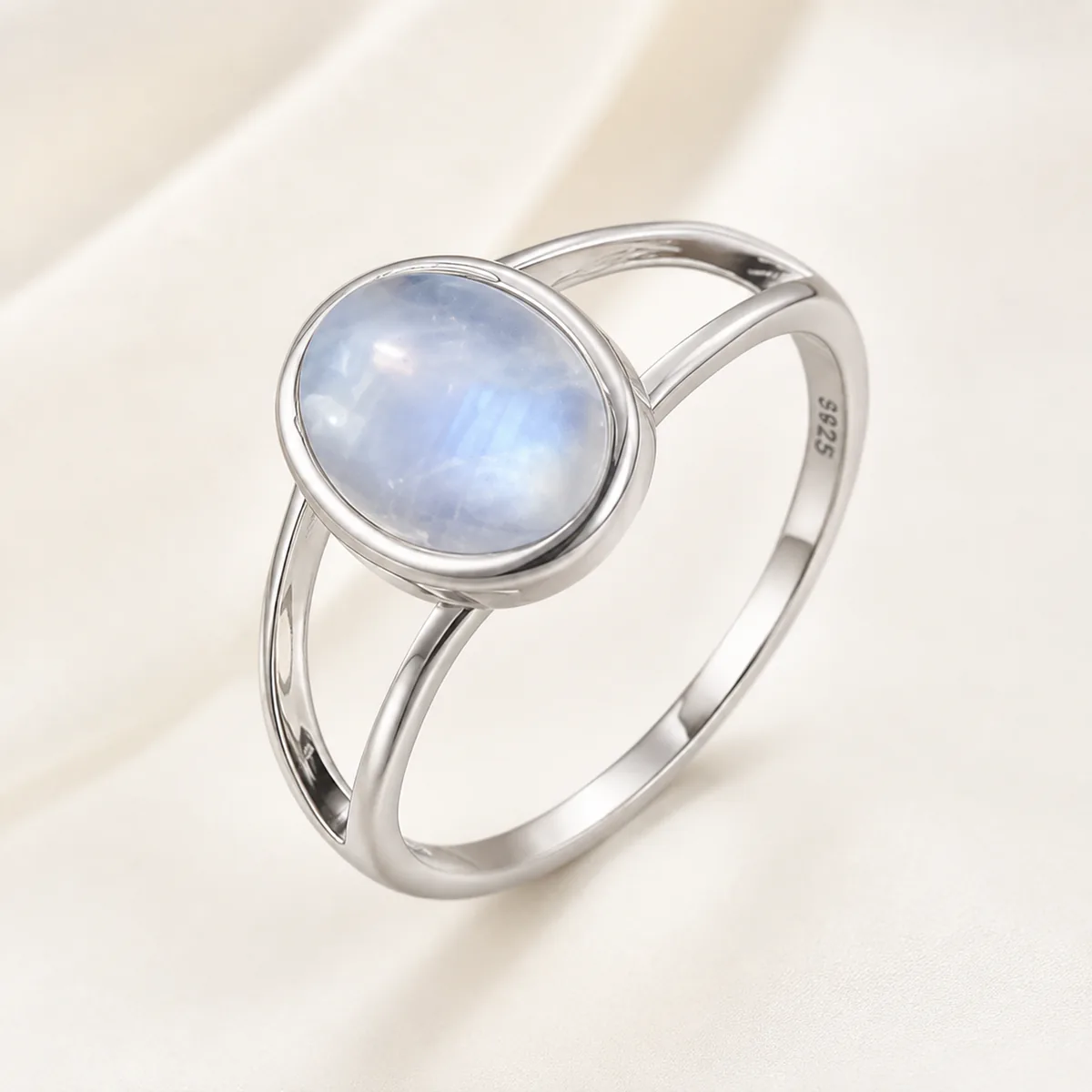
It is the ring where there is nothing else to look at but the stone. An oval cabochon, a smooth silver bezel that runs around it, a band that splits in two so it does not crowd the stone. Everything else has been stripped away. This is the one you choose when you want a real moonstone, and you want to see it.
A real moonstone, and how to check it
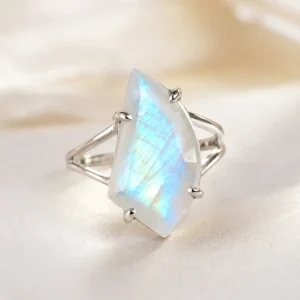
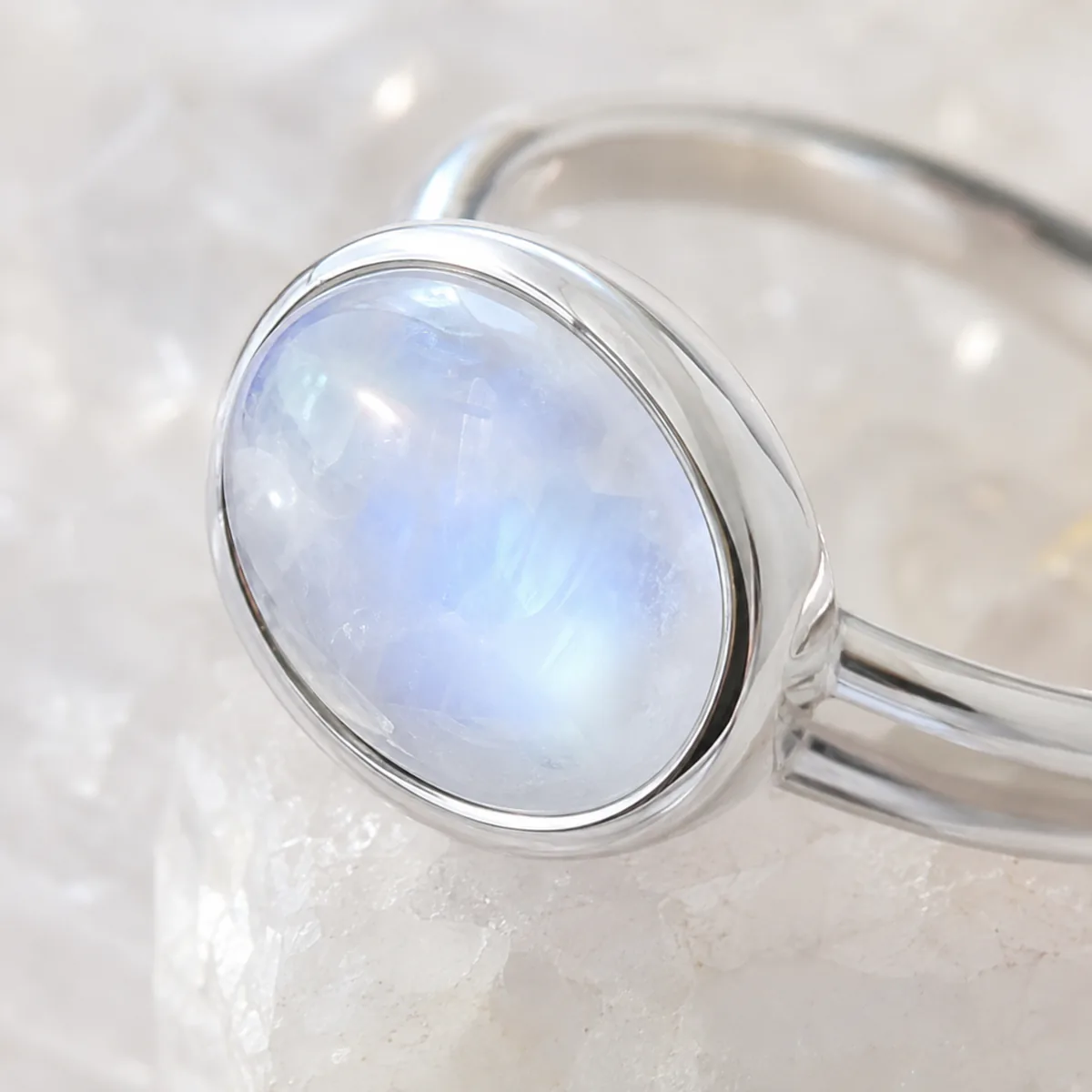
The blue veil you see sliding across the dome is called adularescence. It comes from no treatment, no coating, no film: it is born of microscopic feldspar layers stacked inside the stone, which scatter blue light and let the rest through. That is why it needs a polished dome, not facets. A faceted cut slices through that veil and kills it. If someone sells you a faceted moonstone throwing fixed pink and orange flashes, that is not adularescence you are looking at.
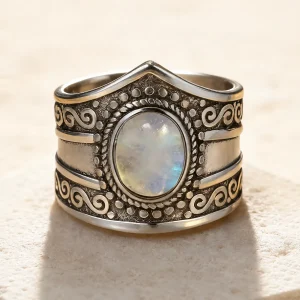
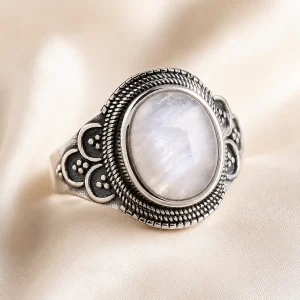
That is also why the metal steps back. The bezel is smooth, no beads, no decoration, just tall enough to hold the edge of the cabochon. The band splits at the shoulders and reopens under the stone: that lightens the ring, lets light in from underneath, and above all avoids the mass of silver that would throw back the same glare as the dome. The shop’s other rings do the opposite, one with a blackened beaded crown, another leaning on the warmth of gold. They are all here, and the size guide will save you a return if you are torn between two.
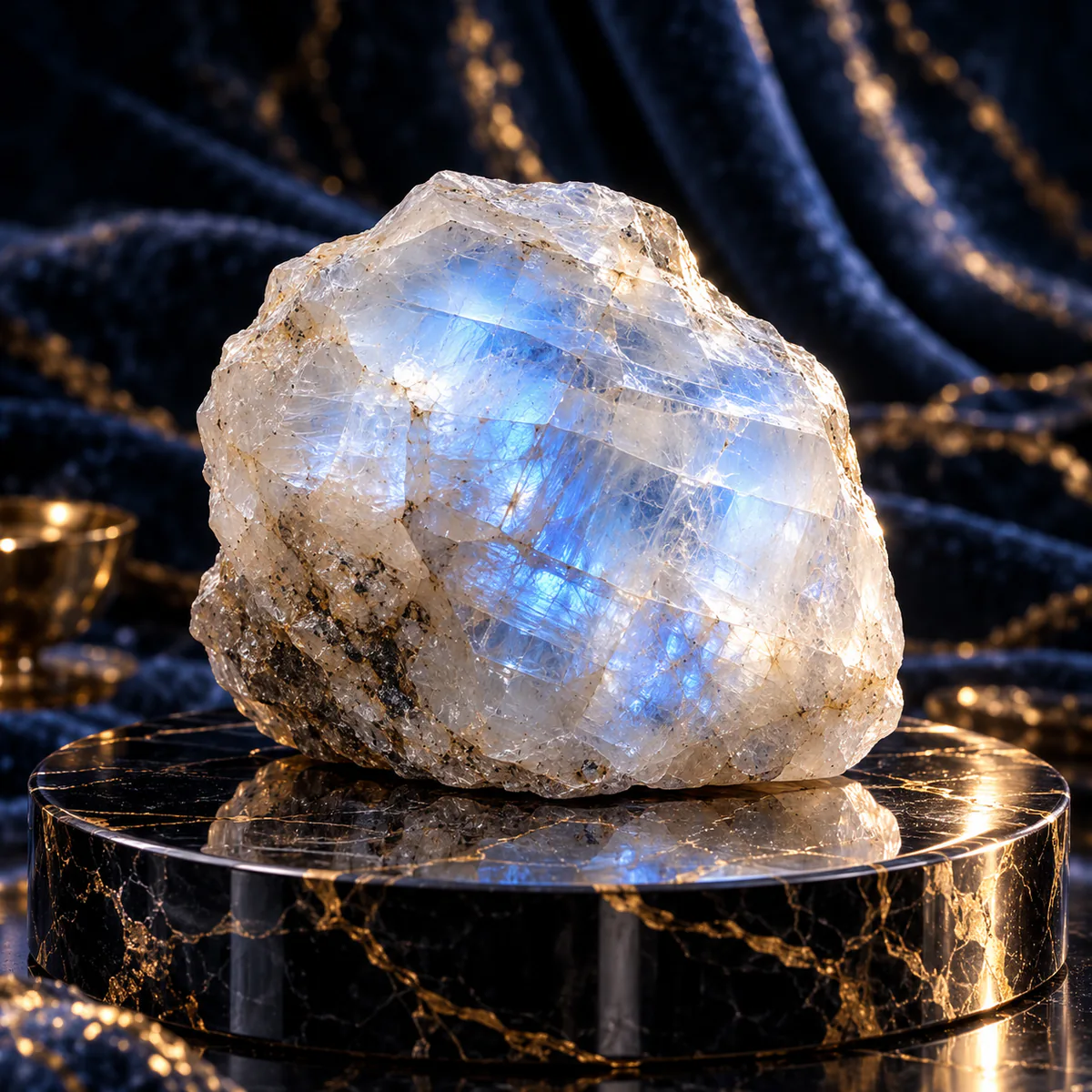
Now the part that surprises people most, and that I would rather write before the sale than after: a real moonstone is not clean. Look closely at the dome and you will see veils, planes, sometimes fine ladder-like cracks the trade calls centipedes. These are not flaws, they are exactly what imitations lack, because imitations are flawless. A moonstone with not a single inclusion, at this price, should worry you rather than reassure you. I have detailed the six criteria I judge a stone by, and what actually sets the price of one.
- Real moonstone, oval cabochon with a tall dome, a clear blue veil centred on the dome.
- Sterling silver hallmarked S925. Smooth closed bezel, split band, no glue at all.
- Sizes I 1/2 to T 1/2 (48 to 62 mm). Delivered in two weeks with a cotton pouch, a handwritten note and a care card.
- The plainest ring in the catalogue. Bought for the stone, not for the setting.
The specifications
- Stone
- Real moonstone (adularia), oval cabochon cut
- Metal
- 925 sterling silver, S925 hallmark
- Setting
- Smooth closed bezel, no glue
- Band
- Split at the shoulders, polished
- Sizes
- I 1/2 to T 1/2 (48 to 62 mm)
- Gender
- Women
- Brand
- Melissa Moon
What I look for before keeping a stone
I sort them in front of a north-facing window, never under a lamp. Under a lamp, a mediocre stone looks blue; in that light, it does not. I tilt it and look for two things. The sheen has to move: if it stays fixed as the stone turns, it is not moonstone, and it is the one criterion no imitation can fake. Then it has to be centred. A veil pushed to one edge of the dome is stunning in the seller’s hand and disappears the moment the ring is worn, because the hand does not hold that angle. It is the criterion almost nobody looks for, and it accounts for half the price gap between two stones that otherwise look alike.
Out of six or seven stones offered to me, I keep one. The rest are not bad, they are decent, and any shop would sell them without a second thought. I started that way too: I sold opalite for my first few months, in good faith, because my supplier called it white moonstone. A customer is the one who wrote and told me. I pulled it all that same evening, and I ended up writing how to tell the two apart and how to recognise a real stone. The rest of the shop is here.
My grandmother would turn a stone in the light for a full minute before deciding whether it was worth keeping. She never explained what she was looking at. I think I just wrote it down.
No salt, no ultrasonic tank, no hot water. Moonstone is a feldspar with perfect cleavage: it does not scratch easily, but it chips on impact, and all three of those damage it for good. Lukewarm water, a soft cloth, and the ring comes off before the shower, the pool, sport and housework. Store it alone in its pouch: what scratches a moonstone is almost always another piece of jewellery. The detail is in cleaning a moonstone piece, and the safe methods in caring for it without harming it.