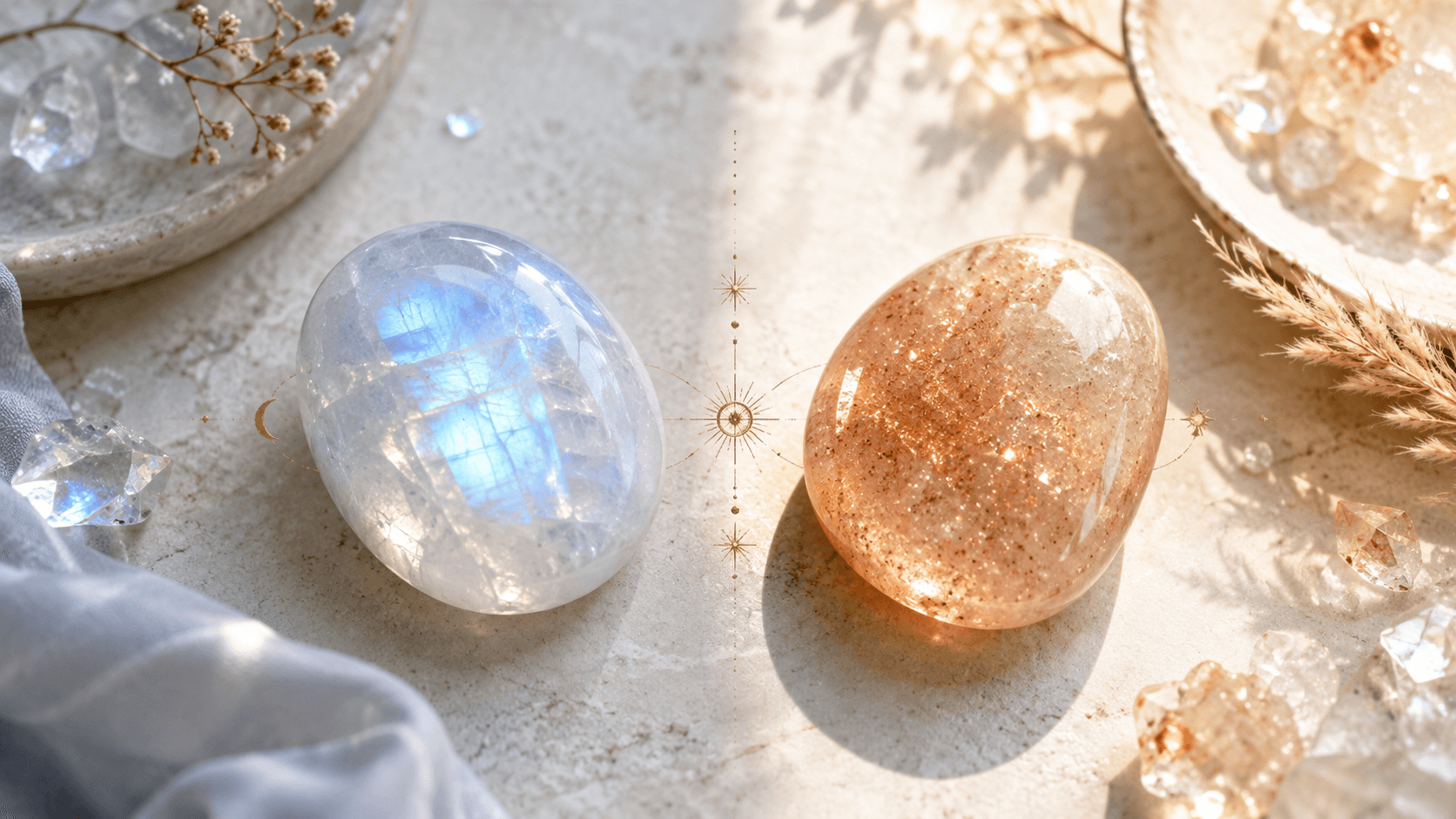
Moonstone and sunstone: two sides of one mineral
They belong to the same family, the feldspars, and there are even stones that show both effects at once. But their optical mechanisms are exact opposites: one scatters, the other reflects. Here is what actually sets them apart, in looks, in origin and in symbolism.
I do not sell sunstone. I know it because it arrives in the same parcels as my cabochons, from the same suppliers, and because people often ask me whether the two go together. This page is my answer, with what I have verified and what I am only reporting.
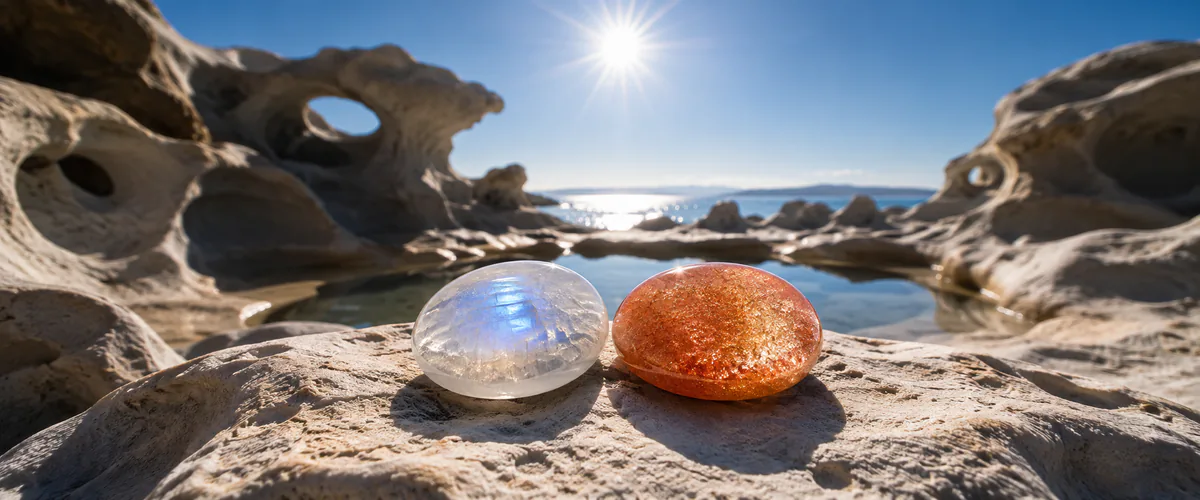
The short version, if you are in a hurry
- Same family, not always the same species. Both are feldspars. Moonstone is most often an orthoclase, sunstone a plagioclase, oligoclase or labradorite.
- But an orthoclase sunstone genuinely exists, so exactly the same species as moonstone. The title of this page is not a figure of speech.
- Two opposite mechanisms. Moonstone scatters light in microscopic lamellae. Sunstone reflects it off metallic flakes.
- The test that settles it in three seconds: a continuous veil that glides, that is moonstone. Pinpoint sparks that flicker, that is sunstone.
- The flakes are copper in Oregon sunstone, hematite or goethite in Indian sunstone.
- Symbolically, they are built as a pair: receptive against active, night against day. That is tradition, not mineralogy.
The title is true, just not the way you think
"Two sides of one mineral": the phrase is a nice one, and also more accurate than most pages on the subject. But it needs spelling out.
The two stones belong to the feldspar group, the most common in the earth crust. At that level, the kinship is real and direct.
At the species level, things most often separate. Classic moonstone is an orthoclase, an alkali feldspar. Sunstone is usually a plagioclase: oligoclase for the Indian one, labradorite for the Oregon one. Two different branches of the same family.
Except that an orthoclase sunstone also exists, whose refractive index, 1.518 to 1.526, is exactly that of moonstone. Same species, same composition, same crystal system. Only the nature of the inclusions changes. At that point, the title phrase becomes literally true: they really are two sides of the same mineral.
And there is more. Some stones, notably Indian ones, show both effects at once: a bluish veil on one side of the dome and copper flakes on the other. The trade sells them as moonstone and sunstone, or sunstone in moonstone. These are uncommon pieces, often grey or beige, and they are what gives this page title its full meaning.
The full feldspar classification is in the properties of moonstone.
Two exactly opposite mechanisms
This is the heart of the matter, and it explains everything else, down to how you photograph each stone.
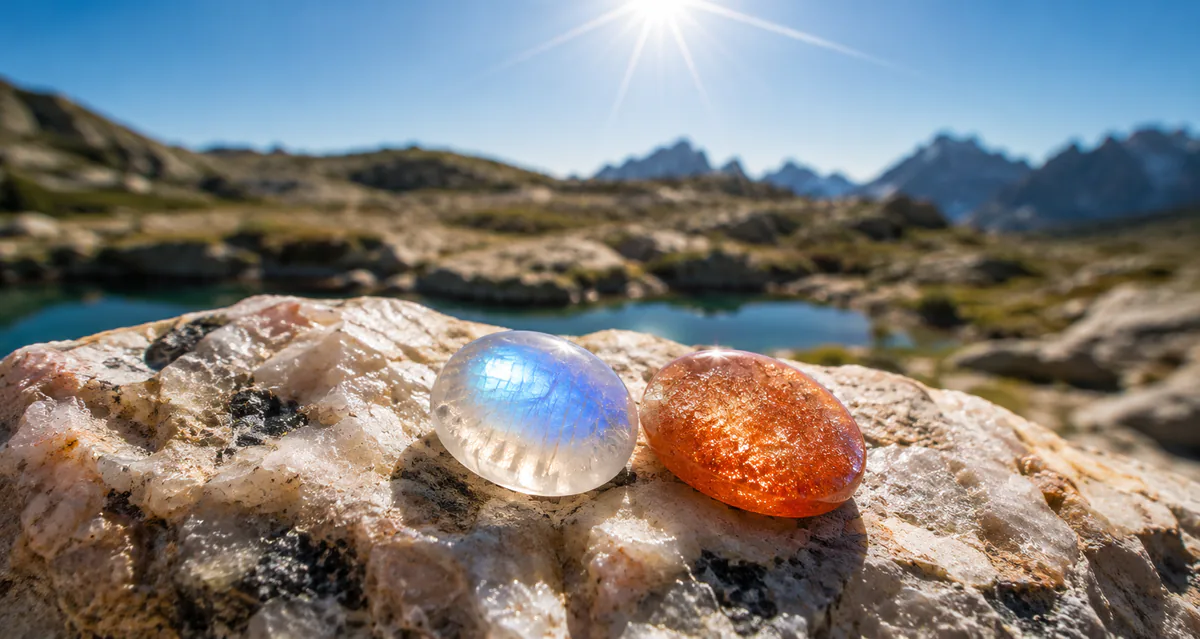
Adularescence, on the moonstone side. As it cools, the crystal separates into alternating microscopic lamellae, roughly the thickness of the wavelength of blue light. Light entering scatters inside and comes back out as a diffuse, bluish veil that seems to float beneath the surface. The phenomenon is internal and continuous.
Aventurescence, on the sunstone side. The crystal contains fine metallic platelets, aligned parallel to a crystallographic plane. They scatter nothing: they reflect light, like so many tiny mirrors. The effect is pointlike, sparkling, and lives on the surface rather than in depth.
Scattering versus reflection, depth versus surface, continuous versus pointlike. Two stones from the same family doing the exact opposite of one another with the same light.
A practical consequence few sellers know how to explain: they do not photograph the same way. Moonstone needs soft, broad light that lets the veil form. Sunstone needs a hard, pointlike source, or the flakes will not light up. A failed sunstone photo is almost always one taken in too diffuse a light.
The mechanism of adularescence is detailed in the article devoted to it.
The two data sheets side by side
| Criterion | Moonstone | Sunstone |
|---|---|---|
| Group | Feldspars | Feldspars |
| Common species | Orthoclase (adularia) | Oligoclase or labradorite |
| Phenomenon | Adularescence | Aventurescence |
| Cause | Exsolution lamellae | Copper, hematite or goethite platelets |
| Visual effect | Continuous, bluish veil | Pointlike sparks, gold to red |
| Body | Colourless to milky | Orange, red, brown, sometimes green |
| Hardness (Mohs) | 6 to 6.5 | 6 to 6.5 |
| Density | 2.55 to 2.63 | 2.62 to 2.67 |
| Refractive index | 1.518 to 1.526 | 1.539 to 1.547 (oligoclase) |
| Cleavage | Perfect | Perfect |
The line to remember is the second to last. Both have perfect cleavage, so the same precautions apply: no ultrasonic cleaning, no salt, no thermal shock, and a bezel setting rather than prongs on a ring.
Telling them apart in three seconds
Tilt the stone slowly under a point light source, a lamp or a window, and watch what moves.
A continuous veil that glides from one edge to the other, staying in one piece: moonstone. The light seems to come from inside.
Bright points that switch on and off one after another, like mica in sand: sunstone. Each flake flickers on its own.
Two complementary clues. The body colour: sunstone is almost always warm, orange to reddish brown, while moonstone is colourless, white or grey. And the loupe: under strong magnification, sunstone platelets are clearly visible, with sharp edges and a metallic shine, where adularescence shows no visible structure at all.
Watch out for one nearby confusion, though: peach or orange moonstone also has a warm body, but its sheen stays silvery and continuous. The varieties are detailed in the colours of moonstone.
Where they come from
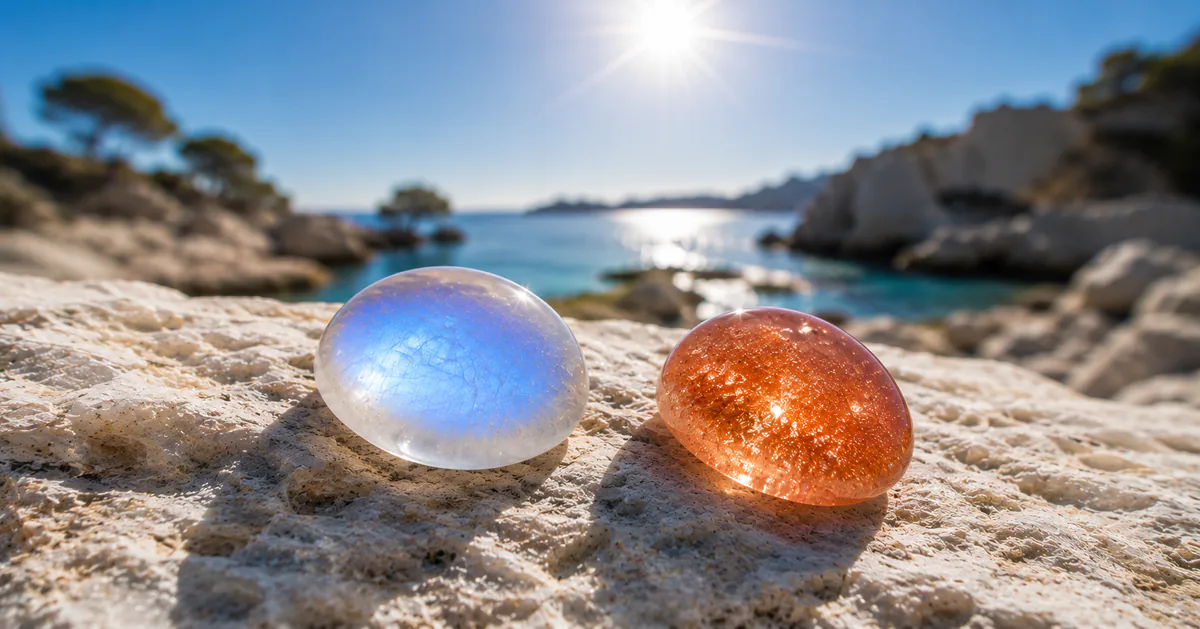
The deposits barely overlap, which makes sense: the two stones do not form under the same conditions.
Moonstone mainly comes from Sri Lanka for the blues, and from India for most of the rest. Madagascar, Tanzania, Myanmar and the United States also supply it. The detail is in the deposits of moonstone.
Sunstone has two main sources. India produces an oligoclase with hematite inclusions, the most common in jewellery, usually as a cabochon. Oregon, in the United States, produces a transparent labradorite with native copper inclusions, faceted and noticeably more expensive. Norway, Russia, Canada and Tanzania also supply it.
Oregon sunstone is a case apart: it is the official gemstone of that US state, and its transparency allows a faceted cut that the more opaque Indian stone cannot support.
Two opposite symbolisms
What follows changes register. Everything above can be measured. What follows belongs to crystal healing, a wellbeing approach founded on traditions and beliefs. I therefore write it in the conditional.
The two stones form an almost too-perfect pair, and that is probably why they have long been sold together. Tradition associates moonstone with the receptive: intuition, cycles, listening, the feminine. And sunstone with the active: vitality, drive, assertion, the masculine.
Night and day, silver and gold, inward and outward. It is a fairly recent Western symbolic construction, reinforced by the fact that the two names echo each other. It has no mineralogical basis: the two stones are chemically very close.
The detailed attributions are in the benefits of moonstone and its meaning. Pairings with other stones are covered in which stone to pair it with.
These correspondences belong to crystal healing, an approach founded on traditions and beliefs. They are not a medical claim and never replace the advice of a health professional. Read the full disclaimer.
Wearing them together
The question comes up often, and the answer has two parts: practically, yes without reservation; aesthetically, it is trickier than you would think.
Practically, no objection at all. Same hardness, same cleavage, same care. They will not scratch each other and store together without issue.
Aesthetically, the trap is colour temperature. A bright orange body next to a cool blue veil creates a very sharp contrast, which works for a bold piece but overwhelms the subtlety of moonstone. Three ways around it:
- Go through a warm moonstone variety, peach or pink, which bridges the gap instead of fighting it.
- Choose a metal that leans into it, yellow gold rather than silver, so the contrast is deliberate rather than accidental.
- Keep them apart, one on each hand or one as a ring and the other as a pendant, rather than side by side on the same piece.
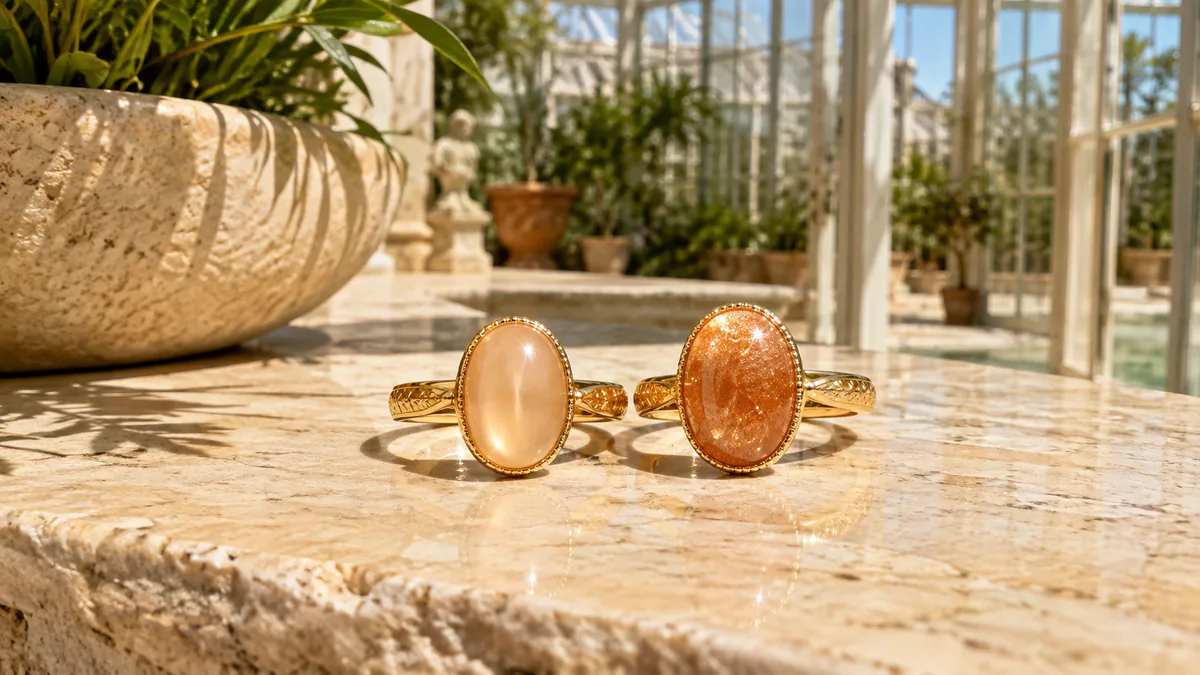
On everyday wear, see how to wear moonstone.
What each one costs
The two price ranges overlap widely, with a higher ceiling for moonstone.
An Indian sunstone cabochon goes for a few euros per carat, much like a peach moonstone. Oregon sunstone, transparent and faceted, climbs to several tens of euros per carat, and the rare red stones with green flashes reach rare-gem prices.
On the moonstone side, the gap runs from a few euros for a milky stone to several hundred for a gem-quality Sri Lankan blue. The full breakdown is in the price of moonstone, and the criteria behind it in judging quality.
A workshop observation at equal budget: for a hundred euros, you will get a fine set Indian sunstone, or a decent but unremarkable moonstone. Moonstone costs more at equal perceived quality, because its phenomenon is rarer to get clear and centred.
Which one to choose
Three questions usually settle it.
What light do you have? Sunstone needs a point source to light up: it is stunning outdoors and under evening lighting, dull under a diffuse ceiling light. Moonstone is steadier, content with window light.
What metal do you wear? Sunstone wants gold, yellow or rose, or it risks looking dull on silver. Moonstone accepts both, with a preference for silver on cool varieties.
What do you want people to notice? Sunstone reads from a distance, moonstone reveals itself up close. It is not the same piece of jewellery, nor the same intention.
I only sell moonstone, so my opinion is a biased one and you can weigh it accordingly. But I am happy to answer anyone torn between the two, including to say that sunstone would suit them better.
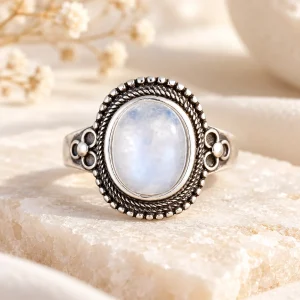
Rings from the workshop




Frequently asked questions
Are moonstone and sunstone the same mineral?
Not always, but sometimes yes. Both are feldspars. Moonstone is most often an orthoclase, sunstone a plagioclase. However, an orthoclase sunstone exists, so strictly the same species, and there are even stones that show both effects at once.
How can you tell them apart quickly?
Tilt the stone under a point light source. A continuous veil that glides in one piece is moonstone. Bright points that switch on separately, like mica, is sunstone. Body colour helps too: warm and orange for sunstone, colourless or white for moonstone.
Can you wear them together?
With no technical issue at all: same hardness, same cleavage, same care. The only real concern is aesthetic, since the contrast between an orange body and a blue veil is very sharp. A peach moonstone bridges better than a white one.
Where does the sparkle of sunstone come from?
From fine metallic platelets included in the crystal and aligned with each other: native copper for the Oregon stone, hematite or goethite for the Indian one. They reflect light like tiny mirrors. It is the opposite of the moonstone mechanism, which scatters it.
Which one is more expensive?
The ranges overlap, but the ceiling is higher on the moonstone side: a gem-quality Sri Lankan blue far exceeds an Indian sunstone. Oregon sunstone, transparent and faceted, on the other hand, sits well above ordinary moonstones.
Is sunstone just as fragile?
Yes, exactly as fragile. Both have a hardness of 6 to 6.5 and above all perfect cleavage, so they split on impact rather than scratch. Same prohibitions: no ultrasonic cleaning, no salt, no hot water, and a bezel setting preferred on a ring.
Why does not my sunstone sparkle in my photos?
Because you are lighting it like moonstone. The flakes need a hard, point light source to light up; in diffuse light, they stay dark. It is the opposite for moonstone, whose veil forms better in soft light.
Where to go next
- Not mixing it up: with labradorite, with selenite, with opal.
- Understanding: adularescence, the mineral data sheet, the colours and varieties.
- Pairing: which stone to pair it with, those that sit badly together.
- The bigger picture: the complete guide.
Everything I set is in the shop, and it is moonstone only. Torn between it and a sunstone? Write to me: I answer myself within 48 working hours, and I will tell you honestly if the other one would suit you better.
My sources
The feldspar classification, the nature of the inclusions and the optical constants follow the public data sheets of the GIA, Mindat and the International Gem Society. The price ranges come from readings on trading places and my own purchases: there is no official price list for either stone. The symbolic correspondences are reported as traditions, and never presented as properties of the mineral.
Last updated: August 19, 2026. If you find a mistake in this article, tell me about it: I correct it and I note it.
✦ À porter, à offrir
Découvrez mes créations