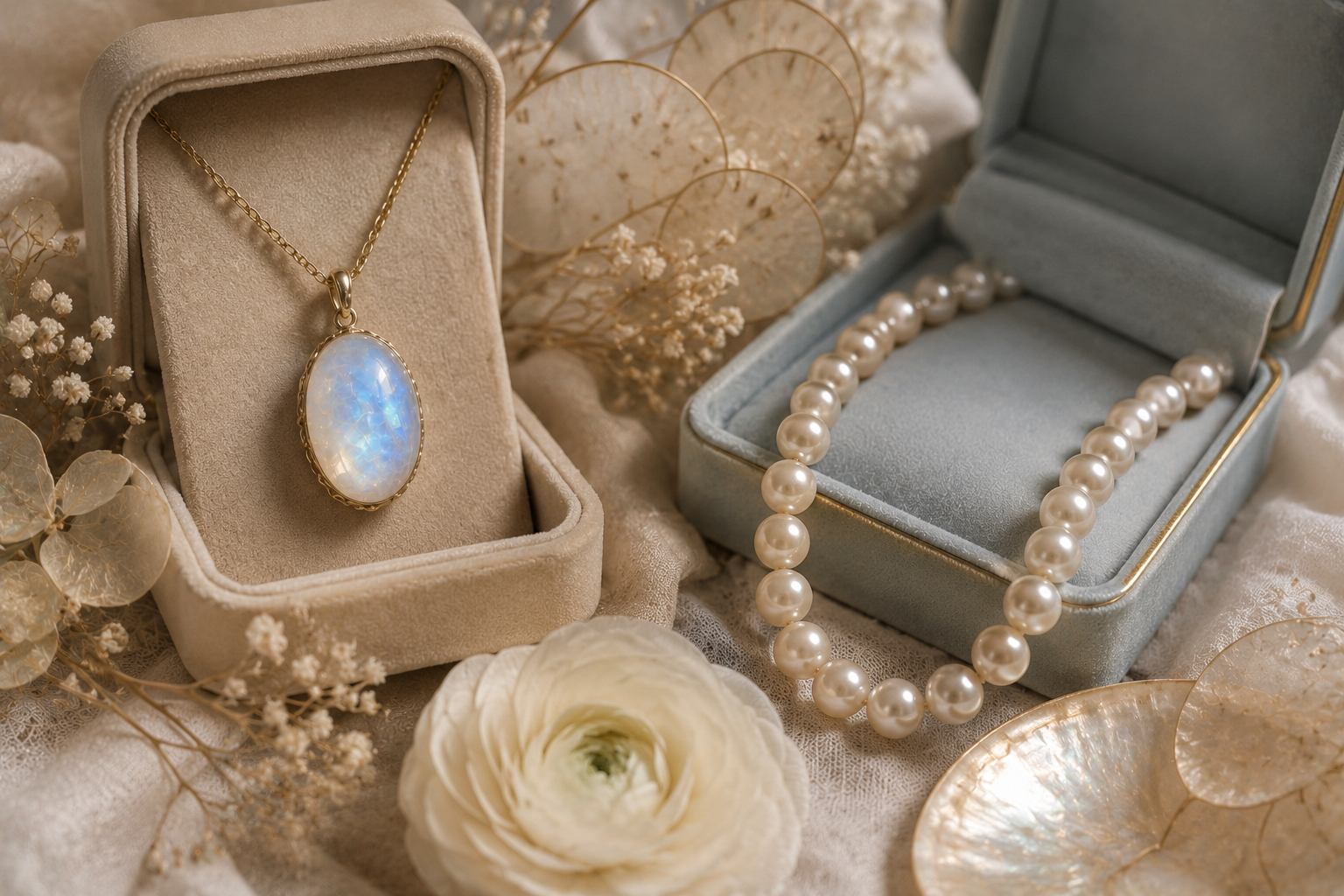
Moonstone or pearl: which to give
Both are white, both have that soft lustre you look for in a gift, and both are birthstones for the month of June. So the question is a real one. Here is how I settle it, taking into account three things people often forget: the perceived age of the piece, the actual fragility, and what the person will be able to do with it day to day.
This article is not trying to sell you moonstone at any cost. There are situations where the pearl is the right choice, and I say so. For the rest of the comparisons, there is opal and labradorite.
The short version, if you are in a hurry
- Both are June birthstones, which makes the choice a legitimate one and not an arbitrary one.
- The pearl is far more fragile: it is organic, very soft, and perfumes and cosmetics attack its surface.
- Moonstone takes water and soap, which makes it an everyday piece that is simpler to live with.
- The pearl is seen as more classic, even as older. That is not a flaw, but it is a fact to take in.
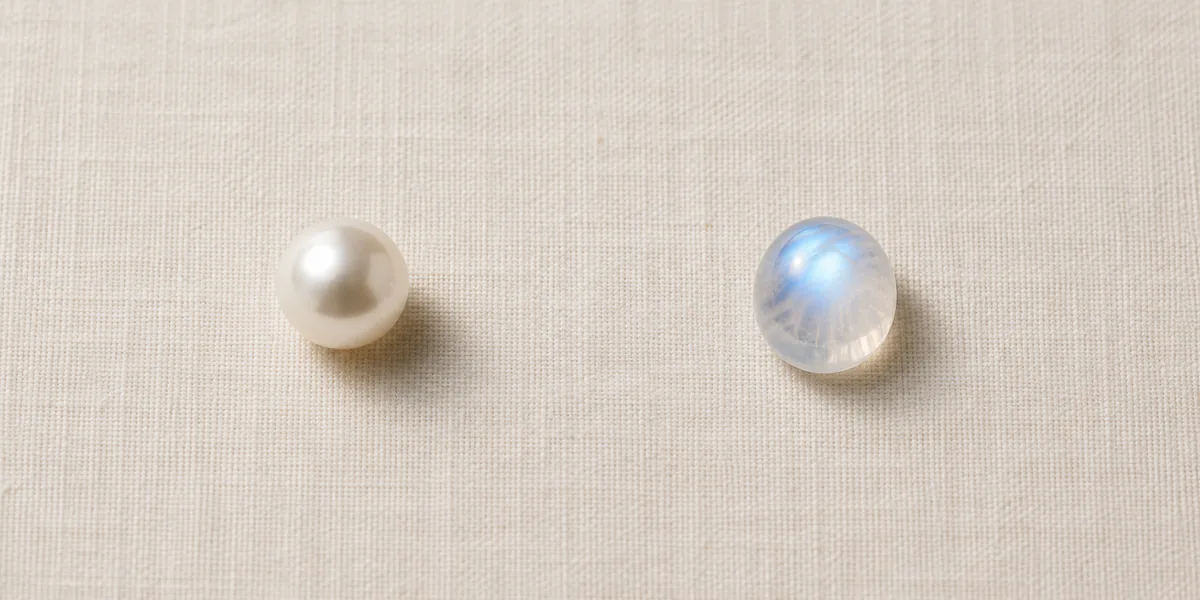
- The lustre of a pearl is on the surface, that of a moonstone comes from inside and moves.
- The budgets overlap at the entry level, and diverge sharply at the top.
- For a wedding or a formal gift, the pearl remains the safe answer. For everything else, moonstone works better.
The starting point: both are June stones
This is what makes the question interesting, and it is also what created it.
The modern birthstone calendar, as it circulates today, gives the month of June several stones and not just one. The pearl and moonstone both appear on it, which is no accident: the lists were revised several times during the 20th century and ended up keeping options, in part to allow for differences in price.
The practical result is simple: if you are looking for a gift for a June birthday, both are correct answers, and nobody will be able to tell you that you got it wrong. So this whole page is about deciding on criteria other than legitimacy. The full calendar is in the June birthstone.
A mineral, and a living thing
The underlying difference is this: one is a mineral, the other is a product of life.
The pearl is organic. It is produced by a mollusc, an oyster or a freshwater mussel, which lays down successive layers of nacre around a foreign body. That nacre is made of platelets of calcium carbonate bound by an organic material. So it is not a rock, it is a secretion, and it keeps all the properties of one: sensitive to acids, sensitive to drying out, sensitive to time.
Moonstone is mineral. A crystallised feldspar, formed by slow cooling inside rock, with no organic matter and no water in its structure. Its data sheet is in the properties of moonstone, and how it forms is in how moonstone forms.
A word on cultured pearls, since the question always comes up. Almost all the pearls sold today are cultured pearls, that is, produced by a mollusc after a human intervention that starts the process off. They are not imitations: the nacre is genuine and laid down by the animal. Natural pearls, formed without any intervention, have become extremely rare and belong to the collectors market.
Two whites that are nothing alike
From a distance you might hesitate. Up close, never, and here is why.
The lustre of a pearl is a surface phenomenon. Light reflects and refracts between the outermost layers of nacre, which gives that satin depth and sometimes the coloured sheen called orient. That lustre wraps the whole sphere and follows your eye without travelling across the stone.
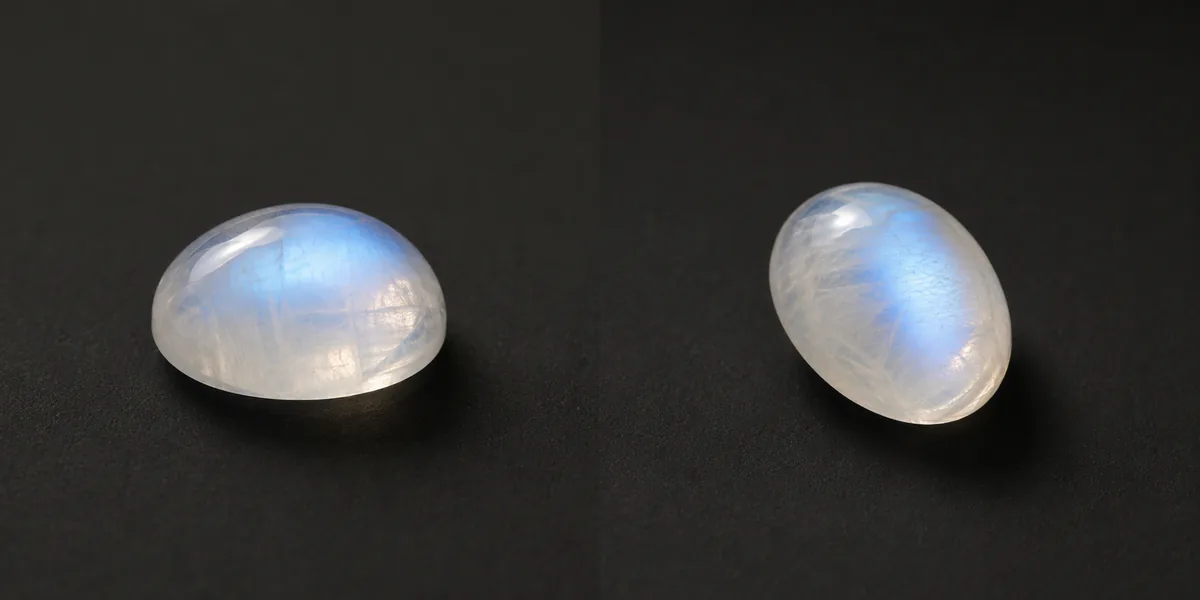
The veil of a moonstone comes from inside. It is born from lamellae buried below the surface, and so it behaves like an object separate from the cabochon: when you tilt the stone, the veil slides, goes from one edge to the other, disappears and comes back. That movement is what makes it singular, and it is explained in adularescence.
The one-second test: tilt it. If the light stays where it is, it is a pearl. If it wanders, it is a moonstone.
Toughness, and the myth turned around
Here is the point that surprises most people, because it runs against the intuition.
Moonstone has a reputation for fragility, largely deserved as it happens, because of its cleavage: it can split clean through on an impact, as I explain in is moonstone fragile. It sits around 6 on the Mohs scale.
The pearl is far softer, well below that, in a range that places it among the most delicate materials in jewellery. In practice, it scratches against just about anything: sand, dust, another ring, the bottom of a bag. A scratched pearl cannot be repaired, because the scratch has cut into the nacre itself.
And it has a weakness moonstone does not have at all: nacre is attacked by acids. Perfume, hairspray, cream, sweat, vinegar, lemon juice: all of it dulls the surface, pits it and eventually eats it away. That is where the pearl wearers rule comes from, put your necklace on last and take it off first.
The reversal is clear. Moonstone fears the one-off knock, an accident you can avoid. The pearl fears ordinary use, which is far harder to work around.
What that changes day to day
Let us turn those differences into gestures, because that is where the satisfaction of a gift is decided six months later.
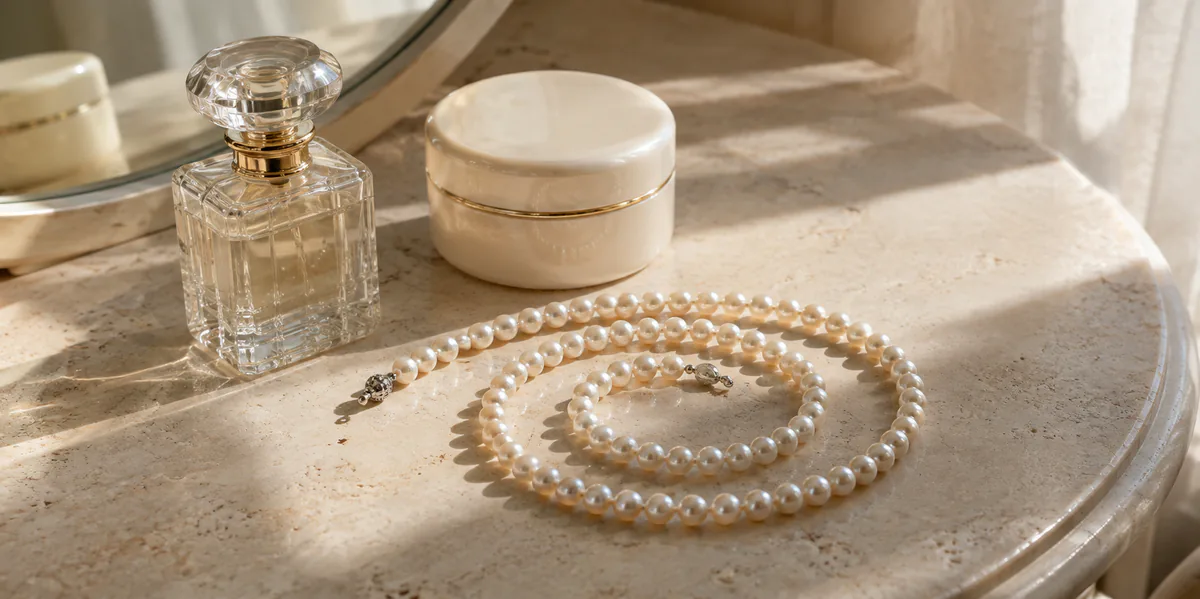
Cleaning. A moonstone is washed in lukewarm water with mild soap, the procedure is in how to clean a moonstone piece. A pearl necklace is not washed: you wipe it with a soft cloth after each wearing, and you do not soak it, among other reasons because the silk thread it is strung on likes neither water nor soap.
Upkeep over time. A strand of pearls worn regularly has to be restrung from time to time, because the thread stretches and eventually gives way. That is real upkeep, with a cost and a trip to have it done. A moonstone piece needs nothing of the kind.
Storing. Pearls are stored flat, kept apart from other jewellery so they do not get scratched, and not somewhere too dry. A moonstone is simply stored away from knocks, which is more forgiving.
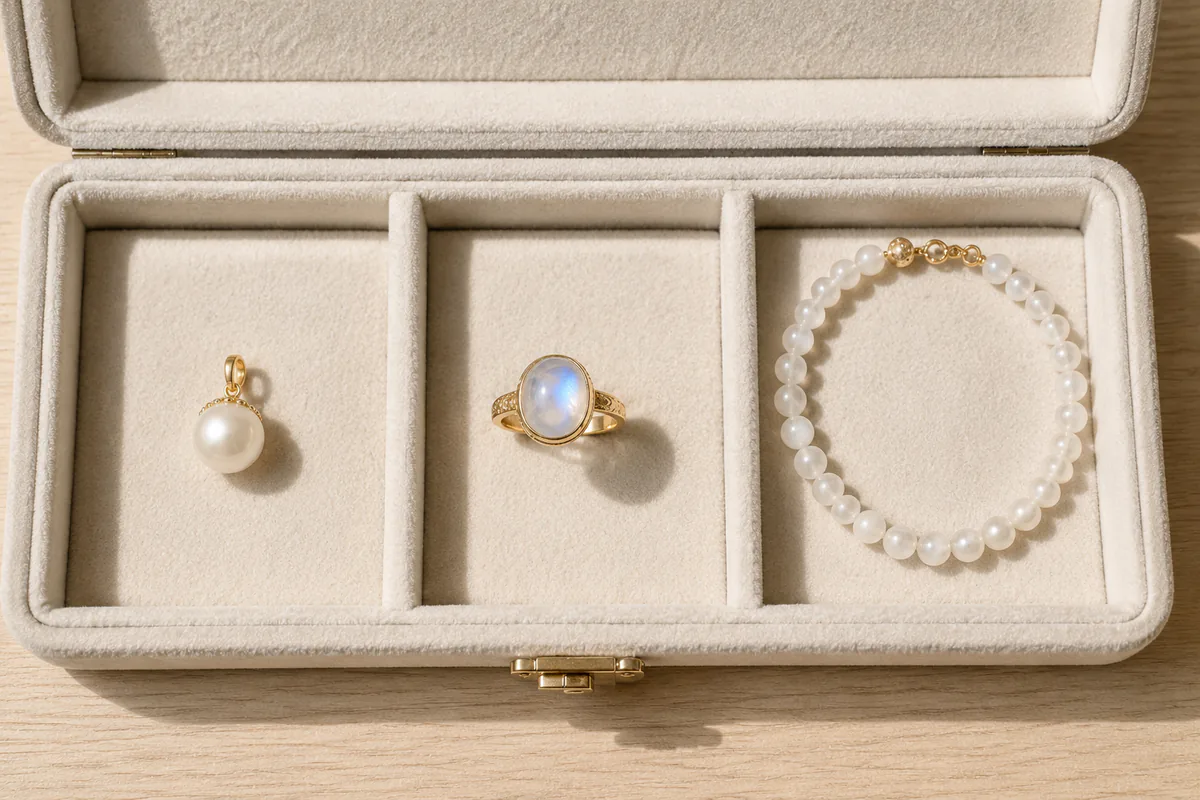
Wearing it every day. This is the real decider. A moonstone bracelet or ring is worn daily with a minimum of common sense. Pearls worn every day against the skin, with perfume and cream, visibly degrade within a few years.
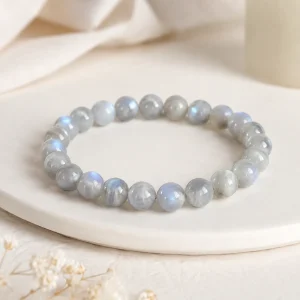
Pieces you can wear without thinking about them
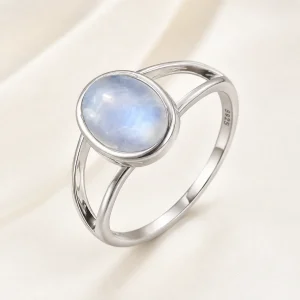
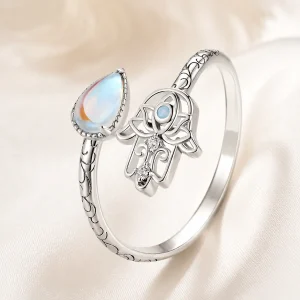
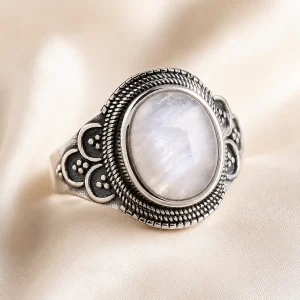
Perceived age, the criterion nobody mentions
A delicate point but a useful one, and I would rather say it plainly.
The pearl carries an image. Strand of pearls, tailored suit, wedding, family handing-down: that is a classic vocabulary, tied to formality and often to a generation. Plenty of young women own inherited pearls they never wear, not because they dislike them, but because they cannot find an occasion.
Moonstone carries another image, more contemporary and freer: silver rather than gold, cabochon rather than strand, everyday rather than ceremony. It has no age label on it.
This is not a value judgment, and a well-chosen strand of pearls on someone who owns the look is superb. But if you are giving to someone whose taste you do not know perfectly, the question to ask is: will she have an occasion to wear it? The answer is yes more often with a cabochon than with a strand.
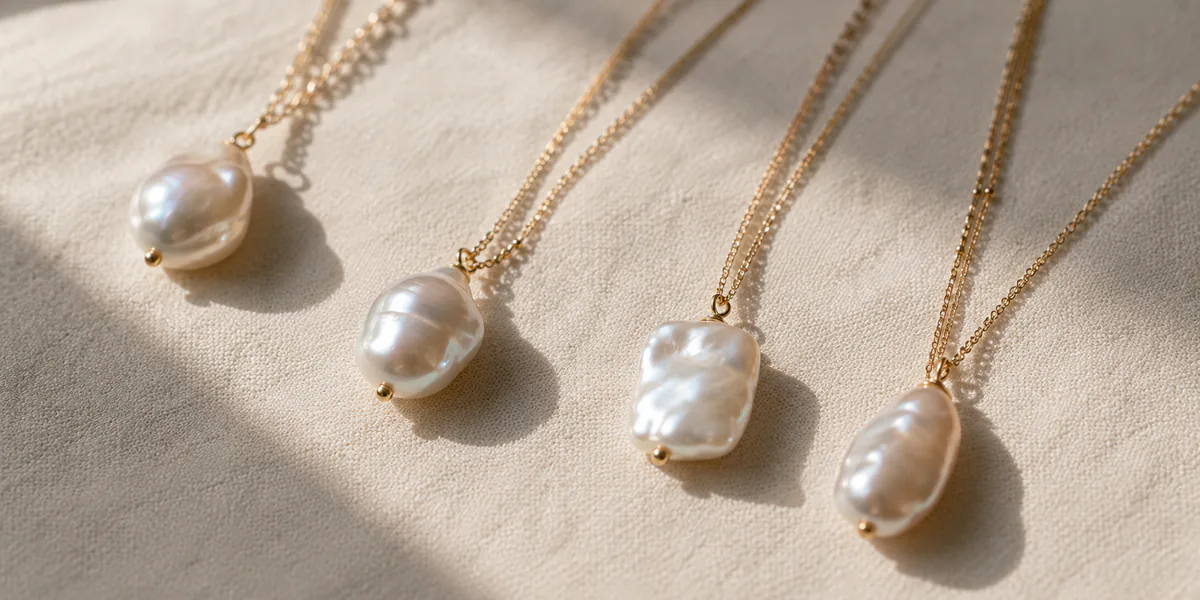
The honest counter-example: the pearl has moved on a great deal. Irregular baroque pearls, single pearls set on a fine chain, grey or golden pearls, none of that is dated. If you go for the pearl, go in that direction rather than the classic strand.
The budget, upkeep included
The two families overlap at the bottom and diverge at the top.
At the entry level it is comparable. A freshwater cultured pearl simply set and a decent white moonstone sit in the same orders of magnitude, those of a good costume piece.
At the top end, the pearl breaks away. Saltwater pearls, akoya, Tahitian or South Sea, reach prices on quite another scale, and a matched strand costs more than the sum of its pearls, because matching them for size, shape and lustre is a job in itself.
Moonstone stays modest, except for the fine transparent blues. The detail is in the price of moonstone.
The budget trap, for a pearl: you have to count the upkeep. Periodic restringing and the occasional replacement of the clasp are part of the real cost of ownership, and nobody tells you that at the time of purchase.
What each one says
What follows belongs to tradition and to symbolism. No effect of these materials on health is demonstrated, and nothing here replaces a diagnosis, a treatment or the advice of a health professional. Read the full disclaimer.
The pearl sits on the side of purity, of hard-won wisdom and of handing down. It is the wedding stone in the Western world and the rite-of-passage gift par excellence, from a mother to her daughter. A minority tradition also reads tears into it, which makes it a gift to avoid in certain families: that gets checked before giving, with one question.
Moonstone sits on the side of the cycle, of intuition, of the night and of beginning again. A body of belief set out in the meaning of moonstone and in the virtues ascribed to it.
The difference in tone matters for a gift: the pearl states a place already held, moonstone states a movement. One suits a milestone birthday, the other the beginning of something.
The decision grid, occasion by occasion
The table I use when someone puts the question to me in the shop.
| Occasion | My advice | Why |
|---|---|---|
| June birthday | Either works | Shared birthstone |
| Wedding, ceremony | Pearl | Settled codes, formal dress |
| First piece given | Moonstone | Less committing, more wearable |
| Everyday gift | Moonstone | Takes real wear |
| Family handing-down | Pearl | Strong symbolic weight |
| Teenager | Moonstone | No age label |
| Birth, fresh start | Moonstone | Symbolism of the cycle |
| Small budget | Either | Overlapping ranges |
| Someone with busy hands | Neither, as a ring | Both too soft |
Read the last line: it is the most honest in the table. For someone who gardens, does repairs or works with their hands, neither will survive as a ring worn all the time. Steer towards a pendant or earrings instead, and the full reasoning is in how to wear moonstone.
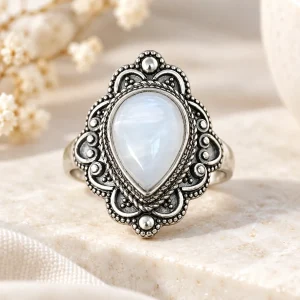
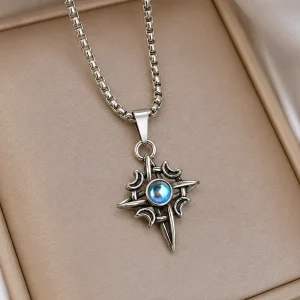
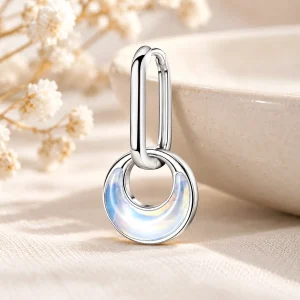
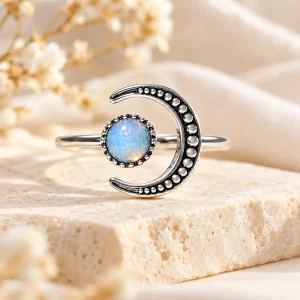
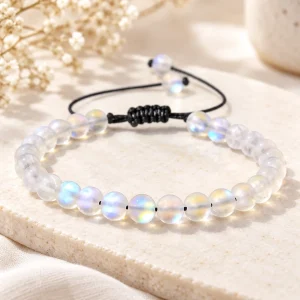
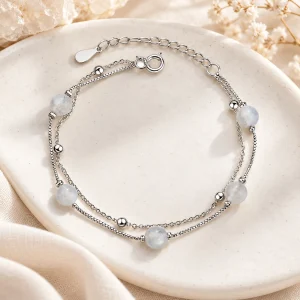
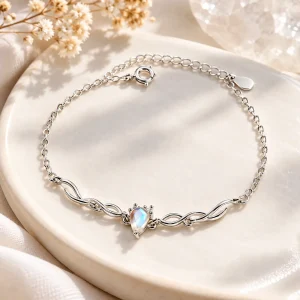
Gift ideas, in silver
Frequently asked questions
Moonstone or pearl, which one to give?
For a gift meant to be worn every day, moonstone, because it takes water, soap and ordinary use. For a wedding, a ceremony or a family handing-down, the pearl, whose codes are settled.
Are both of them June birthstones?
Yes. The modern calendar gives June several stones, among them the pearl and moonstone. Both are therefore legitimate answers for a birthday in that month, and nobody will be able to tell you that you got it wrong.
Which is the more fragile?
The pearl, plainly. It is far softer and scratches against almost anything, and above all its nacre is attacked by acids, so by perfume, hairspray, creams and sweat. Moonstone fears only knocks.
Can you wash a pearl piece?
No, you wipe it with a soft cloth after each wearing. Soaking damages the nacre and the silk thread the pearls are strung on. A moonstone piece, on the other hand, washes without any trouble in lukewarm water with mild soap.
How do you tell a pearl from a moonstone?
Tilt the piece. The lustre of a pearl wraps the sphere and stays put, whereas the veil of a moonstone travels from one edge to the other, because it comes from inside the stone.
Is a cultured pearl a real pearl?
Yes. The nacre is genuine and laid down by the mollusc, and the human intervention only starts the process off. It is natural pearls, formed without any intervention, that have become extremely rare and belong to the collectors market.
Does a pearl necklace really need restringing?
Yes, periodically, because the thread stretches with wear and eventually gives way. It is a real cost of ownership that is rarely mentioned at the time of purchase, and one a moonstone piece does not have.
Does the pearl look older?
The classic strand, yes, it carries a formal and generational image. But the pearl has moved on a great deal: irregular baroque pearls, single pearls on a fine chain, grey or golden pearls are nothing like dated.
Which costs more?
The ranges overlap at the entry level, but the pearl breaks away towards the top: saltwater pearls reach prices on quite another scale, and a matched strand costs more than the sum of its pearls, because of the matching work.
Can you wear pearl and moonstone together?
Yes, and it works well: the two whites are close without being identical, one satin on the surface, the other veiled in depth. The rules for pairing are set out in the article devoted to pairings.
Where to go next
- Giving: giving a moonstone, the June birthstone, an engagement ring, my view.
- The other comparisons: or opal, or labradorite, or selenite.
- Wearing and caring: how to wear it, cleaning a piece, is it fragile.
- Pairing: which stone to pair it with, what is better avoided.
- The whole picture: the complete moonstone guide.
The pieces are in the shop, with the rings and the bracelets. If you are hesitating over a particular gift, tell me who it is for and for what occasion: write to me, and I will tell you if the pearl is the better choice, which does happen.
My sources
For the composition of nacre, its hardness and its sensitivity to acids, the gemmological files of the GIA on pearls, together with the care recommendations published by the laboratories and the trade associations, which converge on the same points: no soaking, no products, wipe after wearing, periodic restringing.
For the June birthstones, the modern lists that came out of the 20th century revisions, set out in the article devoted to them, which explains why that month has several.
What I do not quantify. I give no figures for a price range on pearls, because the gap between a freshwater pearl and a South Sea pearl is such that a single range would mean nothing. Nor do I give an interval for restringing: it depends entirely on how often the piece is worn, and the common recommendations vary threefold from one source to the next.
And a bias I own up to. I sell moonstone, not pearls. I have tried to make the decision table honest, and it comes out for the pearl on three lines, but read it knowing where I am speaking from.
Last updated: 19 August 2026. A disagreement, a correction? Write to me.
✦ À porter, à offrir
Découvrez mes créations