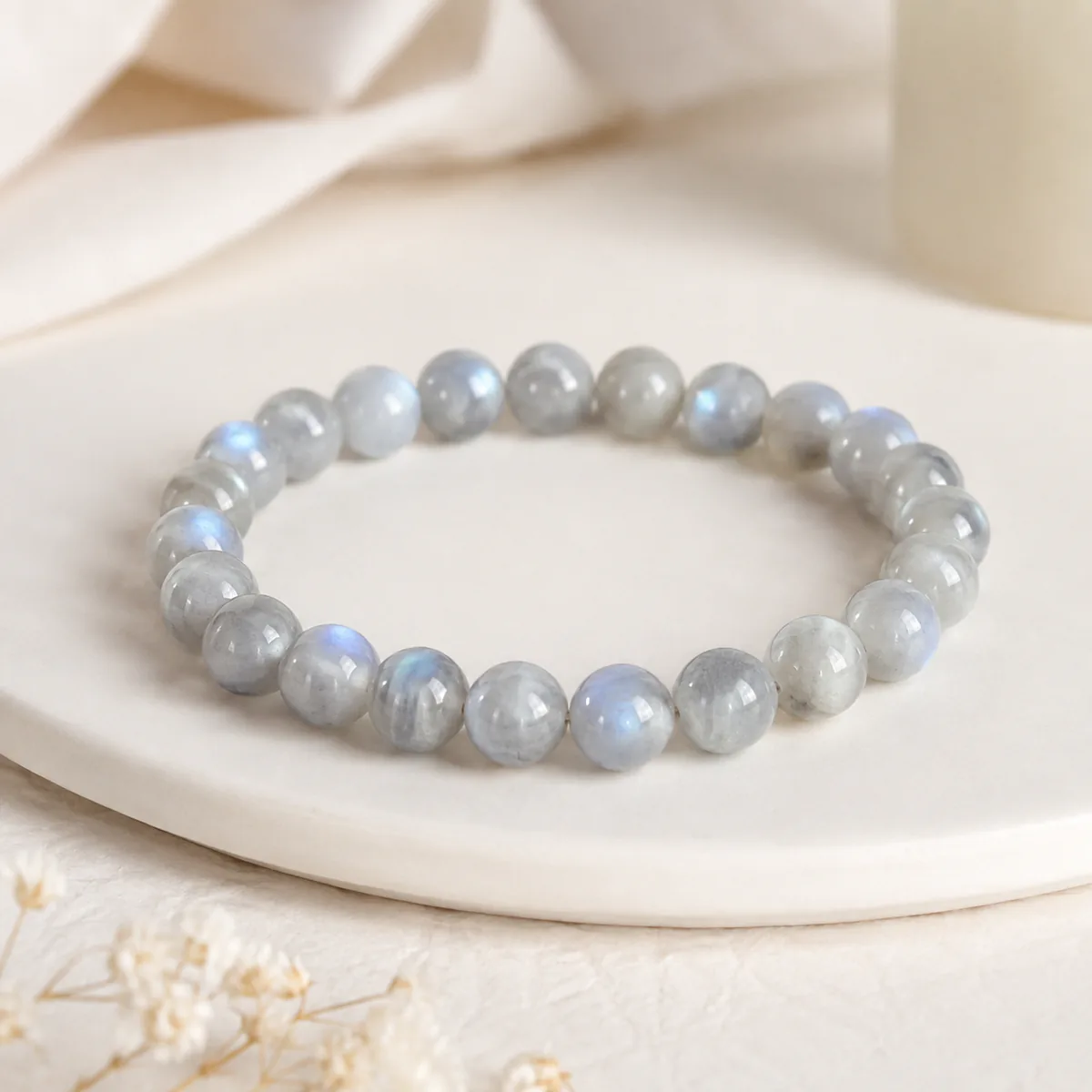



Description
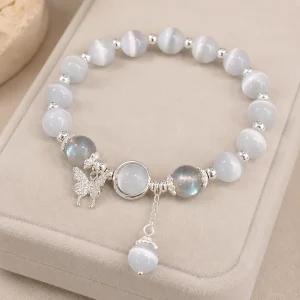
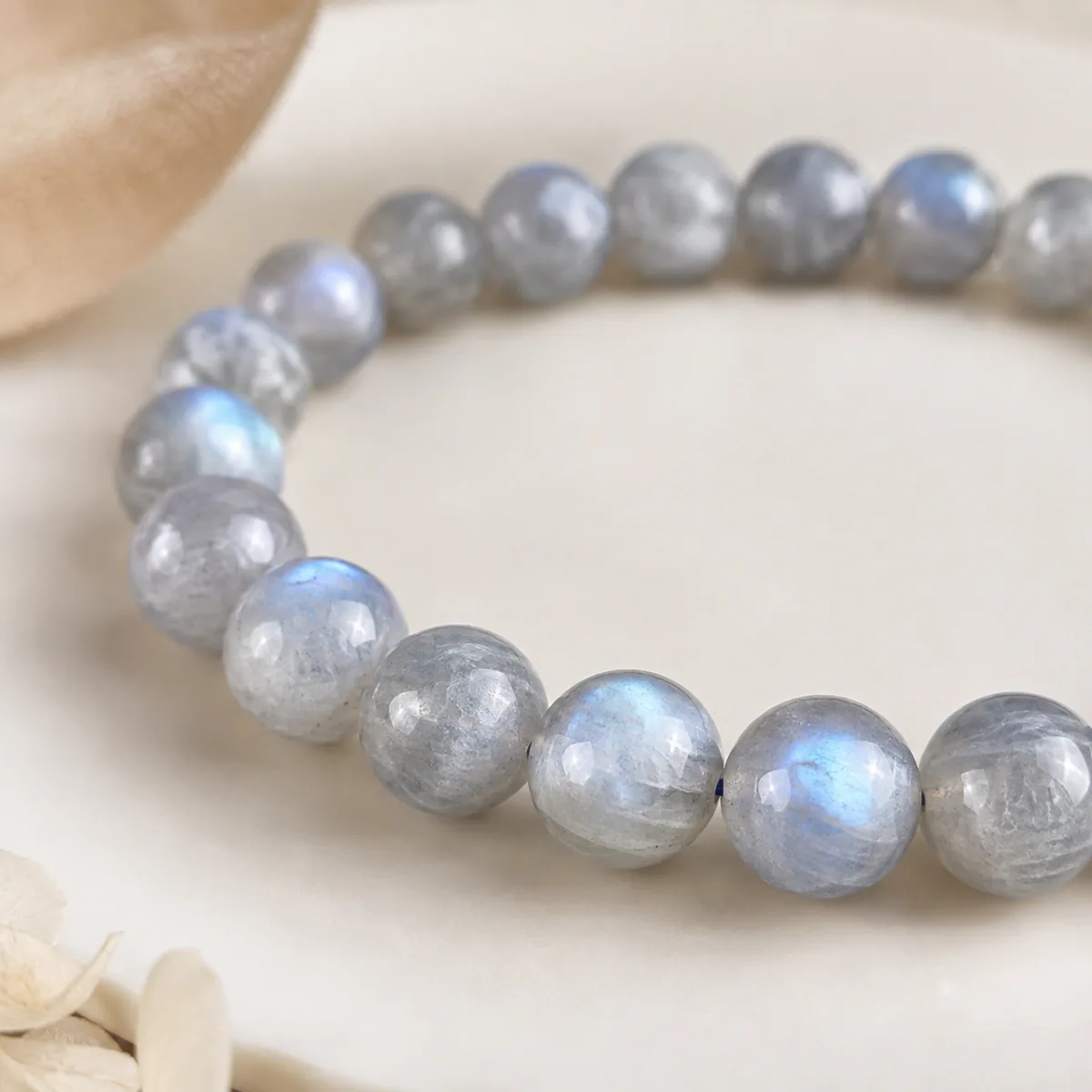
It is the simplest piece in the shop, and the one that shows most honestly what this stone is. About twenty round 8 mm beads strung on stretch cord, no clasp, no metal, nothing to distract. On some the blue light comes through, on others it does not. That is exactly what you should be looking at.
Why the beads do not match
Look at the whole bracelet: a few beads throw back a clear blue, others stay grey, most sit in between. It is the first thing that surprises people on arrival, and it is also the best news on this page. Perfectly identical beads are not natural beads. A moonstone’s sheen depends on the orientation of the crystal’s internal planes; since you cannot pick that orientation when drilling a bead out of a block, each one lands where it lands. A perfectly uniform set means either glass or reconstituted material, and I will let you guess which.
What can be sorted, though, is the average. A poor batch gives twenty grey beads and two that catch the eye; a good batch gives the opposite. That is what I look at, not uniformity. I have detailed the six criteria I apply and how to recognise a real stone, which hold for a bead just as much as for a cabochon.
8 mm is a choice, not an imposed standard. Below it, at 6 mm, the bead is too small for a sheen to have room to unfold and the bracelet becomes a plain grey line. Above it, at 10 or 12, you enter jewellery that is meant to be seen, heavier, more masculine, and it rolls on the wrist. 8 mm is the size where each stone is still distinct without the whole thing feeling heavy. The shop’s other bracelets are here.
Now something almost nobody writes about stretch bracelets, and it explains three quarters of the disappointments. The cord is a wear part. It is not a manufacturing flaw, it is a consumable: a good elastic lasts one to three years depending on how often you put it on, then it tires and eventually gives way, usually without warning. Two things double its life. First: do not stretch it to its full width to put it on, roll it over your hand instead, keeping it as tight as you can. Second: take it off before the shower, elastic hates surfactants far more than the stone does. When it snaps, a jeweller restrings it in ten minutes, and it is not worth throwing the beads away.
- Round 8 mm real moonstone beads, on stretch cord, no clasp.
- The sheen varies bead to bead. That is the signature of a natural stone, not a flaw.
- The stretch cord is a wear part: expect one to three years, then a restring.
- Delivered in two weeks with a cotton pouch, a handwritten note and a care card.
The specifications
- Stone
- Real moonstone, round beads
- Bead diameter
- 8 mm
- Stringing
- Stretch cord, no clasp or metal
- Bead count
- Variable, depends on wrist size
- Wrist sizes
- 14 to 20 cm
- Gender
- Women and men
- Brand
- Melissa Moon
The piece that is easiest to fake
With a cabochon, you look once and you know. An 8 mm bead, no: it is small, it is drilled, it is sold by the kilo, and nobody examines twenty beads one by one before buying. That is why the beaded bracelet is the format where you find the most dyed glass, opalite and reconstituted material sold under the name moonstone. The test still takes ten seconds: tilt the bracelet in front of a window. If every bead lights up at once and in the same way, it is not stone.
I do not drill these beads myself, nobody does at this scale. What I do is open the bags and set aside batches where the average is poor, which happens more often than I would like. The rest of the shop is here, including what I have taken out of the catalogue.
I am sometimes asked if I can guarantee every bead will have the sheen. No. And the day someone guarantees that to you, find another shop.
No salt, no ultrasonic tank, no hot water: moonstone is a feldspar, and all three damage it for good. Lukewarm water and a soft cloth are enough, drying carefully between the beads. Take it off before the shower: soap does not attack the stone but it wears the cord, which is the only fragile part of this bracelet. And put it on by rolling it over your hand rather than stretching it to full width, that is what decides its lifespan. The detail is in cleaning a moonstone piece, and the safe methods in caring for it without harming it.