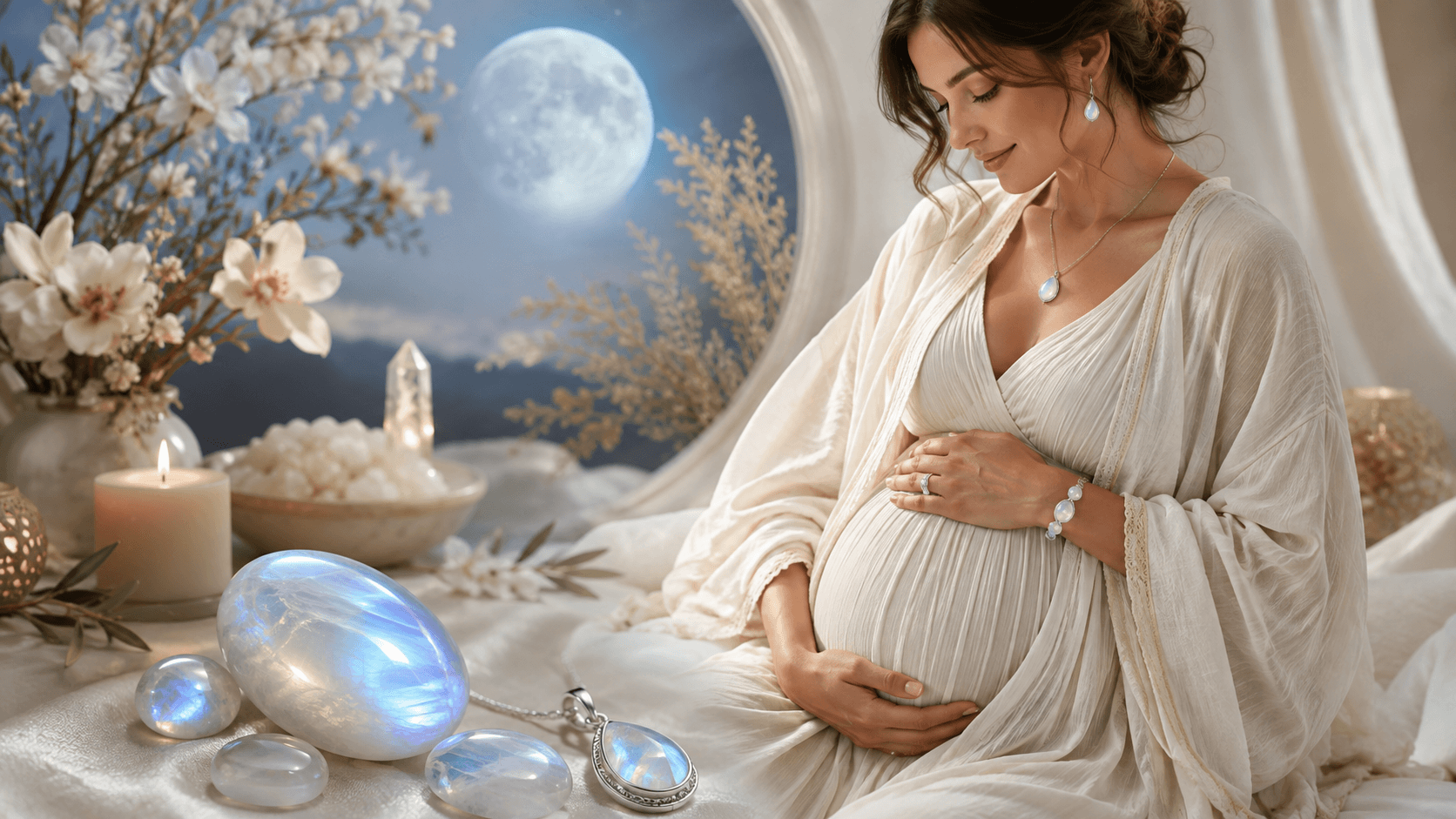
Best crystals for pregnancy
Moonstone, rose quartz, amethyst: here is what tradition credits them with during pregnancy, and why the list of "not recommended" stones doesn't hold up. Then the useful part, which nobody writes about: what actually changes over nine months isn't the stone, it's the jewellery.
This page contains a serious warning, and it has nothing to do with moonstone. If you only read one section, read the one on amber necklaces: it's the only section on this entire site where French health authorities have weighed in, and they all said the same thing.
The essentials, if you're in a hurry
- No stone has an effect during pregnancy, good or bad. It's the same answer both ways.
- Lists of stones "not recommended for pregnant women" don't hold up: a stone with no effect also can't be dangerous because of its effects.
- The real issue is the jewellery. Fingers swell late in pregnancy, and a ring can get stuck.
- Take off fitted rings early, as soon as your fingers start to swell, without waiting. A pendant or bracelet doesn't have this problem.
- Hospitals ask you to remove jewellery before delivery, and always before a C-section.
- Amber teething necklaces are dangerous and their effectiveness has never been shown. France's DGCCRF, ANSM and Society of Pediatrics have all weighed in.
- A beaded bracelet has no business within reach of an infant. A cord that breaks means beads on the floor.
The answer, and it holds both ways
You're probably looking for whether there's a stone to wear, or a stone to avoid. Both answers are the same.
A stone has no effect on a pregnancy. It doesn't support it any more than it disturbs it. It doesn't act on any bodily function, neither yours nor the child you're carrying. This isn't a shop owner's caution, it's simply how things are, and it's true for moonstone just as it is for every other stone.
That fact has a consequence almost nobody draws, and it should reassure you if you've read elsewhere that you should be wary of this or that stone: if a stone does nothing, it also can't harm you through that mechanism. The list of stones "forbidden during pregnancy" rests on exactly the same belief as the list of beneficial stones. Both fall together. I come back to this further down.
A pregnancy is followed medically, and that's the only thing that matters. Your midwife, your OB-GYN or your primary care doctor are the right people for any question. A jewellery shop is not, including this one.
What this page can offer you, though, are the three middle sections: what actually changes when you wear jewellery while pregnant, what hospitals ask for, and a documented health warning about an object that still gets given as a gift often.
A piece of moonstone jewellery has no demonstrated effect on health, on a pregnancy, or on an unborn child. It does not replace prenatal care, an exam, or the advice of a healthcare professional. Never interrupt care and never delay a consultation because of a stone. Read the full disclaimer.
The stones tradition cites for pregnancy
Here is the full list of what's said, with its real age. I'm giving it to you so you don't have to look for it elsewhere, where it will come bundled with promises.
| Stone | What tradition credits it with | Origin |
|---|---|---|
| Moonstone | The body's rhythms, life passages | 1990s |
| Rose quartz | Softness, bonding, soothing | 20th century |
| Amethyst | Calm, sleep | 20th century |
| Jade | Protection, continuity | 20th century |
| Unakite | Support through pregnancy | Recent |
| Rhodonite | Fears, blockages | 20th century |
| Moss agate | Grounding, growth | 20th century |
Look at the right-hand column. None of these attributions is more than a century old, and unakite, often presented as "the pregnancy stone" par excellence, is one of the most recent of all. These correspondences come from crystal guides published between 1985 and 2003, whose publication I've dated in the properties of moonstone.
Moonstone's case is particular, and it's worth understanding. It tops these lists because a chain of analogies links it to the feminine cycle: the lunar cycle lasts about twenty-nine and a half days, the menstrual cycle runs a similar length, and the stone carries the Moon's name. That's a resemblance between names, not a property, and I detail it in moonstone and fertility.
The "not recommended" stones, and why that doesn't hold up
This section exists because it worries people for no reason, and I find that more serious than the rest.
You'll read on several sites that, pregnant, you should avoid certain stones. Carnelian, malachite, hematite and bloodstone come up most often, with justifications like "it stimulates too much," "it acts on circulation," or "it can trigger contractions."
These sentences are medical claims, and they're all the more problematic for being aimed at pregnant women. Triggering a contraction is a clinical event. No stone does this, no study shows it, and nobody ever provides the slightest reference for it.
The reasoning is simple and worth stating once. A stone with no effect cannot have an adverse effect. You can't claim that moonstone supports a pregnancy while carnelian endangers it: both claims rest on the same belief, and if one falls, the other falls with it.
So I don't maintain any list of esoteric prohibitions on this site, here or anywhere else. The only real precautions concern the jewellery's material, not the stone's symbolism, and they're in the three sections that follow. The general principle is explained in the contraindications of moonstone.
What actually changes: the jewellery, not the stone
Let's get to the useful part. What follows is written in the indicative, because it can be observed.
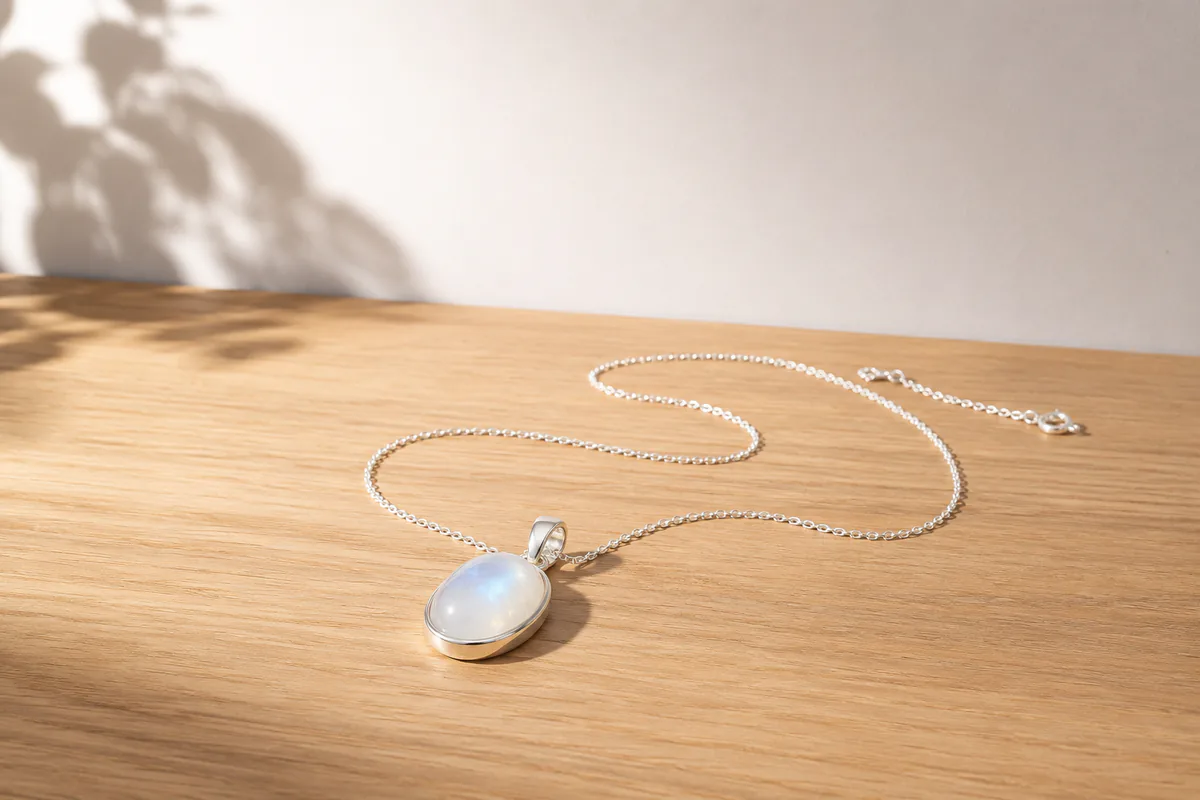
Fingers swell. Swelling in the hands, ankles and feet is common late in pregnancy, and it can set in quickly. A ring that slid on easily in month six can become impossible to remove in month eight. That's problem number one, and it's a mundane one.
Take off fitted rings early. The right time isn't when the ring is tight, it's when you start to feel your fingers changing. Put it away, wear it on a chain around your neck if it matters to you, and put it back on afterward. If a ring is already tight, run your hand under cold water, use soap, and twist it while pulling gently. If the finger tingles, changes colour or stays numb, that's no longer a jewellery problem: call your midwife or your doctor.
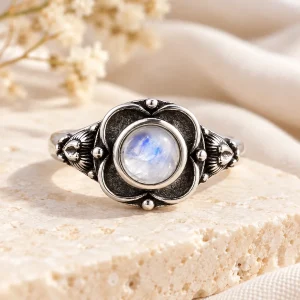
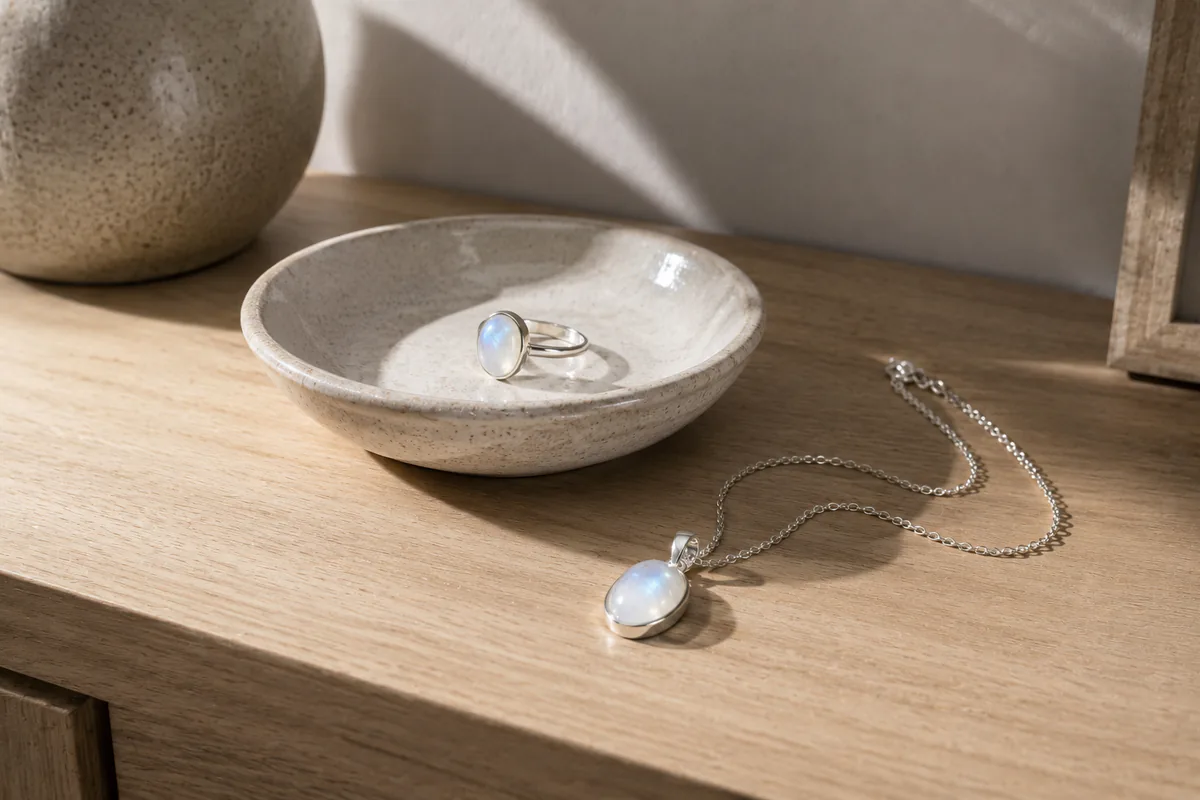
This point isn't trivial for a moonstone ring in particular. A stuck ring sometimes ends up cut off, and a stone with perfect cleavage doesn't take kindly to a ring cutter's vibrations. The stone's actual fragility is detailed in is moonstone fragile.
Skin changes too. Some people become more reactive to metals during pregnancy, or become reactive for the first time because of it. Sterling silver is alloyed with other metals, most often copper, and plated pieces have a base metal and a coating. If you notice redness or itching, remove the jewellery and see a doctor.
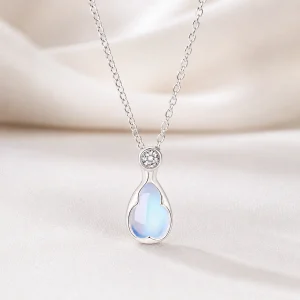
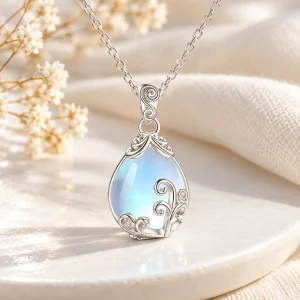
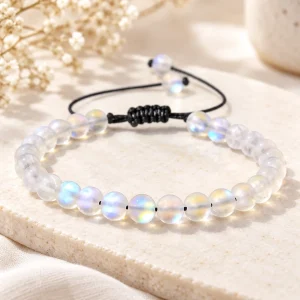
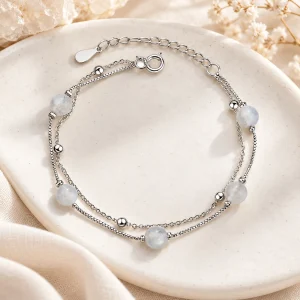
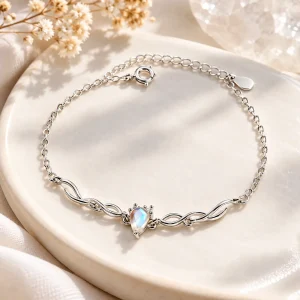
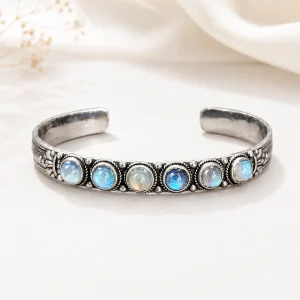
The practical takeaway fits in one sentence: during the last months, the pendant and the bracelet are the untroubled shapes, the ring is the one that causes problems. Wearing questions are detailed in how to wear moonstone and which wrist to wear a bracelet on. For sizing, there's the size guide, and the best advice I can give is to wait until after the birth to get a ring sized to fit you.
One honest note: I don't have pendants in the catalog yet. They're planned, they're just not there, and I'd rather write that than send you to an empty page.
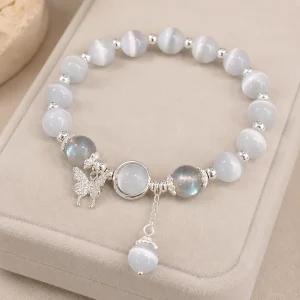
Bracelets, the shape that never gets stuck
At the hospital, and the day itself
A practical point few people plan ahead for, and one that avoids a hassle at the wrong moment.
Hospitals ask you to remove jewellery before delivery, and it's standard procedure before a C-section, which is a surgical operation. Hospital guidelines target rings, wedding bands, bracelets, chains and piercings.
The reasons are concrete and have nothing administrative about them. Jewellery is a germ reservoir. It gets in the way of the care team's movements and can throw off sensors placed on the skin. And above all, a delivery room can turn into an operating room at any moment: hospital recommendations explicitly target patients admitted to the delivery room who might need emergency intervention involving an electrosurgical device. A metal ring has no business being there.
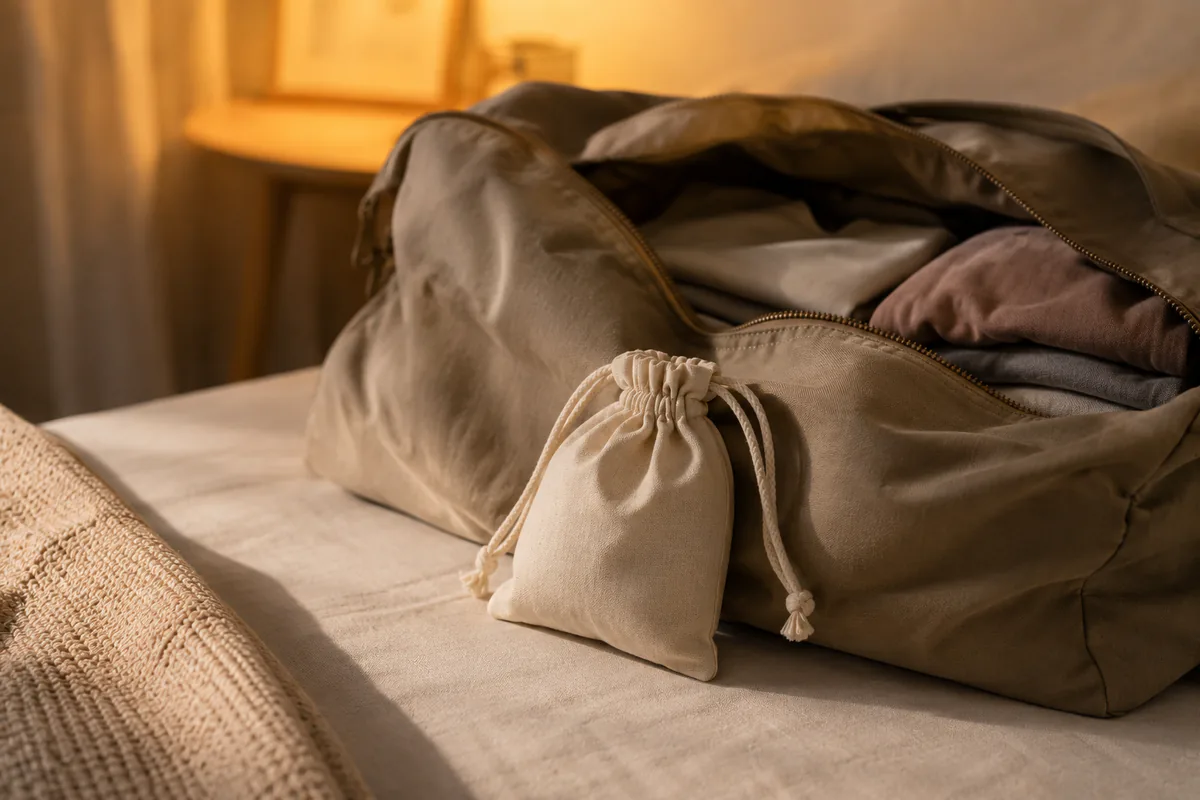
The useful move: put your jewellery in a small closed pouch, inside your bag, before you leave. Not in a pocket, not on the nightstand. And if a ring won't come off, mention it to the care team when you arrive rather than at the last minute: that's exactly what the protocols ask for.
Amber necklaces, this page's real warning
Here is the only section on this site where I'm not reporting a belief: I'm relaying the opinions of health authorities. This topic comes up in almost every pregnancy, often through a well-intentioned gift.
The amber teething necklace has been sold for years as a way to soothe an infant's teething pain. Two things are established, and they point the same way.
Effectiveness has never been shown. A search of the scientific literature finds no study establishing it. In 2011, France's ANSM medicines agency banned eight advertisements for these necklaces, which carried health benefit claims that couldn't be substantiated. In 2012, France's DGCCRF consumer protection authority forced a company to withdraw a claim that amber was recognised for soothing babies' teething pain.
The danger, on the other hand, is documented. It's twofold: strangulation, when the necklace gets caught, and ingestion or inhalation of beads when it breaks. In 2015, a DGCCRF investigation identified 28 dangerous bracelets and necklaces on these grounds. France's Society of Pediatrics warned parents as early as 2012. And to give a sense of the scale of the strangulation risk in young children, all necklaces and chains combined, a pediatric emergency department recorded thirty child deaths by strangulation in 2003 alone.
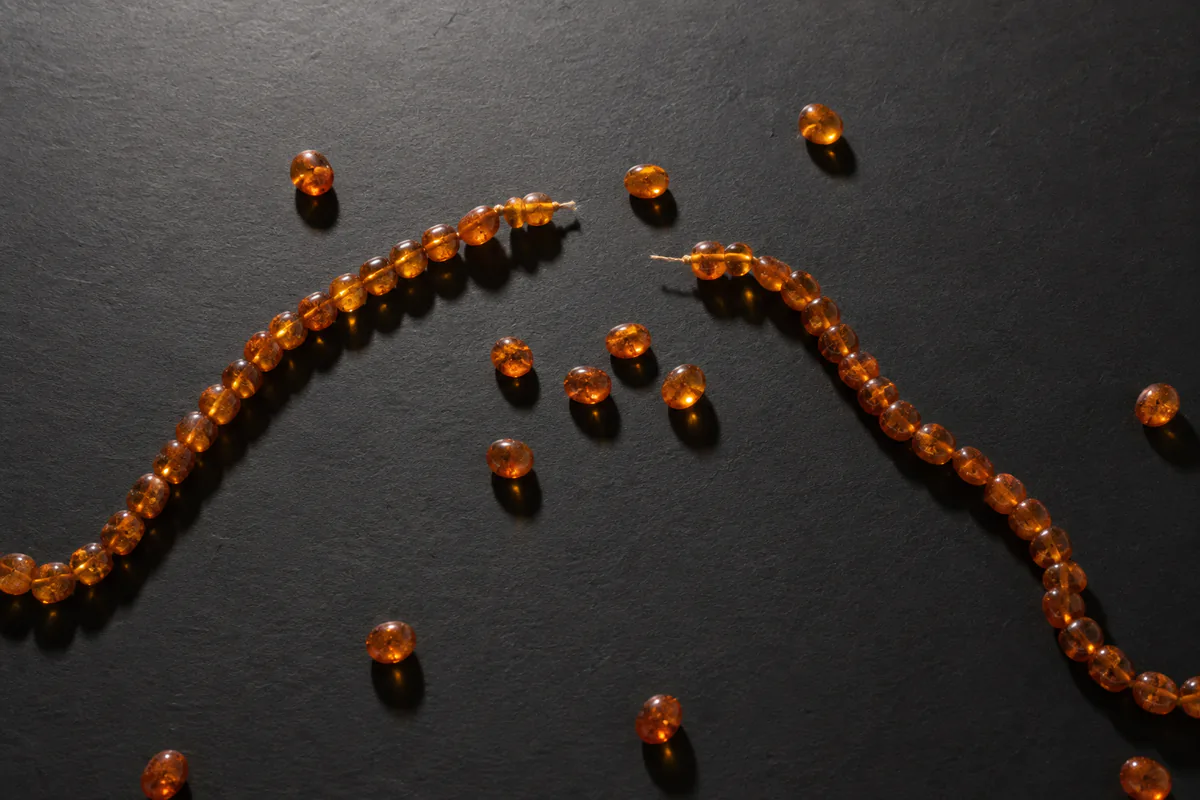
My position is therefore simple, and it applies to what I sell too: no necklace, amber or otherwise, should ever be worn by an infant, not at night, not under supervision, and not shortened into an anklet. There's no safe version of this object.
After birth: beads, chains and small hands
The logical follow-up, and it concerns your own jewellery more than the child's.
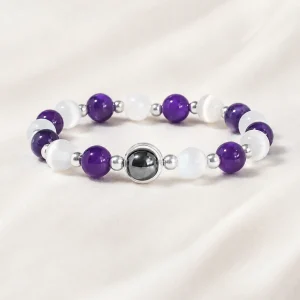
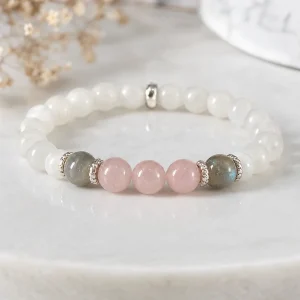
A beaded bracelet is a risky object within reach of a baby. The studio's beaded bracelets are strung on elastic cord, which is a wear part: it lasts one to three years depending on use, then needs restringing. A worn elastic that gives way near an infant means twenty eight-millimetre beads on the floor. An eight-millimetre bead fits in a child's mouth.
Chains get pulled. A pendant attracts a small hand, and a small hand pulls hard. A clasp that gives way is good news in this specific case, but it's better not to get there at all: many people put their pendants away during the first months of babywearing and breastfeeding, and bring them back out later.
The gesture that settles the matter: store beaded bracelets out of reach, up high or in a closed box, and have the elastic checked once a year. Routine care is in how to clean a piece of moonstone jewellery.
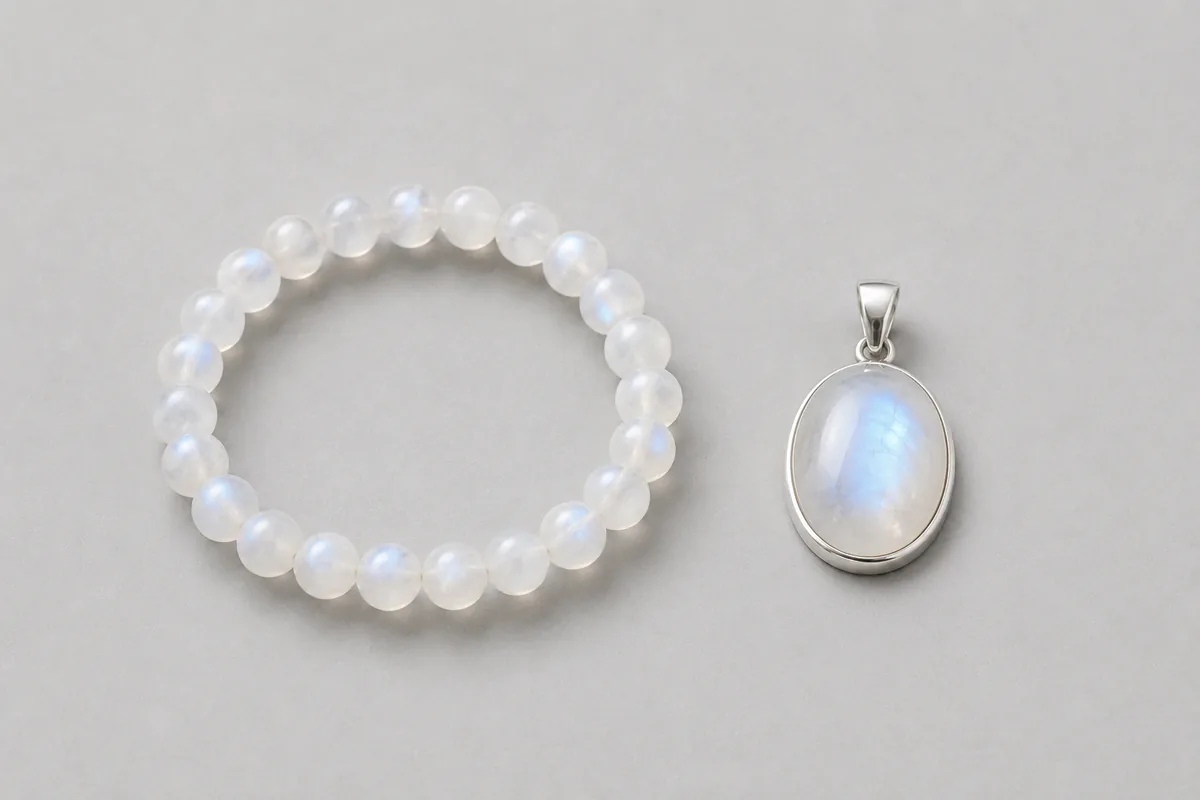
Giving jewellery to a pregnant woman
People write to me about this often, and it's a gift that works well as long as you avoid two traps.
The first trap is the ring. It's the gift people picture first, and it's the only one that risks not being wearable, or getting stuck. A pendant or a bracelet always works. If you're set on a ring, give it with the idea that it will be sized after the birth.
The second trap is the message. Jewellery given with "this will protect you" or "this helps with the birth" turns a gift into a promise, and puts the person in an uncomfortable position if the pregnancy doesn't go well. "I was thinking of you" is more than enough, and it's what people remember anyway.
What the gesture says, without promising anything, is developed in the meaning of moonstone and giving a moonstone. And if you're unsure which piece to choose, write to me rather than guess.
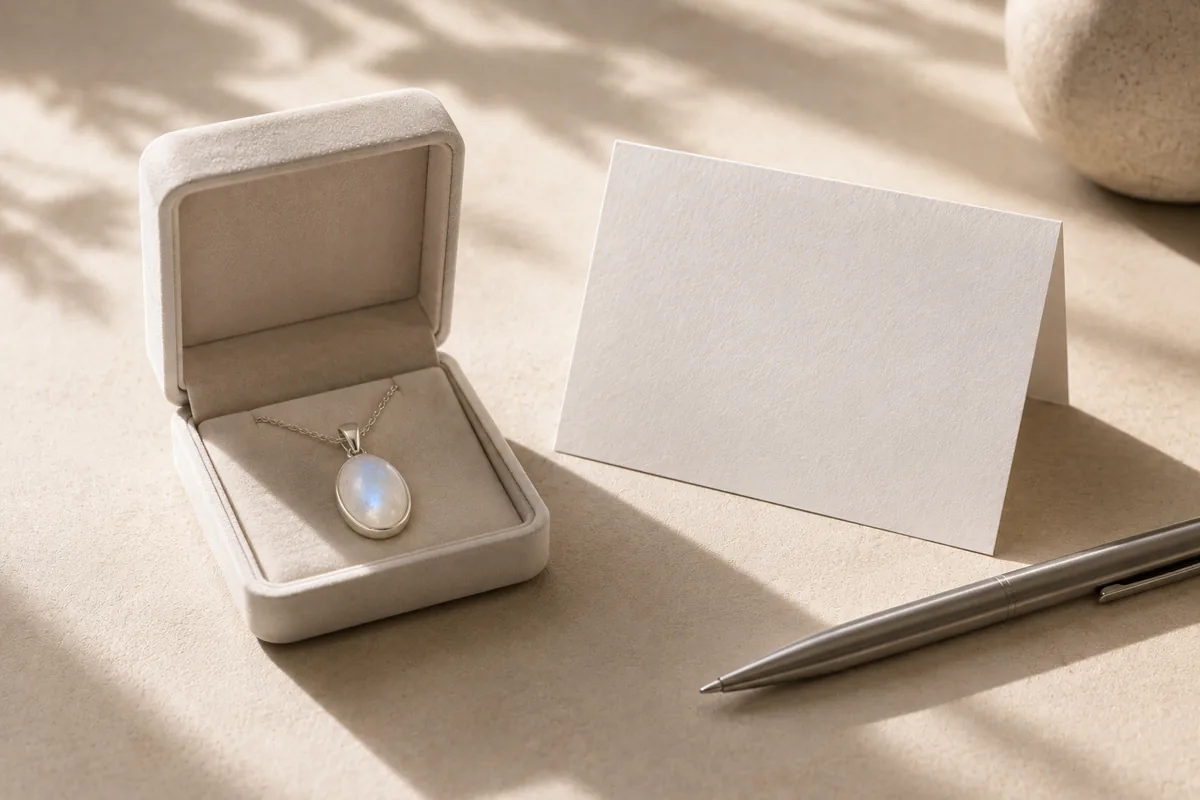
What you can wear worry-free during the last months
Frequently asked questions
What crystals are best for pregnancy?
Tradition mostly cites moonstone, rose quartz, amethyst, jade and unakite. None has an effect, good or bad: these are recent correspondences, and a pregnancy is followed medically, not by a piece of jewellery.
Are there stones not recommended during pregnancy?
No, and the lists that circulate should be read with suspicion. Claiming a stone "triggers contractions" is a medical claim with no reference behind it. A stone with no effect cannot have an adverse effect.
Can you wear a ring while pregnant?
Yes, but take it off early. Fingers commonly swell late in pregnancy and a ring can get stuck. The right time is as soon as you feel your fingers changing, not when the ring gets tight. Wear it on a chain in the meantime.
What do you do if a ring is already stuck?
Run your hand under cold water, use soap, then twist the ring while pulling gently. If the finger tingles, goes numb or changes colour, that's no longer a jewellery problem: call your midwife or your doctor.
Do you have to remove jewellery for delivery?
Yes. Hospitals ask for it, and it's standard before a C-section. A delivery room can turn into an operating room at any moment, and guidelines target rings, bracelets, chains and piercings. Pack a closed pouch in your bag.
Does an amber necklace soothe teething pain?
No, no study establishes that. France's ANSM banned eight advertisements for these necklaces in 2011, and its DGCCRF authority had a claim of this kind withdrawn in 2012. The danger, on the other hand, is documented: strangulation and bead ingestion.
Is an amber necklace worn as an anklet safer?
No. The risk of bead ingestion remains if the cord breaks, and an infant puts their feet in their mouth. There's no safe version of this object.
Can you wear a beaded bracelet around a baby?
Wear it, but store it out of reach when it's not on your wrist, and have the elastic checked once a year. An elastic that gives way near an infant means twenty eight-millimetre beads on the floor, and a bead that size fits in a child's mouth.
Is moonstone linked to motherhood?
Contemporary crystal healing links it to the feminine cycle, by analogy with the lunar cycle. That's a resemblance between names dating from the 1990s, not a property. The detail is in moonstone and fertility.
What jewellery should you give a pregnant woman?
A pendant or a bracelet rather than a ring, which risks not being wearable. And a note that doesn't mention the pregnancy: "I was thinking of you" beats "this will protect you," which turns a gift into a promise.
Where to go next
- Related topics, handled with the same care: moonstone and fertility, periods and the cycle, contraindications.
- The general picture: the properties and benefits, the meaning, the chakras.
- Wearing and caring for it: how to wear it, which wrist, is it fragile, cleaning a piece of jewellery, the size guide.
- Choosing and giving: giving a moonstone, recognising a genuine stone, the complete guide.
The jewellery is in the shop and the bracelets in their collection. If you're unsure about a ring size to give during a pregnancy, write to me: the answer is almost always to wait, and I'll tell you so even if it delays an order.
My sources
For amber necklaces: the fact sheet from Santé.fr, France's public health information service, which notes the absence of any study establishing effectiveness, the ANSM's 2011 ban on eight advertisements carrying unproven health claims, the DGCCRF's 2012 action against a claim of relief from teething pain, its 2015 investigation identifying 28 dangerous bracelets and necklaces for strangulation or suffocation risk, and the Society of Pediatrics' 2012 alert. The figure of thirty child deaths by strangulation in 2003 comes from a pediatric emergency department, all necklaces and chains combined.
For hospital guidelines: recommendations on the surgical management of patients wearing rings and piercings published by a university hospital, which explicitly target patients admitted to the delivery room who might need emergency intervention involving an electrosurgical device.
For late-pregnancy swelling, standard public-facing medical references. I deliberately give no percentage: the figures circulating on this point come from commercial sites, and I haven't found a solid source to back them up.
For dating the attributions, crystal healing guides published between 1985 and 2003, whose list is in the properties of moonstone.
One limitation I own: the "origin" column in the table gives a period rather than a precise date. Dating a belief that circulates is approximate, and what I'm describing is the moment an idea becomes massively present in the texts.
Last updated: August 19, 2026. If you find an error in this article, let me know: I'll correct it and note it.
✦ À porter, à offrir
Découvrez mes créations