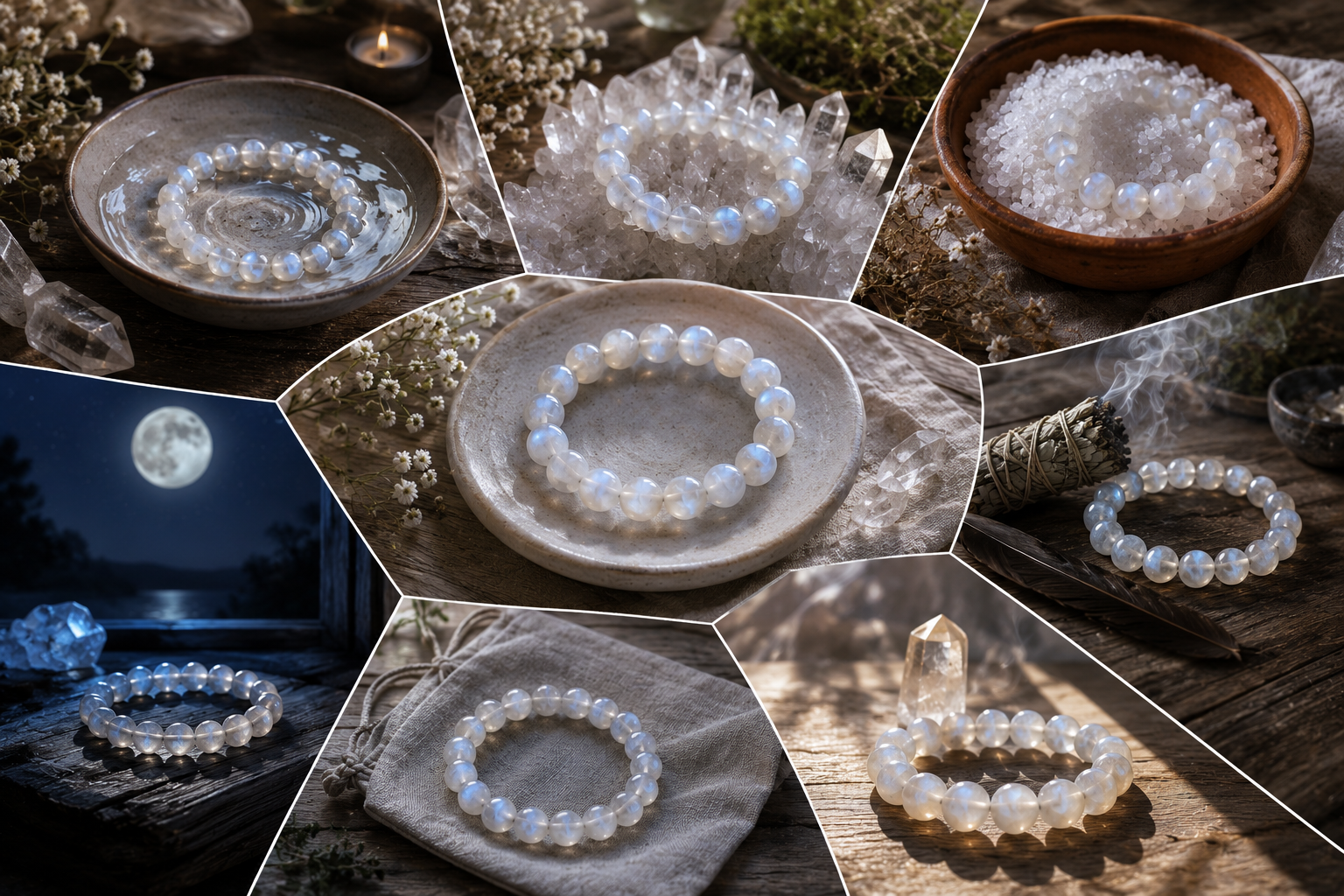
How to cleanse and charge crystals: 7 methods
Water, salt, moonlight, sunlight, incense, quartz clusters, earth. Here are the seven methods, what each one actually does to a crystal, and above all which one suits which. Because the real question isn't "which method works best," it's "which method won't destroy what I'm holding."
I sell moonstone, and this article covers every crystal. That's deliberate: half the damage I see comes from people applying a protocol written for quartz to a feldspar. The specific case of moonstone is covered separately, in how to cleanse and charge moonstone.
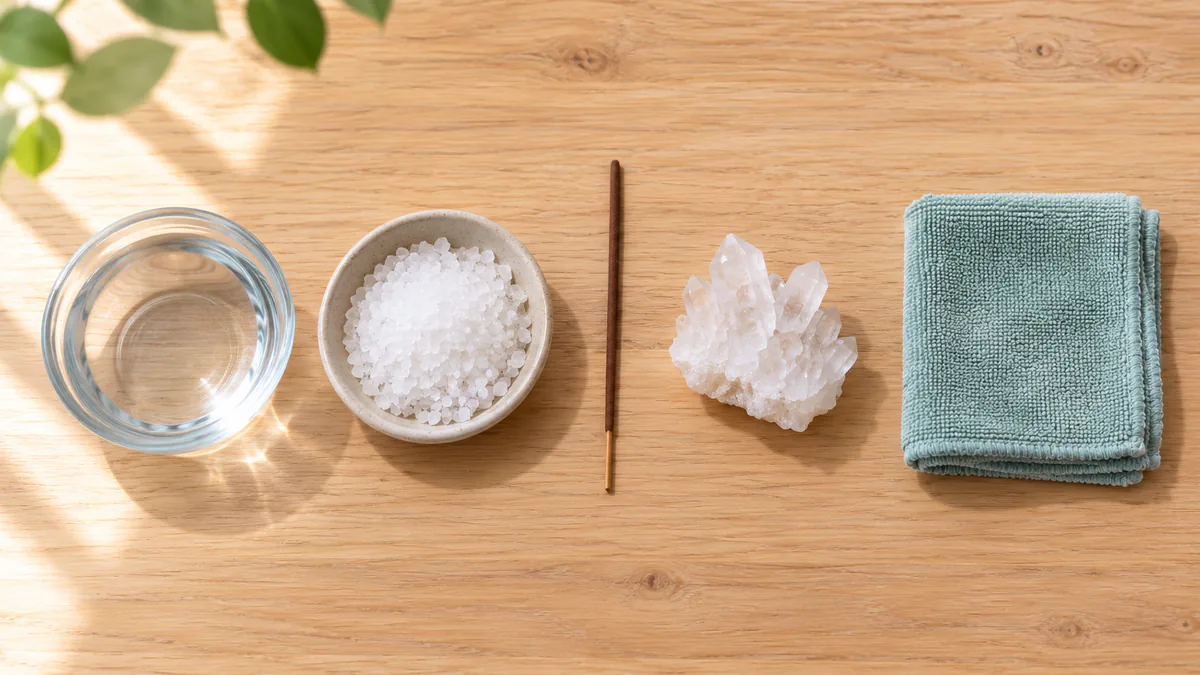
The essentials, if you're in a hurry
- Cleaning, cleansing and charging are three things. The first can be verified, the other two belong to belief.
- Two methods out of seven genuinely damage crystals: salt and earth. A third, sunlight, fades some of them.
- The rule "under 7 on Mohs, no water" is wrong, or at least very incomplete. Hardness measures scratch resistance, not water resistance.
- The real criteria are three: is the crystal soluble, is it porous, does it contain copper or iron.
- Selenite dissolves in water. It's gypsum, and it's the classic beginner mistake.
- Moonlight and incense cost nothing to any crystal. If you want a risk-free ritual, those are the two.
- None of these methods has a demonstrated effect beyond physical cleaning. What I'm sorting here is material risk.
Three words, three different things
The title of this article contains three verbs, and mixing them up is the source of almost every accident.
Cleaning is physical. You remove grease, soap, dust. It's verifiable by eye, and it's written in the indicative. A crystal is clean or it isn't.
Cleansing and charging belong to contemporary crystal healing, which assumes a crystal fills up with use and then needs to be emptied and refilled. Nothing demonstrates this. These notions come from manuals published between 1985 and 2003, whose publication I date in the properties of moonstone, and I write about them in the conditional.
What interests me here isn't settling the belief. It's that the physical gestures themselves are perfectly real. A symbolic protocol carried out with salt, water or earth produces entirely material effects on a mineral. So this article sorts the seven methods by what they do to the crystal, not by what's attributed to them.
The seven methods in one table
Here's the overview. The detail on each method follows, in the order of the table.
| Method | The material risk | Verdict |
|---|---|---|
| Water | Dissolves, causes rust, or penetrates porous stones | Depends on the stone |
| Salt | Corrodes settings, lodges under the setting | Avoid |
| Moonlight | None, except a fall from a ledge | No risk |
| Sunlight | Fades several stones, heats up behind glass | Depends on the stone |
| Incense, smoke | Oily residue on the polish, wipes off | No risk |
| Quartz cluster | Quartz is a 7, it scratches softer stones | With care |
| Earth | Prolonged moisture and dirt in the setting | Avoid |
Only two rows are an unqualified "avoid," and they're the two most recommended online. That's the whole point of this article.
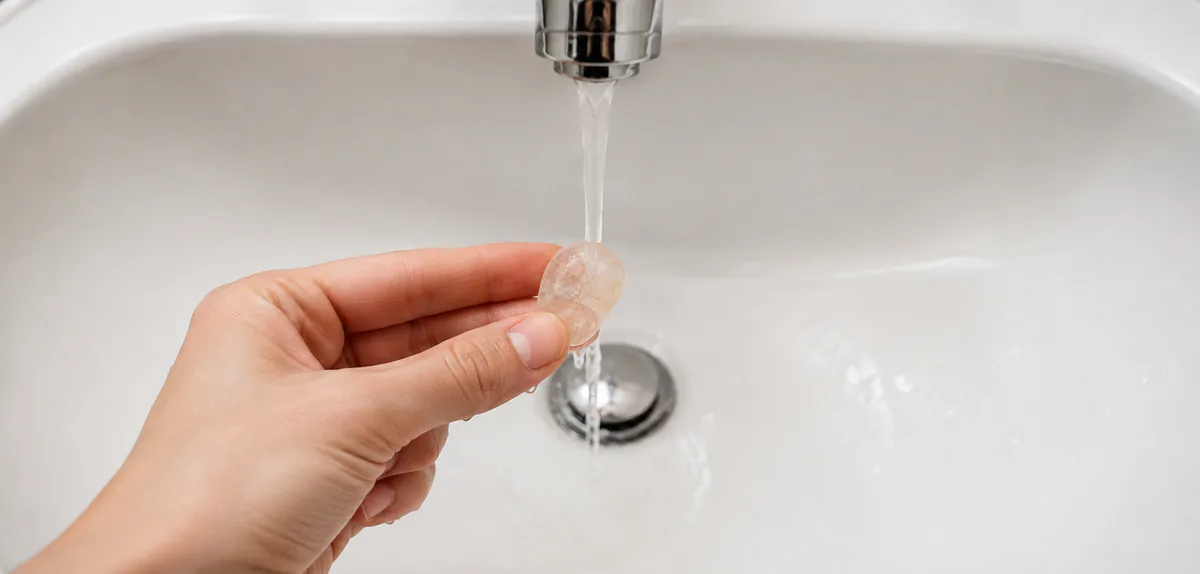
1. Water
The most universal method, and the one that requires the most judgment.
What tradition says. Running water would carry away whatever the crystal had accumulated. Some protocols specify spring water, rainwater or a minimum duration.
What actually happens. A lukewarm rinse removes an oily film, and that's it. The danger depends entirely on the mineral, and the rule going around, "under 7 on the Mohs scale, no water," is a bad rule: hardness measures scratch resistance, not resistance to water. A quartz at 7 and an amethyst at 7 get wet just fine, while a malachite at 3.5 has a chemistry problem, not a hardness one.
The three real criteria are: is the crystal soluble, is it porous, does it contain copper or iron. The list of problem cases is further down.
What I do. Lukewarm water, a drop of mild soap, thirty seconds, not overnight, complete drying. Never hot water: a sharp temperature swing cracks several stone families. The case of water for moonstone has its own article, can moonstone go in water.
2. Salt
The most recommended method on the web, and the one I most firmly advise against.
What tradition says. Salt would absorb. You bury the crystal in coarse salt for several hours, or soak it in salt water.
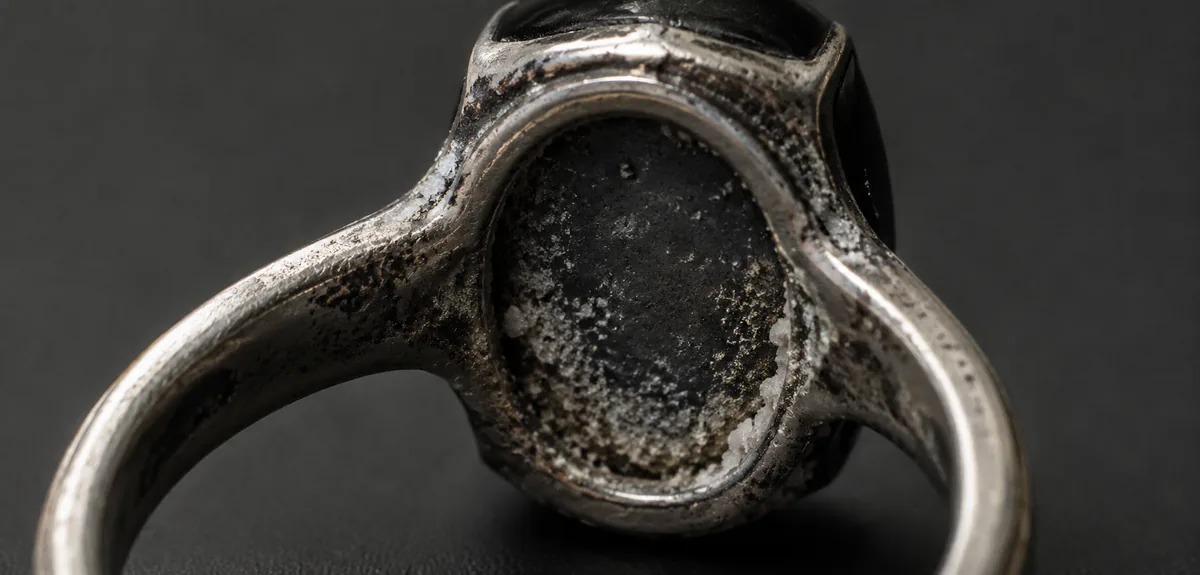
What actually happens, and it isn't what you read. Salt scratches nothing: rock salt sits at 2 or 2.5 on the Mohs scale, softer than almost every crystal. The problem lies elsewhere, and it's threefold. Dissolved salt is an electrolyte that speeds up metal corrosion, sterling silver first in line. The crystals lodge under the setting and in micro-cracks, where they stay. And salt is hygroscopic: it holds moisture against the metal.
On a bare, unset, uncracked stone, dry salt doesn't do much. As soon as there's a setting, a cord, glue or a crack, it causes damage. Since almost everyone is cleansing jewellery rather than raw stones, the practical answer is no.
3. Moonlight
The gentlest method, and the only one I recommend without reservation when people ask.
What tradition says. You expose the crystal to moonlight for a night, preferably at the full moon. It's the most popular method of all, and it has its own article, because the calendar keeps a lot of people busy: when to charge your crystals with the moon.
What actually happens. Nothing measurable. Moonlight is reflected sunlight, roughly 400,000 times less intense than direct sunlight. A crystal left on a ledge for a whole night receives less light than it would in one minute of daylight.
The material risk is zero, and that's what matters here. There's only one precaution, and it's a practical one: place the crystal indoors and away from the edge. The only accident this method causes is a fall from a windowsill, and on a cleavable stone that's unforgiving.
4. Sunlight
A common method, and the one that causes the most irreversible damage without anyone noticing right away.
What tradition says. Sunlight would charge, where moonlight cleanses. Some protocols recommend a few hours, others a full day.
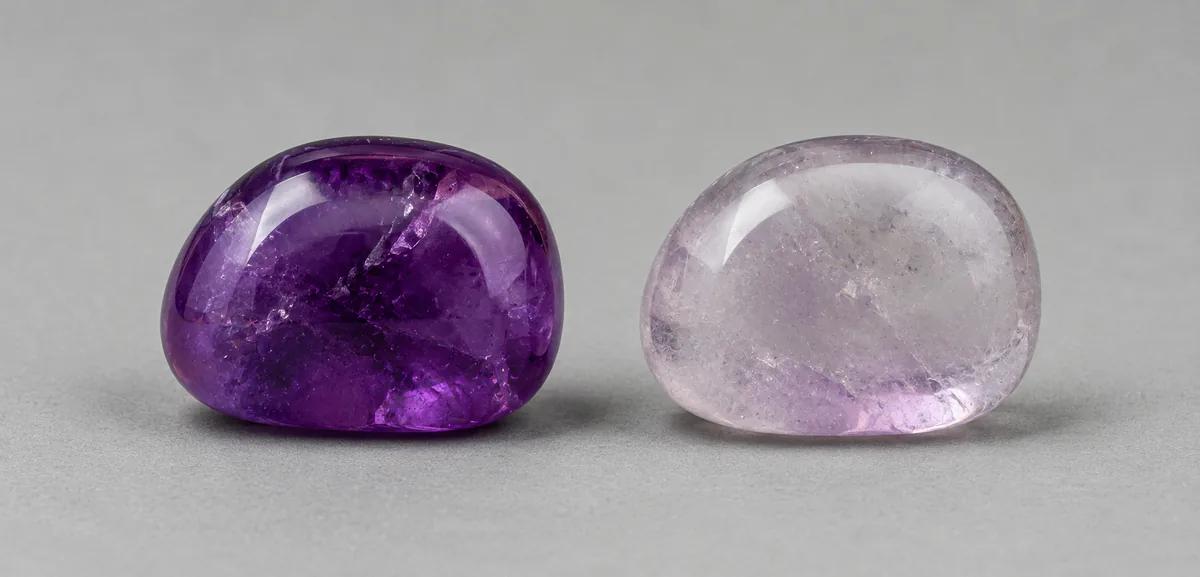
What actually happens. Several crystals fade in light, and it's permanent. Amethyst loses its purple, rose quartz fades, and kunzite, topaz, fluorite and celestite are also sensitive. Opal, for its part, dehydrates and can crack. Repeated exposure behind a window in summer adds a temperature problem on top.
What I do. I don't use this method. If you insist, a few hours of indirect light are enough, never behind a window in full summer, and never with an amethyst or a rose quartz in the mix.
5. Incense and smoke
An ancient method, risk-free, and handy when nothing else is possible.
What tradition says. You pass the crystal through the smoke of incense, sage, palo santo or a wood stick. It's the protocol most used by practitioners, and the oldest of the seven.
What actually happens. Nothing, except a light oily residue on the polish after several passes. It shows up on a well-polished cabochon, wipes off with a soft cloth, and damages nothing.
This is the fallback method par excellence: it suits selenite, which fears water, malachite, which fears water, pyrite, which rusts, and any set piece whose glue you don't know. Ventilate the room, that's the only precaution, and it concerns your lungs rather than your crystals.
6. Quartz clusters
An elegant method, no chemical risk, with a mechanical trap nobody mentions.
What tradition says. You place the crystal on a druse or quartz cluster, sometimes for several hours, sometimes overnight. Quartz would supposedly play a regenerating role.
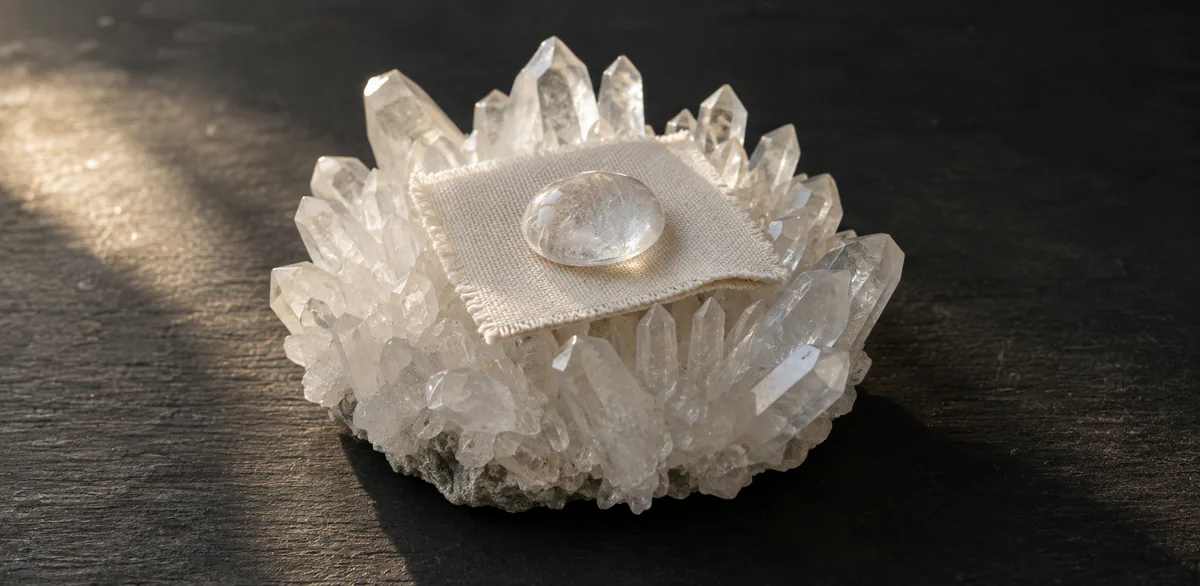
What actually happens. No chemical reaction, no moisture, no risk of fading. But quartz sits at 7 on the Mohs scale, so it's harder than most of the stones set on it. And a cluster is made of points. A moonstone at 6.5, a malachite at 3.5 or a fluorite at 4 placed between two points and shifted twice gets scratched.
The precaution comes down to one gesture: place the stone on the points, flat, without pressing it in or letting it slide between them. Or slip in a square of fabric, which solves the issue without changing anything about the ritual.
7. Earth
The most radical method, and the riskiest one after salt.
What tradition says. You bury the crystal in a pot or directly in the ground, from a few hours to several days, sometimes a full lunar cycle.
What actually happens. Permanent moisture against the metal, which oxidizes silver and attacks glue. Dirt that gets under the setting and never comes back out. Sometimes an acidic pH depending on the soil. And, very concretely, crystals that never get found again, which is the most common failure of this method.
What I do. Never on set jewellery. On a bare, hard, non-porous tumbled stone, the risk is low, but the material benefit is zero.
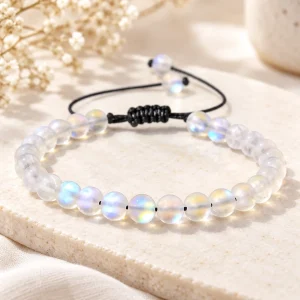
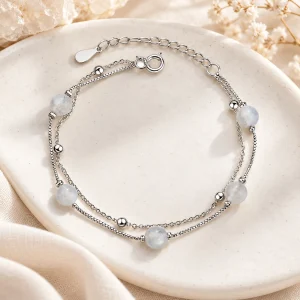
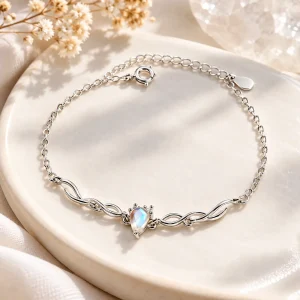
The wire-strung bracelets, the ones that tolerate these protocols the least
The crystals that tolerate almost nothing
Here's the table I was looking for when I started, and couldn't find anywhere.
| Crystal | Why it's a problem | Off-limits |
|---|---|---|
| Selenite | It's gypsum, it dissolves | Water |
| Halite | It's salt, it dissolves | Water |
| Malachite | Copper carbonate, soft at 3.5 | Water |
| Pyrite | Contains iron, it rusts | Water |
| Hematite | Iron oxide, it rusts | Water |
| Turquoise | Porous, it absorbs and stains | Water |
| Lapis lazuli | Porous, and it contains pyrite | Water |
| Opal | Hydrated, it cracks as it dries | Water, sunlight |
| Amethyst | Its purple fades in light | Sunlight |
| Rose quartz | Fades in light | Sunlight |
| Moonstone | Cleavage, poor toughness | Ultrasonic cleaner |
A note on method regarding this table. Hardness barely shows up in it, and that's deliberate: it poorly explains these cases. Malachite is soft, but its problem is copper. Pyrite is harder than malachite, and yet it rusts. Opal sits at 5.5 to 6.5, above the threshold quoted everywhere, and it's the most fragile of the bunch against water.
So remember the three real questions: soluble, porous, metallic. They explain ten of the eleven rows. The eleventh, moonstone, is a different matter, cleavage, and that's covered in is moonstone fragile.
Choosing, in three questions
You don't need to know all eleven special cases. Three questions are enough to choose a safe method for any crystal.
First question: is it set? If so, rule out salt and earth, whatever the crystal. It's no longer the mineral that decides, it's the metal, the glue and the cord.
Second question: do you know what it is? If you can't identify the crystal with certainty, use incense or moonlight. Those are the two methods that can't break anything, and they cover every case.
Third question: is it coloured purple or pink? If so, rule out sunlight. That's the family that fades, and the damage is permanent.
With these three answers, you're always left with at least two workable methods. If this is your first crystal, there's an article made for that, getting started with crystal healing, and for combining several crystals on one piece of jewellery, which crystal to pair with moonstone gives the hardness chart.
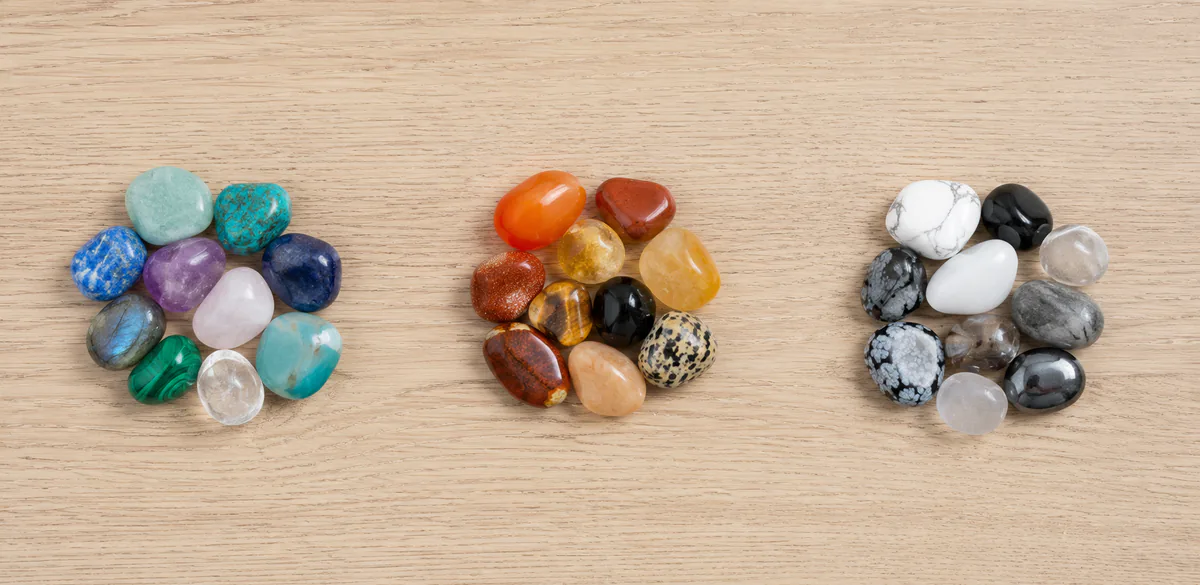
The notions of cleansing and charging belong to crystal healing, an approach based on tradition and belief. They do not constitute a medical claim and never replace the advice of a health professional. Read the full disclaimer.
The workshop's rings, care card included in the package




Frequently asked questions
What's the best method to charge crystals?
There isn't a best one, there are safer ones. Moonlight and incense carry zero material risk for any crystal. Salt and earth are the two to rule out, and sunlight fades several families.
Can you put every crystal in water?
No. Selenite and halite dissolve, pyrite and hematite rust, malachite releases copper, turquoise and lapis absorb liquid, opal cracks. The rule "under 7 on Mohs, no water" is too simple: hardness measures scratch resistance, not resistance to water.
Why advise against salt when it's recommended everywhere?
Because almost everyone is cleansing jewellery, not raw stones. Dissolved salt corrodes silver, and the crystals lodge under the setting and hold moisture against the metal. It isn't the stone that fails first, it's what holds it.
How long should you leave a crystal in moonlight?
Tradition says one night. Materially, the duration doesn't matter at all: moonlight is roughly 400,000 times less intense than direct sunlight. The only precaution is placing the crystal indoors and away from the edge.
Does sunlight really damage crystals?
Several, yes, and permanently. Amethyst, rose quartz, kunzite, topaz, fluorite and celestite fade in light. Opal dehydrates and cracks. A window in full summer adds a temperature problem.
Can a quartz cluster damage a crystal?
Mechanically, yes. Quartz sits at 7 on the Mohs scale, harder than most crystals placed on it, and a cluster is made of points. Set the crystal flat on the points without pressing it in, or slip in a square of fabric.
Do you need to cleanse a new crystal?
Nothing requires it. What is useful, though, is a pass through soapy water: a stone fresh from the workshop sometimes carries a residue of polishing compound, and that part shows and comes off.
What should I do if I don't know what my crystal is?
Incense or moonlight. Those are the two methods that can't break anything, whatever the mineral. It's also the right reflex for a piece of jewellery whose setting or glue type you don't know.
How often should you do this?
For cleaning, when it's dirty. For cleansing, no frequency has more grounding than another. One material note: the more you handle a piece of jewellery, the more you drop it, and many crystals crack on impact.
And moonstone specifically?
Warm soapy water and a soft cloth, never salt, never ultrasonic, never steam, never hot water. The detail and the reasons are in how to cleanse and charge moonstone.
Where to go next
- The moonstone case: cleansing it without damage, cleaning a piece, the water question, is it fragile.
- Moonlight in detail: the lunar calendar for charging.
- Several crystals together: pairings and hardness, ones to avoid.
- The belief framework: the properties and their dating, the chakras, getting started with crystal healing.
- Recognising what you have: recognising a genuine stone, the mineral profile, the complete guide.
The jewellery is in the shop, and every package ships with a care card. If you have a crystal you can't identify, send me a photo: I'm not a gemmologist, but I know how to recognise a feldspar, and I'll tell you honestly when I don't know.
My sources
For the properties of the minerals mentioned: Mindat and the GIA for hardness, solubility and composition. Selenite is a soluble gypsum; malachite a copper carbonate at 3.5 to 4; pyrite an iron sulfide that oxidizes; opal a hydrated silica prone to cracking through dehydration.
For the light sensitivity of amethyst, rose quartz, kunzite, topaz and fluorite, the standard gemmological care sheets, which all recommend avoiding prolonged exposure.
For the comparison of light intensities: full moon light is roughly 0.1 to 0.3 lux, against about 100,000 lux in direct sunlight, a ratio of about 400,000. That's a common astronomical figure, tied to the moon's albedo of roughly 12%.
For moonstone: the GIA's Moonstone Care and Cleaning sheet, which rules out ultrasonic and steam cleaners without qualification.
Two limitations I'll flag. First, the "verdict" column in the first table is my own judgment, based on material risk rather than assumed effectiveness: it says nothing about the value of these methods as rituals. Second, the table of sensitive crystals isn't exhaustive: I kept the eleven cases I actually encounter, and there are others.
Last updated: August 19, 2026. If you find an error in this article, let me know: I'll fix it and note it.
✦ À porter, à offrir
Découvrez mes créations