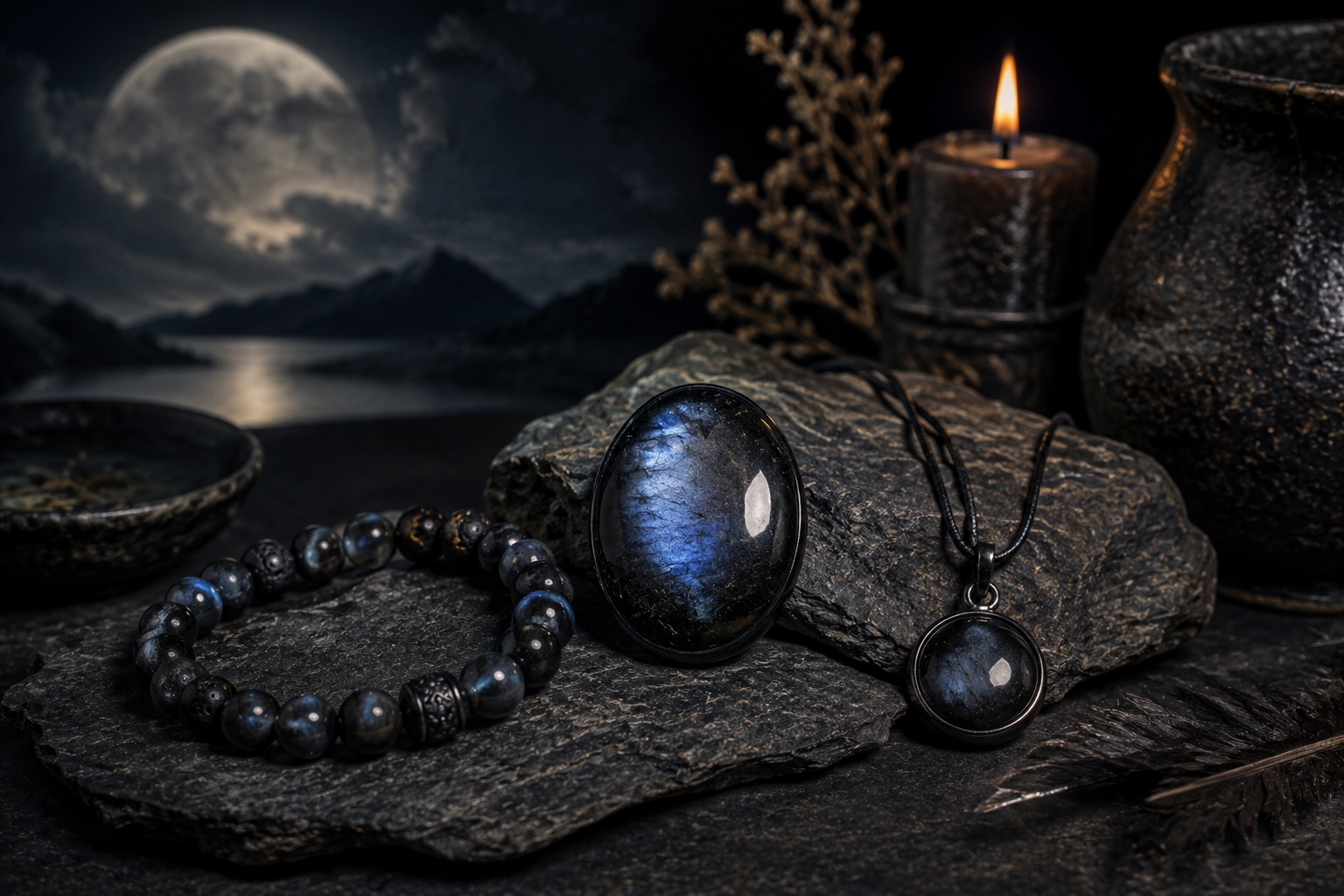
Black moonstone: meaning and properties
Grounding, protection, the kept-back part: here's what tradition attributes to black moonstone. And something I've never read anywhere else, which changes how you should read the whole list: none of these attributions actually belong to it. It inherits them three times over, from its name, its species and its colour.
It's the variety people write to me about the most, right after the blue one, and the one whose profile is the most inaccurate everywhere else. So let's start with what it actually is, because that decides half of what gets attributed to it. For the properties of moonstone in general, see here; for the jewellery, see the collection.
The essentials, if you're in a hurry
- It's not adularia, it's labradorite. A plagioclase feldspar, a cousin of classic moonstone but not the same species.
- It's credited with grounding and protection, where the white one is tied to gentleness and beginnings.
- None of these attributions are specific to it. It inherits them from its species, its colour and its name, never from itself.
- The protection comes from labradorite, whose classic reputation this is. The black one inherits it because it is one.
- The grounding comes from the colour. In crystal healing, almost every black stone gets the same thing: obsidian, tourmaline, onyx, hematite.
- All of it is recent, like the rest of these correspondences: the manuals that fixed them date from 1985 to 2003.
- Three stones are sold under this name without being it: Norwegian larvikite, dyed onyx and black opalite.
Three inheritances, and none of them its own
Here's the key to reading this whole article, and I'm putting it before the lists rather than after.
When you read that black moonstone "brings grounding and protection," you're actually reading the sum of three things that have nothing to do with each other:
- What it gets from its species. It's a labradorite, and labradorite has its own reputation, that of a filter and a shield.
- What it gets from its colour. Black mechanically triggers the same attributions in every manual, whatever the stone.
- What it gets from its name. It's called moonstone, so it picks up the lunar attributions along the way, cycles and intuition included.
Nothing is left. None of these attributions comes from an observation made on this specific stone. That's not an accusation: it's how a system that reasons by correspondence normally works, and it's better to know that when reading a list than to believe it describes a particular object.
The three sections that follow take the three inheritances one by one, and the table further down puts them back together, column by column.
The first inheritance: it's a labradorite
Let's start with the fact, in the indicative, because it can be verified.
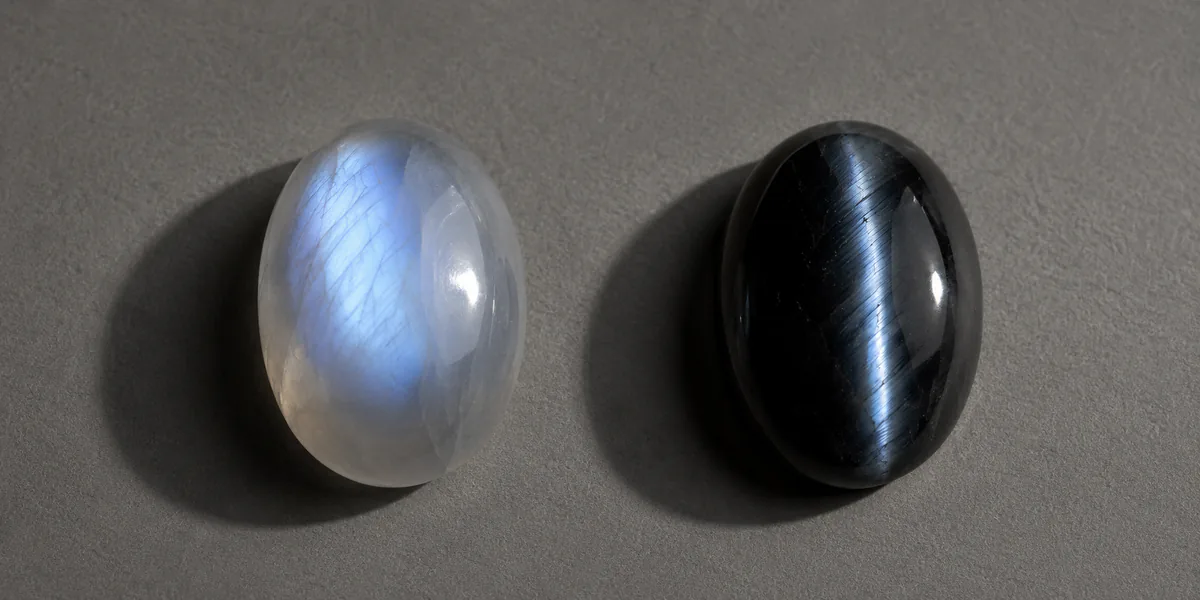
Classic moonstone is an orthoclase, called adularia, a potassium feldspar. Black moonstone is a labradorite, a plagioclase feldspar. The GIA and Mindat classify them separately, as does the International Mineralogical Association. They're two branches of the same large family, not the same species.
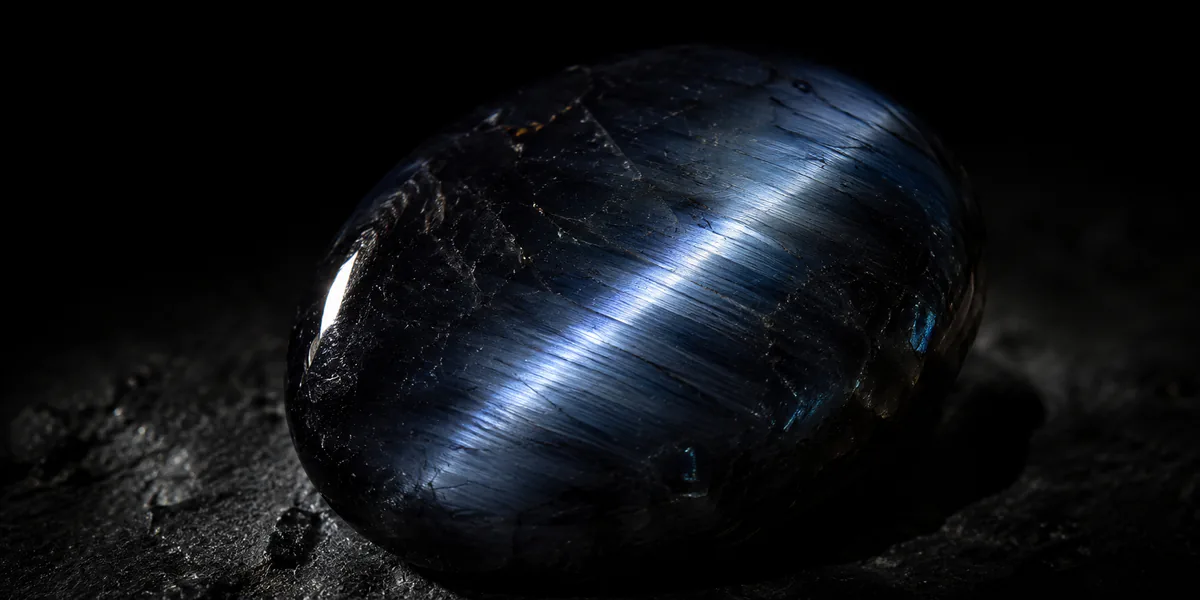
The play of light isn't the same either, and it shows. Adularia produces adularescence: a diffuse, bluish veil that seems to float beneath the surface. Labradorite produces labradorescence: sharper, more contrasted flashes, sometimes coloured, that switch on and off distinctly depending on the angle. Against a dark ground, these flashes come out silver or steel blue. The full breakdown is in moonstone or labradorite.
Now to the register of tradition, in a separate paragraph. Labradorite is, in crystal-healing manuals, the protection stone par excellence: it's presented as a filter, a shield, something that sorts what gets through. It's its most consistent attribution, well ahead of the others.
The consequence is direct. When you're told a black moonstone protects, you're being told, without anyone realizing it, what's been said about labradorite for forty years. That's not false in the sense that tradition genuinely says it: it's just that it isn't talking about moonstone.
The second: the rule of black stones
Second inheritance, and the one I find most revealing.
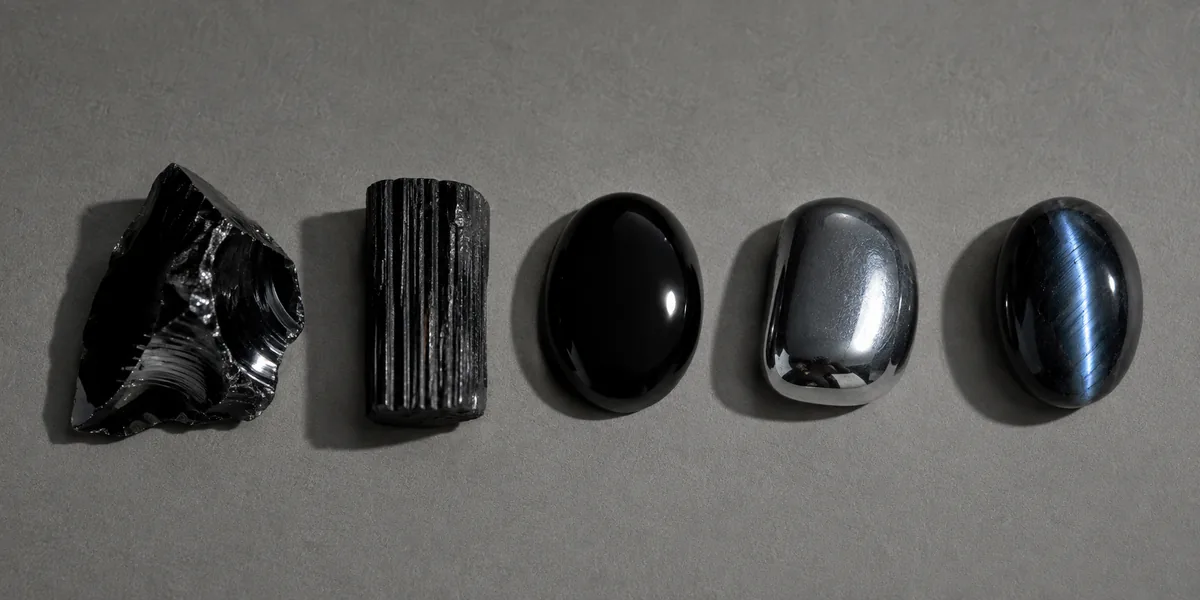
Look at what crystal healing attributes to other black stones. Obsidian: grounding and protection. Black tourmaline: grounding and protection. Onyx: grounding and protection. Hematite: grounding and protection. Jet, shungite, black spinel: the same thing.
These stones have nothing in common, though. A volcanic glass, a borosilicate, a chalcedony, an iron oxide, fossilized lignite, a carbon, an oxide. Composition, hardness, formation, origin: everything differs. The only thing they share is being dark.
The test fits in one sentence, and it's unanswerable: if black moonstone were any other black stone, it would be credited with exactly the same properties. So this isn't a description of this stone, it's a palette rule.
The same logic explains the chakra it gets associated with. Classic moonstone is filed under the third eye, the black one under the root chakra, which is red and dark in the modern chart. Here again, it's the colour that decides, not the stone. How these charts were built, and their exact date, are in moonstone and chakras.
The third: what its name drags along
Third inheritance, the most discreet and the most stubborn.
Because it's called moonstone, this stone picks up the lunar attributions along the way: cycles, intuition, the body's rhythms. You'll find them on plenty of black moonstone profiles, even though they come from a chain of analogies built on white adularia, a stone this one doesn't belong to.
The chain, for the record: the lunar cycle lasts twenty-nine and a half days, the menstrual cycle a similar length, the stone carries the Moon's name. It's a resemblance between names, not a property, and I detail it in the properties of moonstone. Add that moonstone has no real connection to the celestial body, as told in piece of the Moon or moonstone, and you get an attribution inherited from a name that is itself a metaphor.
In other words: black moonstone is associated with the feminine cycle because a different stone, of a different species, happens to share its trade name. It's worth saying that slowly to really hear it.
What it's credited with, line by line
Here's the full list of what circulates, with the real source of each attribution. The middle column is the one that matters.
| What it's credited with | Inherited from | Since |
|---|---|---|
| Protection, filtering | Labradorite, its species | 20th century |
| Grounding | The colour black | 20th century |
| The kept-back part, the night | The colour black | 20th century |
| The root chakra | The colour black | 20th century |
| A shield against overflow | Labradorite, its species | 1980s |
| Cycles, the feminine | The name moonstone | 1990s |
| Intuition | The name moonstone | 20th century |
Read the middle column from top to bottom. It never contains "black moonstone." Seven attributions, three sources, zero that come from the object being discussed.
And the right-hand column says the rest: none of it is forty years old. These correspondences come from English-language crystal manuals published between 1985 and 2003, whose publication I date in the properties of moonstone.
I'll clarify what this table doesn't say, because the nuance matters. It doesn't say these beliefs are illegitimate, nor that people who recognise themselves in them are wrong about themselves. It says where they come from. A recent tradition is still a tradition; a borrowed tradition is still a borrowed tradition.
These correspondences belong to crystal healing, an approach based on tradition and belief. They do not constitute a medical claim and never replace the advice of a health professional. Read the full disclaimer.
Its meaning, and the oxymoron of its name
Meaning is a different question from properties: it's what the stone says, not what it's believed capable of doing. The distinction is developed in the meaning of moonstone.
What the black one says is, for once, a bit cleaner. It carries the tension between two things that shouldn't coexist: a dark ground and a light that runs through it. Where the white one evokes a veil laid over something clear, the black one evokes a glow piercing something opaque. It's a different symbol, and it holds up without any correspondence chart at all.
That's also why they get given at different moments. The white one goes with beginnings. The black one goes more with what's being gotten through: a period you're coming out of, a decision made in doubt, a hard stretch. None of that is written in any manual, it's what the people who order it from me tell me.
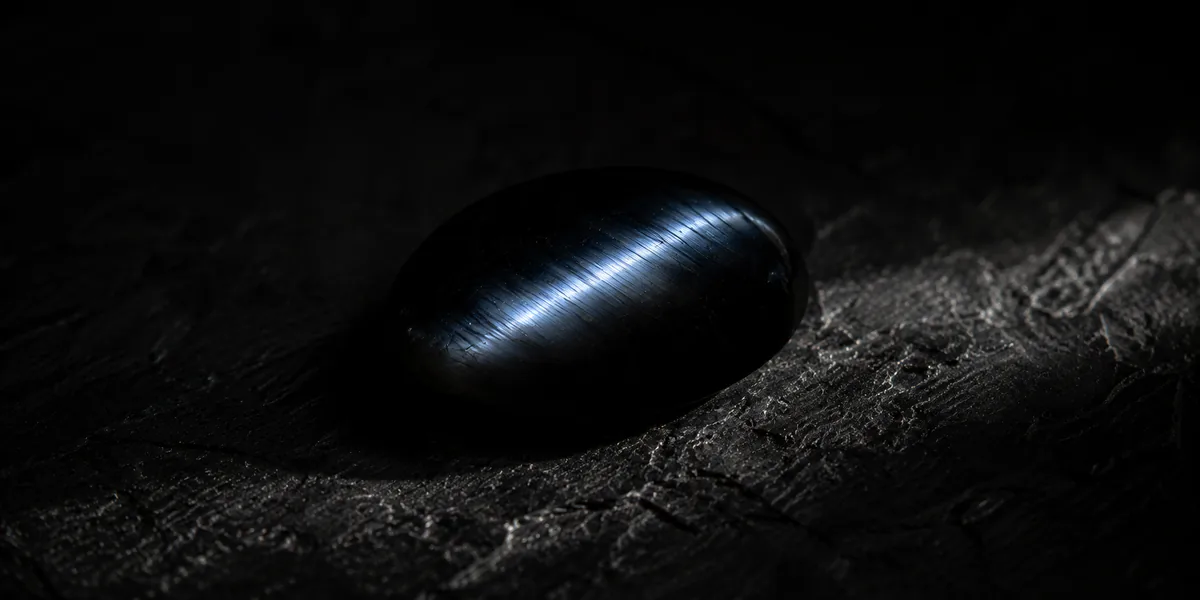
What remains is the name itself, which is nearly an oxymoron. A moonstone takes its name from moonlight, that is, a pale light; calling it black amounts to describing a dark moonlight. The trade adopted it anyway, because the stone genuinely is a feldspar with a play of light, and the public searches for it under that name. I use it for the same reason, and I specify the species every time.
The rainbow variety, and the species written on the listing
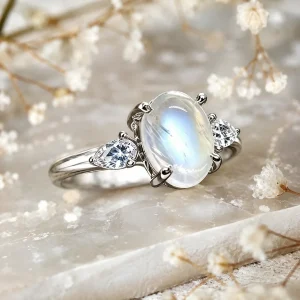
Three black stones sold under this name
It's the variety easiest to fake, because a dark stone with flashes can be made several ways. Three cases circulate, and the first one even surprises sellers.
Larvikite. A Norwegian rock from the Larvik region, commonly sold under the names black moonstone, Norwegian moonstone or black labradorite. It has beautiful silvery flashes in scale-like flecks, and it is neither moonstone, nor labradorite, nor even a gem: it's an igneous rock, a monzonite, rich in feldspars. It can be identified by its grainy look, in small scattered flecks within a grey matrix, where labradorite shows continuous flash zones.
Dyed onyx or agate. A flatly black, uniform stone, with no play of light at all. It's the easiest to rule out: tilt it, and absolutely nothing happens.
Black opalite. Tinted glass. The flash is too regular, too milky, and it stays stuck to the surface instead of moving. Opalite has its own article, and it earns it.
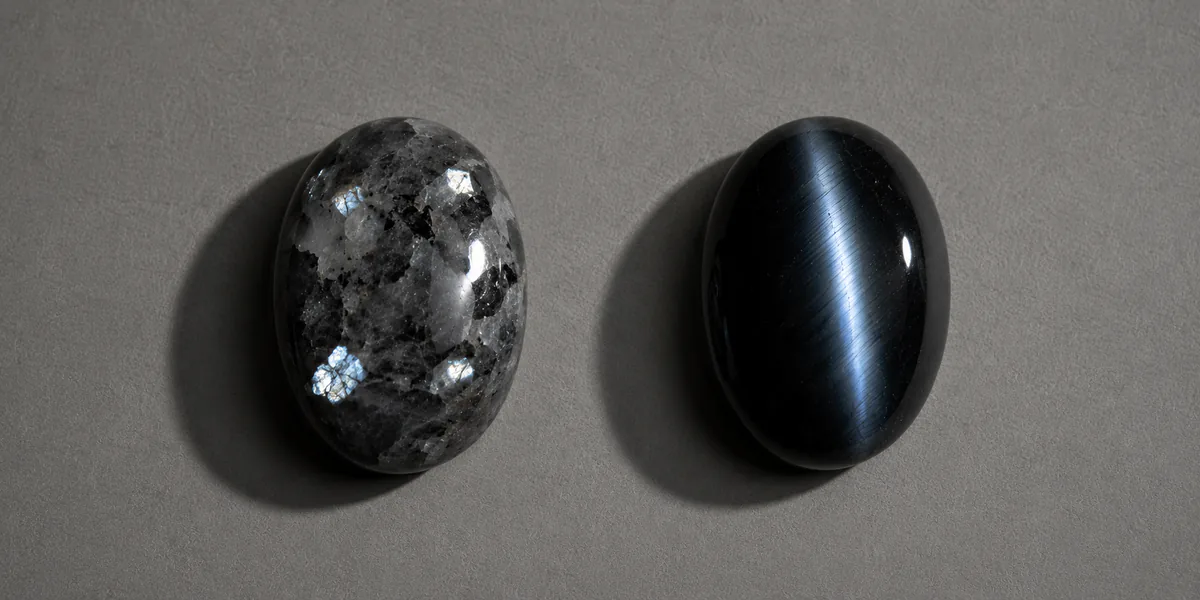
The test that settles it needs no equipment: tilt the stone slowly under a lamp. On a real labradorite, the flash moves and switches off depending on the angle, because it originates in internal lamellae. On an imitation, the shine follows your eye without moving. The other five tests are in recognising a genuine moonstone, and the quality criteria in judging moonstone quality.
Wearing it, choosing it, caring for it
Back to the indicative, and to what I actually know.
Labradorite has exactly the same constraints as adularia: 6 to 6.5 on the Mohs scale, and perfect cleavage. It doesn't scratch easily, it splits cleanly under impact, along internal planes. The difference between hardness and durability is explained in the properties of moonstone, and its consequences in is moonstone fragile.
Three habits follow from this, the same as for the whole family. A bracelet is the least exposed setting, a ring the most exposed. Take off jewellery for sports, cleaning and gardening. Store pieces separately rather than in a pile. The detail by family is in how to wear moonstone.
On care: never salt, never prolonged soaking, never ultrasonic cleaners, whose vibrations find the cleavage planes. Cleaning a piece and compatible cleansing methods cover the rest in detail.
A real advantage of the black one, and I've never seen it written anywhere: its dark ground hides micro-scratches and wear marks far better than a milky white stone. For the same amount of use, it visually ages better. That's a concrete argument, and it asks you to believe in nothing.
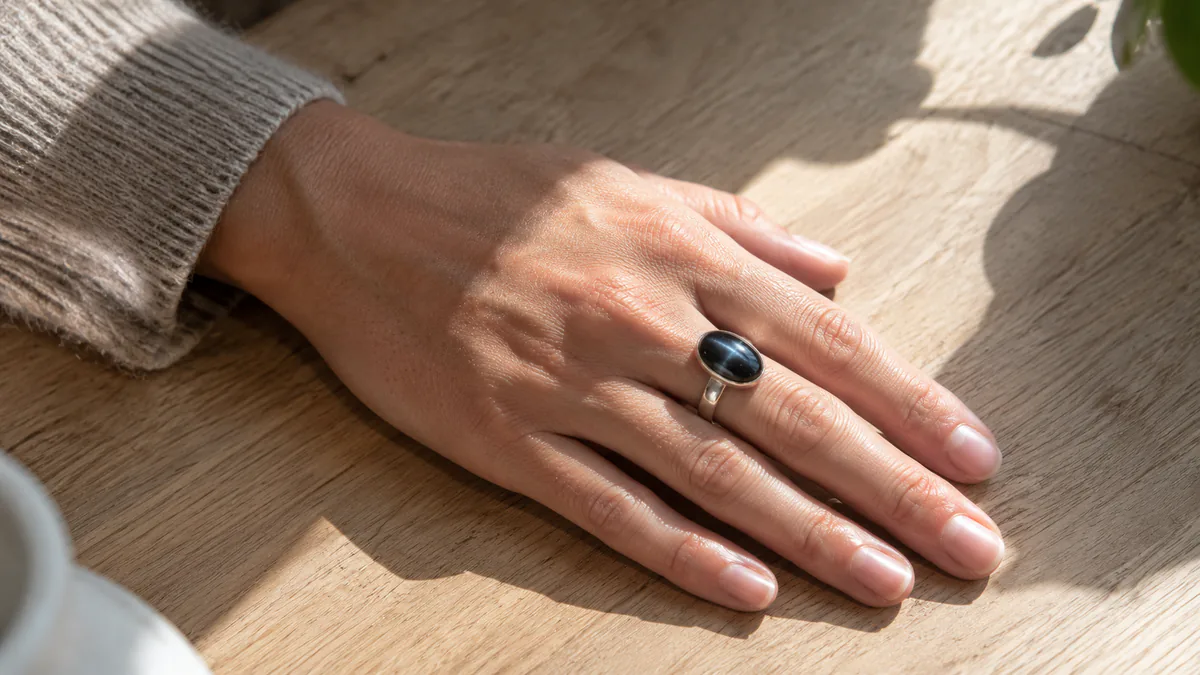
On pairings with other stones, watch a point of material rather than symbolism: quartzes, amethyst included, are harder than it and will mark it on a bracelet. The hardness chart is in which stone to pair moonstone with, and the pairings I advise against in which stone not to pair.
Finally, origin: this variety comes mainly from India and Madagascar, like the rainbow one, and not from Sri Lanka, which supplies the blue adularias. The map of deposits details who produces what.
The workshop's rings, and what's really on them




What I won't say
Four sentences, and they all sell very well elsewhere.
"It protects against negative energy." I won't write that any stone protects against anything. It's the best-selling attribution in the black-stones section, and it has no reality to it.
"It absorbs and discharges." The idea that a stone fills up and then empties out is a recent construction. What is true, though, is that a cabochon gets dirty and worn: a soft cloth fixes that.
"It's a higher-grade adularia." That one isn't a health claim, it's a mineralogical lie, and it's everywhere. When a piece has labradorite, my listing says so.
"The ancients used it for..." Not without a dated source. The table above shows that nothing attributed to it is forty years old, and that on top of that, none of it is truly its own.
The rest of what I refuse to say is in the complete guide, and if this is your first stone, getting started with crystal healing is built for that.
Frequently asked questions
What are the properties of black moonstone?
Tradition credits it with grounding, protection, the kept-back part and the root chakra. None of these attributions are specific to it: it inherits them from its species, labradorite, and from its colour. These are recent beliefs, with no demonstrated effect.
Is black moonstone real moonstone?
It's a feldspar, so from the same large family, but not the same species. Classic moonstone is an orthoclase, called adularia; the black one is a labradorite, a plagioclase. "Black moonstone" is a trade name, not a mineralogical one.
Why is it credited with protection?
Because that's labradorite's classic reputation in crystal-healing manuals, and it is one. The attribution comes from the species, not from moonstone.
Why is it credited with grounding?
Because it's black. Obsidian, black tourmaline, onyx, hematite, jet, shungite get exactly the same attribution, even though these minerals have nothing in common. The common ground is the colour, not the stone.
What's the difference with white moonstone?
The species, first: the white one is an adularia, the black one a labradorite. The flash next: a diffuse veil versus sharp flashes. And the symbolism: the white one goes with beginnings, the black one with what's being gotten through. The detail is in colours and varieties.
Which chakra does it correspond to?
The root chakra, most often, while classic moonstone is filed under the third eye. Here again, it's the colour that decides. The history of these charts is in moonstone and chakras.
What is larvikite?
A Norwegian igneous rock, a monzonite rich in feldspars, sold under the names black moonstone, Norwegian moonstone or black labradorite. It is neither. It can be identified by its silvery flecks scattered within a grey matrix.
How do you recognise a real black moonstone?
Tilt it slowly under a lamp: the flash should move and switch off depending on the angle. If it stays stuck to the surface, it's glass. If there's no play of light at all, it's onyx or dyed agate.
Is it sturdier than the white one?
No, exactly the same: 6 to 6.5 on the Mohs scale and perfect cleavage. It does, however, have a real cosmetic advantage, since its dark ground hides micro-scratches far better than a milky white stone.
Where can you buy black moonstone?
The workshop's pieces are in the collection, and every listing states the mineral species. Elsewhere, ask the seller whether it's a labradorite: the answer, or the lack of one, will tell you quickly.
Where to go next
- The jewellery: the black moonstone collection, the rainbow one, the white one.
- The species and the light: moonstone or labradorite, adularescence, colours and varieties, the mineral profile.
- The belief framework: properties and benefits, the meaning, the chakras.
- Buying without getting it wrong: recognising a genuine stone, opalite, the six quality criteria, the price.
- The full picture: the complete moonstone guide.
The rest of the workshop is in the shop. If a seller ever told you their black moonstone was adularia, tell me about it: I collect those.
My sources
For the species: the GIA, Mindat and the nomenclature of the International Mineralogical Association, which classify orthoclase and labradorite as two distinct species within the feldspar family. Hardness 6 to 6.5 on the Mohs scale and perfect cleavage for both.
For larvikite: it's a monzonite from the Larvik region of Norway, documented as a rock and not a gem, and sold commercially under the names black moonstone, Norwegian moonstone, black labradorite and blue pearl granite. None of these four names is accurate.
For dating the attributions, the founding manuals of contemporary crystal healing published between 1985 and 2003, whose list and dates are in the properties of moonstone.
Three limitations I'd rather state. First, the "inherited from" column in the table is my own analysis, not published data: I built it by comparing, attribution by attribution, what the same works say about labradorite, other black stones and classic moonstone. It's debatable, and I present it as such. Second, the "since" column gives a period rather than a date: dating a circulating belief is approximate. Finally, what I write about the moments people choose a black one over a white one comes from what my customers tell me, not from a source: I flag that in the text where I write it.
Last updated: August 19, 2026. If you find an error in this article, let me know: I'll fix it and note it.
✦ À porter, à offrir
Découvrez mes créations