


Description
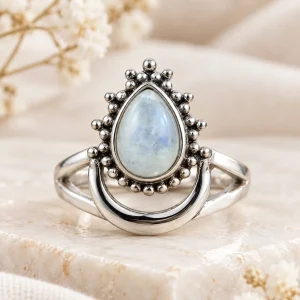
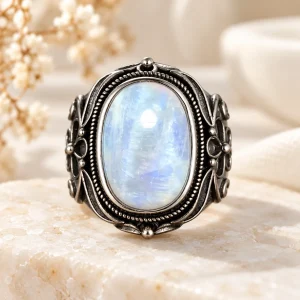
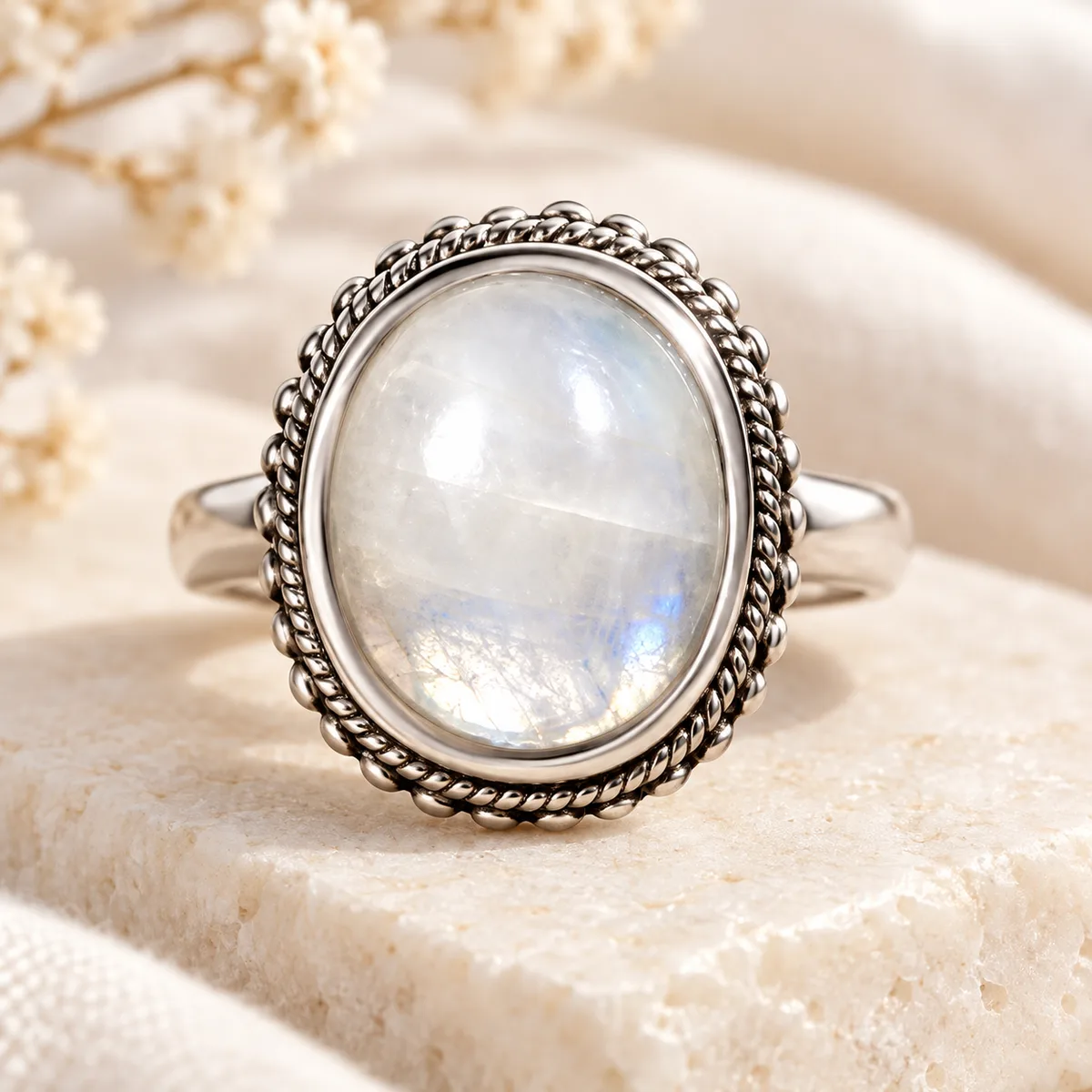
A large oval cabochon, a thick twisted rope all around it, and under all that a deliberately thin band. Everything heavy is at the top, and everything light is underneath.
All the mass at the top
This is a composition that jewellers use constantly and rarely explain. The head of the ring, meaning the stone and its surround, is generous: a large oval and a rope thick enough to read from across a room. The band is thin, half the width of the rope. The effect is that the stone appears to float, because there is no visual weight under it to anchor it. Make the band as thick as the rope and the same stone would look half the size.
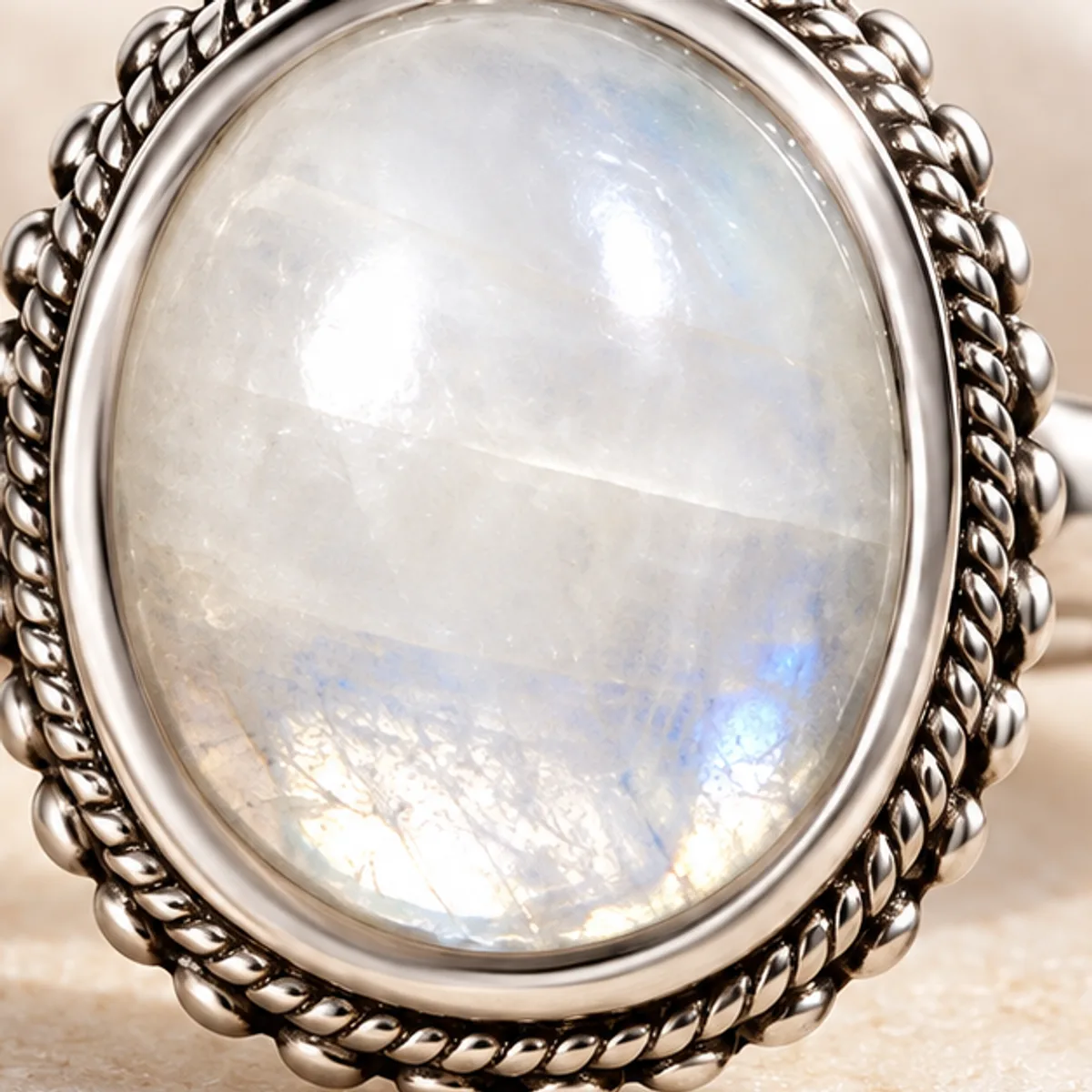
The rope is the heavy version of a motif that runs through this collection. Two thick silver wires rolled together, laid around the bezel and soldered. At this scale each turn of the twist is a distinct object, catching light on its crest and holding shadow in its groove, and the whole surround reads as a braid rather than as a texture. It is also what gives the ring its physical weight, which is more than people expect from a silver piece.
The thin band has one consequence to know about: a ring with a heavy top and a light bottom rotates on the finger. It will turn so the stone sits to one side, especially if the size is a little generous. There is no design that eliminates this entirely. There is a size that reduces it to nothing, and it is the one where the ring is snug rather than comfortable, so I advise erring downward on this model and using the size guide rather than guessing.
The stone is held by a closed bezel inside the rope, so the two functions are separate: the bezel holds, the rope decorates. The blue veil on a large cabochon is at its best here, because the thick dark braid around it does the same work as a black frame. The other rings are here.
- Large oval moonstone cabochon, closed bezel inside the rope, a deep veil.
- 925 sterling silver hallmarked S925, thick twisted rope surround, thin band.
- All the mass at the top: the stone appears to float.
- sizes I 1/2 to T 1/2, that is 48 to 62 mm. Delivered in two weeks.
The specifications
- Stone
- Real moonstone (adularia), large oval cabochon
- Origin
- India
- Metal
- 925 sterling silver, S925 hallmark
- Setting
- Closed bezel inside the rope, no glue
- Shape
- Thick twisted rope surround, thin band
- Finish
- Oxidized silver, crests rubbed back with a cloth
- Sizes
- I 1/2 to T 1/2 (48 to 62 mm)
- Gender
- Women
- Brand
- Melissa Moon
Why a heavy ring turns, and what to do about it
A finger is not round, it is an oval, taller than it is wide. A ring is round. The ring therefore touches the finger at two points, left and right, and is free to rotate between them. Add a heavy top and gravity does the rest: the mass swings to whichever side is lowest. It is physics, not a fault in the ring, and every jeweller who tells you their design prevents it is selling you something.
What actually works is fit. A ring that is snug at the base of the finger cannot rotate far, because friction holds it. A ring a quarter size too large will turn all day. So on a model like this one, measure carefully, measure at the end of the day, and if you are between two sizes, take the smaller. It is the opposite of the advice I give for wide bands, and the reason is the opposite too.
Everyone blames the design when a ring spins. It is almost always the size, and it is almost always a quarter of a millimetre.
No salt, no ultrasonic tank, no hot water: moonstone is a feldspar, and all three damage it for good. Avoid silver dips, they strip the oxidation from the grooves of the rope, which is what makes the braid legible. Lukewarm water, a soft cloth on the crests, a dry brush in the grooves now and then. The detail is in cleaning a moonstone piece, and the safe methods in caring for it without harming it. The rope stands proud of the stone, so it takes knocks before the cabochon does, which is one reason this fragile stone survives well in this mount.