


Description
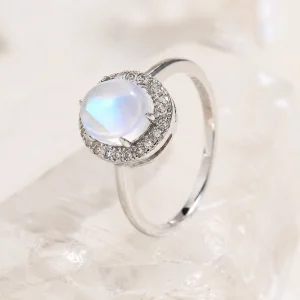
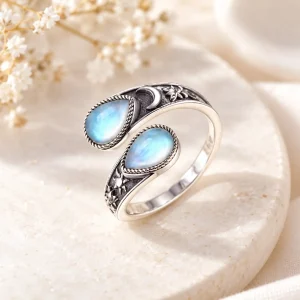
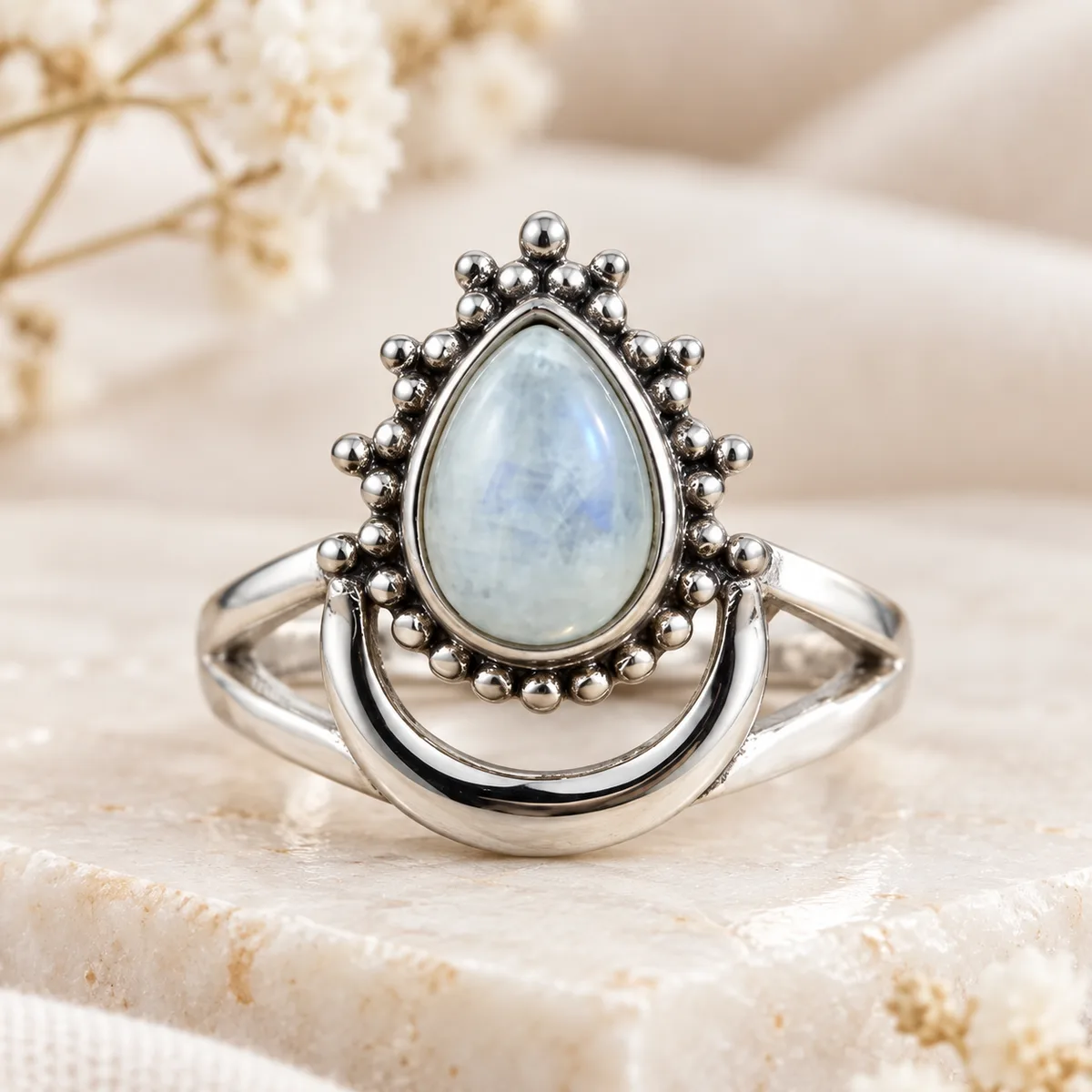
A moonstone drop set on a crown of silver beads, and just beneath it a crescent moon holding it up. Seen from the front you see only the stone; seen from the side, you understand it is carried by something.
The beaded crown, and what it actually does
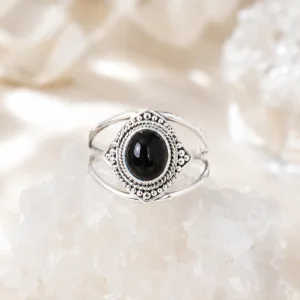
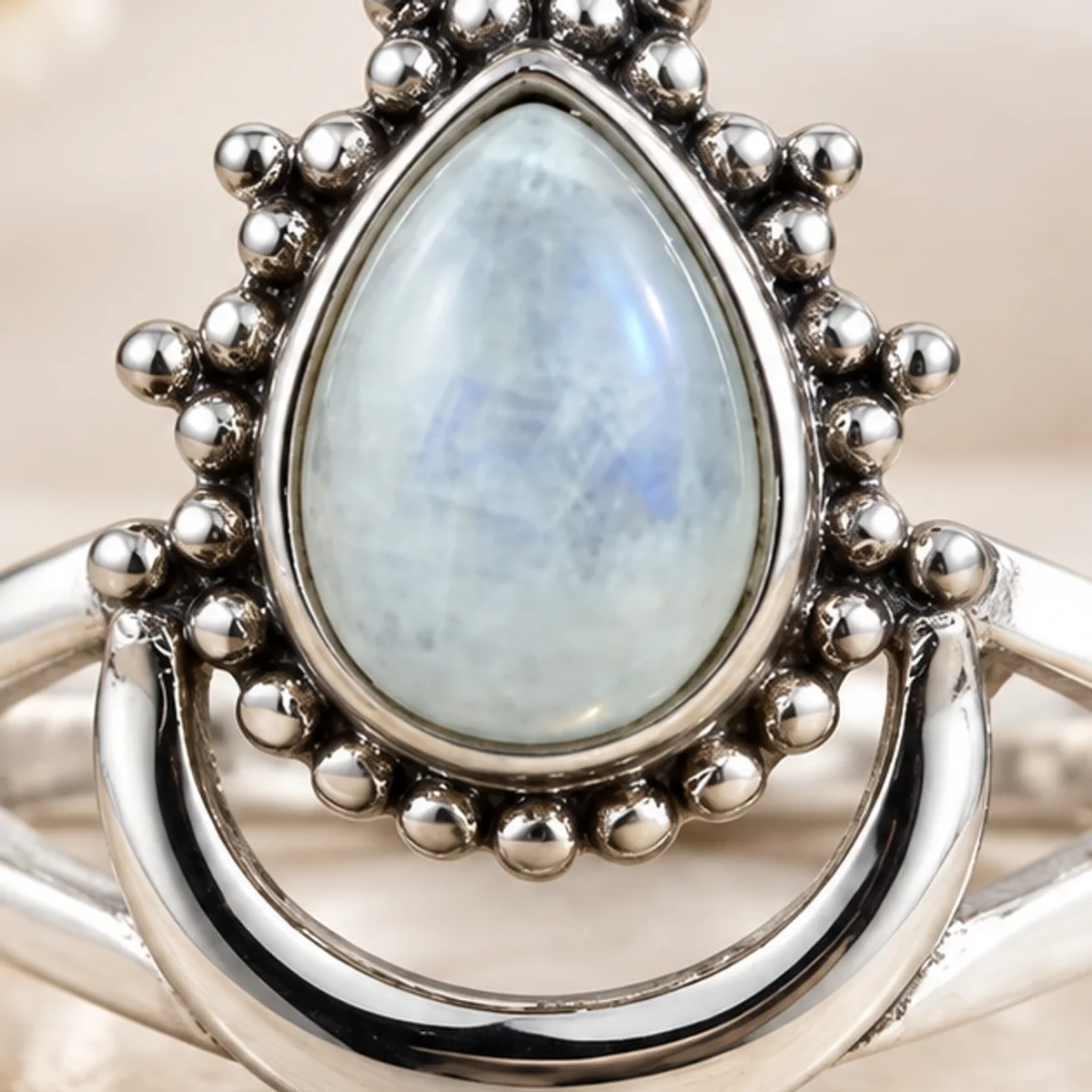
The small beads soldered all around the bezel are not only decorative. They lift the cabochon about a millimetre above the band, and that height changes the way light enters the stone. A cabochon lying flat on a band mostly takes light from above; raised, it also takes it from the sides, and adularescence lights up across a far wider angle. It is an old technique, granulation, already found on Etruscan jewellery, and it has always served that as much as decoration.
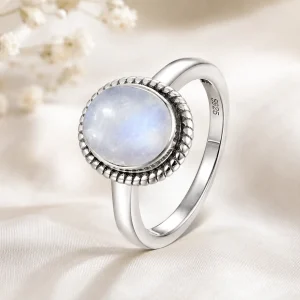
The stone is a drop, that is a pear cabochon with an even dome, point towards the top of the finger. On that shape the blue veil does not spread evenly: it gathers towards the wide part and thins towards the point, which gives the stone a gradient that round cabochons do not have. The body is milky, almost white, with a clear reflection. These stones come from India, and the deposit reads in the reflection more reliably than in a certificate.
Under the crown, an openwork crescent moon closes the base of the bezel. It is a detail you only see when you take the ring off, and I keep it for two reasons. The first is comfort: a solid closed bezel holds perspiration against the skin, an openwork base lets air through. The second is simpler, the stone gains clarity when light can also reach it from below. The setting stays a bezel setting for everything else, no claws and no glue, and that is the right mount for a stone that chips on impact.
It is a quiet dress ring, if that phrase means anything. It has the height and the drawing of a ring people notice, without the weight or the bulk. It is worn on the ring finger or the middle finger, alone. For a flat model that slips under a glove, the other rings are here, and if it is a gift, giving moonstone answers the questions that come before the purchase.
- Real moonstone, pear cabochon, blue veil graded from base to point.
- 925 sterling silver marked S925, crown of soldered beads, openwork crescent under the bezel.
- Bezel set with no glue, stone raised a millimetre to widen the angle of the sheen.
- Sizes I 1/2 to T 1/2, that is 48 to 62 mm. Delivered in two weeks with a cotton pouch and a care card.
The specifications
- Stone
- Real moonstone (adularia), pear cabochon cut
- Origin
- India
- Metal
- 925 sterling silver, S925 mark
- Setting
- Raised bezel, openwork base, no glue
- Decoration
- Crown of soldered beads, crescent moon under the bezel
- Finish
- Polished silver, hollows lightly oxidised
- Sizes
- I 1/2 to T 1/2 (48 to 62 mm)
- Gender
- Women
- Brand
- Melissa Moon
A tall ring, and what that means day to day
It is better said before the purchase than after: a raised stone catches. Not on jumpers, the crown is too rounded for that, but on coat pockets and bag handles. That is not a manufacturing flaw, it is the direct consequence of what makes the model beautiful. If you want a ring to wear eight hours a day at a keyboard, take a flat model; if you want a ring people look at, this one is made for that.
The other thing to know concerns the beads. They are soldered one by one, and on a silver piece the solder always stays slightly lighter than the metal around it. After oxidising, that difference almost disappears, but a careful eye finds it again under a strong lamp. It is the proof that they were placed, not cast in one block.
When I started, I wanted the solders to be invisible. Today I let them show a little, because it is the only thing that separates a crown that was built from a decoration that came out of a mould.
No salt, no ultrasonic tank, no hot water: moonstone is a feldspar, and all three damage it for good. Lukewarm water, a soft cloth, and the ring comes off before the shower and the housework. A soft toothbrush helps between the beads, as long as you stay on the metal. The detail is in cleaning a moonstone piece, and the safe methods in caring for it without harming it.