

Description
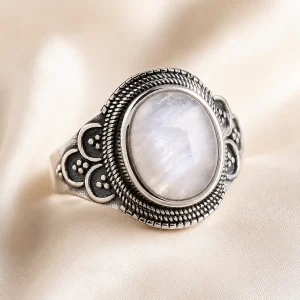
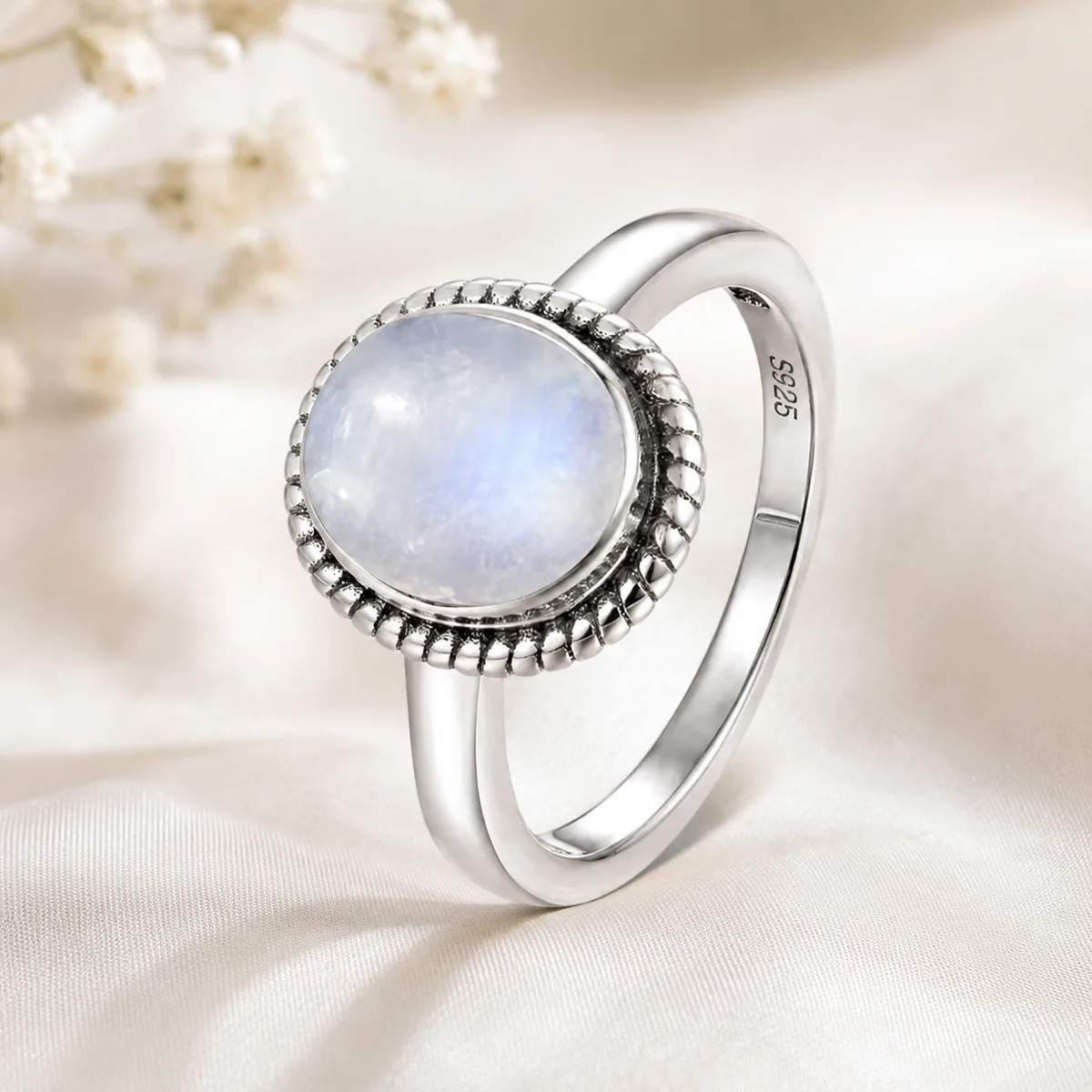
It is the most silver of the shop’s rings. A beaded crown blackened by hand, a solid polished band, and at the centre a moonstone that still gets the last word. This is the one you wear when you want the ring to be seen, not guessed at.
Sterling silver does half the work
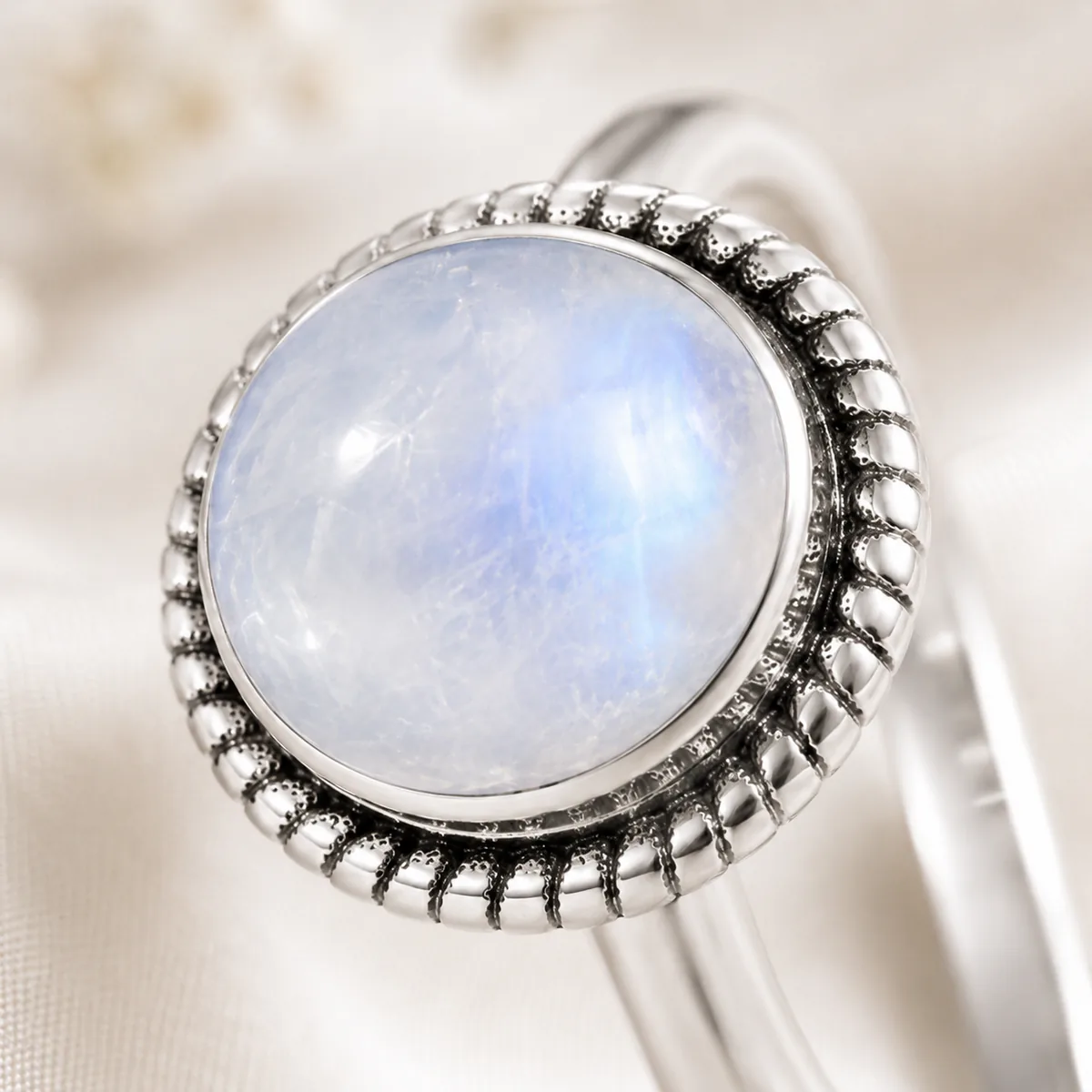
The stone is an oval cabochon, domed rather than faceted because that is the only cut that brings its sheen to life. That bluish veil sliding across the stone as your hand moves has a name, adularescence, and it comes from no coating and no treatment: it is born of microscopic feldspar layers stacked inside the stone. Around it, the metal wraps the dome completely. That is a bezel setting, and on this stone it is not a matter of style: no edge of the cabochon stays exposed, and nothing catches on a jumper or a door handle.
What sets this ring apart is the crown of silver beads circling the stone. It is blackened, then rubbed back with a cloth over the high points: the hollows stay dark, the crests find their shine again. That contrast is not only decorative, it makes the sheen of the stone read brighter than it really is. A mirror-polished surround would have thrown back exactly the same light as the cabochon, and the two would have cancelled each other out. The band itself is left bright, and the S925 mark is struck into the shank, readable with the naked eye.
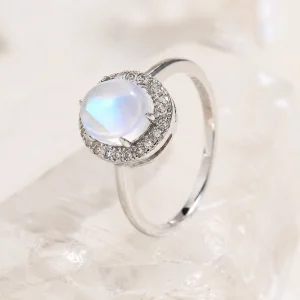
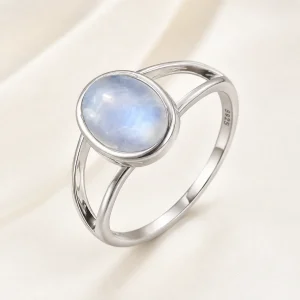
It is deliberately louder than its neighbours. If you want the same stone on a quieter mount, the shop offers a version with a slim band and another where the cabochon sits with no surround at all. All three answer the same question, how to make a brittle stone last, in three different ways: here it is the metal that stands guard. The other rings are here, and if you are torn between two sizes, the size guide will save you a return.
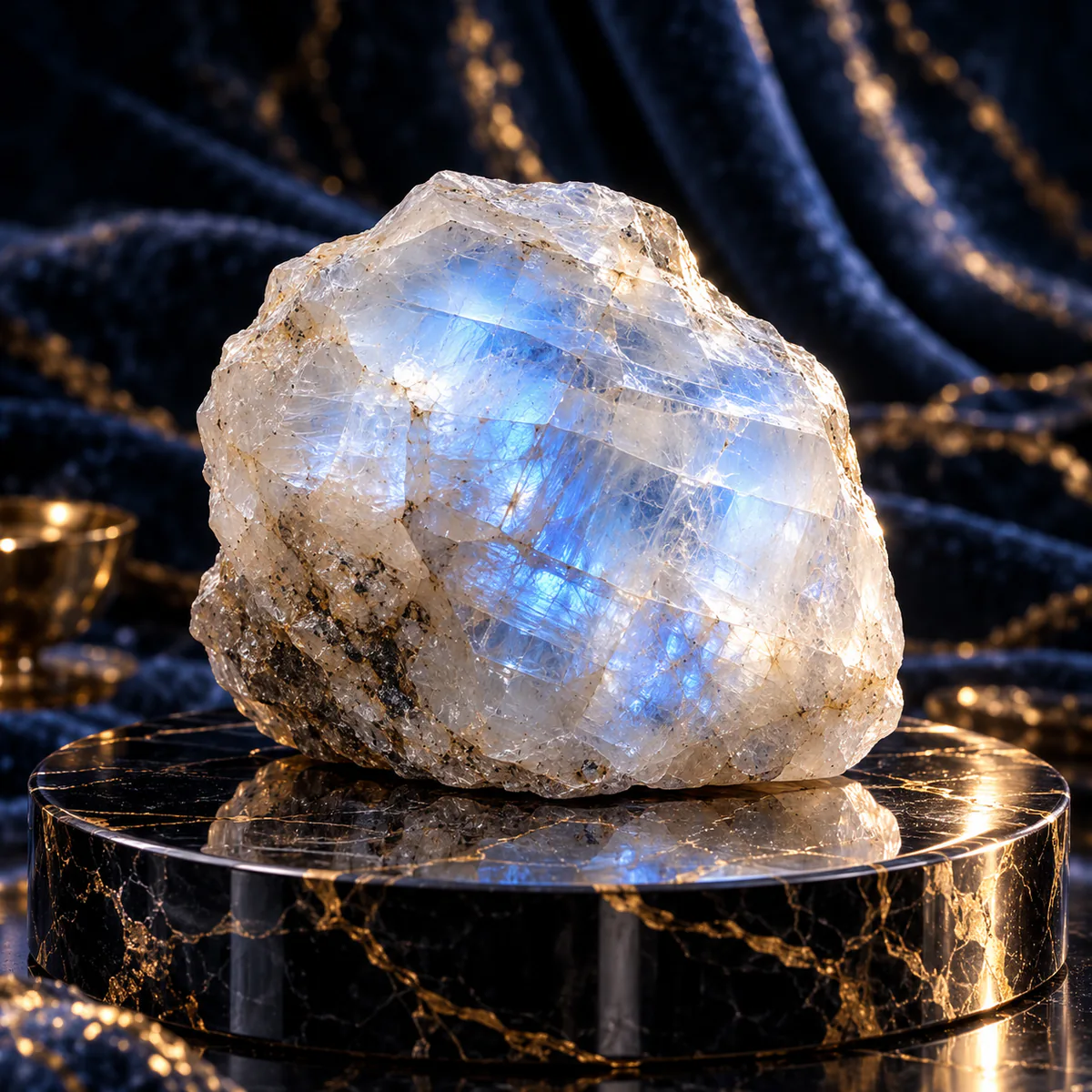
At this price, the stone does not come from Meetiyagoda. I say so because price never lies: Sri Lankan moonstones with that deep blue go for tens of dollars a carat, and a ring set with one of them would not cost this. This one comes from India. Its body is milky white rather than colourless, and its sheen leans silvery blue rather than electric blue, which is what each deposit prints on its stones. In exchange it is clean, and it is centred on the dome: that is the one criterion I never negotiate, because a sheen pushed to the edge disappears the moment the hand moves. Out of six or seven stones offered to me, I keep one. Last thing, the least flattering: moonstone has perfect cleavage. It does not scratch easily, but it chips on impact, and it is the setting that protects it, not its hardness.
Crystal healing tradition makes moonstone a stone of cycles, of intuition and of a return to calm; it is said to accompany periods of change rather than to bring them on. Worn on the hand, it crosses your field of vision a hundred times a day, which probably explains part of what is attributed to it. I will not go further: none of this is proven and no piece of jewellery heals anything. If the subject interests you, I have gathered separately what tradition attributes to it and what a moonstone ring says when you give one, in the conditional from start to finish.
- Real moonstone, oval cabochon, a clear sheen centred on the dome. Neither opalite nor coated quartz.
- 925 sterling silver marked S925, bezel set, beaded crown blackened and rubbed back by hand.
- Sizes I 1/2 to T 1/2 on the British scale, that is 48 to 62 mm. Delivered in two weeks with a cotton pouch, a handwritten note and a care card.
- The loudest ring in the catalogue. The one that is seen, not the one you have to guess at.
The specifications
- Stone
- Real moonstone (adularia), oval cabochon cut
- Origin
- India
- Metal
- 925 sterling silver, S925 mark
- Setting
- Bezel set, no glue
- Surround
- Beaded crown, blackened then rubbed back over the high points
- Band finish
- Polished silver
- Sizes
- I 1/2 to T 1/2 on the British scale, inner circumference 48 to 62 mm
- Gender
- Women
- Brand
- Melissa Moon
Why I blacken the silver instead of leaving it bright
A mirror-polished surround throws back exactly the same light as the dome of the stone. Set side by side, the two neutralise each other, and the adularescence disappears into the glare of the metal. Blackening the hollows of the crown gives the sheen a dark ground to stand out against. It is an old jeweller’s reflex, and it is also what gives this ring the look of a piece found rather than bought. The trade-off is an honest one: that patina wears. On the most prominent beads it will lighten over the years. That is not called a flaw, it is called a ring that has been worn.
This ring exists because moonstone is so often given timid mounts. It gets set on a wire of silver, almost apologised for. Yet it takes being taken seriously very well, as long as the metal protects it instead of putting it at risk. That is the opposite of claws, which leave four points of impact on a stone that chips. The rest of the shop is here, including what I have taken out of the catalogue.
My grandmother would turn a stone in the light for a full minute before deciding whether it was worth keeping. I do exactly the same, except that it is at a window facing the sun and I have a loupe. The gesture has not changed.
No salt, no ultrasonic tank, no hot water: moonstone is a feldspar, and all three damage it for good. Lukewarm water, a soft cloth, and the ring comes off before the shower, the pool and the housework. Above all, no silver polish and no polishing cloth on the crown: those products are made to strip black off metal, and they would strip yours in a single pass. The detail by type of setting is in cleaning a moonstone piece, and the safe methods in caring for it without harming it.