


Description
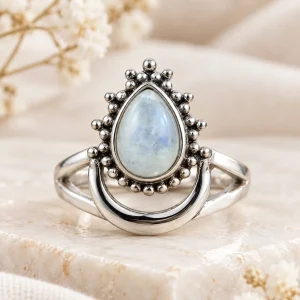
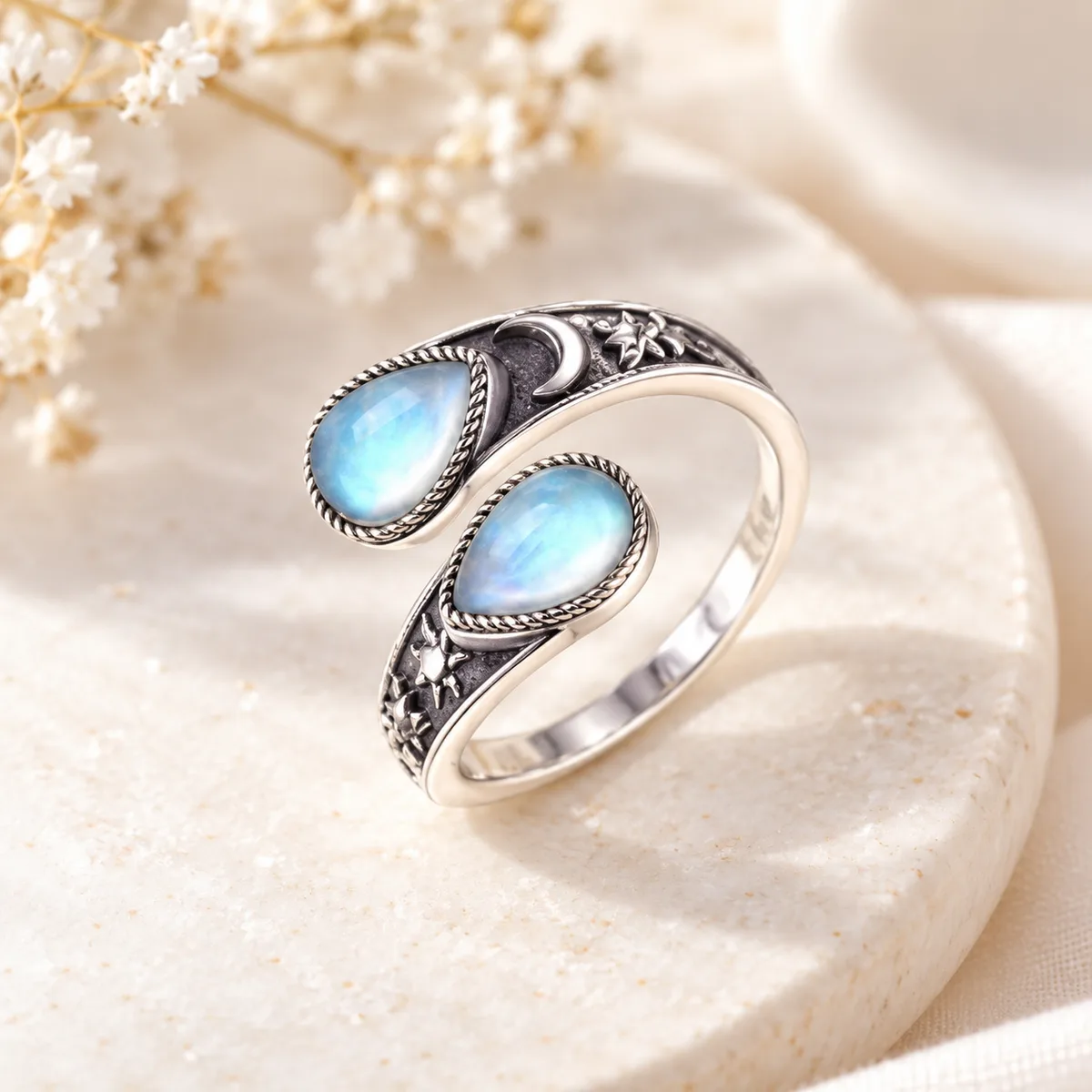
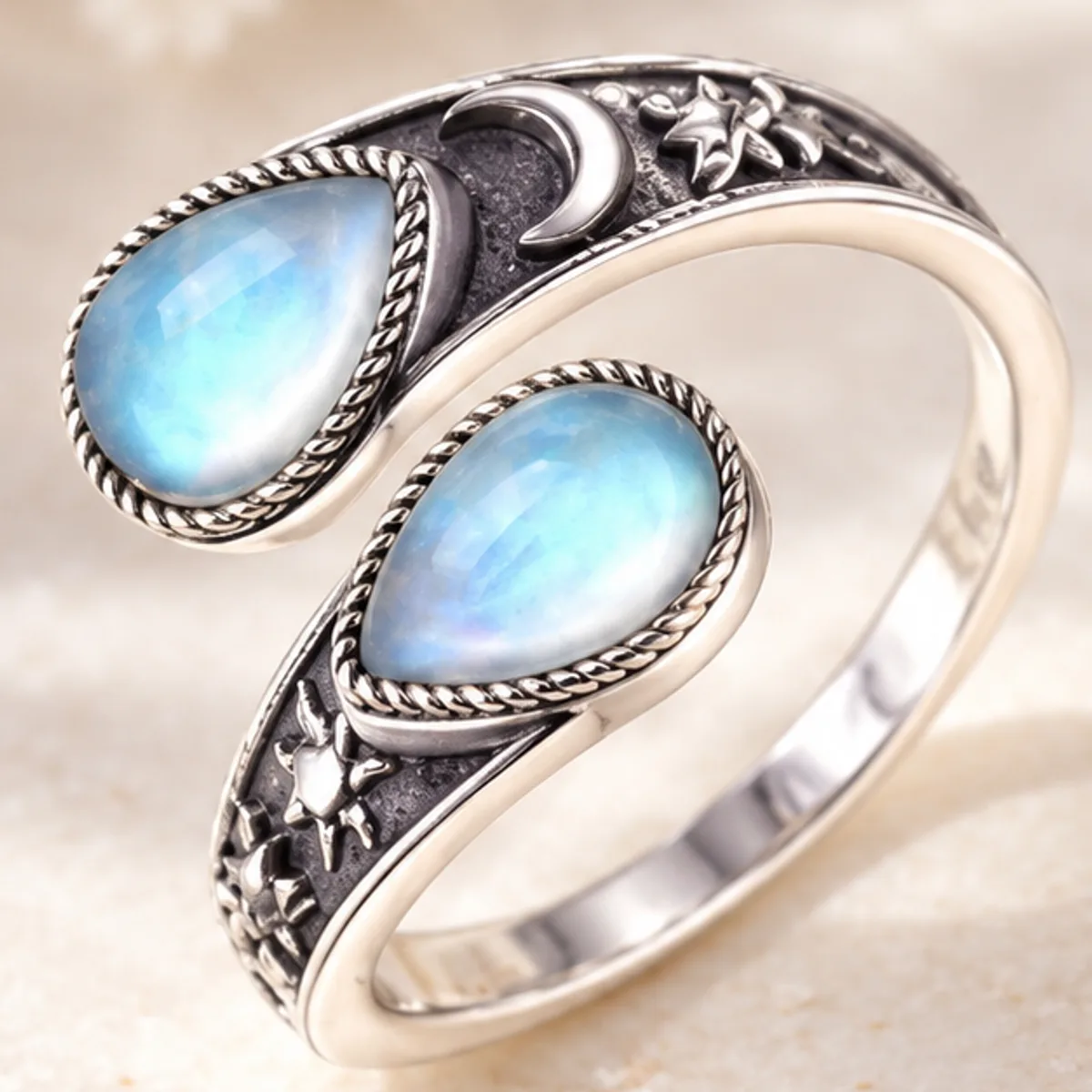
Two moonstone drops at the ends of a coiling band, and between them an engraved sky: crescents, stars, dots. It is the most worked piece of the series, and the one that takes the most bench time.
A band that coils instead of closing
The ring is not a circle: it is a strip of silver coiled into an open spiral whose two ends cross without touching. Each one carries a moonstone drop, cut as a pear cabochon and held in a bezel setting. One points towards the nail, the other towards the palm, and depending on how you turn it, one or the other catches the light. That construction has a practical benefit: the coil adjusts by hand, and one ring easily covers four sizes.
Between the two stones, the strip is engraved. Crescent moons in three sizes, stars with five and six points, and a dust of dots struck one at a time with a punch. That last detail is what costs the time: a struck dot is not an engraved dot, it presses the metal down instead of removing it, and light catches in it differently. After the engraving the ring goes into an oxidising bath, then the high points are rubbed back with a cloth. The ground stays dark, the crests find their shine, and the engraved sky becomes readable at arm’s length instead of disappearing.
The two stones are matched by hand, which is anything but obvious. Two cabochons taken at random from the same lot almost never have the same veil: one leans blue, the other silver, one lights up face on and the other at an angle. On a ring where they answer each other two centimetres apart, the difference jumps out. So I spend more time pairing than setting. That veil, adularescence, is born of feldspar layers stacked inside the stone, and it never repeats itself exactly.
It is a ring that shows. It is worn on the index or the middle finger, alone, and it needs no company. If you want something quieter for every day, the rest of the rings are here, and several carry a single cabochon on a plain band. To understand what the moon and the star ended up saying on a piece of jewellery, the myths and legends of moonstone are more honest than a product page.
Moonstone has perfect cleavage: it does not scratch easily, but it chips on impact, and on a pear cut the two points are the sensitive zones. The metal is turned up a little higher there than elsewhere, which is the only reason this shape is workable at all.
- Two real moonstones, pear cabochons matched by hand, a blue veil on both.
- 925 sterling silver marked S925, coiled band engraved with crescents, stars and struck dots.
- Bezel set, no glue, on both stones. Nothing that catches on a jumper.
- Adjustable by coiling, about four sizes. Delivered in two weeks with its pouch.
The specifications
- Stone
- Two real moonstones (adularia), pear cabochon cut
- Origin
- India
- Metal
- 925 sterling silver, S925 mark
- Setting
- Two bezel settings, no glue
- Decoration
- Crescents, stars and punch-struck dots
- Finish
- Oxidised silver, high points rubbed back
- Sizes
- Adjustable by coiling, roughly K to S (50 to 60 mm)
- Gender
- Women
- Brand
- Melissa Moon
Why two stones cost more than twice one
On a single-stone ring, I pick the best of the lot and I set it. On a two-stone ring, I have to find two cabochons whose veil runs at the same angle, with the same dominant tone and roughly the same intensity. In a lot of thirty, that rarely gives more than six or seven acceptable pairs. The rest goes onto single-stone models, where the pairing problem does not exist. That is why a two-stone model does not simply double the price of the stone: it doubles the sorting too.
What I will not promise is an identical pair. Two moonstones never are, and a listing that swears otherwise is probably selling something other than moonstone. What I do guarantee is that the difference will not show at the distance from which a hand is looked at.
The longest part of this ring is neither the engraving nor the setting. It is the half hour spent turning stones under the lamp to find two that light up together.
No salt, no ultrasonic tank, no hot water: moonstone is a feldspar, and all three damage it for good. Lukewarm water, a soft cloth, and the ring comes off before the shower and the housework. Above all, no silver polish and no polishing cloth on the engraving: those products are made to strip black off metal, and they would erase the sky in a single pass. The detail is in cleaning a moonstone piece, and the safe methods in caring for it without harming it.