

Description
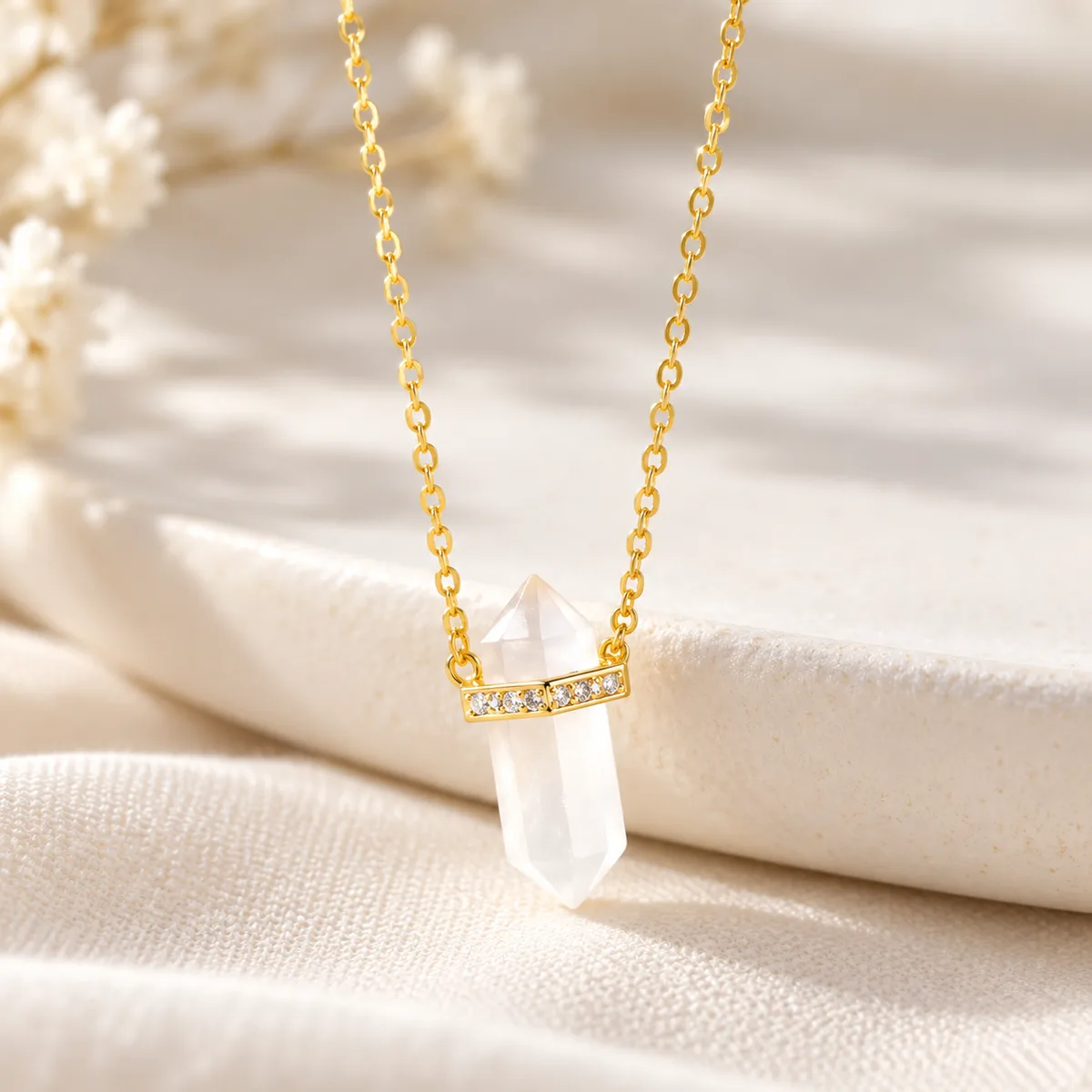
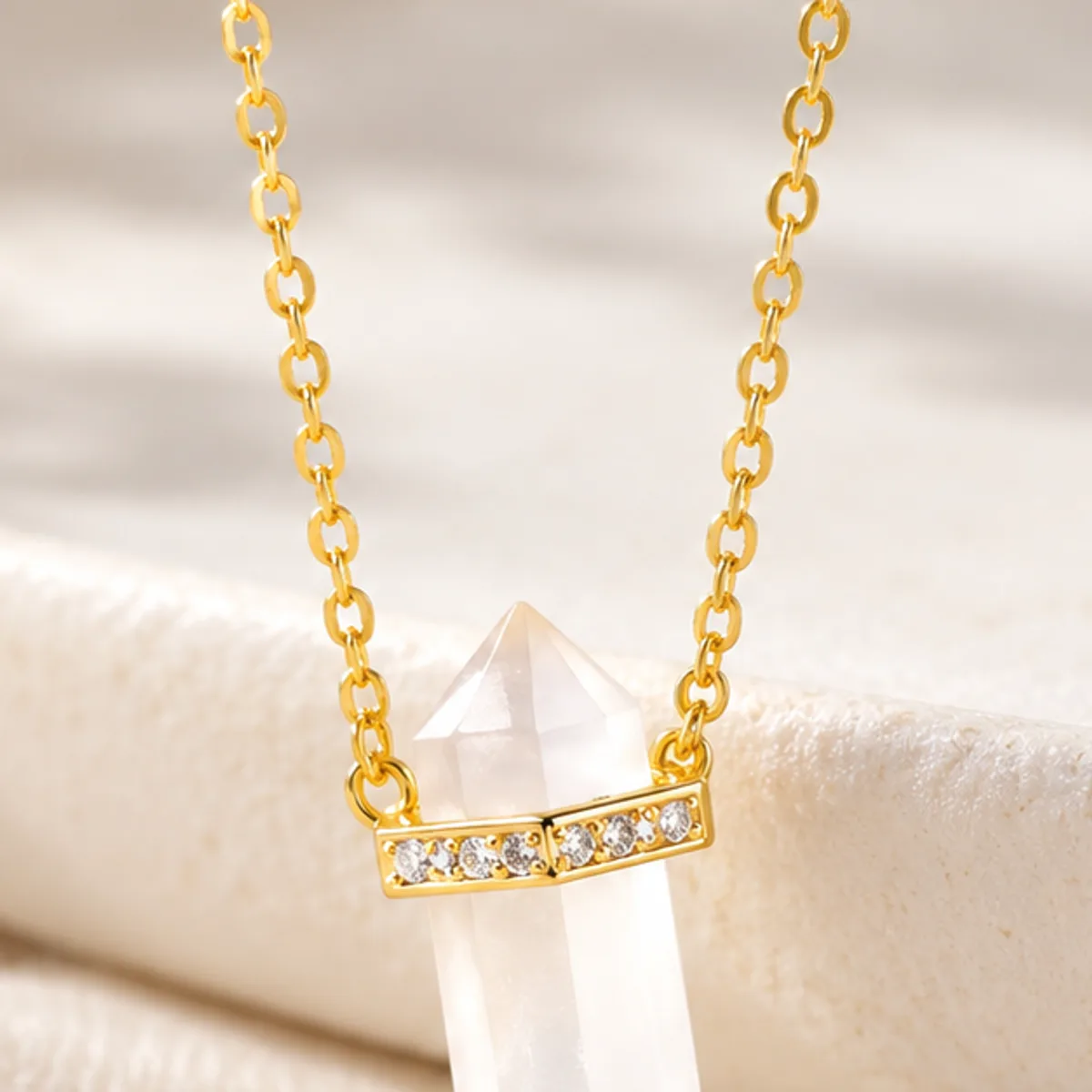
A hexagonal moonstone point, cut as a prism and finished in a pyramid, hanging from a gold plated chain. The only model in the catalogue where the stone is a volume and not a dome.
A prism, not a cabochon
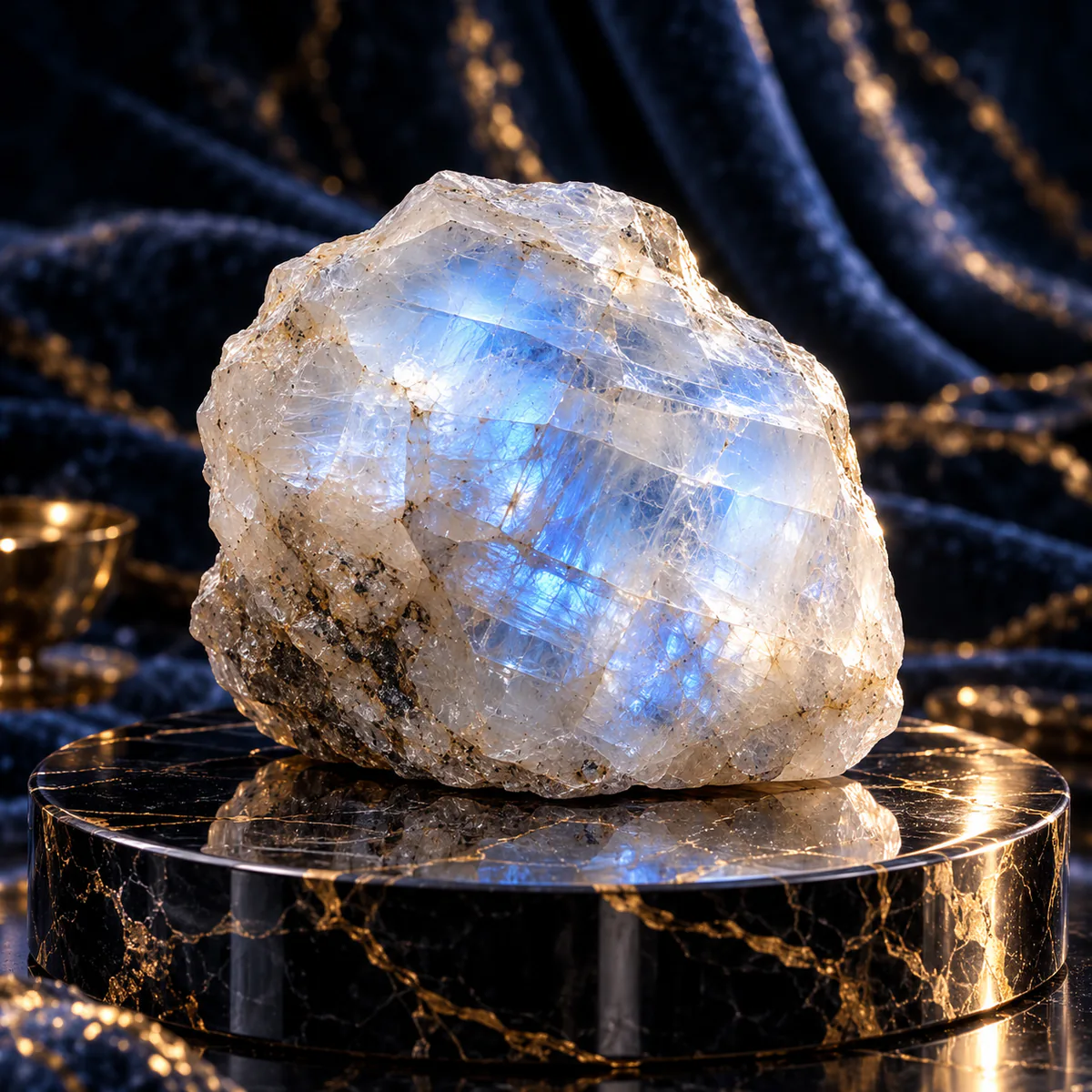
The stone is not polished into a dome: it is cut as a six sided bar topped by a small pyramid. Every face is flat and polished, and light behaves quite differently on it. On a cabochon the adularescence forms a veil that slides; here each face lights up separately as it comes into the right angle, and the veil passes from one facet to the next like a light turning around the stone.
It is spectacular and it is also more demanding. The six faces have to be cut parallel to the internal layers of the crystal, failing which some light up and others stay dead. On cheap points you often see two or three living faces and the rest dull. That is the first thing I check, and it is what eliminates the most pieces.
The mount is reduced to a silver cap that wraps the top of the pyramid and carries the suspension ring. Nothing touches the body of the prism, which stays entirely visible on all six faces. Since moonstone chips on impact, particularly on the edges, the cap projects slightly: it takes the knocks from above, which is where a pendant is struck most often.
The chain is gold plated, which is a layer of a few microns on a base metal core and not solid gold. It will wear at the clasp and at the nape in one to two years of daily wear, and that is what makes this price possible. The other necklaces are here, and what a moonstone necklace says was written for the people giving one.
- Real moonstone cut as a hexagonal prism with a pyramid top, six polished faces.
- Faces cut parallel to the internal layers: all six light up, not two or three.
- Silver cap projecting slightly over the point, nothing touching the body of the prism.
- Gold plated chain, which wears in one to two years of daily wear. Said before you buy.
- Delivered in two weeks.
The specifications
- Stone
- Real moonstone (adularia), hexagonal prism with pyramid top
- Origin
- India
- Metal
- 925 sterling silver cap, S925 hallmark, gold plated chain
- Setting
- Cap over the top of the pyramid, no glue on the faces
- Shape
- Point hanging free, six visible faces
- Finish
- Polished stone, polished silver cap
- Sizes
- Chain of 45 cm, lobster clasp
- Gender
- Women
- Brand
- Melissa Moon
How to tell a good point from a cheap one
Hold it up and turn it slowly through a full circle in daylight. On a well cut point, each of the six faces takes its turn to flash and then hands over to the next, so the light appears to travel around the stone. On a badly cut one, two faces do all the work and the other four stay grey however you turn it. It takes ten seconds and it is the only test that matters on this shape.
The reason is simple and it is not about polish. Adularescence comes from layers inside the crystal, and a face has to be cut roughly parallel to them to show it. Cutting a hexagon that respects the layers wastes rough and takes judgement; cutting one that ignores them is fast. That is the whole difference between the points at eleven euros and the ones I buy, and you can see it without any equipment.
Turn it once in daylight. Six faces should take turns. If two do all the work, put it down.
No salt, no ultrasonic tank, no hot water: moonstone is a feldspar, and all three damage it for good. On this shape the edges between the faces are the vulnerable part, so keep it away from other pieces in storage. For the plated chain, no silver dip and no polishing cloth, which strip the gold immediately. Cleaning a moonstone piece and caring for it without harming it cover the rest.