

Description
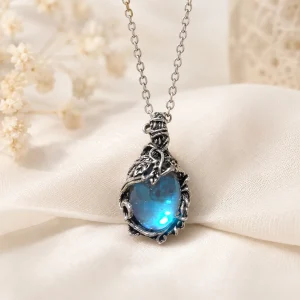
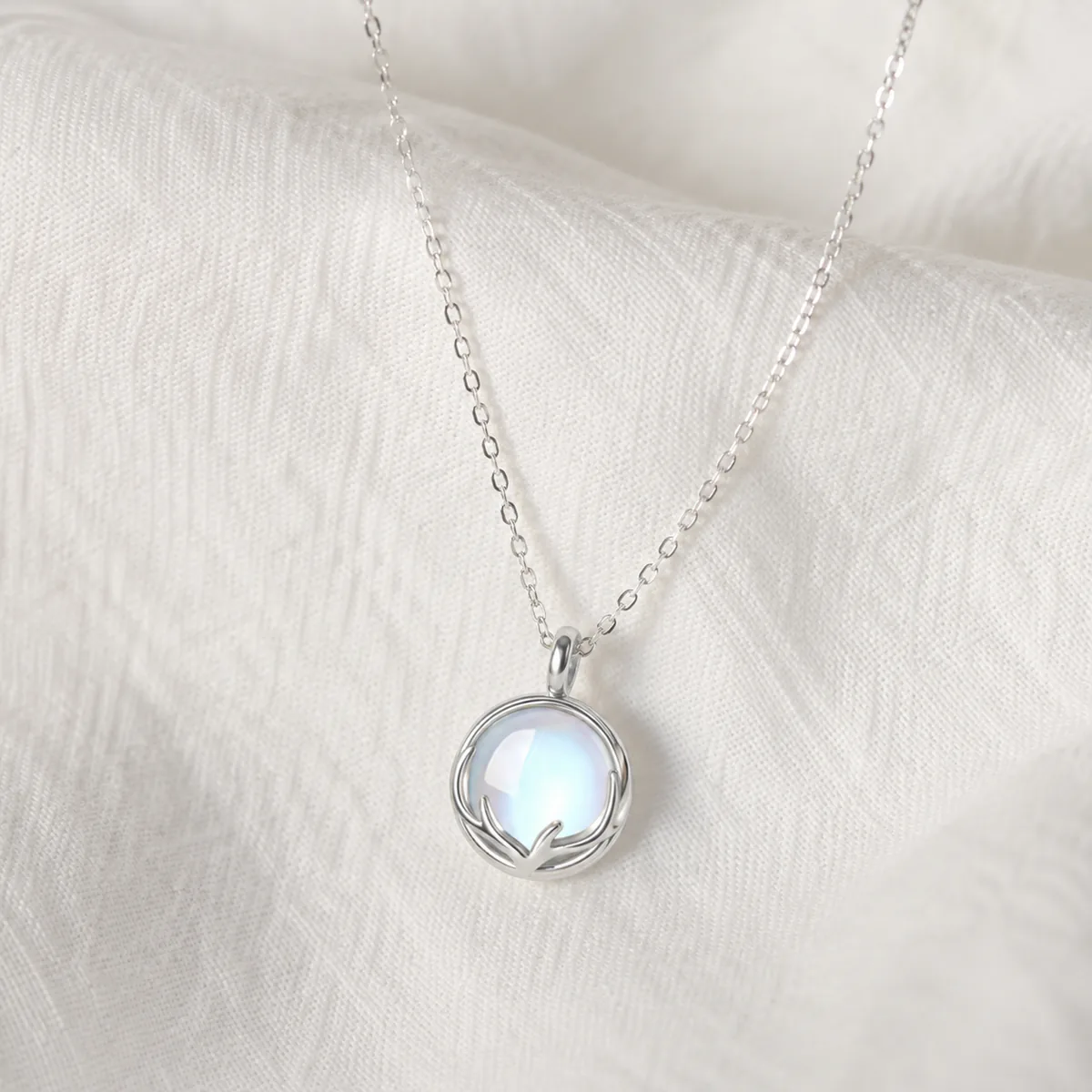
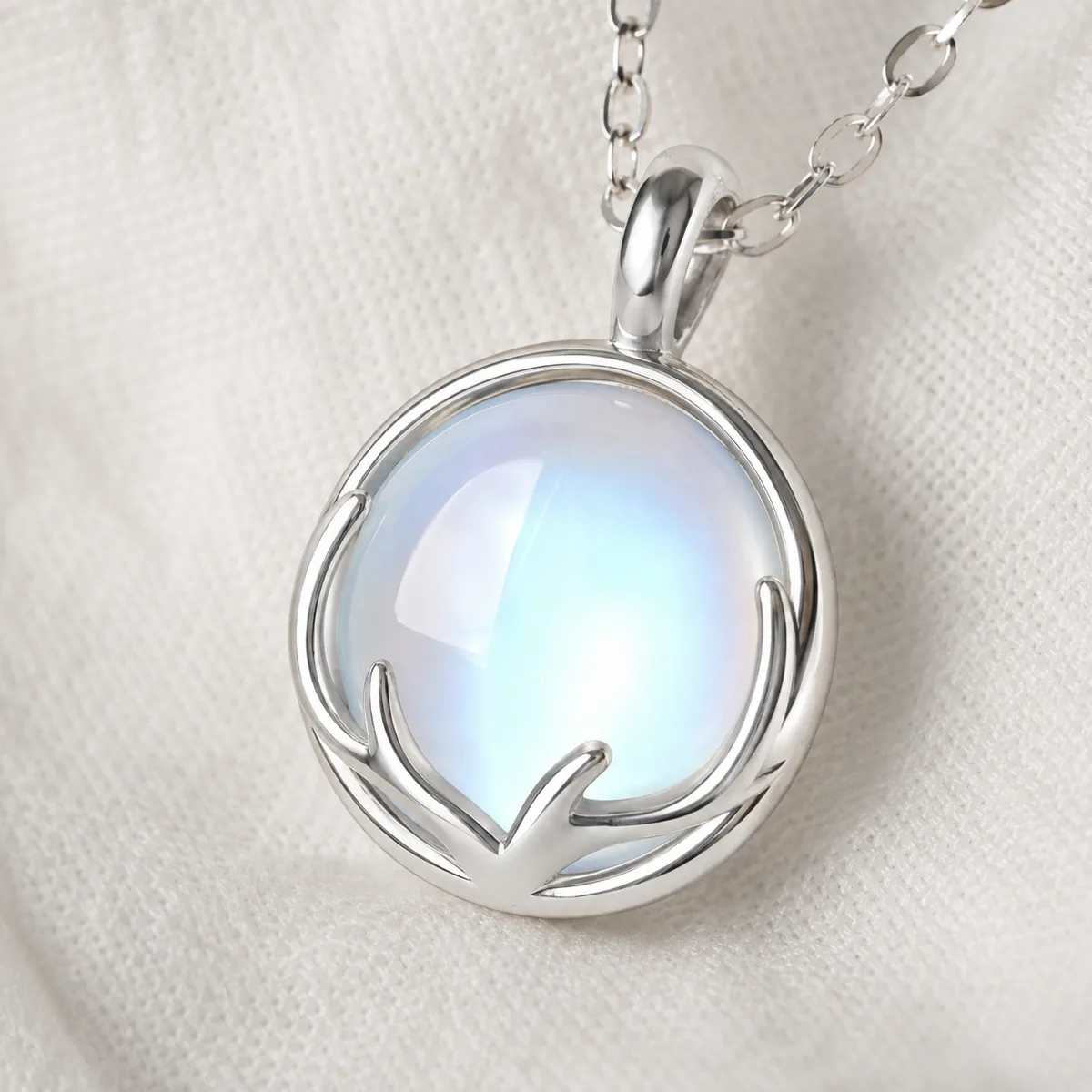
A round, domed cabochon, milky white crossed with blue and pink depending on the angle, set inside a silver circle wrapped in fine openwork branches. The whole thing hangs from an oval-link chain. This is the most searched-for necklace in the shop, and the one people buy while wondering if the stone is real.
How to tell that it really is
This is the question that brings most people to this page, so it deserves a serious answer first. A cabochon is the format where nothing can be faked, because the stone is large, whole, visible, and one glance is enough to judge it. On a strand of small beads, nobody examines twenty at once; here there is only one, right in front of you.
The test takes five seconds. Stand near a window, light coming from behind you, and slowly tilt the pendant back and forth. What you should see is a veil that travels across the dome, lighting up on one side then sliding to the other, with no sharp edge. That motion is what signs a real moonstone, and no imitation reproduces it correctly. The phenomenon is explained in detail here.
What you should not see: a fixed colour, identical from every angle, that does not move when the stone moves. A colour that stays put is a body colour, not a sheen, and that is how dyed glass behaves. Another test, a decisive one: look at the stone against the light, with a source behind it. Opalite turns noticeably orange or honey-coloured; moonstone stays white and milky. The full comparison is here, and the question of labradorite is covered there.
One last word on what you are looking for: a clear blue veil is the rarest and most sought-after sheen this stone offers, the one that really drives up the price. The criteria for a fine moonstone are detailed here.
Openwork is never neutral
The stone does not sit in a plain ring: it is surrounded by a motif of fine openwork silver branches that climb up over the edges of the cabochon. That is what gives the piece its character, and it changes two things day to day that no product page ever bothers to write.
The first is that relief catches. A smooth setting glides over clothing; fine branches and cutwork catch the loops of a jumper, the threads of a scarf, long hair. Nothing serious, but if you wear a lot of wool, wear the pendant over the collar rather than under it.
The second concerns silver, and it is the more useful one. On an openwork piece, tarnish does not settle evenly: it starts in the hollows and under the branches, where air stagnates and no cloth reaches. This is not entirely a flaw, since a slight darkening in the recesses brings out the pattern, and that contrast is what makes a design legible. But if you rub the whole thing with a silver polishing cloth, you will only clean the raised parts and end up with a half-clean piece. On this kind of setting, clean gently with lukewarm water, soap and a very soft brush, and leave the recesses alone.
The motif also plays a mechanical role: climbing over the edge of the stone, those branches hold it and protect its rim, exactly where a cabochon chips. Moonstone chips on impact without scratching easily, and an exposed edge is always its weak point.
A link chain can be repaired, but it twists
A necklace is bought for its stone, talked about for its stone, and it is almost always the chain that decides how long it lasts. This one is oval link, the most classic there is, and that is good news: it is the one type of chain a jeweller can genuinely repair, replacing a link or resoldering it, for very little money. A braided or snake chain that breaks, on the other hand, gets replaced.
Its flaw lies elsewhere, and it always passes for wear when it is not. A link chain twists. From going over the head and turning against the neck, it winds around itself, shortens, forms small loops, and those loops eventually bend a link. The fix takes five seconds: unhook the clasp, hold the chain by one end, let the pendant hang freely, and it will untwist on its own as it spins. Do it once a month and the chain will never bend.
Two more habits for any necklace, this one included: the clasp drifts to the front over the course of a day, which is not a flaw but simple mechanics, and the pendant rotates on itself, the heaviest point seeking the bottom. A flick of the finger sets it straight. The shop’s other necklaces are here, and the size guide explains how to choose a length.
- Round domed cabochon, 925 silver circle with openwork branches, on a link chain.
- The test takes five seconds: tilt the stone, the veil should move. A colour that does not move is not a sheen.
- On openwork, tarnish starts in the hollows: lukewarm water and a soft brush, not a silver cloth everywhere.
- Delivered in two weeks with a cotton pouch, a handwritten note and a care card.
The specifications
- Stone
- Moonstone, round domed cabochon
- Look
- Translucent milky white, shifting blue and pink sheen
- Metal
- 925 sterling silver
- Setting
- Openwork branch circle, closed over the stone’s edge
- Chain
- Oval link, 925 silver
- Gender
- Women
- Brand
- Melissa Moon
Why this necklace carries the word real in its name
That word should mean nothing. Nobody sells real shoes or real bread, and nobody would think to specify it. It appears here because part of the market sells mass-produced opalescent glass under the name moonstone, and people have caught on: they type the word into a search engine because they are wary, and they are right to be.
My position is simple. Rather than write the word and ask you to take it on faith, I would rather give you the gestures that let you check for yourself, including on a piece bought elsewhere. A seller who teaches you to inspect their own merchandise is taking a risk, and it is exactly the risk I want to take. The rest of the shop is here.
The word real should serve no purpose at all. That it has to be written means the market has a problem.
No salt, no ultrasonic tank, no hot water: moonstone is a feldspar, and all three damage it for good. The ultrasonic tank is doubly forbidden here, since an openwork setting offers a thousand places for vibration to catch. Lukewarm water, a drop of mild soap, a very soft brush for the cutwork, a rinse and a complete drying, patting under the branches where water gets trapped. A silver polishing cloth belongs on smooth, open surfaces only: it is mildly abrasive and has no business on the stone, or in the depths of the openwork, which it will only half clean anyway. Take the necklace off before the shower, the pool and sport, and hang it rather than leaving it in a pile. The detail is in cleaning a moonstone piece, and the safe methods in caring for it without harming it.