Description
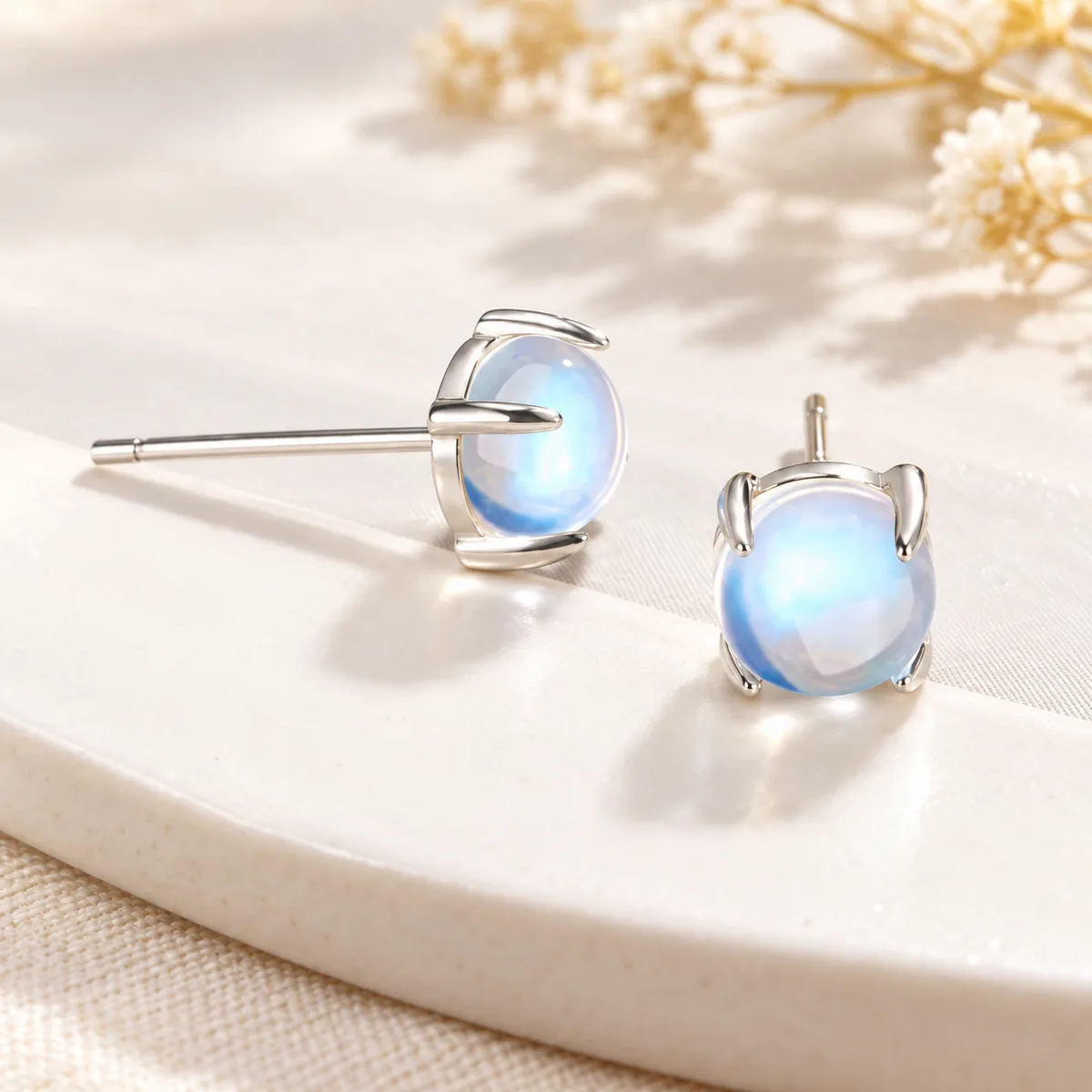
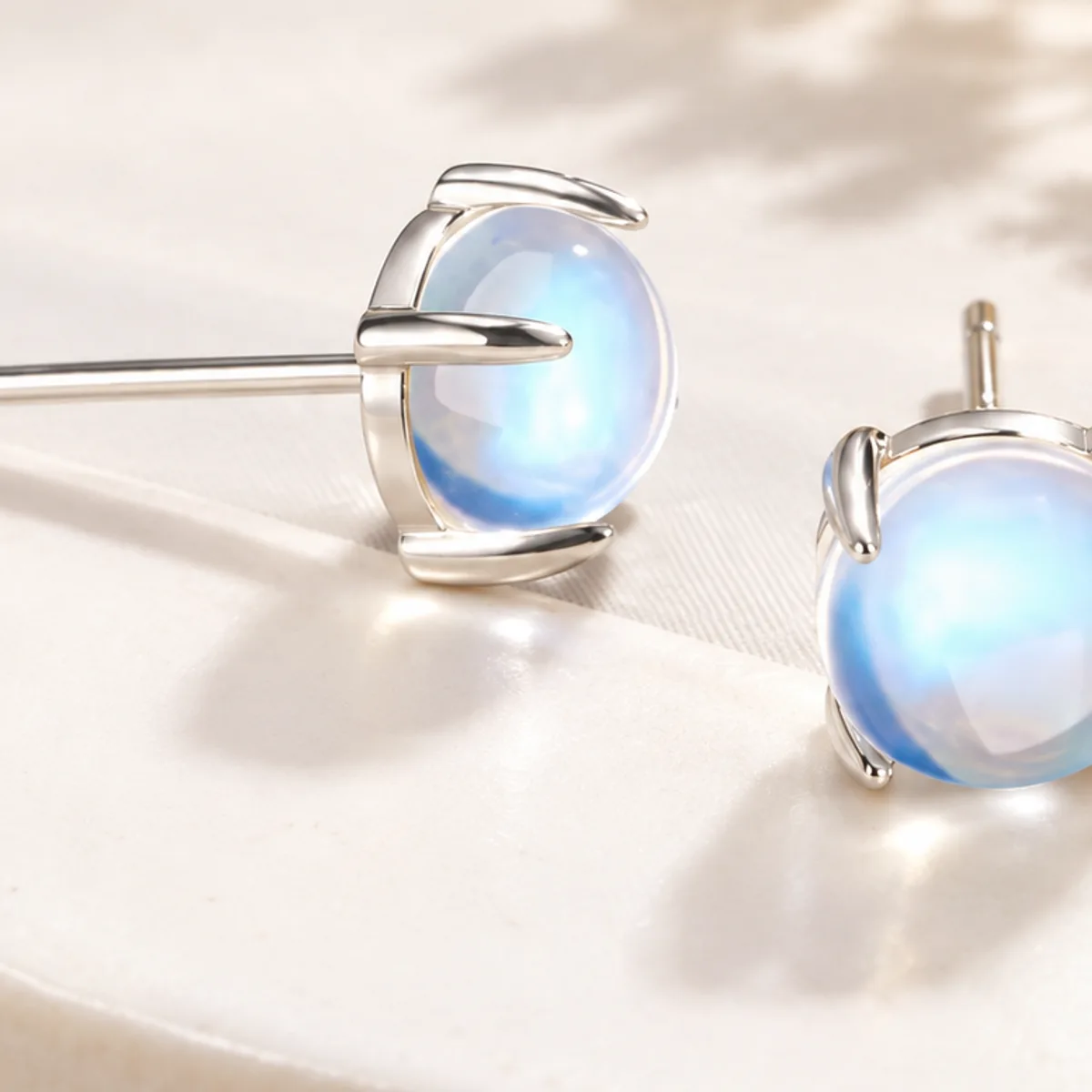
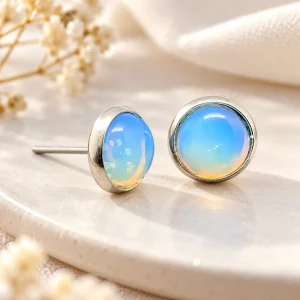
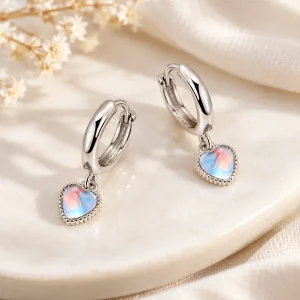
Two small round cabochons with a very high dome, each held by four fine claws, on posts with butterfly backs. The dome is tall, and that changes the reflection a great deal.
A high dome, and what it gives at the ear
A very domed cabochon is not a styling whim: the height of the dome determines how the adularescence appears. On a flat dome the veil spreads limply and only lights up within a narrow angle. On a tall dome it concentrates into a bright patch at the summit, and that patch stays visible over a far wider range of angles. On a small stone, that is the difference between a discreet stud and a dull one.
The four claws are fine and folded over at the top of their travel, so they bite very little on the stone. They let light in through the flanks of the cabochon, which a closed bezel does not, and the dome looks brighter. In exchange they expose the edges, and moonstone chips on impact: on an earring the risk is low, but the yearly check of the claws applies here too.
This is the most affordable model in the catalogue, and the reason is simple: the stone is small, the mount has no ornament and no secondary setting, and the assembly is the quickest there is. The other earrings are here.
- Two real moonstones, small round cabochons with a high dome, matched for tone.
- 925 sterling silver hallmarked S925, four fine claws, posts with butterfly backs.
- The tall dome concentrates the veil: visible over a much wider angle than a flat one.
- The most affordable model here, and the reasons are stated. Delivered in two weeks.
The specifications
- Stone
- Real moonstone (adularia), two small round cabochons, high dome
- Origin
- India
- Metal
- 925 sterling silver, S925 hallmark
- Setting
- Four fine claws, no glue
- Shape
- Studs, tall domes
- Finish
- Polished silver
- Fastening
- Post and butterfly back
- Gender
- Women
- Brand
- Melissa Moon
Why the cheapest piece is not the worst one
Low price here comes from the quantity of work and metal, not from the quality of the stone. The cabochons are sorted with the same eye as the ones going into a ninety euro piece, because a dull stone is a dull stone at any size. What you are not paying for is a frame, a second setting, an oxidation pass and an hour of filing. If your budget is twenty euros, this is the piece where the money goes almost entirely into the mineral.
The cheapest piece here has the same stones as the dearest. What it does not have is metal and hours.
No salt, no ultrasonic tank, no hot water: moonstone is a feldspar, and all three damage it for good. Claws deserve a fingernail check once a year, and butterfly backs loosen with time: pinch them gently back into shape. Cleaning a moonstone piece and caring for it without harming it cover the rest.
What tradition attributes to moonstone
What follows belongs to the traditions and beliefs attached to this stone. I keep it apart from the rest of the page: none of it is proven, and no piece of jewellery heals anything.
The high cabochon
Tall domes were the norm before faceting spread in Europe, kept for practical reasons of light rather than for meaning.
Small stones
Wearing small stones daily and large ones rarely is a habit driven by cost and by risk, documented in most periods. Practice, not belief.
Sacral chakra (Svadhisthana)
Traditional correspondences attach moonstone first to the second chakra, the one of emotion and creativity, and secondarily to the third eye. Worn as a ring it stays on the hand, far from both points, and tradition then makes it a matter of looking rather than of placement.
The traveller's talisman
Long before modern crystal healing, this was the stone taken on the road, in India as in Rome, and given to whoever was leaving. It is probably its only genuinely ancient use, and there is nothing therapeutic about it.
Traditions and beliefs, nothing else. None of these associations amounts to medical advice, and no piece of jewellery replaces a treatment or an examination. If you are on medication, pregnant or in a course of care, talk to your doctor rather than to your jeweller. The full disclaimer is here.
How your jewellery reaches you
Nothing is kept in stock. Each piece is ordered from a partner workshop after you place your order, then dispatched to you directly.
- Delivered in two weeks, tracking number provided as soon as it is dispatched
- Free delivery on orders over 47 €
- 14 days to change your mind, with no explanation required
Customs duties are included wherever you are: there is nothing further to pay on delivery. Lead times, zones, exchanges and refunds are detailed on the Delivery and returns page.
Caring for a moonstone
No salt, no ultrasonic tank, no hot water. Moonstone is a feldspar with perfect cleavage: it does not scratch easily, but it chips on impact, and those three damage it for good. Lukewarm water and a soft cloth are enough.
Take the piece off before the shower, the pool, sport and housework. Store it on its own in a pouch rather than loose: what scratches a moonstone is almost always another piece of jewellery.
Crystal healing also likes to cleanse and recharge a stone from time to time. On this one, moonlight suits it very well. Salt does not, and yet it is the method most often recommended online.
Chosen one by one
I do not make these pieces myself: I choose each design from partner workshops, and I drop from the catalogue anything that does not live up to its description.
- Metal, stone and dimensions stated on every listing
- No opalite, no coated quartz sold as rainbow moonstone: both were pulled from the catalogue
- No piece sold for anything it might heal
My story, and what I stopped selling.