Moonstone and fertility: what tradition says
Moonstone is the most cited fertility stone in crystal healing. Here is exactly what tradition credits it with, since when, and what a stone cannot do. If you've landed here while trying to conceive, the short answer is in the first section, and it's straightforward.
This is the page I hesitated most to write. The topic sells well, it speaks to people going through a period when you want to believe, and that's exactly why all sorts of things get said about it. I chose to write it rather than leave the field open, but on one condition: nothing on this page should leave even the smallest door ajar.
The essentials, if you're in a hurry
- No stone has an effect on fertility. Not moonstone, not carnelian, not any other. Nothing shows it, for any of them.
- A stone doesn't regulate any cycle and doesn't act on any hormone. Wording that implies otherwise is a health claim.
- What tradition actually says is more modest: it links the stone to the feminine cycle by analogy with the lunar cycle. That's a resemblance between names, not a property.
- The link to conception is recent. It spread starting in the 1990s, in the wake of English-language crystal healing guides.
- The World Health Organization estimates that one person in six is affected by infertility at some point in their life. You are not alone, and this isn't a topic for a shop to weigh in on.
- The benchmark worth knowing: seeing a doctor is recommended after twelve months of trying, or six months past age 35.
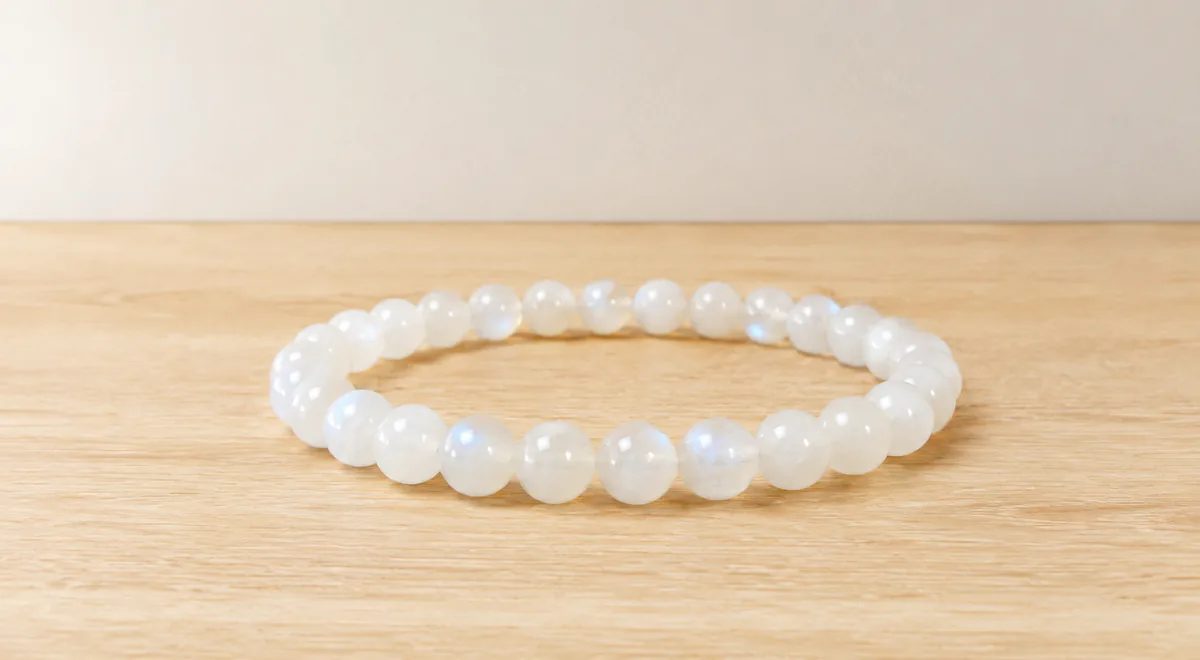
- I sell a bracelet with this name, and I explain why further down, without dodging it.
The answer, right away
You may have arrived here after several months of waiting, or after bad news. I'm not going to make you read three thousand words before answering.
Moonstone does not increase your chances of conceiving. It doesn't regulate a cycle, it doesn't act on any organ, on any hormone, on any bodily function. No study shows anything of the kind, for this stone or for any other. This isn't a cautious position on my part, it's simply how things are.
If you're looking for something that could actually help, it isn't here. It's with a doctor or a midwife, and I've put the useful benchmarks in the section on that topic, with the timeframes past which seeing someone is recommended.
What I can do, though, is the rest of this page: explain where this reputation comes from, since when it has existed, and above all how to recognise the wording that does promise you something. Because you're going to run into a lot of it.
A piece of moonstone jewellery has no demonstrated effect on health or on fertility. It does not replace a diagnosis, a treatment, or the advice of a healthcare professional. Never interrupt ongoing care and never delay a consultation because of a stone. Read the full disclaimer.
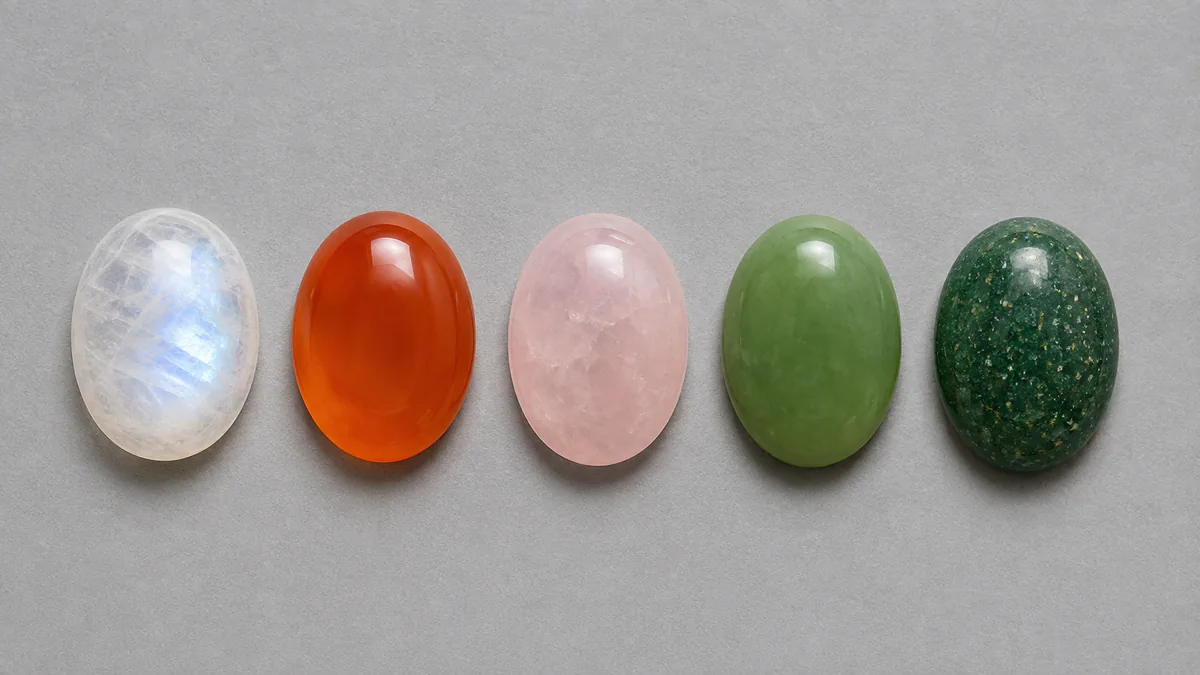
The stones tradition calls fertility stones
Since you probably landed here looking for which stone is supposed to help, here is the full list of what's said, and where it comes from. I'm giving it to you so you don't have to look for it elsewhere, where it will come bundled with promises.
| Stone | What tradition credits it with | Origin |
|---|---|---|
| Moonstone | The cycle, the body's rhythms, the feminine | 1990s |
| Carnelian | Life force, the lower belly, warmth | Disputed |
| Rose quartz | Self-tenderness, soothing | 20th century |
| Jade | Protection, family continuity | 20th century |
| Green aventurine | Renewal, growth | 20th century |
| Rhodonite | Emotional blockages | 20th century |
| Garnet | Energy, vitality | 20th century |
Look at the right-hand column before the others. None of these attributions is more than a century old, and most are much more recent. These aren't transmitted bodies of knowledge, they're correspondences established by guidebook authors in the twentieth century, whose works I've dated in the properties of moonstone.
The "disputed" line for carnelian deserves a word, because it's the argument most often raised to give these lists some depth. You'll read everywhere that ancient Egypt made it a stone of fecundity. What's established is that carnelian appears in Egyptian funerary and protective amulets, notably linked to the goddess Isis. Turning it into a conception stone is a modern shift, and I haven't found a single ancient source that says so.
On what these pairings between stones are actually worth, and which ones damage each other, see what crystals to pair with moonstone.
Why moonstone always comes up first
Of the seven stones in the table, it's the one cited first nine times out of ten. The reason is simple, and it has nothing to do with the stone.
It's a matter of name and calendar. The lunar cycle lasts about twenty-nine and a half days. The menstrual cycle runs a similar length. Nearly every culture made that connection, long before understanding anything about either one. A stone that carries the Moon's name inherited the association through its name.
That's the whole chain: the Moon makes the month, the month makes the cycle, the stone carries the Moon's name, so the stone is the stone of the cycle, so the stone is the stone of fertility. Every link is an analogy, none is an observation.
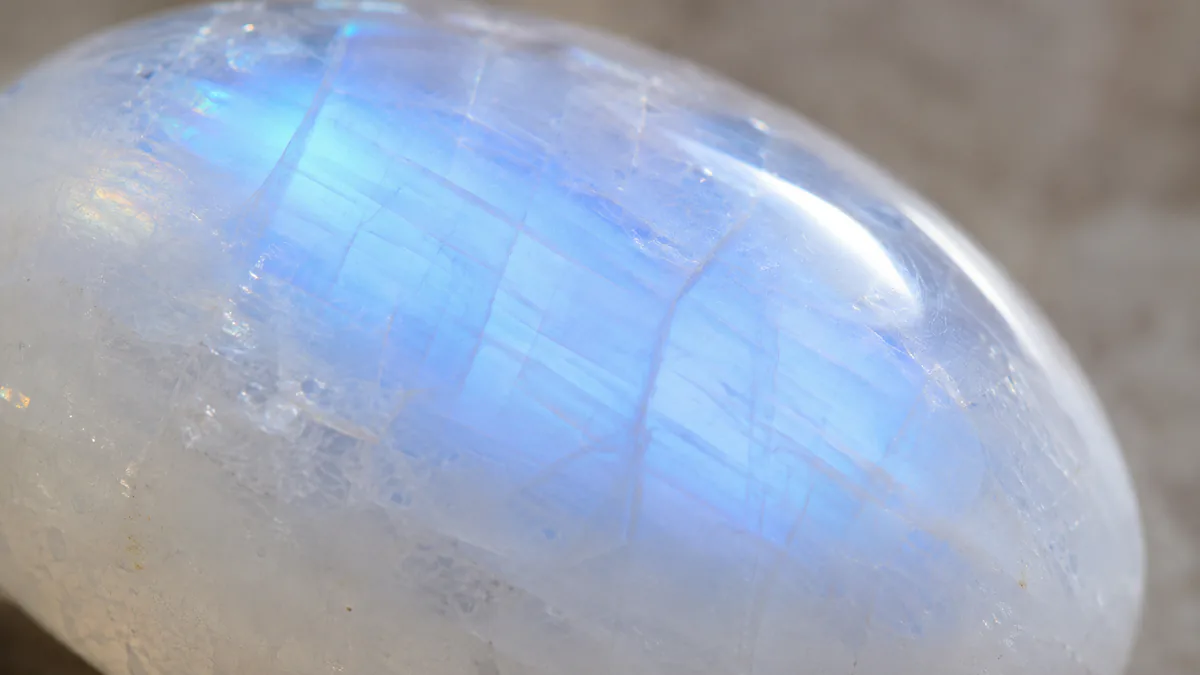
I'll state, in a separate paragraph and in the indicative, what's actually true of the stone itself: it's a feldspar, an orthoclase, whose name comes from its sheen, not from the Moon. It has no relationship to the Moon, neither in origin nor composition, and the topic is covered in moonstone or piece of the Moon. So the chain of analogies starts from a name that is itself a metaphor.
Since when, exactly
There are two layers, and they constantly get mixed up. Separating them changes the reading entirely.
The old layer exists, and it doesn't talk about conception. In India, moonstone is a traditional wedding gift, linked to the lunar god Chandra, and given at certain life milestones. That is documented and it is real. But it's about union, marital bonds and passage, not fertility in the medical sense. The full traditions are covered in the myths and legends of moonstone, and the meaning of the gift in the meaning of moonstone.
The recent layer is the one that talks about conception, and it's about thirty years old. It appears in the wake of English-language crystal guides published between 1985 and 2003, then spreads massively into French from the 1990s onward. That's the layer that produced the vocabulary of "fertility stones," "conception bracelets" and wearing protocols.
The distinction isn't a scholarly detail. When a shop writes "the ancients used this stone to encourage conception," it passes off a thirty-year-old idea as ancient knowledge, on a topic where people are ready to believe a great deal. That's the core of what bothers me.
One thing I want to state clearly: no serious ancient tradition presents a stone as a means of conceiving. Promises of results, timeframes for effectiveness and wearing protocols belong to no body of tradition. They are sales arguments, written recently, for people who are hoping.
The wording that should put you on alert
Here is what I think is the single most useful thing on this whole page, because you're going to look at other sites after this one.
There's a very clear line between reporting a belief and promising an effect, and it shows in the choice of verbs. A few phrases actually in circulation, and what they do:
- "Harmonizes hormone levels": an explicit medical claim. A hormone is a measurable molecule, not a metaphor.
- "Supports balance in the reproductive system": the same thing, worded more softly. A reproductive system is a set of organs.
- "Activates the sacral chakra, the centre of reproduction": mixes a belief system and anatomical vocabulary in the same sentence. That is exactly what I refuse to do.
- "An excellent complement to your journey": the word complement suggests an action added to a treatment. Nothing is added.
- "How to wear it to maximize its effects": assumes there are effects to maximize.
This isn't a matter of taste. I work under French law, and in France, any advertising claim must be substantiated by whoever makes it, including properties attributed to a mineral. Without scientific proof, such a claim can amount to deceptive marketing: that's the position of the DGCCRF, France's consumer protection authority, which I detail in the properties of moonstone.
Honest phrasing exists, and it's easy to spot: it says who claims it, when, and it uses the conditional. "Contemporary crystal healing links this stone to the feminine cycle" is a true sentence. "This stone regulates the cycle" is a false one.
The medical benchmarks, and when to see someone
This section isn't here to check a box. It's the only genuinely useful information on this entire page, and it comes from public sources you can verify yourself.
Infertility is a medical condition, not a personal failure. The World Health Organization defines it as the inability to achieve a pregnancy after twelve months or more of regular, unprotected intercourse. That's a medical definition, with a time threshold, and it says nothing about you.
You are very far from alone. In its April 2023 report, WHO estimates that 17.5% of the global adult population, or roughly one person in six, is affected by infertility at some point in their life. Rates are comparable in wealthy and low-income countries alike. The organization also published its first global guideline on the topic in November 2025.
The timeframes past which seeing someone is recommended: after twelve months of regular, unprotected trying under age 35, and after six months from age 35 onward, or sooner if there's a known issue likely to affect either partner's fertility. Your GP can refer you on from there.
Three things I'll add, because people write to me about them often. A workup concerns both partners in the couple, not just the person who would carry the pregnancy. Booking an appointment commits you to nothing and doesn't mean starting a protocol. And if a timeframe worries you before those thresholds, nobody will fault you for seeing someone earlier.
The person to talk to is your primary care doctor, your OB-GYN, or a midwife. Not a jeweler, and not a forum.
Why I sell a bracelet with this name
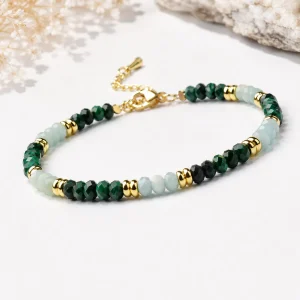
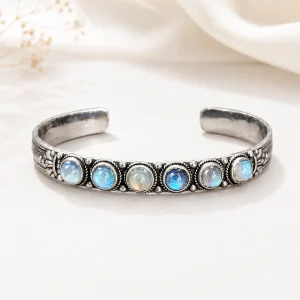
The question is fair, and it would be cowardly not to raise it myself on this page. There's a bracelet in the catalog called the moonstone fertility bracelet.
It carries that name because that's how it's searched for and named in the trade. The name describes a reputation, not a function. On its product page, the most visible sentence states that it has no effect on fertility, spelled out plainly, with no wording that would leave a door ajar.
So why sell it? Because people search for this bracelet, in real numbers, and they'll find it no matter what. The only thing I have any control over is what they'll read when they find it. Elsewhere, they'll be told how to wear it to maximize its effects, which moon phase to recharge it under, and how long to wait before seeing results. I'd rather you buy this bracelet here, where nothing is promised, than somewhere that promises you everything.
This reasoning has a limit, and I know it: someone could tell me a name like that shouldn't exist at all. That's an argument I understand. If I came to think they were right, the piece would come off the catalog, and this article with it. That's not a rhetorical flourish: the two go together.
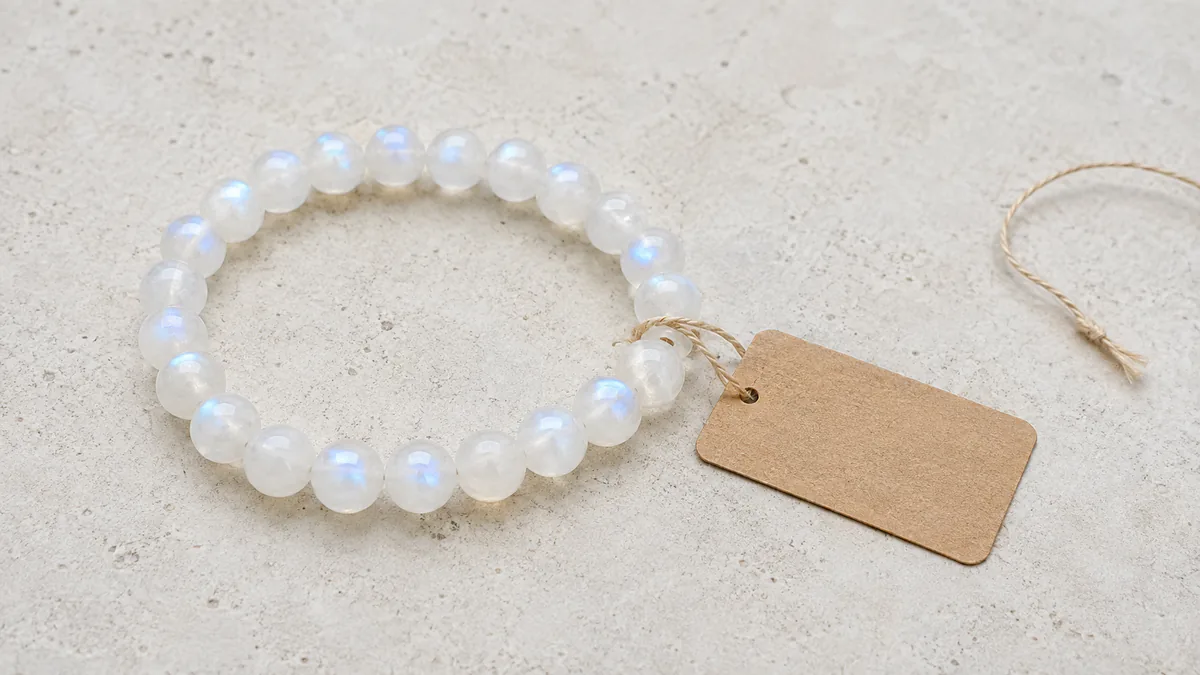
What a beautiful object can do, nobody denies: you grow attached to it, you look at it, it marks an intention or a period of time. That's already something, and it's honest to call it by its name rather than another one. The rest of what I refuse to do is in the complete guide.
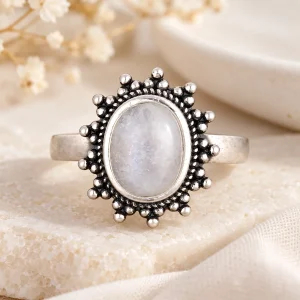
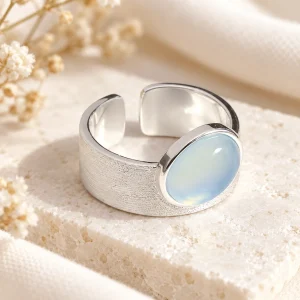
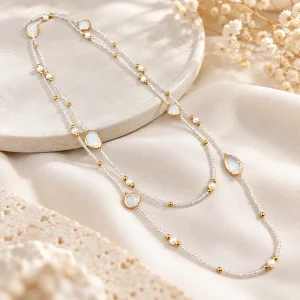
The bracelet I just mentioned, and three others
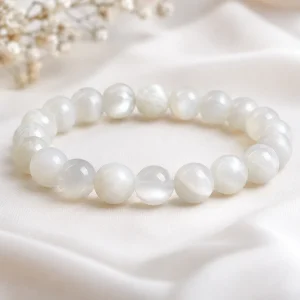
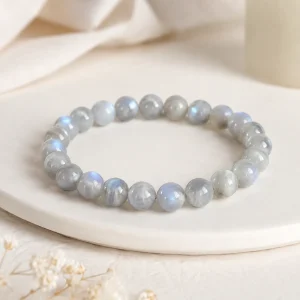
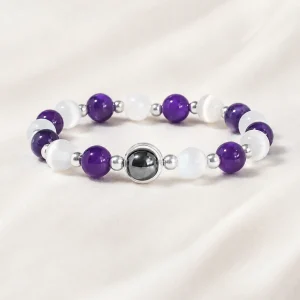
Giving a stone to someone who's trying
People write to me about this regularly, often on behalf of a sister or a friend, and the question is always asked very carefully. It deserves an equally careful answer.
The risk isn't the object, it's the message that comes with it. A bracelet given with "this will help you" puts the person in an impossible position: if nothing happens, the object becomes a daily reminder, and on top of that, she'll have to manage your feelings too. A gift should never create that kind of debt.
What works instead is a gift that doesn't bring up the topic. "I was thinking of you" is more than enough, and it does perfectly well without a stone chosen for its reputation. Many people trying to conceive say the same thing: what they want is for people to be there without commenting.
What's best avoided: a stone chosen explicitly for that reason, a card that alludes to it, advice on how to wear it, anything that would turn a piece of jewellery into an intervention. On the gesture of giving in general, there's giving a moonstone.
And if the person is already pregnant, the topic changes entirely, with its own precautions: that's which stone for a pregnant woman.
Frequently asked questions
Does moonstone help you get pregnant?
No. It doesn't increase your chances of conceiving, doesn't regulate any cycle and doesn't act on any hormone. No study shows anything of the kind, for this stone or for any other. If this concerns you, the person to talk to is a doctor or a midwife.
What is the fertility stone in crystal healing?
Lists mostly cite moonstone and carnelian, then rose quartz, jade, green aventurine, rhodonite and garnet. None of these attributions is more than a century old, and none has a demonstrated effect.
Why is moonstone linked to fertility?
Through a chain of analogies: the lunar cycle lasts about twenty-nine and a half days, the menstrual cycle runs a similar length, and the stone carries the Moon's name. The association comes from the stone's name, not from its properties. It has no actual relationship to the Moon, either.
Is this an ancient tradition?
There are two layers. An old one, Indian, that makes the stone a wedding gift linked to the god Chandra: it speaks of union, not conception. And a recent one, which talks about fertility and spread starting in the 1990s.
After how long should you see a doctor?
Guidance generally points to twelve months of regular, unprotected trying under age 35, and six months from age 35 onward, or sooner if there's a known issue. The workup concerns both partners in the couple. Booking an appointment commits you to nothing.
How many people are affected by infertility?
According to WHO's April 2023 report, roughly 17.5% of the global adult population, or about one person in six over their lifetime. Rates are comparable regardless of a country's income level.
How do you spot a shop that's promising too much?
By the verbs. "Harmonizes hormones," "supports balance in the reproductive system," "a complement to your journey" are health claims. Honest wording says who's making the claim, since when, and uses the conditional.
Why do you sell a bracelet called fertility?
Because people search for it and will find it regardless, and the only thing I have any control over is what they'll read when they find it. Its product page states plainly that it has no effect. If I decided that name shouldn't exist, the piece would come off the catalog, and this article with it.
Should you give a stone to someone trying to conceive?
A gift, yes. A gift that brings up the topic, no. A stone given with "this will help you" becomes a daily reminder if nothing happens. "I was thinking of you" is enough, and does perfectly well without a stone chosen for its reputation.
Can you wear moonstone while pregnant?
A piece of jewellery worn normally poses no particular risk, and it has no added effect either. The real precautions, metal allergies and the stone's fragility, are in which stone for a pregnant woman and the contraindications.
Where to go next
- Related topics, handled with the same care: which stone for a pregnant woman, periods and the cycle, contraindications.
- The general picture: the properties and benefits, the meaning, the chakras.
- The stone's history: the myths and legends, moonstone or piece of the Moon.
- The stone and the jewellery: the complete guide, pairings, recognising a genuine stone.
The jewellery is in the shop, and the bracelets in their collection. If you want to tell me this page is poorly written, or that it's well written, write to me: it's the one page on the site where I'm still not sure I've found the right tone.
My sources
For the medical benchmarks: the World Health Organization, its fact sheet on infertility for the twelve-month definition, and its April 2023 report for the 17.5% figure of the global adult population, or one person in six. WHO published its first global guideline on infertility in November 2025. For the timeframes for seeing a doctor, and for the principle of a couple's workup, standard reproductive medicine guidance available through your GP.
For the legal framework around claims: the position of France's DGCCRF consumer protection authority, which states that any advertising claim must be substantiated by whoever makes it, including properties attributed to a mineral, and that failing this it may amount to deceptive marketing practice.
For dating the attributions: the founding guides of contemporary crystal healing, published between 1985 and 2003, whose list and dates are in the properties of moonstone. For the old Indian layer, the historical fact sheets of the GIA and the traditions reported in the myths and legends.
Two limitations I'd rather state. First, the "origin" column in the table gives a period rather than a date: dating a belief that circulates is approximate, and what I'm describing is the moment an idea becomes massively present in the texts. Second, the phrases quoted in the wording section are genuinely in circulation on shops, but I'm not naming anyone: my aim is to teach you to recognise them, not to call out competitors.
Last updated: August 19, 2026. If you find an error in this article, let me know: I'll correct it and note it.
✦ À porter, à offrir
Découvrez mes créations