


Description
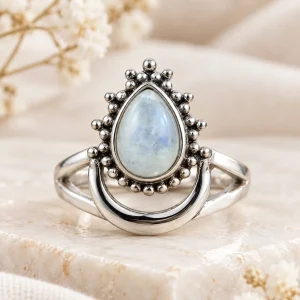
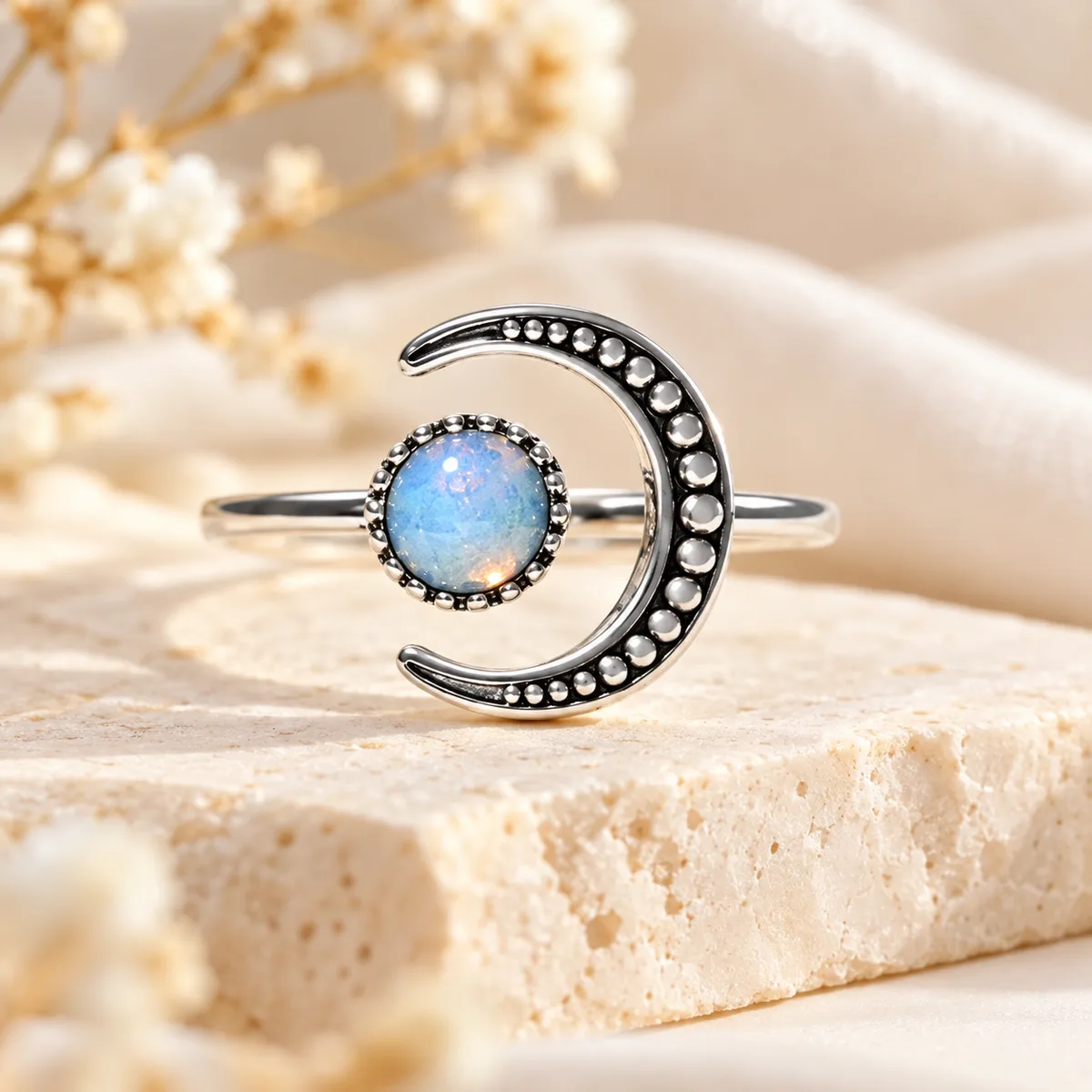
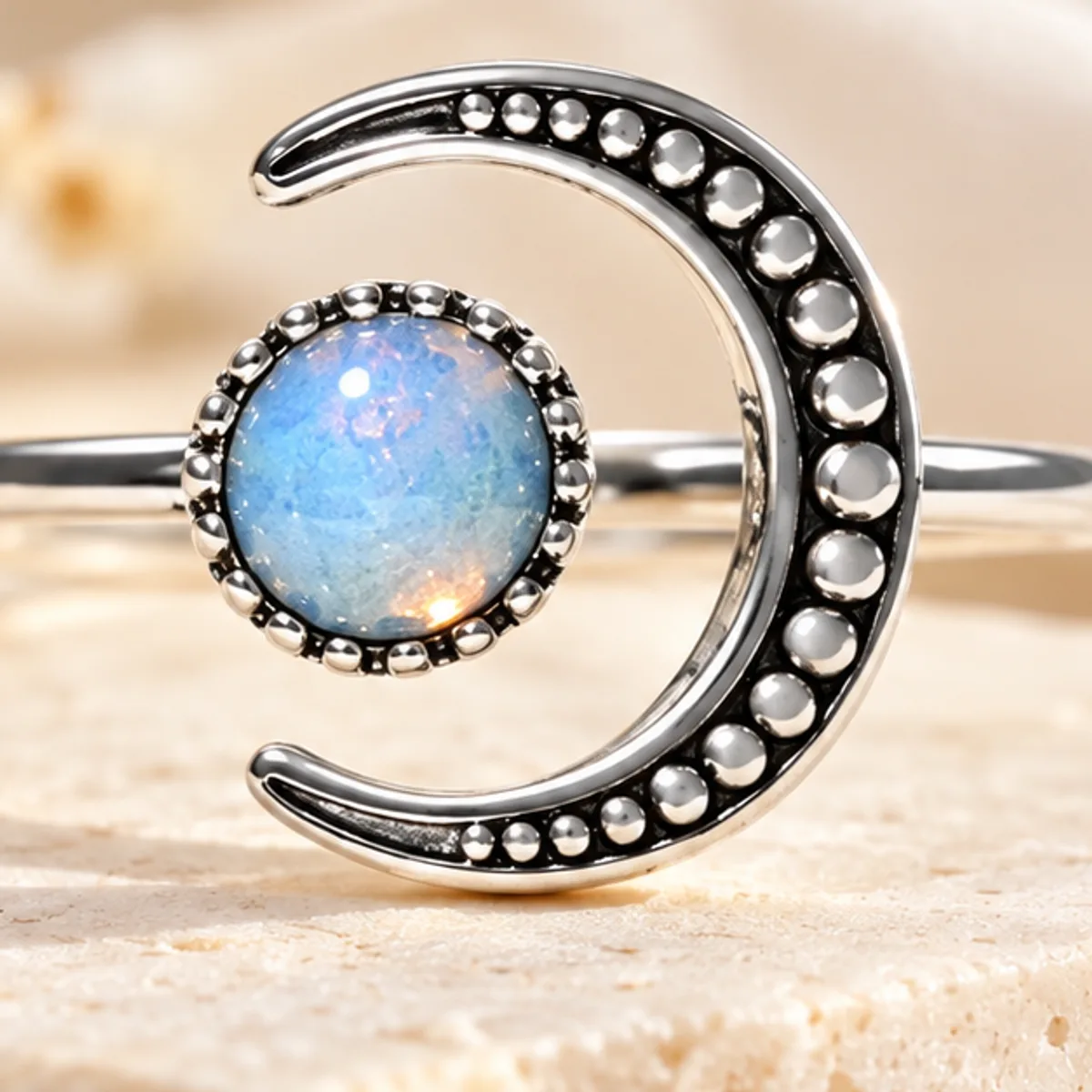
A small round cabochon, and beside it a crescent moon drawn by a line of silver beads soldered one to the next. The moon is not cut out of the metal, it is built bead by bead.
A crescent made of beads
The difference from a cut out crescent is immediate. A silver blade in an arc gives back a flat surface and a clean shadow; a line of beads gives back a succession of small bright points that light up one after another as the hand turns. The crescent glitters instead of shining, and that gives it the grain the moon has to the naked eye rather than the edge of a logo.
The beads are graded in size: the largest in the middle of the arc, the smallest at the two tips. That is what gives the crescent its natural taper. A line of identical beads would have produced a regular arc of a circle, and the eye would not have recognised a moon in it. The motif depends on that gradation, not on the curvature.
The round cabochon makes the full moon facing the crescent. On this shape the adularescence gathers into a centred disc of light that moves without deforming as the hand turns. It is the only composition here where the ornament and the optical effect tell the same story, and that is what makes this small piece truer than it looks.
Mounted in a closed bezel, with no claws and no glue, on a fine two millimetre band. Nothing sticks out, nothing catches, and the stone, which chips on impact, is protected all the way round. The ring can be worn on any finger, including the little finger. The other rings are here.
- Real moonstone, small round cabochon, disc of light centred on the dome.
- 925 sterling silver hallmarked S925, crescent built from soldered beads of decreasing size.
- Closed bezel with no glue, fine 2 mm band.
- sizes I 1/2 to T 1/2, that is 48 to 62 mm. Delivered in two weeks.
The specifications
- Stone
- Real moonstone (adularia), small round cabochon
- Origin
- India
- Metal
- 925 sterling silver, S925 hallmark
- Setting
- Closed bezel, no claws, no glue
- Shape
- Fine 2 mm band, crescent of graded soldered beads
- Finish
- Polished silver, between the beads lightly oxidised
- Sizes
- I 1/2 to T 1/2 (48 to 62 mm)
- Gender
- Women
- Brand
- Melissa Moon
Why beads and not a cut arc
A cut crescent takes twenty minutes: saw, file, polish, done. The beaded one takes two hours, because each bead is melted separately, sorted by size, and soldered in place without moving the ones already set. The heat that joins bead six is the same heat that can loosen bead three, so the order matters and so does the speed. It is the sort of work that is invisible in a photograph and obvious in the hand.
I keep making it because granulation is old, useful and nearly extinct in cheap silver, and because the surface it gives cannot be imitated by stamping. If you have a piece of antique jewellery with the same texture, it was made the same way, probably by somebody who also wondered whether anyone would notice.
A stamped crescent has one shadow. This one has thirty little ones, and that is the whole point.
No salt, no ultrasonic tank, no hot water: moonstone is a feldspar, and all three damage it for good. Dirt gathers between the beads, which is where the ring loses its sparkle first, so a soft toothbrush with lukewarm water once a month restores it completely. Cleaning a moonstone piece covers the routine and caring for it without harming it the rest.