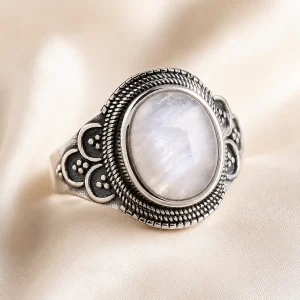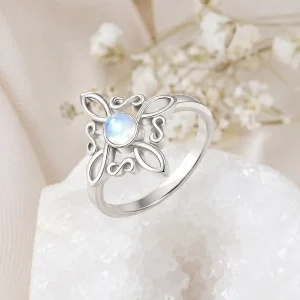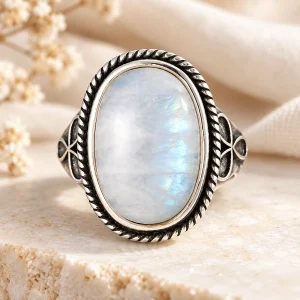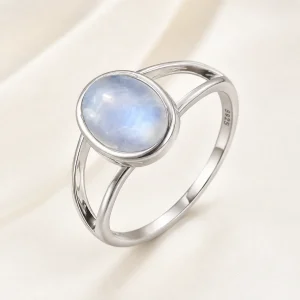


Description
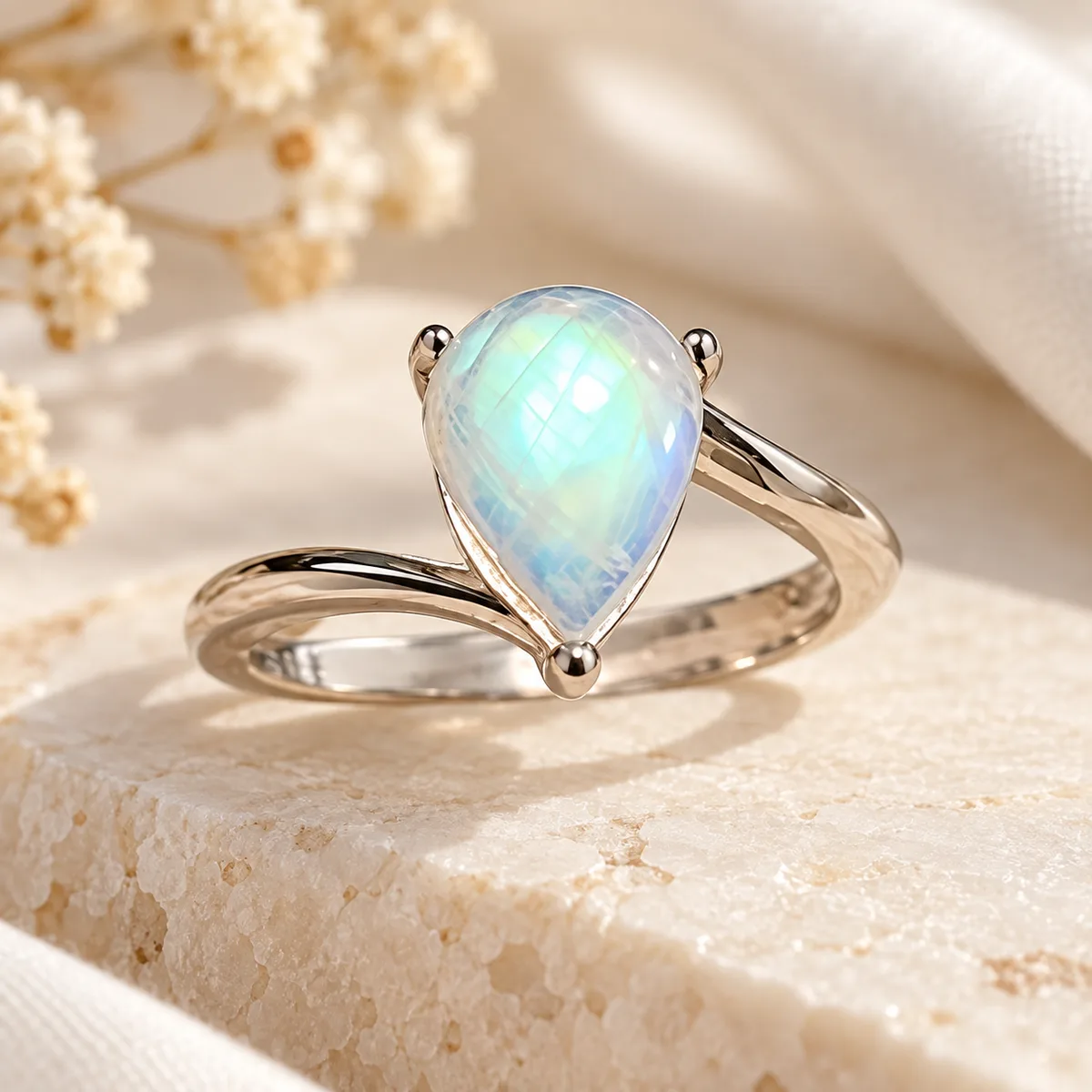
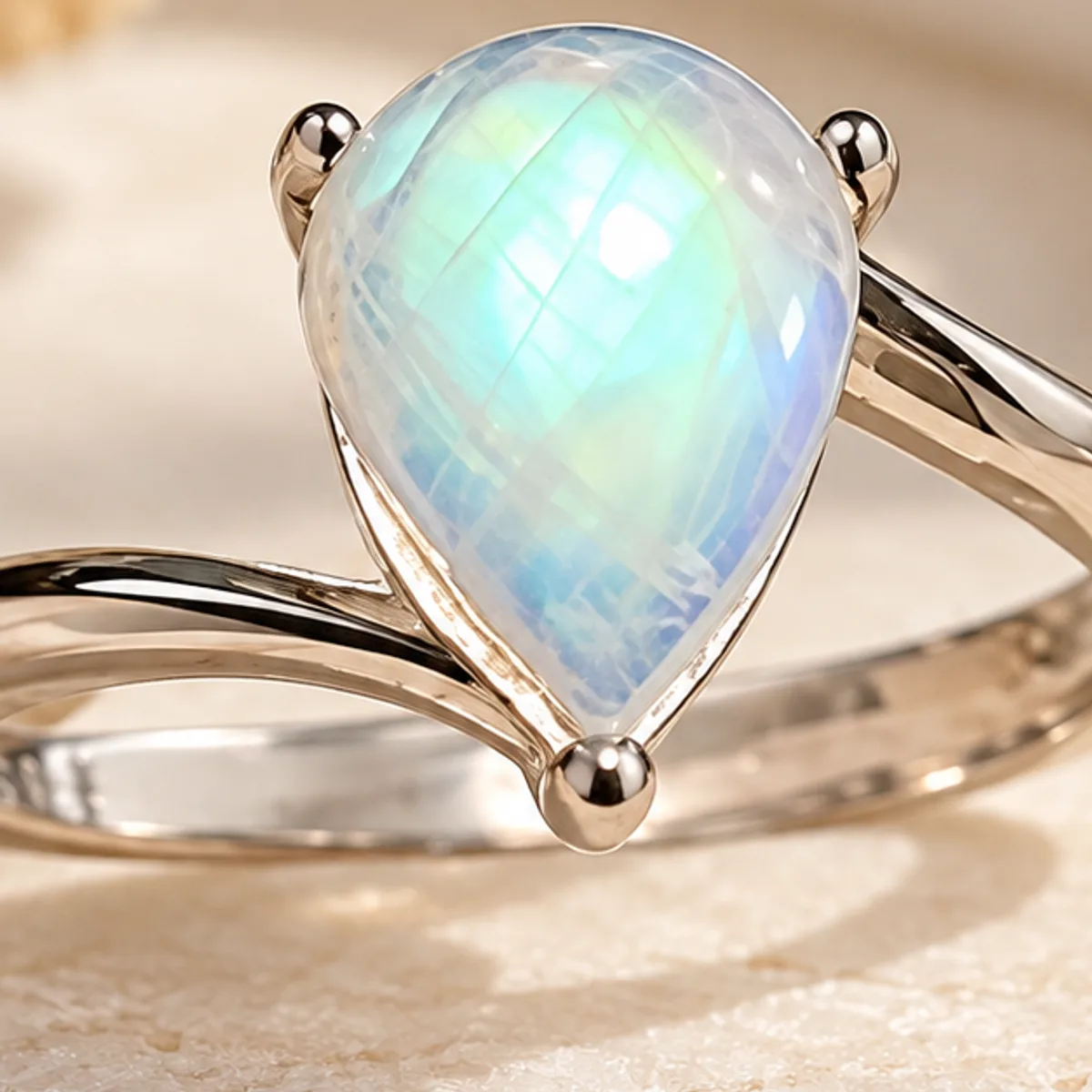
A teardrop cabochon raised on fine claws, above a shank whose two arms cross under the stone. It is the most expensive ring in the collection, and I would rather explain that than let you guess.
Where the price goes
I sell a plain bezel ring at thirty-one euros and this one at seventy-eight, with the same silver and a stone from the same parcel. The difference is entirely in the hours. A closed bezel is one strip of silver, soldered, trued, and pushed over the stone: an hour of work once I am warmed up. This ring is four claws, each drawn down, filed to the same height, and polished individually, plus a shank made of two arms that cross and have to meet at exactly the right angle or the whole thing sits crooked on the finger. Six hours, and about one in six is scrapped along the way. That is the price, and there is nothing else in it.
Claws on a teardrop are the combination I usually refuse, so I owe you the reason I made an exception. The tip of a teardrop is the fragile part, and a claw setting normally leaves it exposed. Here the fourth claw sits directly over the point, wider than the other three, and is the only reason this piece exists in this shape. Look at the photographs: the claw at the tip is visibly heavier. That is not a styling choice.
What you get for the money is height. The stone stands clear of the finger, light reaches it from below as well as above, and the blue veil moves across it in a way it never does in a closed setting. Side by side with the bezel models, this one is unmistakably brighter. Whether that is worth forty-seven euros more is your call, not mine.
The crossover shank means the ring has no single narrowest point, so your usual size is right. The other rings are here, including the plain one at the other end of the range.
- Teardrop moonstone cabochon raised on four claws, the one at the tip deliberately heavier.
- 925 sterling silver hallmarked S925, crossover shank, hand-drawn claws.
- Six hours of bench work, which is the whole of the price difference.
- sizes I 1/2 to T 1/2, that is 48 to 62 mm. Delivered in two weeks.
The specifications
- Stone
- Real moonstone (adularia), teardrop cabochon
- Origin
- India
- Metal
- 925 sterling silver, S925 hallmark
- Setting
- Four hand-drawn claws, reinforced at the tip, no glue
- Shape
- Crossover shank, two arms meeting under the stone
- Finish
- Polished silver, hollows lightly oxidised
- Sizes
- I 1/2 to T 1/2 (48 to 62 mm)
- Gender
- Women
- Brand
- Melissa Moon
What costs more and what does not
It is worth knowing what does not change with the price. The stone is from the same parcel as the thirty-one euro ring, the silver is the same alloy from the same supplier, the hallmark is the same, and the two-week lead time is the same. Nobody upgrades the material at this level, and a workshop that tells you the stone is better in the expensive model is either buying badly or describing badly.
What does change is the number of operations and the failure rate. Claws are unforgiving: filed a tenth of a millimetre too far and the stone rocks, and that piece goes back in the crucible. I build that loss into the price rather than shipping the marginal ones, which is the only honest way to do it and also the reason I will not be talked down on this model.
The stone costs the same in both rings. You are paying for six hours and for the ones that did not survive.
No salt, no ultrasonic tank, no hot water: moonstone is a feldspar, and all three damage it for good. On a claw setting there is a second habit worth having, which is to run a fingernail over the four claws once a month and feel whether one has lifted. It takes five seconds and it is how you avoid losing the stone. Cleaning a moonstone piece and caring for it without harming it cover the rest. Chipping is the risk this setting manages rather than removes.