

Description
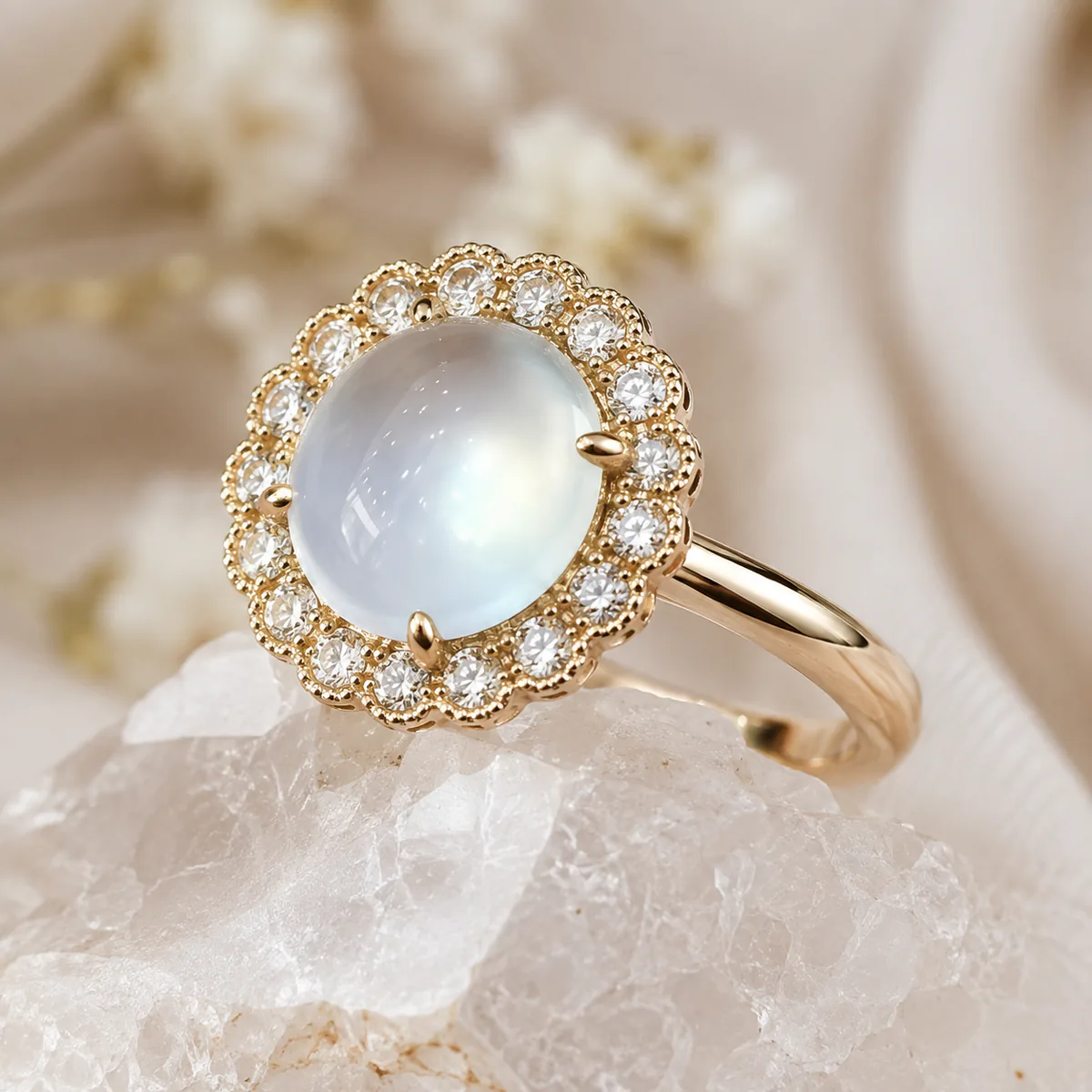
It is the only ring in the shop that surrounds its stone. A round, very pale cabochon, almost translucent, ringed by a crown of small clear stones set one by one in scalloped seats, all of it in yellow gold on a band left plain. It is the one you choose when you want a frank light around a soft one.
A crown around a soft stone
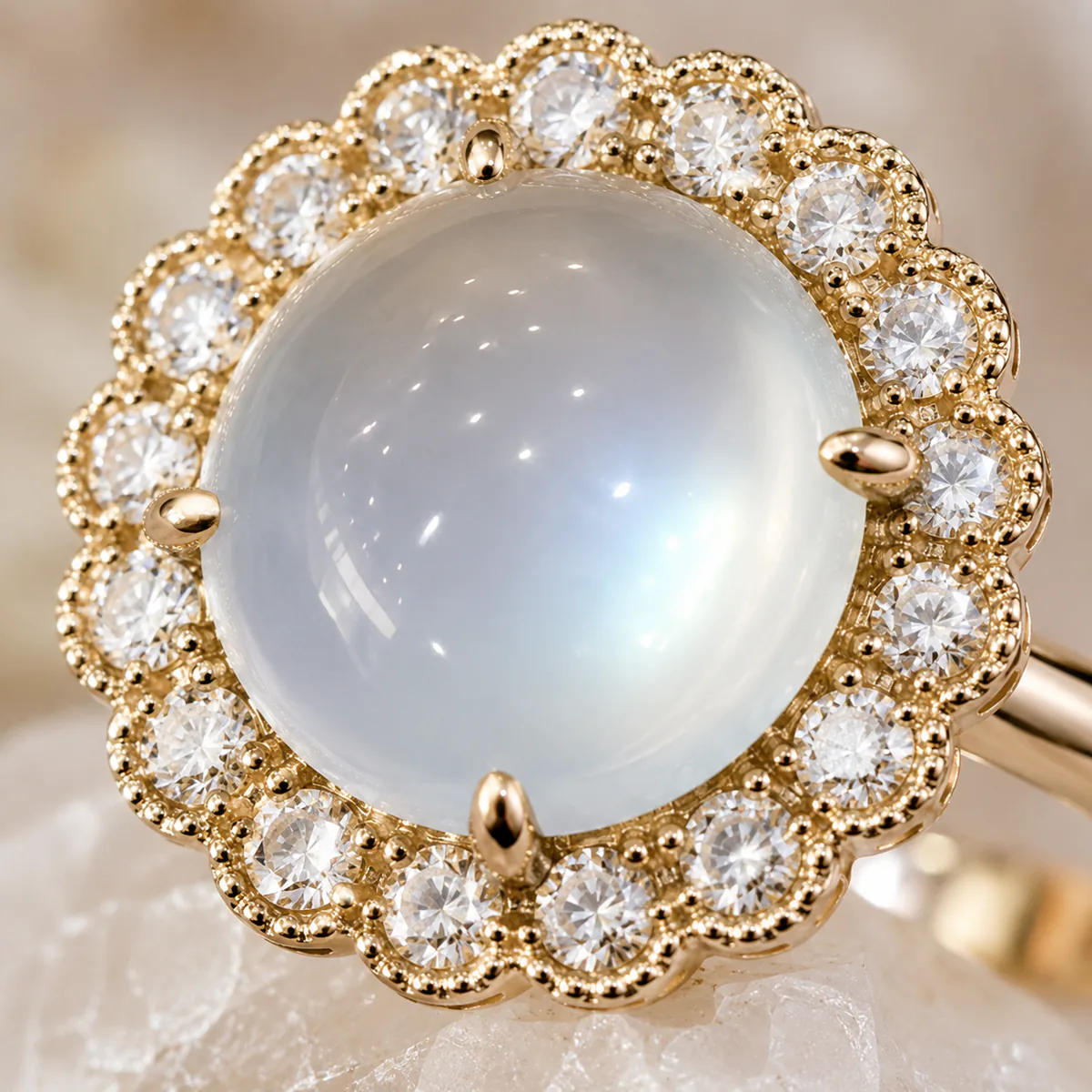
The halo counts about fifteen stones, each in its own seat bordered by a fine beaded edge, those minute balls worked along the ridge of the metal. It is a detail you only see close up, and it changes everything: without it, the crown would make a ring of bare metal between the stones, a little hard. With it, the outline melts together and the whole takes on that flower-like air which gives this kind of setting its name.
The central stone is round, high-domed, and far more translucent than the other cabochons in the catalogue. It does not play the same part: where a milky moonstone lays down a frank blue veil, this one lets light through and its sheen reads in transparency, more discreet, more liquid. The four claws holding it are minute and placed on the diagonals so as not to break that reading. I have set out elsewhere the six criteria I judge a stone by, and translucency is one of them.
A halo means two very different hardnesses on one piece
Here is the point to have in mind before buying a ring of this type, from any shop at all. The stones of the outline are much harder than the one at the centre: moonstone sits at around 6 on the Mohs scale, the accent stones of the halo between 8 and 8.5. Concretely, it is the small ones that will scratch the large one, and not the other way round. It does not happen while wearing it, it happens when the ring rolls around at the bottom of a pouch with other pieces, or when you rub it absent-mindedly.
The remedy is simple but you have to know it: this ring is stored on its own, in its pouch, and never loose. Add that moonstone has perfect cleavage and chips on impact without scratching for all that, and that the sizing guide will save you a return, this mounting not being easy to resize.
The most classic silhouette in the catalogue
It is also the plainest in shape of the whole catalogue. The shop’s other rings take positions, a crossed band, a blackened decoration, an openwork mounting. This one seeks none of that: it is a silhouette you recognise immediately, and that is precisely what is asked of it. The others are here if you are looking for the opposite. Sizes run from I½ to T½.
Crystal healing tradition makes moonstone a stone of cycles, of intuition and of the return to calm; it is said to accompany periods of change rather than to bring them about. I will go no further: none of it is demonstrated and no piece of jewellery heals anything. Separately, I have gathered what tradition lends it and what a moonstone ring is said to mean when it is given.
- Round moonstone cabochon, very translucent, held by four fine claws.
- Halo of about fifteen accent stones, each in a scalloped seat bordered with beading.
- Yellow gold, plain polished band. The most classic silhouette in the catalogue.
- Sizes I½ to T½. Delivered in two weeks with a cotton pouch, a handwritten note and a care card.
The specifications
- Central stone
- Moonstone, round cabochon cut
- Halo
- About fifteen accent stones in scalloped bezel settings
- Metal
- Yellow gold
- Setting
- Four claws on the central stone, beading around the outline
- Hardness
- Around 6 for the central stone, far higher for the halo
- Sizes
- I½ to T½
- Gender
- Women
- Brand
- Melissa Moon
Putting a halo around a soft stone is a wager
A halo is made for a hard stone. It was invented for the diamond and for resistant coloured stones, and it fills two functions: visually enlarging the centre, and protecting it with a rampart. On a moonstone, the first function works perfectly, the second far less. The rampart does exist against side impacts, but it brings its own risk with it, that of scratching what it surrounds. It is a compromise I own on condition of saying so, and it is settled entirely by how you store the ring.
The beading, on the other hand, is a pure pleasure of making. Those minute balls are rolled with a tool along the ridge of the metal, one by one, and it is an early twentieth-century technique that cannot be simulated by casting without it showing. It is the detail I look at to judge the quality of a mounting of this type. The rest of the shop is here.
People think a halo protects the stone. It protects it from the outside and threatens it from the inside. Store it on its own, and the question no longer arises.
No salt, no ultrasonic tank, no hot water: moonstone is a feldspar, and all three damage it for good. The ultrasonic tank is all the more to be banned here since it makes the stones vibrate in their seats. Lukewarm water, a soft cloth, and careful drying between the stones of the halo, where soapy water likes to linger. Store this ring on its own in its pouch, never loose with other pieces: it is the only precaution that really counts on this model. The detail is in cleaning a moonstone piece, and the safe methods for the stone in caring for it without harming it.