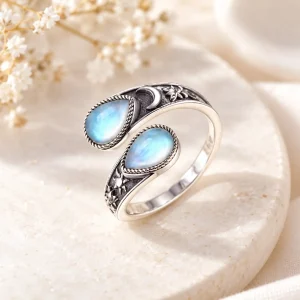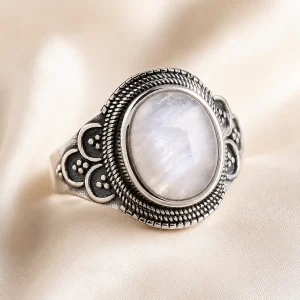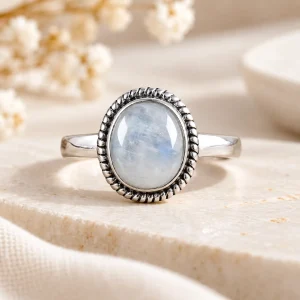



Description
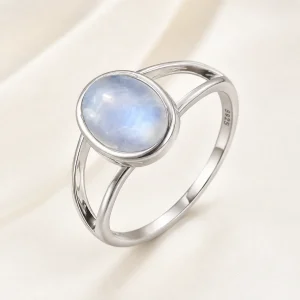
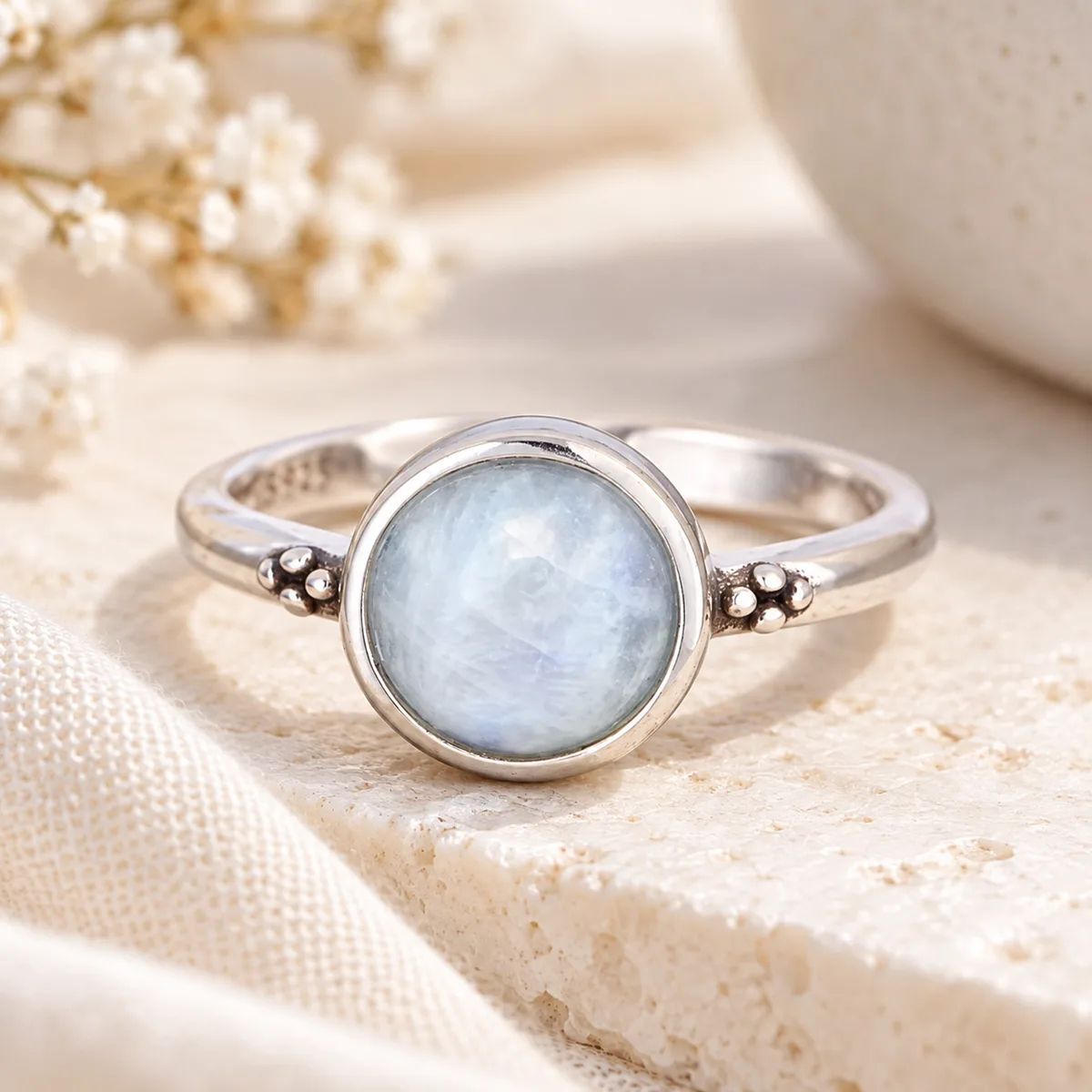
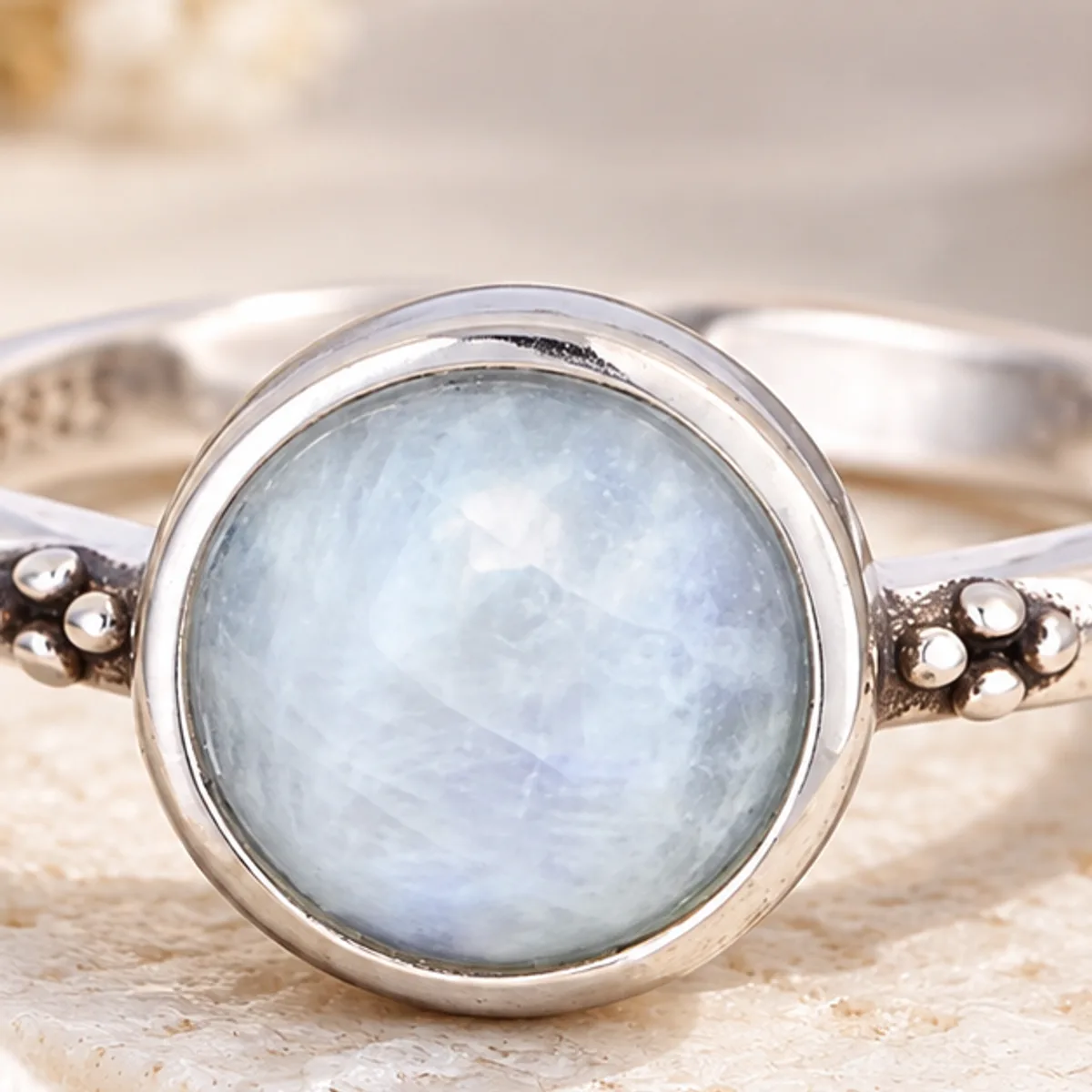
A round cabochon, a thin band, and a single silver bead on each side. It is the lightest ring I make, and the one designed to be worn next to others rather than alone.
A thin band, and how to stack it
Everything here is subordinate to one idea: this ring is meant to share a finger. A thin band, a low setting, two small beads and nothing else, so that it sits against another ring without fighting it. If you already own a plain band or a fine chain ring, this is the moonstone that will go with them. If you own one of the wide models from this collection, wear this one on another finger rather than beside it.
Stacking has one rule worth knowing: the rings must be of similar height, not of similar width. Two thin bands of different heights rub against each other at a single point and both wear there. Two bands of the same height rub along their whole contact line, which spreads the wear and is barely visible after years. This ring is deliberately low so that it stacks with an ordinary plain band.
The thin band raises the question of strength, and the honest answer is that it depends on where. A thin silver band is perfectly strong in tension, which is what it experiences on a finger, and weak in compression, which is what happens if you close a car door on it. It will not break, it will oval, and an oval ring can be reshaped by any jeweller in two minutes. That is a real advantage of silver over harder metals, which crack instead of bending.
The stone sits in a closed bezel and the two beads are set at the base of the bezel, where the band meets it. They hide the solder joint, which is their real function, and they were the smallest decoration I could put there without leaving the transition bare. The blue veil appears as a flash rather than a permanent haze, which suits a small stone. The other rings are here, and the size guide is quick.
- Round moonstone cabochon, closed bezel, a veil that appears as a flash.
- 925 sterling silver hallmarked S925, thin band, one set bead per shoulder.
- The lightest ring in the collection, made to be stacked.
- sizes I 1/2 to T 1/2, that is 48 to 62 mm. Delivered in two weeks.
The specifications
- Stone
- Real moonstone (adularia), round cabochon
- Origin
- India
- Metal
- 925 sterling silver, S925 hallmark
- Setting
- Closed bezel, no glue
- Shape
- Thin band, low setting, one bead per shoulder
- Finish
- Bright silver, lightly oxidised under the bezel
- Sizes
- I 1/2 to T 1/2 (48 to 62 mm)
- Gender
- Women
- Brand
- Melissa Moon
What a thin silver ring can and cannot take
Silver is soft, and people take that as a warning when it is mostly an advantage. A thin silver band deforms rather than breaking, and a deformed band goes back to round. The same ring in a hard alloy would keep its shape longer and then fail without warning. I would rather have a metal that tells me it has been mistreated and can be put right.
The one thing a thin band genuinely dislikes is being stored loose with heavier pieces. In a bowl with three other rings and a bracelet, it ends up oval within a year simply from the weight. A pouch, a small box, or a ring stand costs nothing and solves it entirely. That is the whole maintenance advice for this model.
I have reshaped hundreds of thin silver rings and never once refused one. I cannot say the same for the hard alloys people buy because they are told they last.
No salt, no ultrasonic tank, no hot water: moonstone is a feldspar, and all three damage it for good. On this model the silver is bright rather than oxidised, so a soft cloth is enough to bring it back. The detail is in cleaning a moonstone piece, and the safe methods in caring for it without harming it. The bezel protects the stone, though a moonstone chips on a real knock, and on a low setting that knock is less likely than on a raised one.