

Description
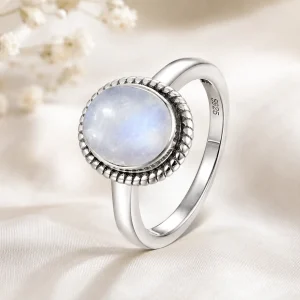
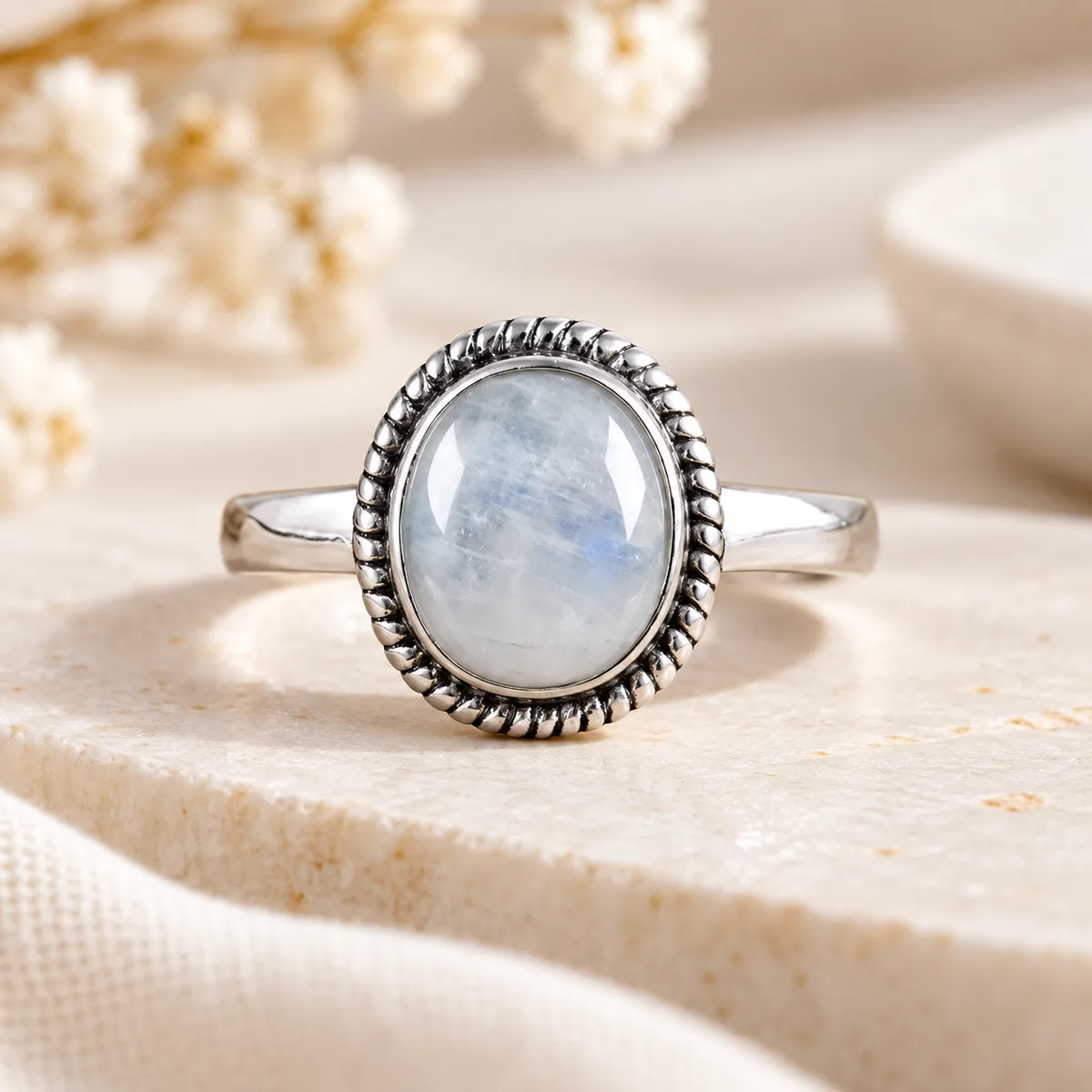
A small oval cabochon, a line of silver beads all around it, a slim band. Nothing more. This is the one I recommend to anyone who has never worn moonstone.
The easiest format to wear
The stone measures less than a centimetre at its longest, the band is a millimetre and a half wide, and the whole thing barely rises off the finger. That has three practical consequences. The ring catches on nothing, it slips under a glove, and it sits happily against anything else, including a wedding band. It is a ring you put on in the morning without thinking and find again in the evening without having once wondered whether it was in the way.
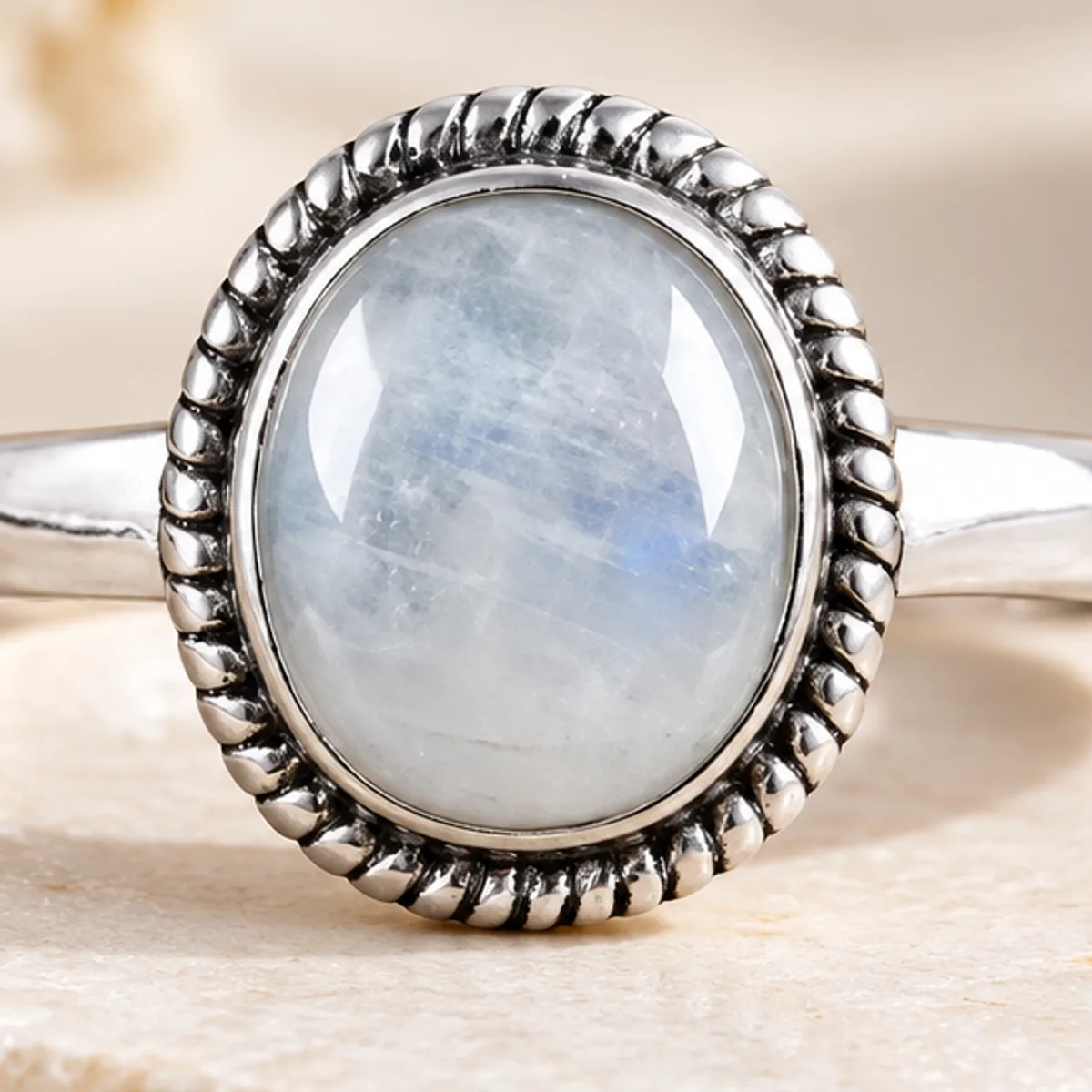
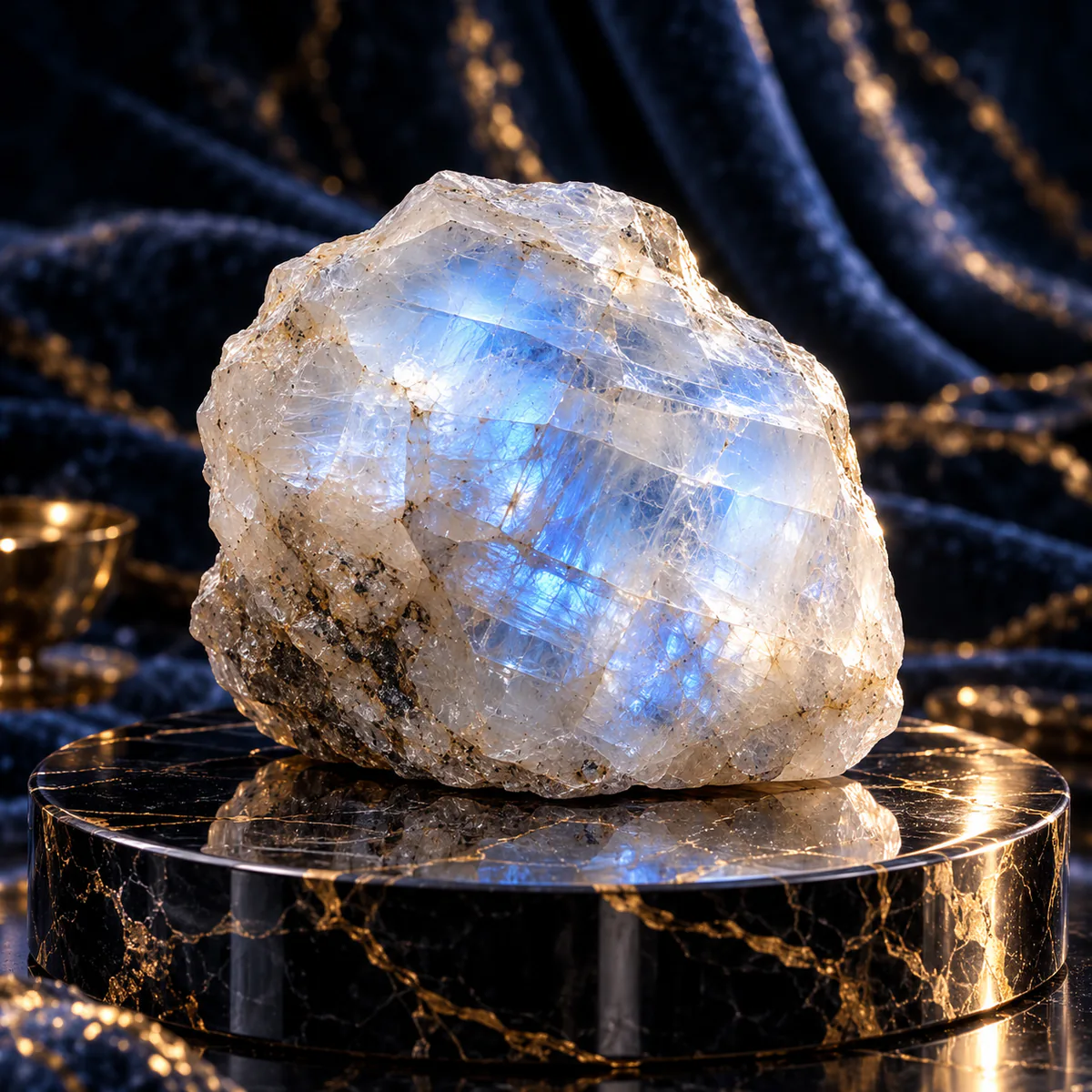
On a stone this size, adularescence does not behave as it does on a large cabochon. The veil does not slide, it ignites: it appears all at once when the angle is right, then goes out as the hand turns. That is less spectacular and more alive, and it is also why a well chosen small moonstone never looks like a dull stone. It does have to be well chosen, and the first criterion I check is that the reflection sits centred on the dome.
The edge around it is made of tiny beads soldered side by side, the same granulation work found on Etruscan jewellery. On a small stone it plays a role of scale: without it the cabochon would look lost on the band; with it the piece has a clean outline and the stone seems larger than it is. The beads are left bright, the band is polished, and only the gaps between the beads keep a little oxidation so the edge stands out.
The mount is a bezel setting, no claws and no glue. On this model that is also what lets the ring be worn all day with no particular care: nothing sticks out, and the stone, which chips on impact despite a decent hardness, is protected all the way around. If you hesitate between two sizes, the size guide is more reliable than a ring tried on in the evening. The other rings are here.
- Real moonstone, small oval cabochon, a clear blue reflection centred on the dome.
- 925 sterling silver hallmarked S925, edge of soldered beads, slim 1.5 mm band.
- Bezel set with no glue. Nothing sticks out, nothing catches.
- sizes I 1/2 to T 1/2, that is 48 to 62 mm. Delivered in two weeks with a cotton pouch and a care card.
The specifications
- Stone
- Real moonstone (adularia), small oval cabochon
- Origin
- India
- Metal
- 925 sterling silver, S925 hallmark
- Setting
- Bezel set, no glue
- Decoration
- Edge of soldered beads around the bezel
- Finish
- Polished silver, gaps lightly oxidised
- Sizes
- I 1/2 to T 1/2 (48 to 62 mm)
- Gender
- Women
- Brand
- Melissa Moon
Why I sell more small stones than large ones
It is not a question of budget, or not only. People buying a first moonstone almost always choose a small cabochon, and they come back to it afterwards. The reason I am given most often is that a large stone has to be matched to the rest, while a small one asks for nothing. There is also a reason nobody puts into words: a small stone is looked at close up, and that distance is more intimate.
The only thing I advise against on this model is taking it too tight. A slim band cannot be resized indefinitely, the material is thin and any alteration leaves a trace. Half a size up beats a band you can no longer pull off in summer.
My first ring was exactly this one, uglier, and I wore it for six years without taking it off. It is the page I found hardest to write without being sentimental.
No salt, no ultrasonic tank, no hot water: moonstone is a feldspar, and all three damage it for good. Lukewarm water, a soft cloth, and the ring comes off before the pool and the housework. A soft toothbrush is enough to clean between the beads. The detail is in cleaning a moonstone piece, and the safe methods in caring for it without harming it.