


Description
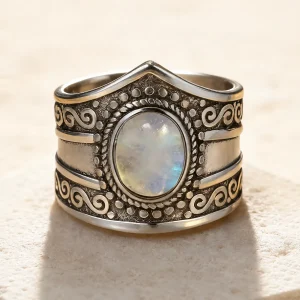
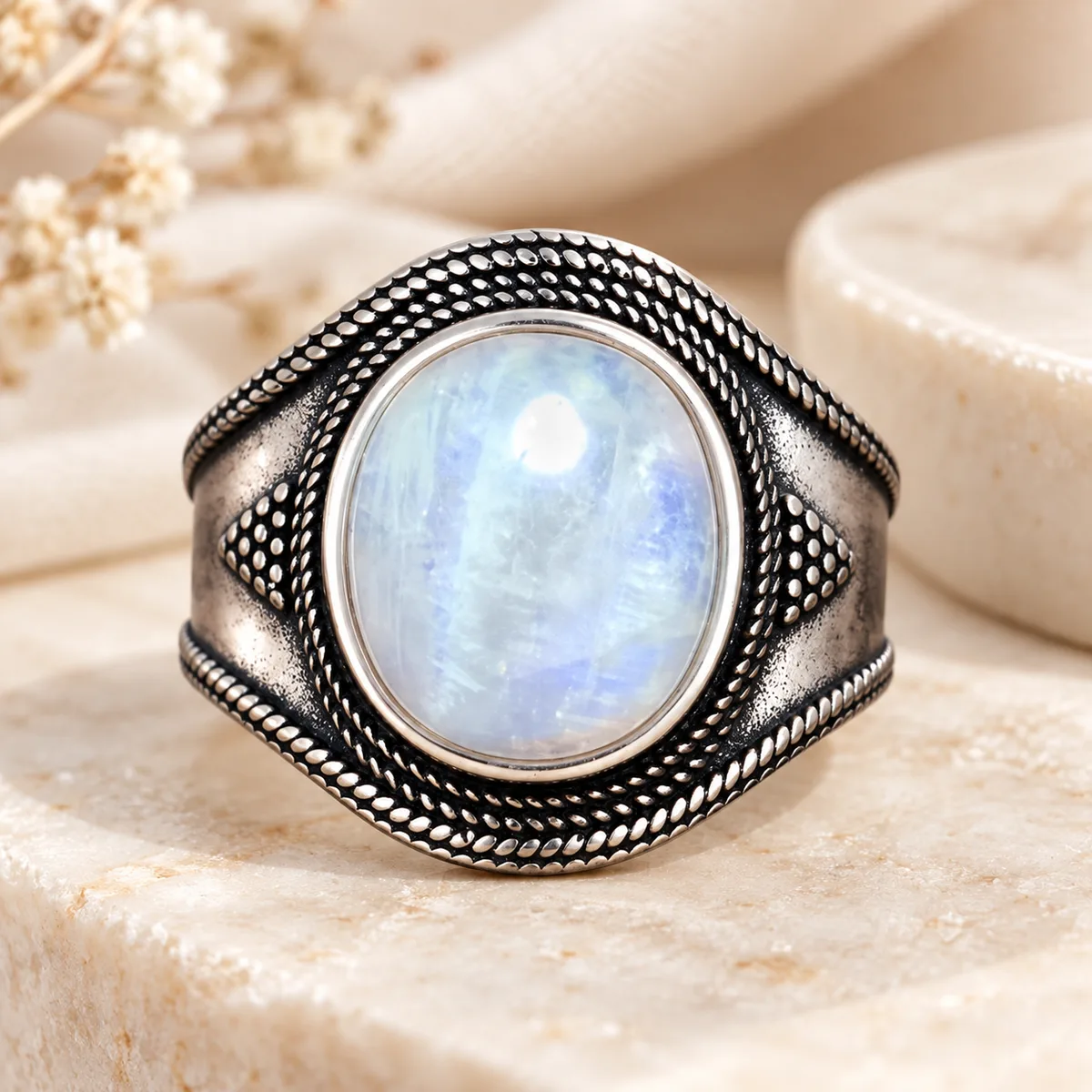
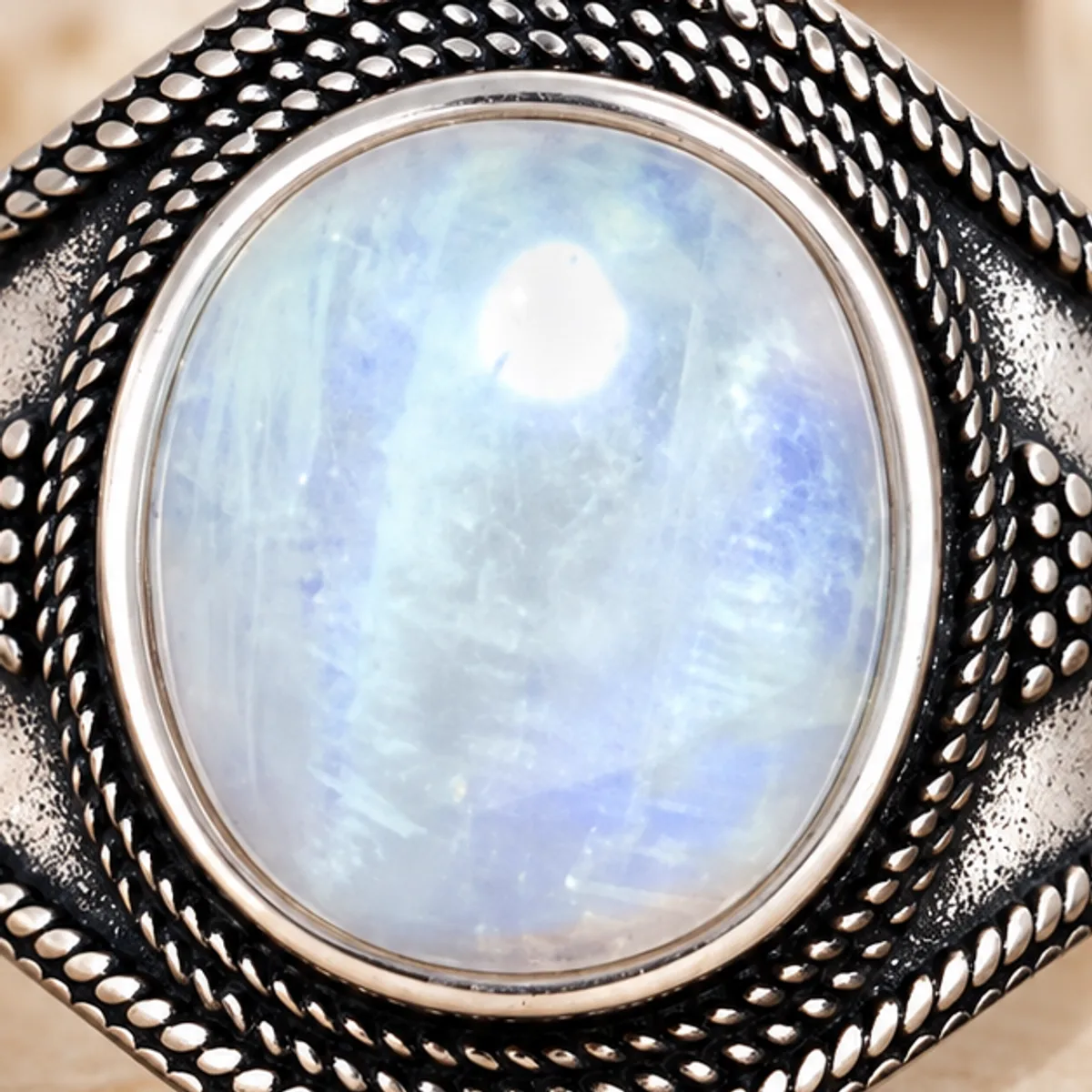
An oval cabochon on the widest band I make, and running along that band a continuous line of chevrons, each one outlined in small beads.
A wide band that does not look heavy
The problem with a very wide ring is not weight, it is the flat expanse. A plain wide band reads as a strip of metal, and on most hands it looks like a piece of hardware. The fix is not to make it narrower, it is to break the surface with lines, and the direction of those lines decides everything. Horizontal lines, running around the finger, make a band look wider still. Diagonal lines make it look narrower. Chevrons are diagonals that change direction, which is why they read as movement rather than as width.
That is the whole design decision here. The band is genuinely wide, wider than anything else in this collection, and the chevrons are there to make the eye travel along it instead of measuring it. Look at the ring on a hand and you will notice the pattern before you notice the width, which is exactly backwards from what the measurements would suggest.
Each chevron is outlined with a row of small beads rather than engraved, and there is a reason. An engraved chevron on a curved band changes apparent width as the surface turns away from you, so the pattern looks uneven at the edges. A beaded outline does not: the beads catch light individually and the eye reads them as a row of points, which stays legible however the band curves. It is a detail that took a failed prototype to learn.
The stone sits in a closed bezel, flush enough that the band stays the subject. Because it is wide, take a quarter to a half size up compared to a thin ring, and measure at the end of the day. The blue veil is the one still, soft thing on a piece that is otherwise all rhythm. The other rings are here.
- Oval moonstone cabochon, closed bezel, set nearly flush.
- 925 sterling silver hallmarked S925, very wide band, chevrons outlined in beads.
- Diagonals make a wide band read as movement rather than as width.
- sizes I 1/2 to T 1/2, that is 48 to 62 mm. Delivered in two weeks.
The specifications
- Stone
- Real moonstone (adularia), oval cabochon
- Origin
- India
- Metal
- 925 sterling silver, S925 hallmark
- Setting
- Closed bezel, no glue
- Shape
- Very wide band, the widest of the collection
- Decoration
- Continuous chevrons outlined in small beads
- Finish
- Oxidized silver, crests rubbed back with a cloth
- Sizes
- I 1/2 to T 1/2 (48 to 62 mm)
- Gender
- Women
- Brand
- Melissa Moon
The direction of a line changes what you see
This is a rule from tailoring, and it works identically on metal. A line running across a shape makes it look wider; a line running along it makes it look longer; a diagonal makes it look narrower and more active. None of this is opinion, it is how the eye estimates proportion, and you can prove it to yourself in thirty seconds with a pencil and two rectangles.
What jewellers add to the tailor’s rule is curvature. A band is not flat, it wraps, so a line drawn on it is foreshortened at the edges. That means a pattern that looks balanced on the drawing is compressed at the sides of the real ring. I draw chevrons slightly wider at the edges of the band than in the middle, so that on the finger they look even. Nobody has ever noticed, and that is the point.
If you can see that I corrected for the curve, I corrected wrong.
No salt, no ultrasonic tank, no hot water: moonstone is a feldspar, and all three damage it for good. A beaded pattern across a wide band holds a lot of soap, so rinse under lukewarm water rather than wiping, and use a dry soft brush once a month. Avoid silver dips, they lift the oxidation from between the beads and the chevrons vanish. The detail is in cleaning a moonstone piece, and the safe methods in caring for it without harming it. Set nearly flush, the stone is well protected.