Moonstone for Men
Moonstone was a men's jewel before it was a women's one. So the real question isn't whether you can wear it, it's what size cabochon holds up on a man's hand without breaking within six months. Here are the numbers, the settings that hold, and what the "feminine stone" reading actually owes to tradition.
People often ask me if I make "men's pieces." The honest answer is that the stone doesn't change, the setting does. A cabochon placed on a large hand has to be bigger, hence taller, hence more exposed, and that's where everything plays out. This page is what I explain to a customer walking out with his first piece.
The essentials, if you're in a hurry
- Nothing ever reserved this stone for women. The "moon stone, therefore feminine" reading takes hold in the literature of the 1980s and 1990s. It's about forty years old.
- Men's use predates this reading, in tie pins and cufflinks around 1900.
- The real problem is mechanical. A man's hand demands a bigger cabochon: the exposed surface grows as the square of the diameter.
- Closed bezel, always. Prongs leave bare exactly the spot where the stone splits open.
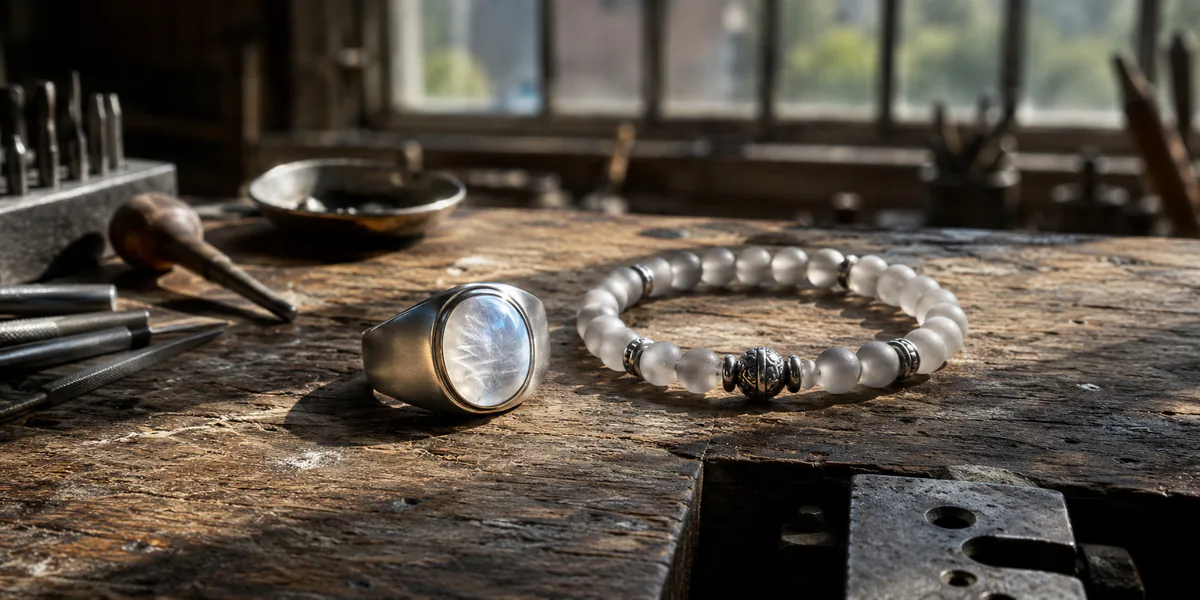
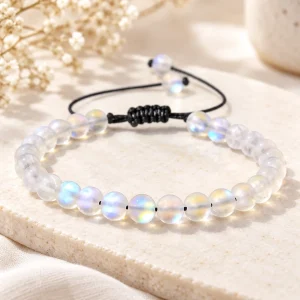
- The simplest format to start with is a beaded bracelet, 8 mm for an 18 to 20 cm wrist.
- The best protected formats are cufflinks and pendants. A ring is the most exposed of all.
- Watch out for names. "Black moonstone" usually refers to labradorite, sometimes a Norwegian rock that isn't a gem at all.
- Wear it on the non-dominant hand, the one that takes the least abuse.
Why people think it's feminine, and since when
Let's start there, since it's the question that stops most people before they even look at a setting.
Three things added up. First language: in French the moon is feminine, and the lunar deities most cited in the West, Selene, Diana, Artemis, are goddesses. Then color: a milky white cabochon with a pale blue sheen fits what twentieth-century jewelry filed under feminine. Finally contemporary crystal healing, which tied the stone to cycles and intuition.
On the first point, French isn't a universal rule. In German the moon is masculine, der Mond. In Mesopotamia, the lunar deity Sin is a god. In India, Chandra is a god. In Japan, so is Tsukuyomi. The gender assigned to the Moon is a matter of language and culture, not a property of the satellite or the stone. The topic is covered in the gods and goddesses of the Moon.
On the third point, timing matters. The moonstone-feminine-cycles-intuition association doesn't come from an ancient, unbroken tradition: it takes hold in the crystal-healing books of the 1980s and 1990s, notably Crystal Enlightenment by Katrina Raphaell in 1985 and Love Is in the Earth by Melody in 1995. Those are the books, widely copied since, that gave the stone its current label.
What's genuinely old is the link between the stone and the Moon. It's in its name, it's in its use in India and Sri Lanka. The male-female split isn't. I say it plainly because it's verifiable, and because the line that almost every page on this topic repeats, "it's a feminine stone but a man can wear it too," gets the problem backwards.
What history actually documents
There's a dated men's use, and it clearly predates the gendered reading.
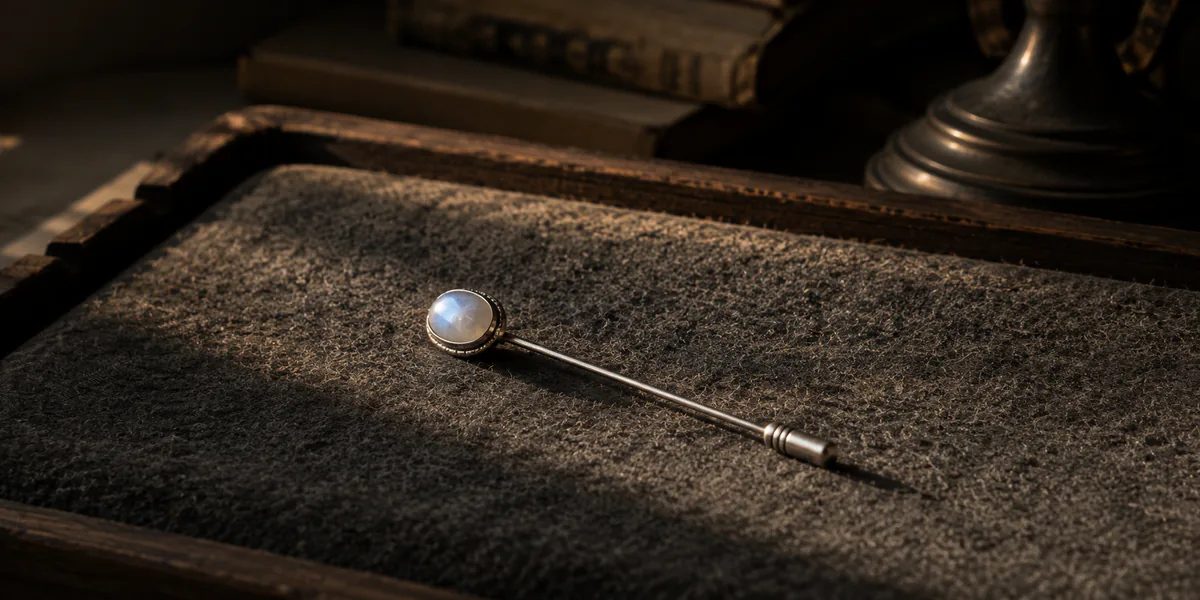
At the end of the Victorian era and under the reign of Edward VII, around 1900, celestial jewelry was in full swing: crescents, stars, comets. Moonstone had a natural place in it, and it shows up then on men's pieces, mainly the tie pin and cufflinks.
The most recognizable motif is a face carved directly into the cabochon, a man in the moon cut in low relief, mounted in silver, gold or platinum, sometimes surrounded by seed pearls. The material lent itself to it: a translucent body brings out a relief better than an opaque stone would.
A note of honesty, because it's the rule on this site. These pieces circulate through British antique jewelry dealers, who date them to the Edwardian period, with some Victorian examples going further back. This isn't a museum catalog, so I won't present the dating as scientific certainty. It's consistent and repeated by professionals who handle the objects, which is already a lot more than what backs up most claims about this stone.
The same period saw Art Nouveau turn it into one of its favorite materials, at Lalique, at Fouquet, at Tiffany. That's the subject of its own article: moonstone in Art Nouveau.
Do the math: the documented men's use predates by roughly seventy years the books that made this stone feminine. A man wearing it today isn't breaking any rule at all. He's returning to a use older than the one people set against it.
The real issue: cabochon size
Let's get to what actually matters, and what nobody writes about.
A men's ring doesn't have the same dimensions as a women's ring. Finger circumference runs roughly US sizes 8 to 11, against 5 to 6.5 on average for women. The most commonly sold band width is 6 to 8 mm, against 2 to 4 mm on a slim band. A men's signet ring plate commonly measures 16 x 14 to 18 x 16 mm, against 10 x 8 to 12 x 10 mm in the women's version.
These proportions aren't decorative, they have a direct consequence. The exposed surface of a cabochon grows as the square of its diameter. A 14 mm cabochon presents roughly 154 mm² of face, against 64 mm² for a 9 mm one: two and a half times more surface to hit. And its volume grows as the cube, so it stands up further above the plane of the hand.
That overhang is the tipping point. A cabochon rising 7 or 8 mm above the finger meets door frames, car door handles, the steering wheel, handlebars, pull-up bars. A flush cabochon never meets them.
The rule I use at the workshop fits in one sentence: the stone isn't more fragile on a man, it's the men's piece that forces it to be bigger, taller and more exposed. Everything else on this page follows from that.
Cleavage, and the impact that lands on the wrong axis
Two properties get confused constantly, and they need to be told apart. Hardness measures scratch resistance: moonstone sits at 6 or 6.5 on the Mohs scale. Toughness measures resistance to breaking, and the GIA rates it poor. A stone can therefore be reasonably hard and still break easily. That's exactly the case here.
The reason is cleavage. Like all feldspars, moonstone has two directions along which the crystal separates cleanly instead of breaking at random. In orthoclase, true moonstone, these two planes meet at a right angle: it's even in its other name, orthoclase, from the Greek for straight fracture. In plagioclase feldspars, including labradorite, the angle is roughly 86 and 94 degrees.
Now comes the point I've never read anywhere else, and it explains everything. The plane in which adularescence forms, that blue sheen floating inside the stone, runs parallel to one of the cleavage directions. The lapidary is therefore forced to orient the flat base of the cabochon parallel to that plane, otherwise the sheen drifts to one side instead of floating at the center of the dome.
In other words, on a properly cut cabochon, the plane of least resistance is horizontal, just beneath the polished surface. And an impact on top of the dome hits perpendicular to that plane. That's precisely the direction of the most common impact on a hand.
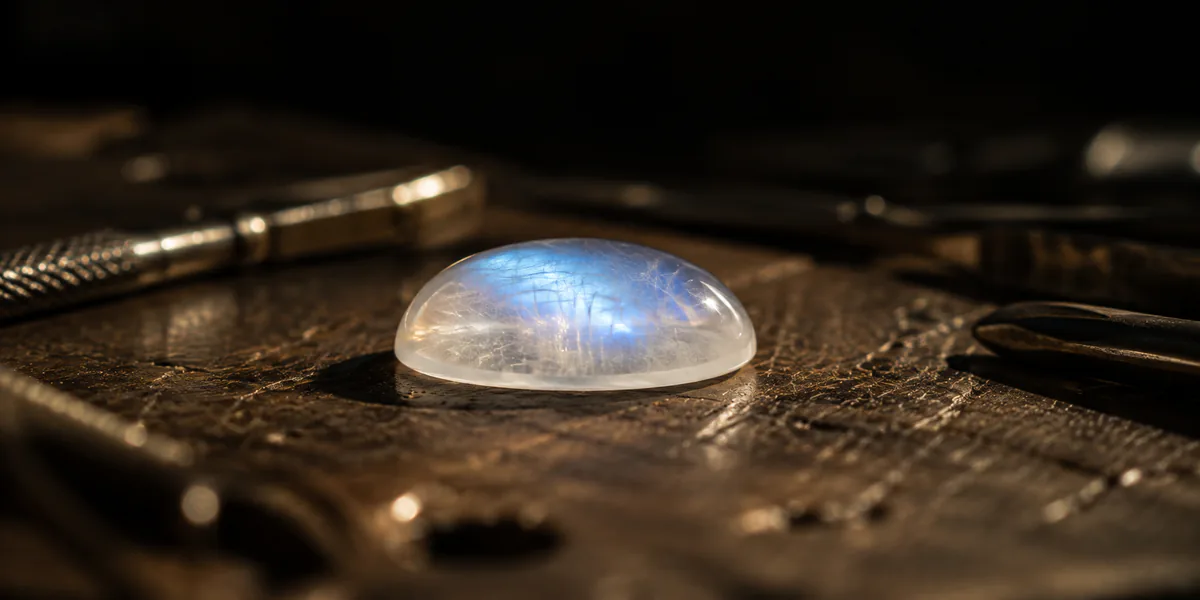
What that means in practice: moonstone almost never dies from a scratch. It fails through a chip on the girdle, the edge running around the cabochon, or through a flat flake that pops off the surface. A scratched stone is still wearable; a cleaved stone is lost. The subject is developed in is moonstone fragile.
There's also a trade-off to accept. A tall dome gives the best sheen and exposes the stone. A low dome protects it and dulls the sheen. No setting wins on both counts, and any seller who tells you otherwise doesn't actually set stones.
The closed bezel, and the four flaws of prongs
Since the weak point is the cabochon's girdle, the setting has to cover the girdle. That's the whole logic of a closed bezel, a continuous ring of metal running around the stone that absorbs the impact before it does.
On a men's piece, I aim for a rim that's flush with the top of the dome or extends just slightly beyond it. The metal then hits the door frame before the stone does, which is exactly the goal.
Prongs stack up four flaws, and the last one is the one nobody mentions.
- They leave the side of the stone bare, exactly where cleavage starts.
- They apply point pressure on a material that splits under point pressure.
- They catch on pockets, gloves, sweaters, bag straps.
- They get re-tightened with pliers, often near a flame, on a stone that dislikes temperature swings and localized stress just as much. A closed bezel never asks for that gesture.
Two checks to make before buying, no matter the shop. Ask whether the stone is set or glued: glue gives way to solvents, hand sanitizer, gasoline, long before the stone would flinch. And ask whether the cabochon size is standard, 10 x 8, 12 x 10, 14 x 12: a free-form stone can't be replaced with an identical match the day it breaks, and the whole setting has to be remade.
Nearly everything I set is in a closed bezel, without glue. The one exception in the catalog is a four-prong halo ring, and that's precisely the one I don't recommend to anyone for daily wear, man or woman. Setting types are covered in detail in closed bezel or prongs.
The formats that work, with the numbers
Here are the dimensions I use, family by family. These are workshop and trade benchmarks, not standards: they hold because they work, not because some institute published them.
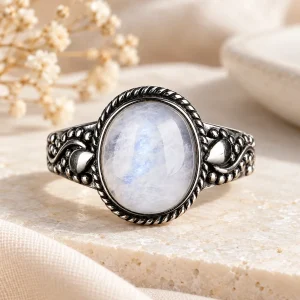
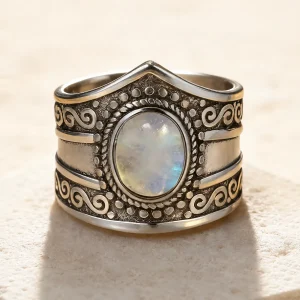
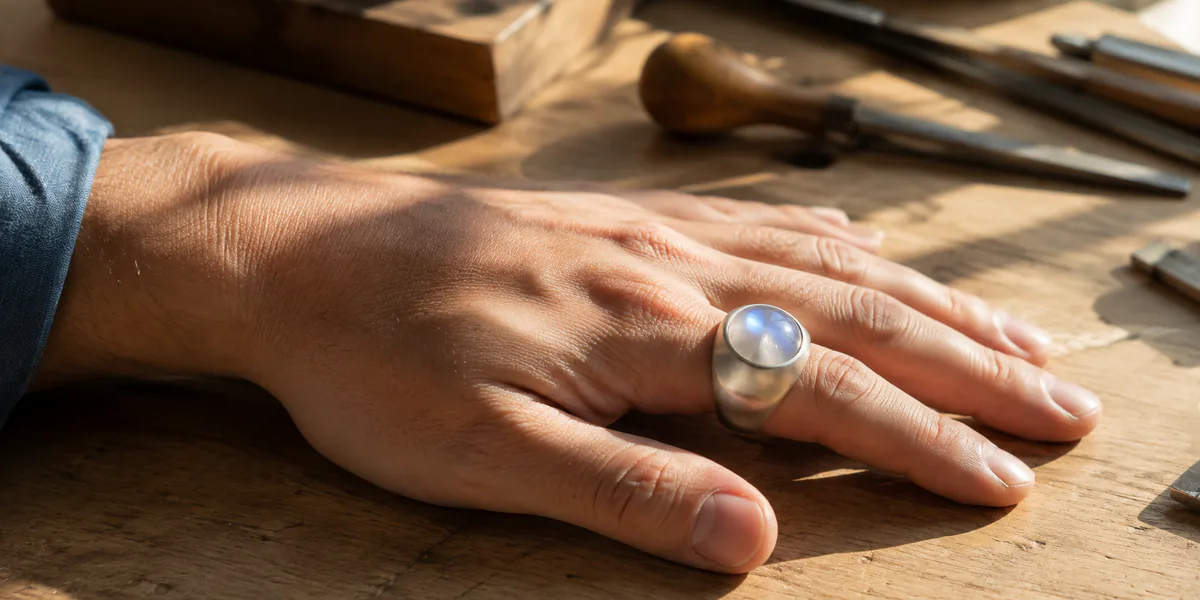
The signet ring with a cabochon. A 16 x 14 mm plate for the most common format, which takes a standard 12 x 10 or 14 x 12 mm cabochon. The stone sits in the recess of the plate, so it's protected by the metal all the way around. It's the most complete men's format for this stone.
The wide ring with an inset stone. A 6 to 8 mm band, with the stone flush at 5 to 7 mm. Above 8 mm in width, size up half a size: at the same size, a wide band fits tighter than a slim one. It's the advice I put on the listing for the workshop's men's ring.
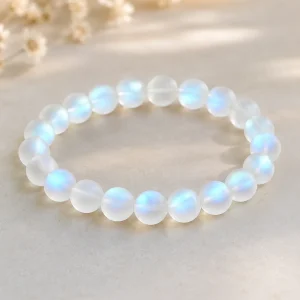
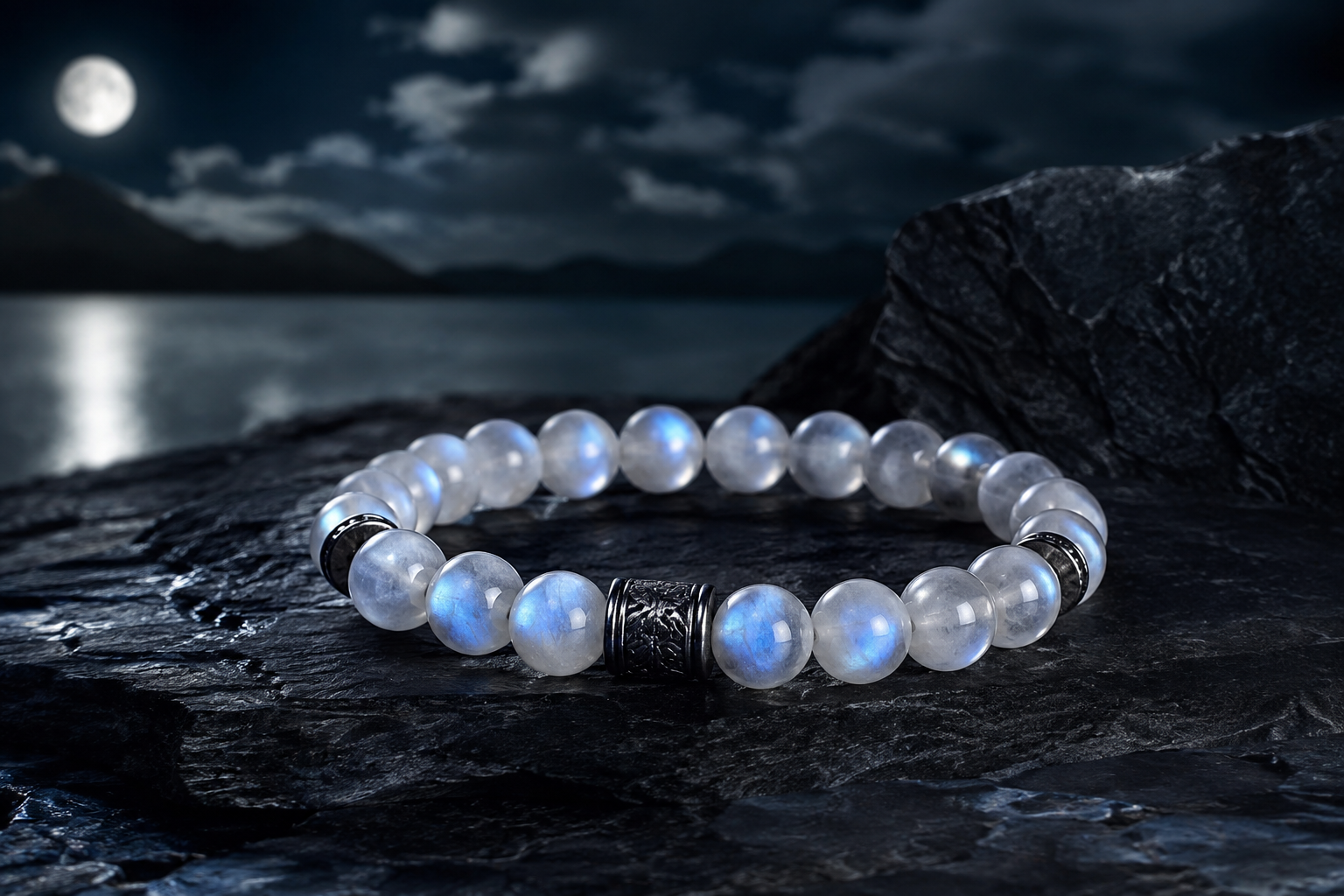
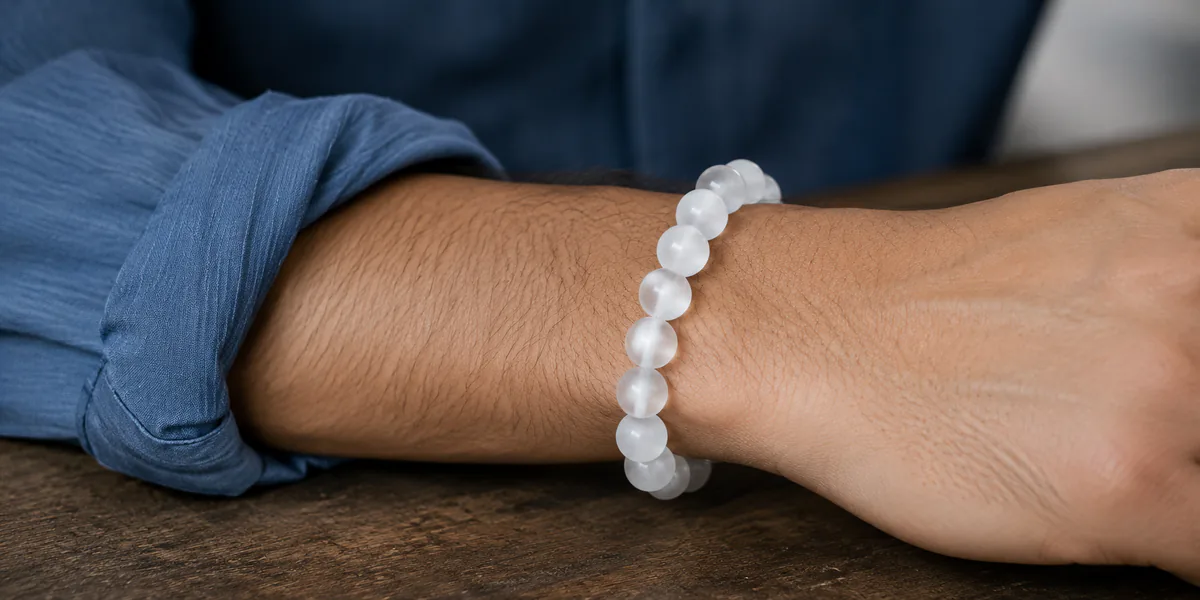
The beaded bracelet. The standard men's bead diameter is 8 mm, for an 18 to 20 cm wrist. Drop to 6 mm if your wrist is under 16 cm or if the bracelet has to fit under a shirt cuff. Go up to 10 mm past 19 cm, or for a deliberately bold look. Stringing runs on wrist circumference plus 1.5 cm: for an 18 cm wrist, count roughly 24 beads at 8 mm.
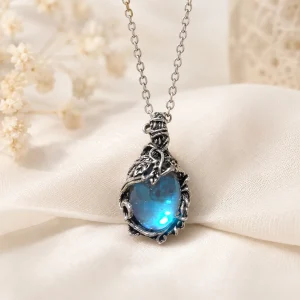
The pendant. The reference men's chain length is 50 cm, which falls at the hollow of the collarbones. 55 cm drops to mid-chest, 60 cm becomes a statement piece. For women, the reference is closer to 40 to 45 cm: that's the first mistake people make when gifting. Chain width, 3 to 4 mm for everyday wear; leather cord, 2 to 3 mm.
Cufflinks. Settings of 16 to 18 mm. It's the format where the stone is best protected of any man's wardrobe piece: it takes no frontal impact at all, only friction from a sleeve.
| Format | Usual dimension | Exposure |
|---|---|---|
| Wide ring, high setting | 6 to 8 mm band, protruding dome | High |
| Signet ring with inset cabochon | 16 x 14 mm plate | Medium |
| Beaded bracelet | 8 mm, wrist + 1.5 cm | Medium |
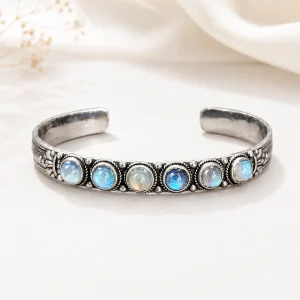
| Rigid bangle | one size, needs adjusting | Low |
| Pendant on a chain | 50 cm chain, 3 to 4 mm | Low |
| Cufflinks | 16 to 18 mm | Very low |
What I set for a man's hand
Gray, black, labradorite: what's sold as masculine
When a man wants something more understated, he's almost always offered a dark stone. It's still worth knowing what he's actually buying, because trade names are a minefield, and this site refuses to copy them without translating.
Moonstone in the gemological sense is orthoclase, a potassium alkali feldspar. Its sheen is called adularescence. There are genuine gray moonstones, smoky gray body with a sheen that's often silvery rather than electric blue: it's the most honest answer for someone who wants understated without changing species.
What's sold under other names isn't the same thing.
| Name sold | Real species | What it changes |
|---|---|---|
| White, blue, gray moonstone | Orthoclase | True moonstone, milky sheen |
| "Rainbow moonstone" | Labradorite (plagioclase) | Play of color, no adularescence |
| "Black moonstone" | Dark labradorite, often from Madagascar | Dark body, sharper contrast |
| "Spectrolite" | Labradorite from Ylämaa, Finland | A specific deposit, not a species |
| "Norwegian moonstone" | Larvikite, a rock | Not a gem at all |
The last row deserves attention, because it mainly concerns men's bracelets. Larvikite is an igneous rock from the Larvik region of Norway, whose blue-silver flashes come from feldspar exsolved within the mass. It's sold as beads under the names black moonstone, Norwegian moonstone or blue pearl granite. It's a handsome material, nothing shameful about it, but it's neither moonstone nor even a gem.
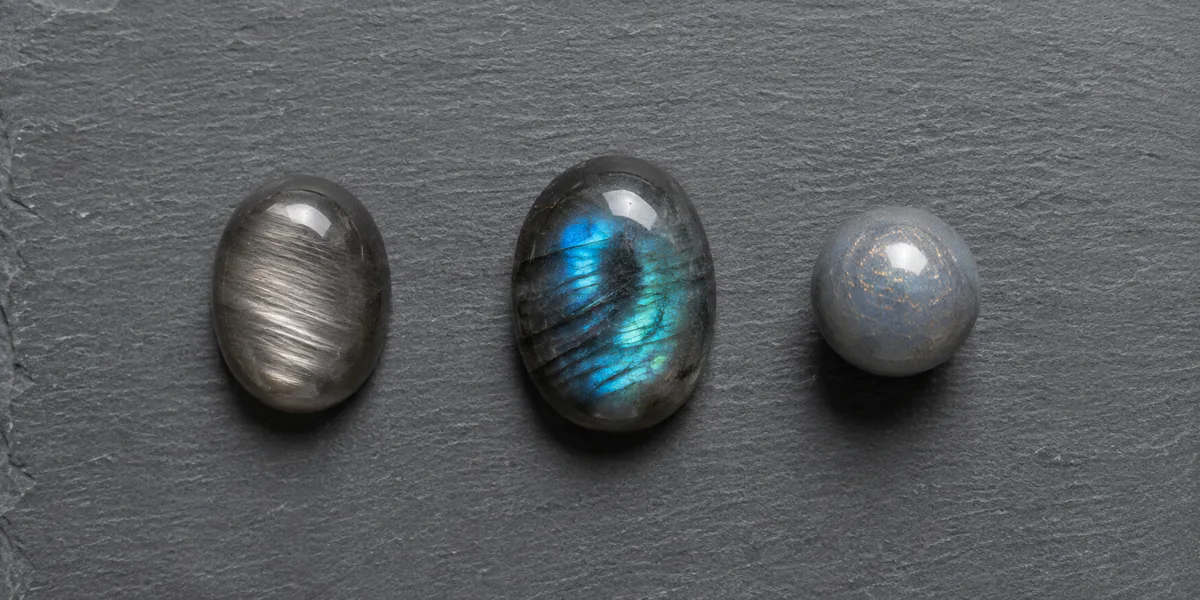
One thing not to tell yourself: switching to labradorite solves nothing on the mechanical side. Same hardness of 6 to 6.5, same cleavage, same fragility. The gain is aesthetic, not structural. Variety details are in colors and varieties, and the species distinction in moonstone or labradorite.
What damages it on an ordinary day
One remark first, because it's specific to this stone. The sheen is read through the polished surface. A matted-out dome doesn't just lose shine, it loses its adularescence. On moonstone, care isn't cosmetic, it preserves the phenomenon you bought it for.
Dust scratches. Household dust contains quartz, hardness 7. A dry wipe with a dust-laden cloth already micro-scratches the surface. And the Mohs scale is ordinal, not linear: the gap between 6.5 and 7 isn't a detail, it's the threshold below which ambient dust bites.
The men's wardrobe has its own traps. Tungsten carbide and ceramic, common in men's wedding bands, sit around 8 or 9 on the Mohs scale. A tungsten band worn on the neighboring finger, or simply stored in the same dish, scratches moonstone effortlessly. Gold and silver, meanwhile, sit around 2.5 or 3 and don't scratch it.
Moments to take the ring off. Weightlifting, where the bar crushes the metal against the stone. DIY work. Gardening, because soil is loaded with quartz. Motorcycling and cycling, gripping handlebars with the full hand. Carrying loads. Ball sports.
Cleaning. Lukewarm water, mild soap, a very soft brush, dry with a cloth. Never ultrasonic, never a steam cleaner: ultrasonics propagate existing fractures along the cleavage planes, and steam adds thermal shock. That also applies to labradorite and spectrolite, same weak planes. The detail is in how to clean a moonstone piece.
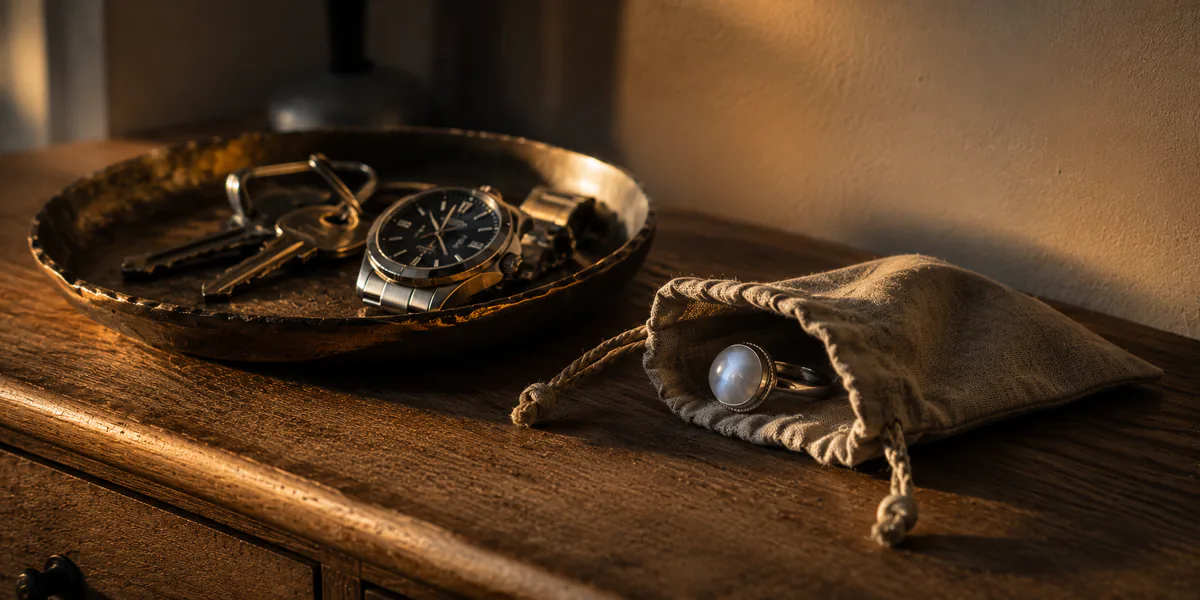
Storage. An individual pouch. The worst enemy of a moonstone isn't the workday, it's the bottom of a shared catchall tray with keys, a watch and coins.
What crystal healing says about it
I report, I don't validate, and I date.
Tradition credits moonstone with a role in calming, intuition and cycles. Applied to men, it openly contradicts itself. Some sources advise against it, on the grounds that a supposedly receptive stone would dampen a temperament whose drive is its strength. Others recommend it for exactly the same reason, presented this time as a useful counterbalance.
When a body of belief says a thing and its opposite on the same question, that's not a sign of subtle knowledge: it's a sign that it's recent and wasn't actually passed down. I'd rather say so than pick whichever version suits me commercially.
A word on astrology, since it's often invoked here. The stone is associated with Cancer, the only sign ruled by the Moon. That correspondence says nothing about the gender of who wears it: a Cancer man has exactly as much claim to it as a Cancer woman. That's detailed in moonstone and astrology, and the symbolic side in the meaning of moonstone.
These correspondences belong to crystal healing, an approach based on tradition and belief. They do not constitute a medical claim and never replace the advice of a health professional. Read the full disclaimer.
How to choose yours
Three scenarios, and I've given the same answer for years.
It's your first stone piece. Get an 8 mm beaded bracelet. Nothing to adjust, nothing to take off twenty times a day, and you'll know within three weeks whether you like having something on your wrist. A matte finish shows even less than a polished one, which helps at the start.
You want it to show. Signet ring or wide ring, inset cabochon, closed bezel, standard size. Wear it on the non-dominant hand and accept taking it off for sports and DIY. That's the price of a cleavable stone, and it's paid in habits, not dollars.
You don't want it to show. Cufflinks, or a pendant on a 50 cm chain worn under a shirt. Those are the two formats where the stone takes almost nothing, and lasts the longest.
Either way, judge the stone before the setting: the sheen should shift as you tilt the cabochon, and it should be centered on the dome. Criteria are in judging moonstone quality, budget benchmarks in the price of moonstone, and imitation traps in how to recognize a genuine stone.
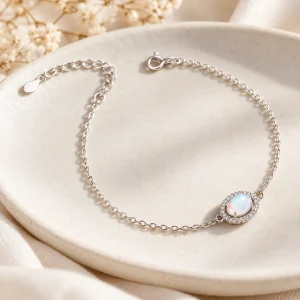
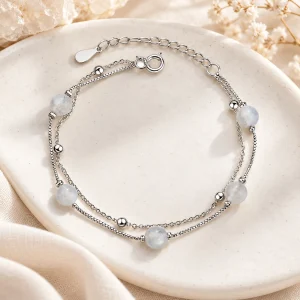
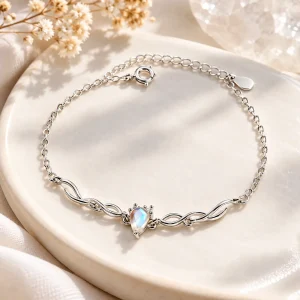
The bracelets, the simplest format to start with
Frequently asked questions
Can a man wear moonstone?
Yes, and it's even the older of the two uses. The stone appears on men's tie pins and cufflinks around 1900, while its feminine reading takes hold in books from the 1980s and 1990s. Nothing in the stone or its history reserves wearing it for anyone.
What cabochon size for a man's hand?
A standard size of 12 x 10 or 14 x 12 mm, set into a signet plate of roughly 16 x 14 mm. Prefer a low dome: a tall dome gives a better sheen but stands up further above the plane of the hand, so it meets handles, steering wheels and door frames.
What bead diameter for a men's bracelet?
Eight millimeters for an 18 to 20 cm wrist, which is the most common case. Six millimeters under 16 cm or to wear under a shirt cuff, ten millimeters past 19 cm or for a bold look. Stringing runs on wrist circumference plus 1.5 cm, roughly 24 beads at 8 mm for an 18 cm wrist.
Closed bezel or prongs on a men's ring?
Closed bezel, without hesitation. Moonstone's breaking point is its girdle, the edge running around it, and a closed bezel is the only setting that covers it. Prongs leave that side bare, apply point pressure, catch on clothing and require re-tightening with pliers.
Is "black moonstone" real moonstone?
Usually not. It's generally a dark-bodied labradorite, and sometimes, as beads, larvikite, a Norwegian rock that isn't a gem. True moonstone is orthoclase. There are, however, genuine gray moonstones, smoky body and silvery sheen, which answer well to a request for understated.
Can you wear it every day, including at work?
It depends on the format. A bracelet, pendant or cufflinks are worn without a second thought. A ring needs to come off for sports, DIY, gardening and carrying loads. If your work is manual, choose something other than a ring.
What chain length for a men's pendant?
Fifty centimeters is the reference length, falling at the hollow of the collarbones. Fifty-five drops to mid-chest, sixty becomes a statement piece. Count 3 to 4 mm chain width for everyday wear. Careful if gifting: the women's reference is closer to 40 to 45 cm.
Is labradorite sturdier for a men's piece?
No. Same hardness of 6 to 6.5, same cleavage, same poor toughness. The dark body gives a more contrasted look often perceived as more masculine, but the gain is purely aesthetic. Precautions are identical, ultrasonics included.
Where to go next
This page is the crossroads of men's jewelry. To go further:
- The mechanics: is it fragile, closed bezel or prongs, cleaning it.
- The material: the mineral profile, colors and varieties, moonstone or labradorite.
- Wearing it: how to wear it daily, which wrist, the ring, the necklace and pendant.
- History and symbolism: Art Nouveau, the gods and goddesses of the Moon, the June birthstone.
- The full picture: the complete guide.
The two pieces designed for a man's hand and wrist are the sterling silver ring and the matte beaded bracelet. Everything else is in the shop. Have a question about a piece you already wear? Write to me, I answer personally.
My sources
Hardness, toughness, cleavage directions and cleaning prohibitions follow the public reference sheets from the GIA, Mindat and the International Gem Society. The distinction between orthoclase and plagioclase feldspars, hence between moonstone and labradorite, is standard descriptive mineralogy.
Setting, bead and chain dimensions are workshop and trade benchmarks, not published standards: I give them because they work, and I flag that rather than passing them off as official measurements.
For the historical part, carved-cabochon tie pins and cufflinks are dated to the Edwardian period by the British antique jewelry dealers who sell them. That's a professional source, not a museum catalog, and I say so. The dating of the association between the stone and the feminine rests on two books with a name and a year attached: Crystal Enlightenment by Katrina Raphaell, 1985, and Love Is in the Earth by Melody, 1995.
Last updated: August 19, 2026. If you find an error in this article, let me know: I'll fix it and note it.
✦ À porter, à offrir
Découvrez mes créations