How to Judge Moonstone Quality: 6 Criteria
Colorless body, blue sheen, centered sheen, spread, transparency, cleanliness. Here are the six criteria a jeweler looks at, in the order they look at them, and how to judge each one by eye with no equipment. They are what explains why one stone is worth $4 a carat and another $500.
This article assumes authenticity is settled. If you are not there yet, the six tests are in how to recognize genuine moonstone. Here the question is no longer "is it real", it is "is it good".
The short version, if you are in a hurry
- The sheen comes before everything else. Its color alone explains most of the price gap.
- Clear blue at the top, soft blue next, milky white lower down, dull gray last.
- The body must be limpid, and colorless. A transparent body with a blue sheen is the rare combination.
- The sheen must be centered on the dome and cover most of its surface.
- The body must not be tinted. A gray-green kills the sheen, and the trade calls that a muddy stone.
- Inclusions count last, and centipedes are not a flaw: they are proof of authenticity.
- One failed criterion does not disqualify. It is the combination that decides, and the trade-offs section explains which ones to give up.
The order matters, and here is why
On a diamond we talk about the four Cs, and the order is more or less settled. On a moonstone there is no standardized grading at all, and that is a real problem: everyone looks at whatever they like.
The order I give here is not arbitrary. It follows the real weight of each criterion on the price, as I see it when buying. The first two explain most of it, the next two make the difference between a good stone and a very good one, the last two separate stones of equal quality.
Two warnings before we start. None of these six criteria calls for equipment, except the last one where a loupe helps. And they are all judged in movement: a moonstone set down and looked at head-on shows only a fraction of what it can do. The mechanism is explained in adularescence.
1. The color of the sheen
Criterion number one, and it weighs more than the other five put together.
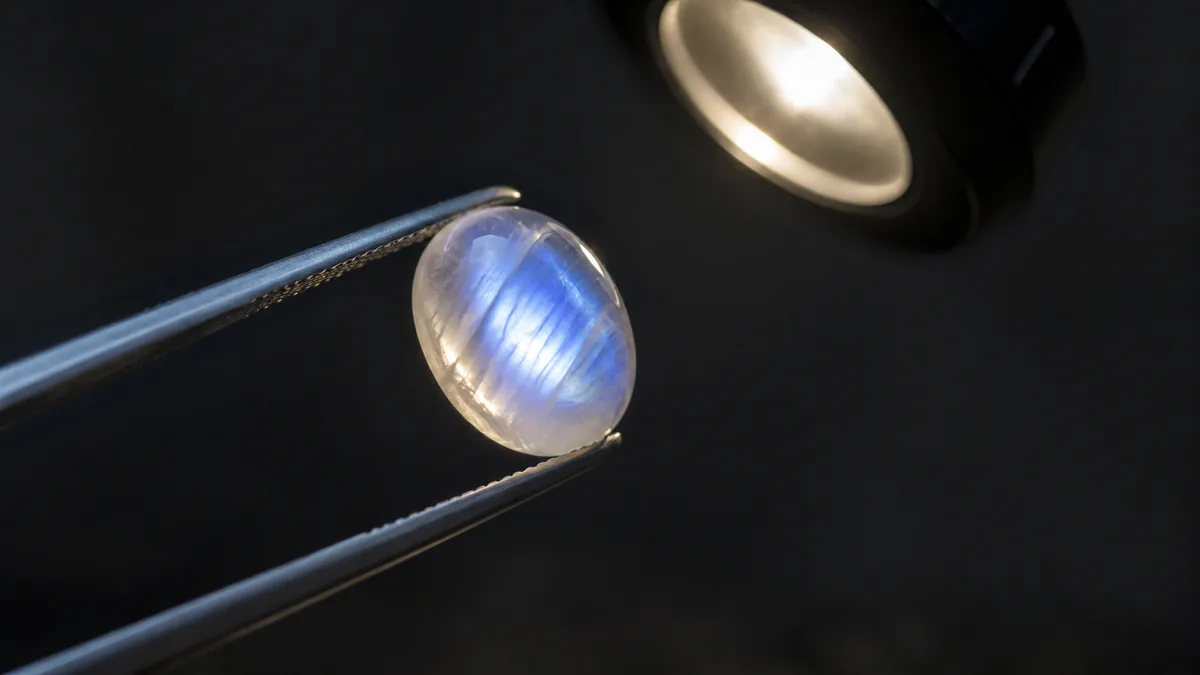
The sheen can run from electric blue to dull gray, by way of soft blue and milky white. The more it leans toward a clear, deep blue, the higher the stone climbs.
How to judge it. A single light source, a dark background, and you tilt slowly. Note the hue at the moment the sheen is strongest, not when it fades. It is that peak that counts.
The trap. Plenty of sales photos are taken under cool light or edited toward blue. A stone that looks blue in a photo and white in the hand is the most frequent case among the returns I get. Ask for a video.
The physical reason for this hierarchy is the fineness of the internal lamellae, and it explains why blue cannot be manufactured. The price that follows is detailed in the price of moonstone.
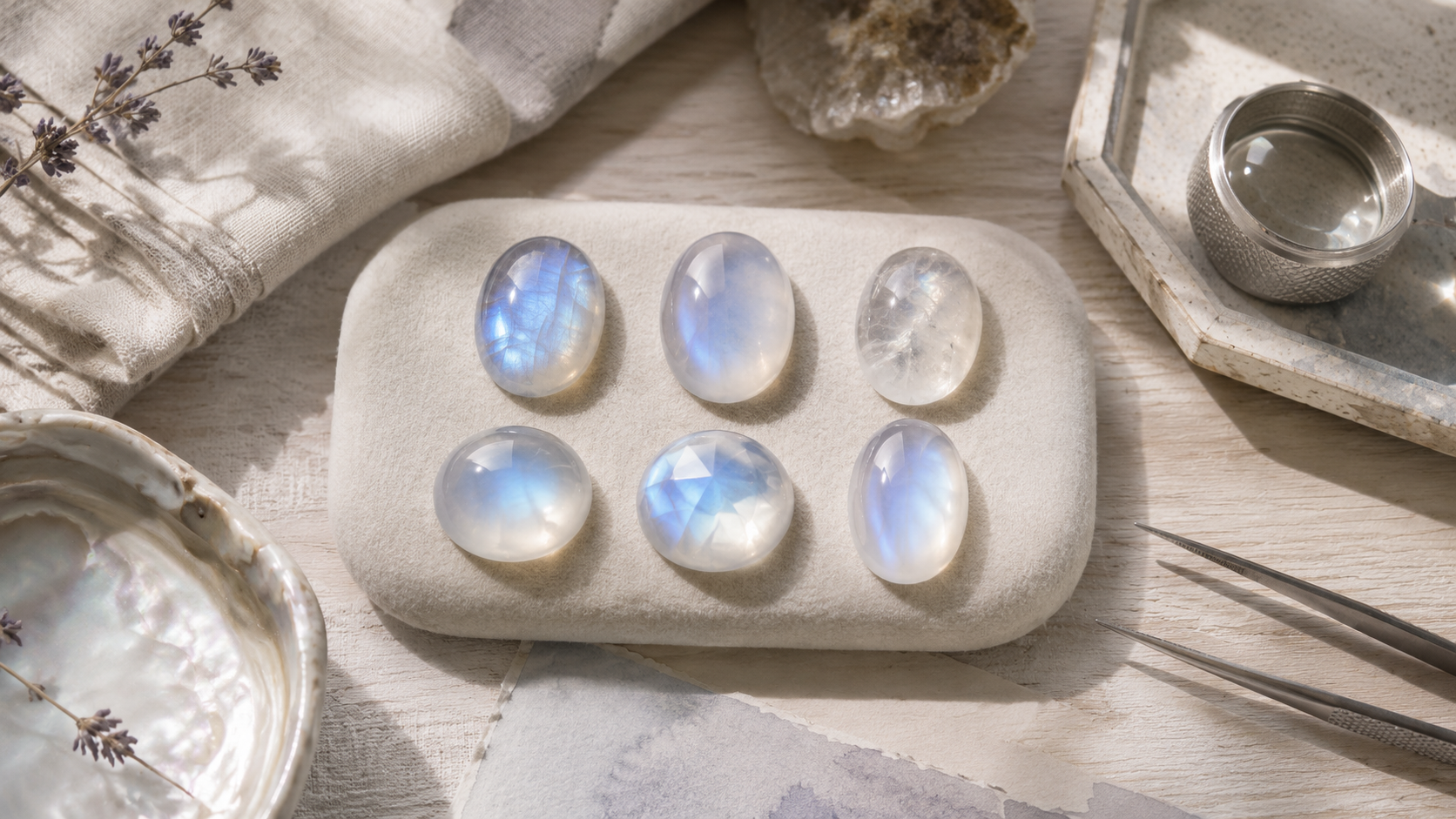
Four stones, four levels of sheen
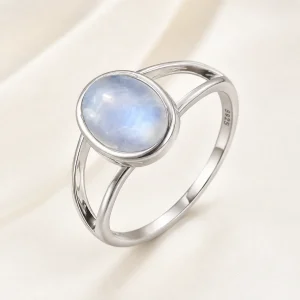
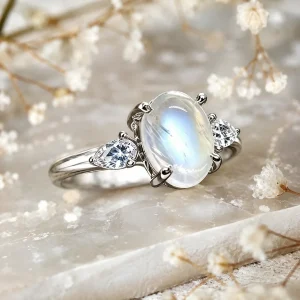
2. The transparency of the body
The most underrated criterion, and the one that separates a beautiful stone from a decent one.
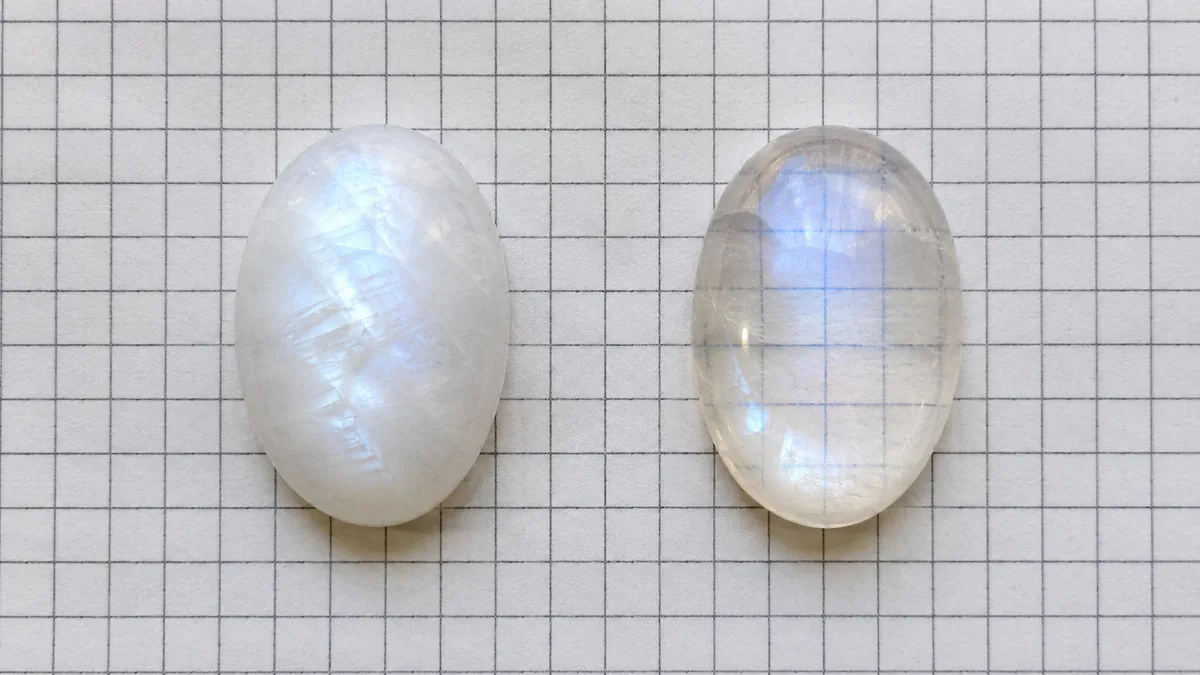
Independently of its sheen, the body of the stone can be as limpid as water or opaque milky white. The more transparent it is, the more the stone is worth.
How to judge it. Set the stone on a sheet carrying a regular pattern, a grid or lines. If you can make out the pattern through it, the body is transparent. If it vanishes completely, it is not. Three seconds, no equipment.
Why it is rare. Transparency and sheen intensity work against each other. A very milky body scatters a great deal, so the sheen shows well, but the stone is cloudy. A limpid body gives depth and often a quieter sheen. Having both is the combination that defines the top of the range, and it is what the Sri Lankan grading calls a crystal stone.
3. The centering of the sheen
The first of the two cutting criteria, and the one that gives away the lapidary's work.
On a well-cut stone the sheen appears at the center of the dome when you look at the stone head-on, and moves away from it gradually as you tilt. On a badly oriented stone it is born at an edge, or only appears at a grazing angle.
How to judge it. Hold the stone facing you, at eye level, under a single source. Look for the position where the sheen is strongest. If it is centered at that point, that is a good sign.
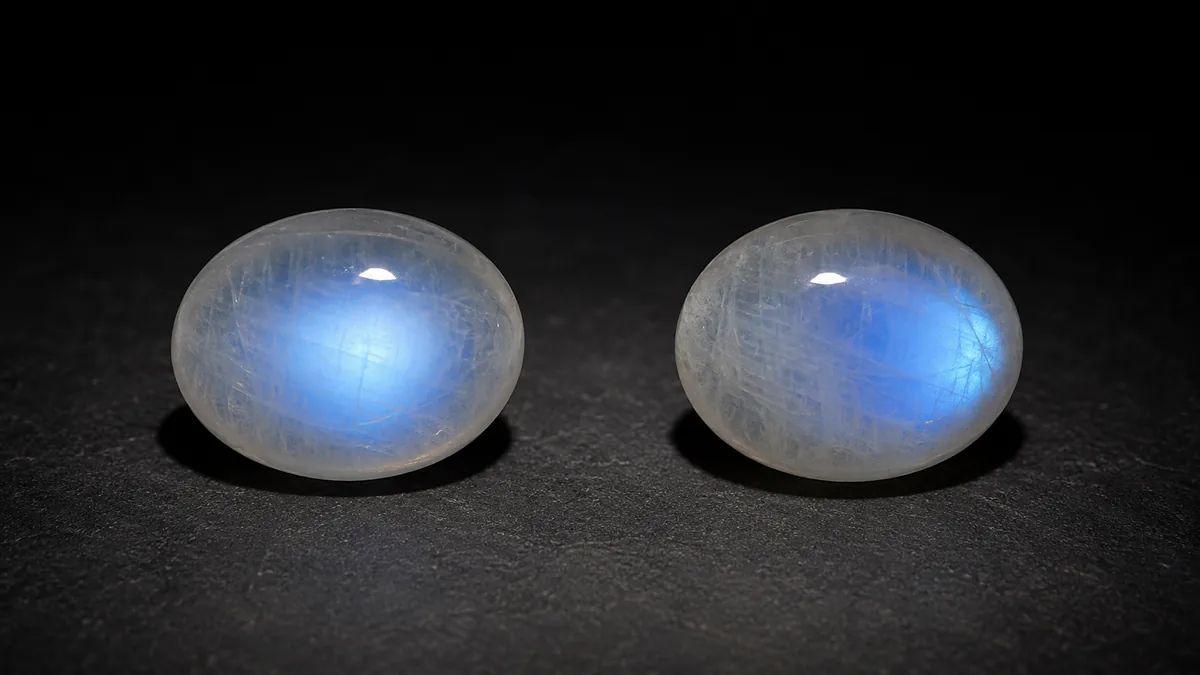
What it reveals. The internal lamellae lie in a precise plane, and the lapidary has to cut parallel to that plane. An off-center sheen means an approximate orientation, often chosen to keep weight on a badly formed rough. It is a manufacturing trade-off, not an accident, and it sells for less.
4. The spread of the sheen
The second cutting criterion, and it is judged at the same time as the previous one.
The sheen can cover almost the whole dome or only a narrow band. The wider the lit surface, the better the stone.
How to judge it. At peak intensity, estimate the proportion of the dome that lights up. Three quarters is very good. Half is decent. A narrow band is an entry-level stone.
A nuance that counts. A stone cut too flat to save weight loses spread and depth: the light does not have enough material to cross. A well-domed cabochon gives a wider, more alive sheen, at the cost of a few carats. It is a lapidary's choice, and it shows.
Careful not to confuse spread with uniformity. A real stone keeps dead zones at certain angles: that is normal, and it is even a sign of authenticity. A dome lit right across at every angle is a sign of glass, as moonstone or opalite explains.
5. The color of the body
The fifth criterion, and the only one judged without looking at the sheen.
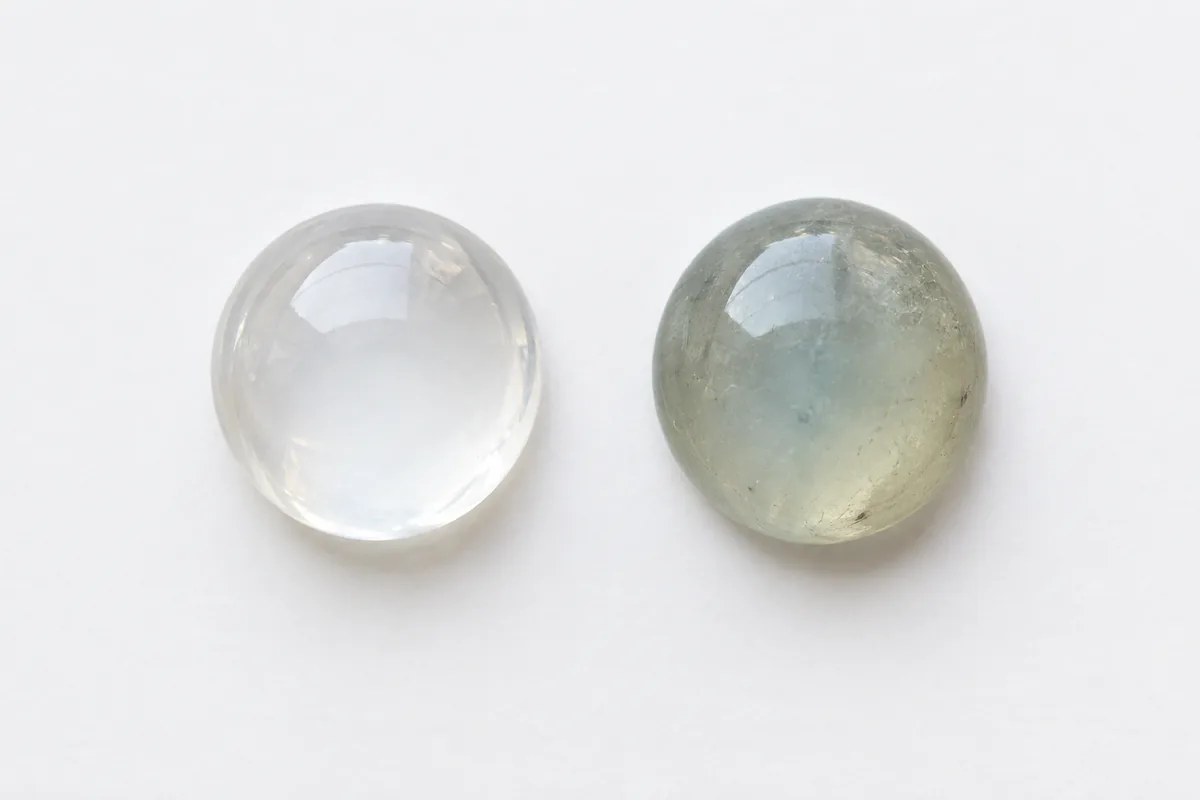
The ideal body is colorless. It can also be frankly colored, peach, pink, orange, and it is then a variety in its own right. What causes a problem is the in-between: a gray-green, a dirty beige, a yellowed white.
Why it is a flaw. A cloudy tint absorbs part of the light before it reaches the lamellae, and kills the sheen. The trade word for it is muddy, and it turns up in the official Sri Lankan grading itself. You will never see it on a price tag, but it structures prices.
How to judge it. Look at the stone flat, without hunting for the sheen, on a white background. The underlying tint shows up immediately.
Openly colored varieties are judged on their own scale: a clear, luminous peach is a good stone, even if it is worth less than a blue. The detail is in the colors and varieties.
6. Cleanliness
The last criterion, and the one where moonstone is judged differently from other gems.
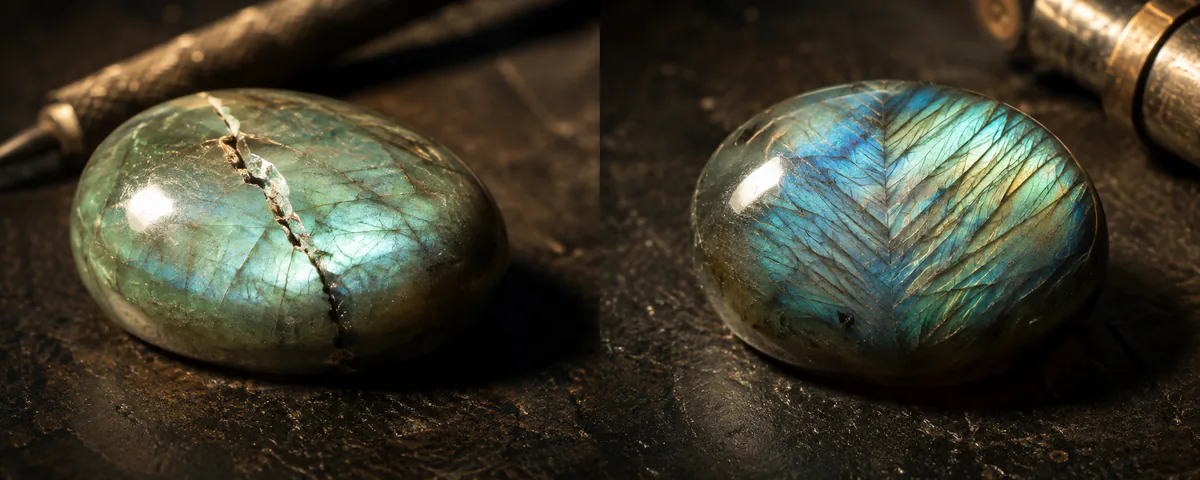
On a sapphire, a visible inclusion sends the value down. On a moonstone, some inclusions are good news.
Centipedes, those characteristic fine tension fractures, take nothing away from a stone as long as they are not visible to the naked eye. They are even a proof of authenticity so typical that seeing them is enough to identify the gem. The detail is in how to recognize genuine moonstone.
What really counts, under this criterion:
- Open fractures, the ones that reach the surface. They genuinely weaken a stone with cleavage, and it is the only flaw that can make the piece break later on.
- Inclusions visible to the naked eye on the dome, which get in the way of the sheen.
- Chips on the girdle, often hidden by the setting.
- The quality of the polish, judged under raking light: matte wheel marks give away a rushed finish.
On fractures and what they imply, see is moonstone fragile.
The summary table
The six criteria, with what to look for and the move that reveals it.
| Criterion | What to look for | Weight |
|---|---|---|
| Color of the sheen | Clear, deep blue at the peak | Decisive |
| Transparency | A pattern visible through the stone | Strong |
| Centering | Sheen in the middle of the dome, head-on | Medium |
| Spread | Half the dome at minimum | Medium |
| Color of the body | Colorless, never gray-green | Medium |
| Cleanliness | No fracture breaking the surface | Variable |
The last row is marked "variable" on purpose: an internal inclusion barely counts, an open fracture can disqualify a stone all on its own.
The trade-offs, when not everything is perfect
In practice you will never get all six. Here is how I decide, and why.
Give up spread rather than color. A clear blue over half the dome beats a milky white everywhere. The sheen is what you look at every day.
Give up transparency rather than centering. A slightly milky body with a well-placed sheen makes a beautiful piece. A limpid body with a sheen escaping to the edge is frustrating to wear.
Never give up on an open fracture. It is the only flaw that gets worse. A stone with cleavage and a fracture breaking the surface will end up separating, and usually at the worst moment. That is a flat no, whatever the rest looks like.
Never give up on a muddy body. A gray-green kills everything, and no setting rescues it. A smaller, cleaner stone is worth more.
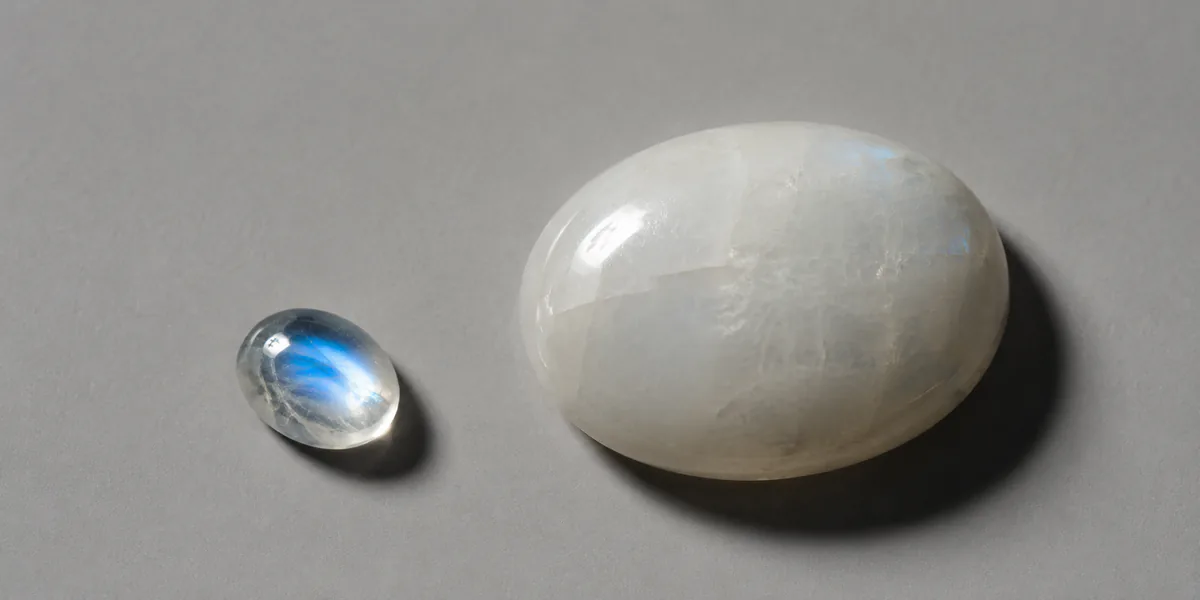
And a word about size. A small stone of fine quality beats a large mediocre one, including for the same money. The price per carat rises with weight, so on a fixed budget you go down in quality to go up in size. The arithmetic is in the price of moonstone.
Finally, what the setting changes: a closed bezel protects the girdle, which is the most exposed zone, and it can also hide a small edge flaw. That is the subject of bezel or prongs.
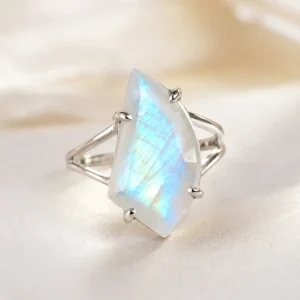
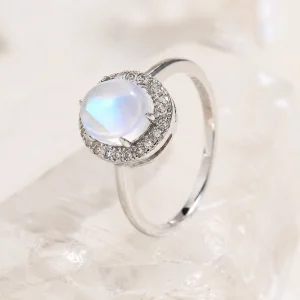
The workshop rings, sorted on these six criteria




Frequently asked questions
How do you judge the quality of a moonstone?
Six criteria, in this order: the color of the sheen, the transparency of the body, the centering of the sheen, its spread, the color of the body and cleanliness. The first two explain most of the price gap.
Which criterion matters most?
The color of the sheen, and by a long way. A clear, deep blue can be worth ten times a milky white sheen at otherwise equal quality, because it depends on a regularity of formation that cannot be had on demand.
How do you check transparency without equipment?
Set the stone on a sheet of grid or lined paper. If you can make out the pattern through it, the body is transparent. If it vanishes, it is not. Three seconds, and it works in a shop.
Is an off-center sheen a flaw?
It is a flaw of cutting, not of material. The lapidary did not orient the cabochon parallel to the internal lamellae, often to keep weight. The stone is genuine, it is simply worth less.
Do inclusions bring the value down?
Not all of them. Centipedes, fine and internal, are a proof of authenticity and do not get in the way. What really counts are the fractures that reach the surface: they weaken a stone with cleavage.
What is a muddy stone?
A trade term for a stone whose body leans toward gray-green or dirty beige. That tint absorbs the light before it reaches the lamellae and kills the sheen. The word appears in the official Sri Lankan grading itself.
Should you prefer a large stone or a fine one?
A fine one, almost always. The price per carat rises with weight: on a fixed budget, going up in size means going down in quality. A small stone with a clear sheen gets noticed more than a large dull one.
Can you judge from a sales photo?
Badly. A photo freezes the sheen, and many are taken under cool light or edited toward blue. Ask for a two-second video with the stone moving: it is the only way to judge the first four criteria.
Is there a quality certification?
No, no standardized grading exists for this stone, unlike the diamond. The official Sri Lankan classification in three categories is the closest thing, and it only covers stones from that country.
Does the variety change the criteria?
The first four hold for all of them. The fifth changes: on a peach or a rainbow, a colored body is normal and not a flaw. What you then judge is how clear and lively the color is, not its absence.
Where to go next
- Before judging quality: recognizing a genuine stone, opalite, treated stones.
- Understanding what you are looking at: adularescence, the colors and varieties, the blue in particular, the glossary.
- Turning it into money: the price of moonstone, the deposits, where to buy.
- After buying: bezel or prongs, is it fragile, cleaning a piece.
- The whole picture: the complete guide to moonstone.
The jewelry is in the shop. If you are torn between two pieces, write to me with both links: I will tell you which one I would take and why, on these six criteria.
My sources
For the optical mechanism that underpins the first four criteria, the GIA and Mindat on exsolution into lamellae and the selective scattering of short wavelengths, detailed in adularescence.
For the vocabulary of quality and the notion of a muddy stone, the official grading of the Sri Lanka Export Development Board, which distinguishes blues, semi-blues and whites, with their sub-categories including the variants called muddy.
For the inclusions known as centipedes, the GIA, which describes them as characteristic tension fractures and typical enough to guarantee identification.
One important limit: no standardized quality grading exists for this stone, unlike the four Cs of the diamond. The order of the six criteria and the "weight" column of the table are my own ranking, formed at the buying bench from what I see actually bearing on prices. Another professional could rank them differently, and I present this as a method and not as a standard.
Last updated: August 19, 2026. If you find an error in this article, let me know: I correct it and I note it.
✦ À porter, à offrir
Découvrez mes créations