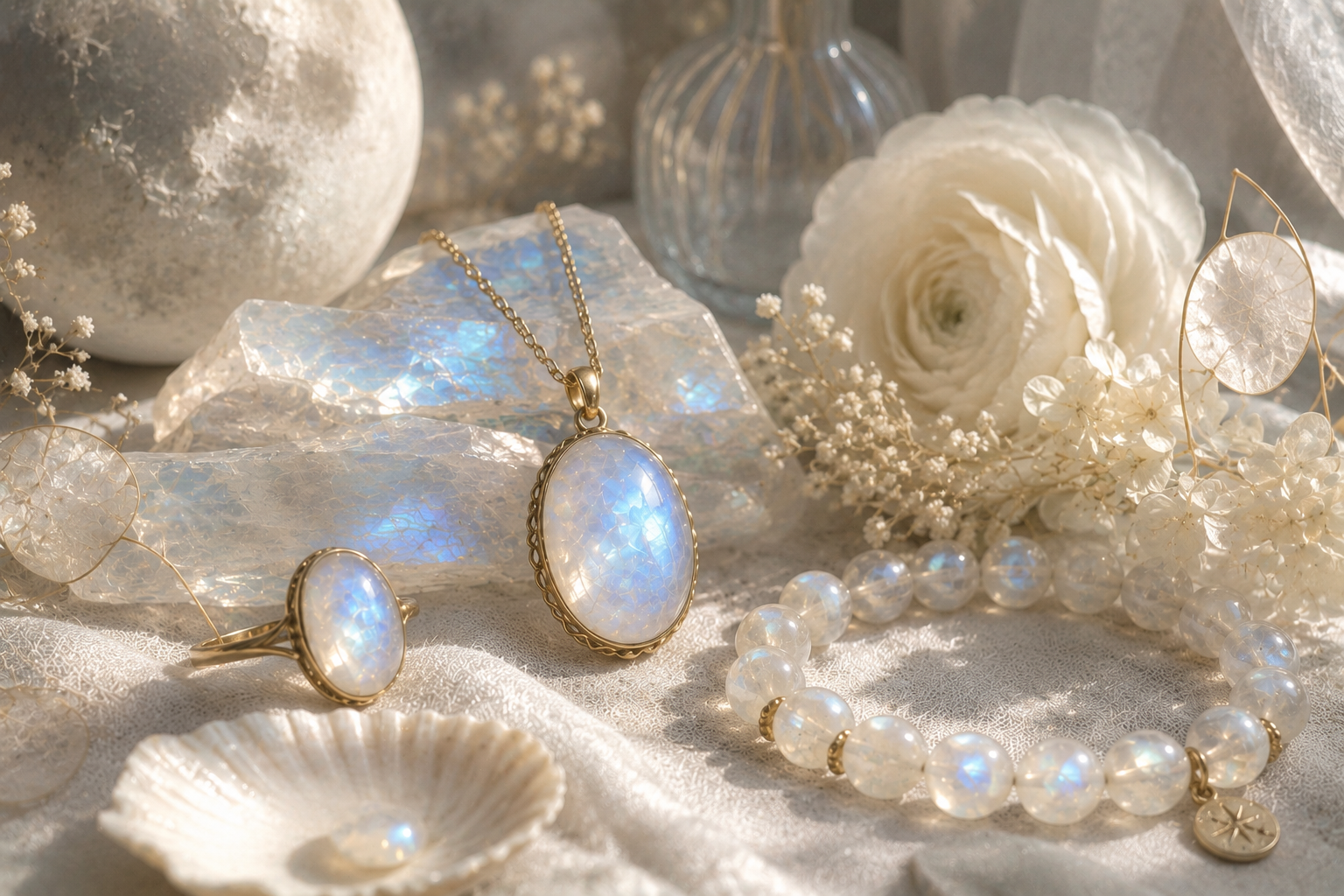
Moonstone, the June birthstone
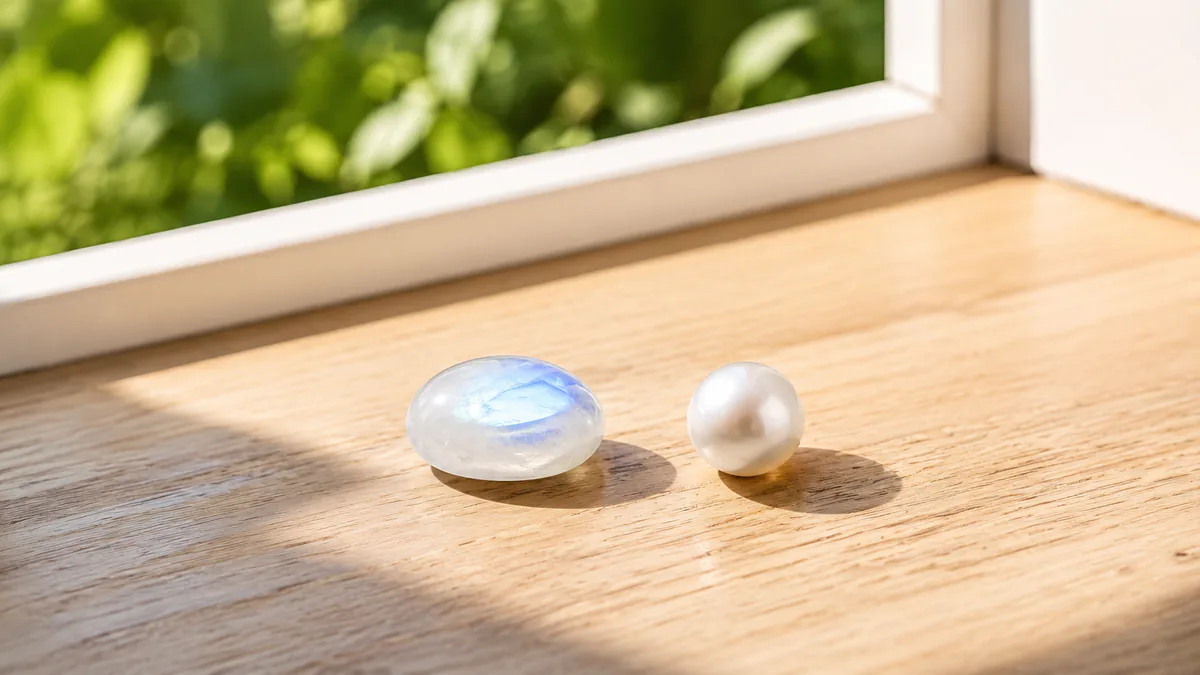
June is one of the few months to have three: pearl, moonstone and alexandrite. This is not an ancient tradition, it is a trade list settled in 1912 and added to in 1952. Here is where it really comes from, which of the three to choose, and why your star sign has nothing to do with your month.
It is the simplest gift I sell, because it explains itself in one sentence. You still have to know what you are explaining: most pages on this subject tell you about a thousand-year-old tradition that does not exist, and forget to mention that pearl and alexandrite are not in the same league.
The short version, if you are in a hurry
- June has three birthstones: pearl, moonstone and alexandrite. Few months have that many.
- The list dates from 1912, settled by the American jewellers. Alexandrite was only added in 1952.
- It is not a thousand-year-old tradition, it is a trade convention, and it is widely known, which is enough to make it a good gift.
- The birthstone follows the calendar month, not the star sign. Someone born on 25 June is a Cancer and keeps the June stone.
- Of the three, moonstone is the best compromise: affordable, visible, and no more fragile than a pearl.
- Real alexandrite is out of reach for an ordinary gift. What is sold under that name is almost always a synthetic.
- The pearl is the most fragile of the three, at 2.5 to 4 on the Mohs scale, and it fears perfume.
June has three stones, and that is unusual
Most months have only one birthstone, or two. June has three, and that abundance has a direct consequence: nobody knows which one to give.
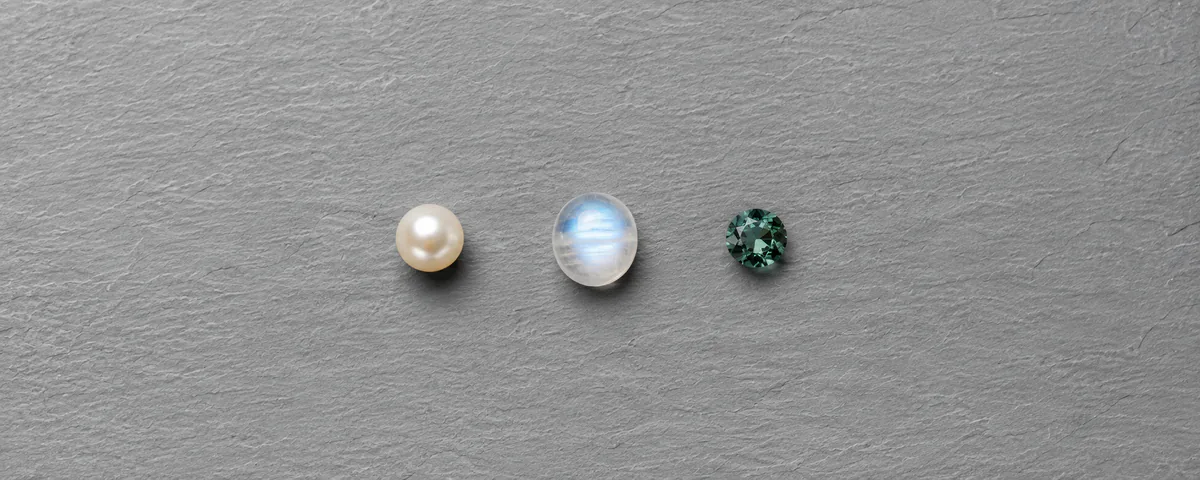
The three are the pearl, moonstone and alexandrite. They have nothing in common. One is organic, produced by a mollusc. Another is a feldspar, an abundant mineral. The third is a variety of chrysoberyl and one of the most expensive gems in the world.
In other words, saying "the June birthstone" without saying which one does not mean very much. This page compares all three, because that is the real question when you are putting a gift together, and because hardly anyone treats it honestly.
Where this list actually comes from
Here is the point I want to establish before anything else, because half the pages on this subject open with "since antiquity".
The modern birthstone list was settled in 1912 by the American jewellers association, with the aim of harmonizing trade habits that varied from one store to the next. June was given the pearl and moonstone at that point.
Alexandrite came later: it was added to June in 1952, during a revision of the list. That is why it appears on some lists and not others, depending on the age of the source you are reading.
These lists have gone on changing since, and other countries have adopted variants of them. So there is no one universal official list: there is a widely circulated American list that the rest of the world has more or less taken up.
None of that disqualifies the gift. A convention everyone knows works perfectly well as a convention. What I refuse to do is sell it as an ancestral heritage when it is a little over a century old.
What is genuinely old in the idea
The idea of matching stones to months is older than 1912. It is worth saying, since this site tries to separate what is datable from what is not.
The principle is generally traced back to the twelve stones of the breastplate described in the book of Exodus, connected with the twelve tribes, and then with the twelve months and the twelve signs by much later authors. That is a descent of an idea, not a descent of a list.
The distinction matters, because none of the breastplate stones can be identified with certainty. The Hebrew and Greek names that designate them do not map neatly onto our present mineral species, and specialists are still arguing about it.
The honest conclusion: the idea of one stone per month has ancient roots, the list you are reading today has none. The same dating work is done in the myths and legends of moonstone.
The month and the sign do not line up
This is the most frequent confusion on the subject, and it sends a lot of people to the wrong page.
The birthstone follows the calendar month, from 1 to 30 June. The zodiac stone follows the sign, and Cancer runs from 21 June to 22 July, straddling two months.
Two concrete consequences. Someone born on 5 June is a Gemini, but their birthstone is still the June one. Someone born on 10 July is a Cancer, but their birthstone is the July one, the ruby.
The two systems do not contradict each other: they answer two different questions. If you are giving for a birthday, take the month. The astrological side is covered in moonstone and astrology.
Pearl, moonstone, alexandrite: the table
Here is the comparison I make out loud every time someone asks me what to give a person born in June.
| Criterion | Pearl | Moonstone | Alexandrite |
|---|---|---|---|
| Nature | Organic | Feldspar | Chrysoberyl |
| Hardness (Mohs) | 2.5 to 4 | 6 to 6.5 | 8.5 |
| Resistance to wear | Low | Medium | Excellent |
| Fears perfume | Yes, a great deal | A little | No |
| Price | Variable, often moderate | Affordable | Very high |
| Risk of imitation | High | High | Very high |
| Visible effect | Pearly lustre | Moving veil | Colour change |
Read the price line and the hardness line together. Alexandrite is the only one of the three you can wear without thinking about it, and it is also the only one you cannot afford. That is the whole problem with June.
The case of alexandrite
It deserves a section of its own, because this is where people get taken in.
Real alexandrite is a variety of chrysoberyl that changes colour with the lighting: green in daylight, red or purple under incandescent light. The effect is spectacular, and it is extremely rare in nature.
The consequence: it ranks among the most expensive gems per carat, on a level with the best rubies. A natural alexandrite of good quality and decent size runs into thousands of dollars.
So what you find online at forty-five dollars under that name is, in the vast majority of cases, a synthetic or another colour-change stone, often a synthetic sapphire or a garnet. That is not illegal if it is declared, and it rarely is declared clearly.
My position when I am asked: if you want to give an alexandrite to someone born in June, either you pay the price at a seller who supplies a laboratory report, or you choose one of the other two stones of the month.
The case of the pearl
It is the most classic choice, and it has two flaws that people systematically forget.
It is very soft. Between 2.5 and 4 on the Mohs scale, with a very thin layer of nacre. A scratch on a pearl is permanent: you do not repolish nacre.
It fears anything chemical. Perfume, hairspray, cream, acidic sweat: the nacre is attacked and goes dull. The last on, first off rule is even stricter for a pearl than for a moonstone.
That does not disqualify it, it is a magnificent material. But if you are giving to someone who will not be careful, the pearl is the worst of the three choices, not the safest as people often think. The full comparison is in moonstone or pearl, which one to give.
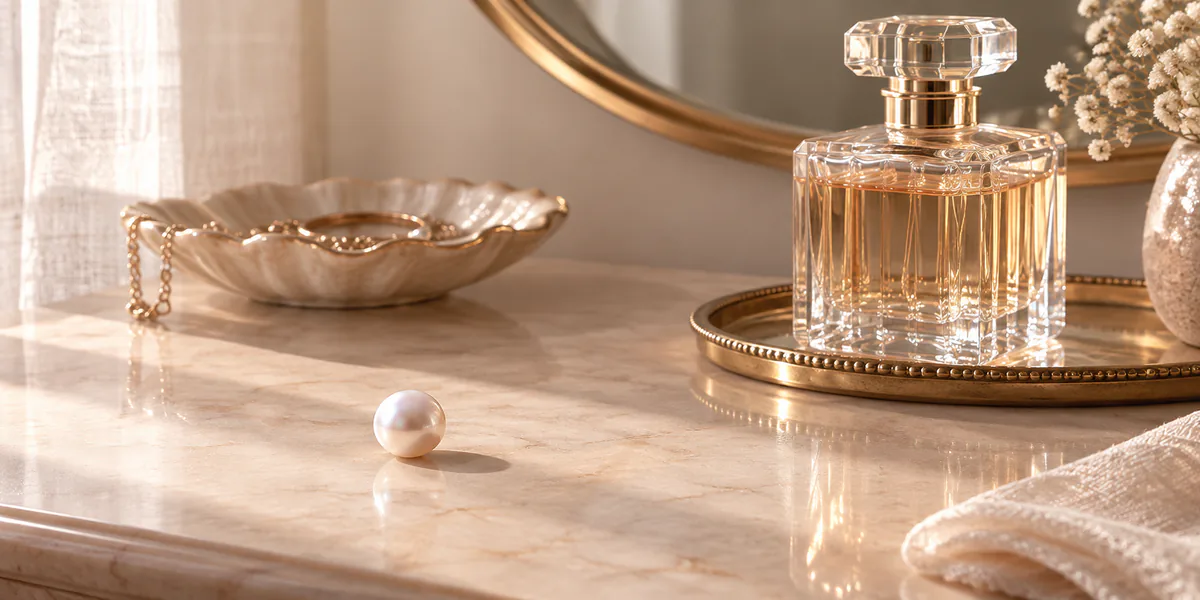
Why moonstone is the best of the three
I sell moonstone, so take this section for what it is. Here are the arguments anyway, and you can judge.
It is tougher than a pearl. At 6 to 6.5 against 2.5 to 4, that is not a small gap. It has perfect cleavage, which makes it liable to break on an impact, but it does not scratch at the slightest contact and it does not fear cosmetics the same way.
It is affordable. Where alexandrite is out of reach, a fine moonstone cabochon stays within the budget of an ordinary birthday gift.
It has a visible effect. The veil moves when you tilt the stone. That is a phenomenon you can show, and tell someone about, and it gives the gift a content beyond its value.
It carries no gender label. Unlike the pearl, often read as classic and feminine, it can be given to just about anyone. See moonstone for men.
Its only real flaw is the cleavage, which makes it unsuited to a ring worn by someone who works with their hands. The subject is covered in is moonstone fragile.
What I give most often for a June birthday
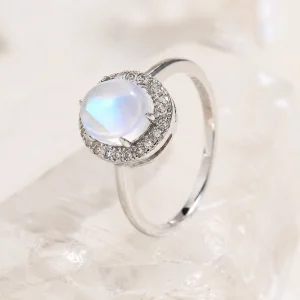
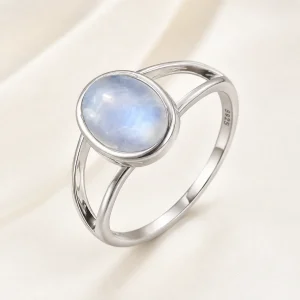
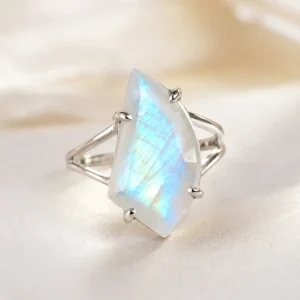
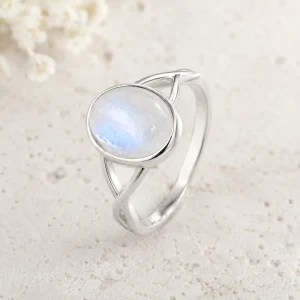
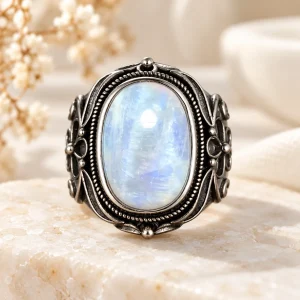
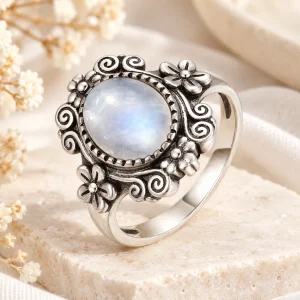
What to give someone born in June
Three practical pieces of advice, and they settle most cases.
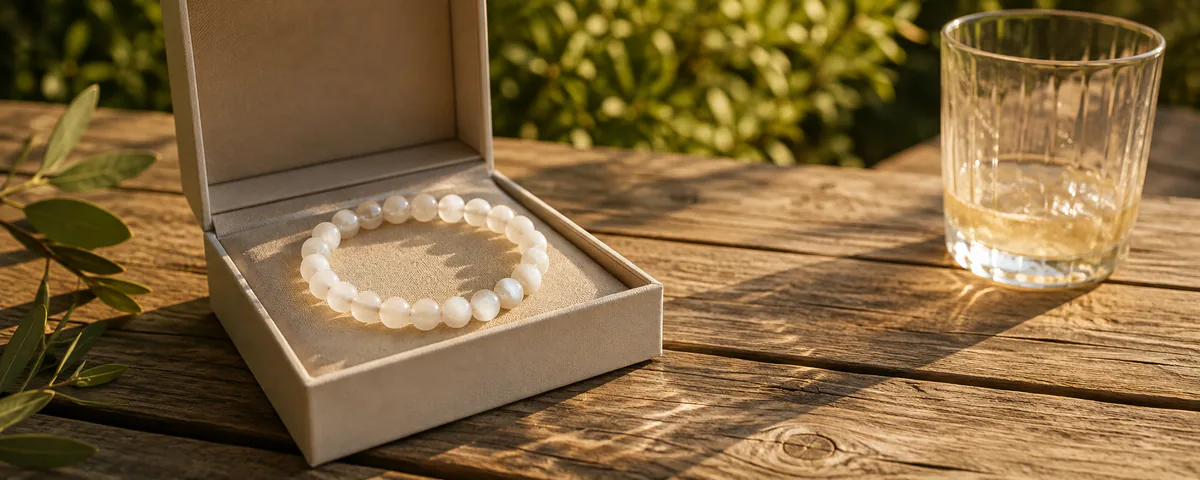
Go plain. A single cabochon, a simple setting. A plain piece goes with everything, and that is what decides whether the gift ends up on a wrist or in a drawer.
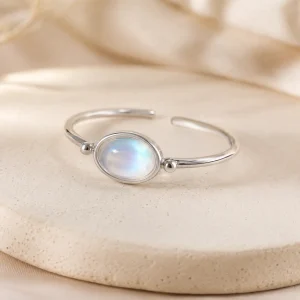
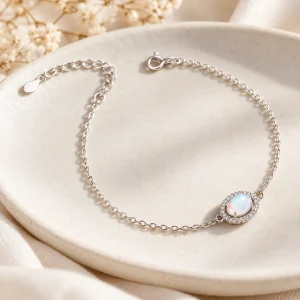
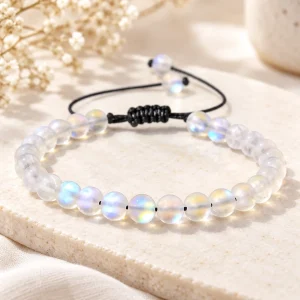
Avoid a ring if you do not know the size. An elastic bracelet or a pendant removes the problem. It is the first cause of an unworn gift, and it is settled in thirty seconds. The detail is in giving a moonstone.
Say that it is the stone of the month. That is the enormous advantage of this gift: it explains itself, and you do not need to invent a meaning. "It is the stone of your birth month" is enough, and it is true.
One common-sense remark to finish: the same person can be given a moonstone several years running without it being a lazy option, since no two cabochons ever have the same veil.
The wedding anniversary lists
A neighbouring question I am often asked, and one that deserves the same caution.
There are lists matching a stone to each wedding anniversary, and moonstone generally appears on them for the thirteenth. Those lists are, likewise, trade constructions of the twentieth century, and they vary from country to country and from source to source far more than the monthly lists do.
So take them for what they are: a gift idea that gives you a pretext, not a tradition to be respected. If your thirteenth anniversary is coming up and you like moonstone, that is a perfectly sufficient reason.
What tradition ascribes to the stone of the month
I report, I do not endorse, and I date.
The idea that a birthstone protects the person wearing it during their month, or that it works better worn by someone born then, belongs to the folklore of stones and not to the 1912 list, which was purely commercial. You find it developed in the crystal healing literature of the second half of the twentieth century.
For moonstone itself, tradition holds on to three words: gentleness, intuition and beginning again. Those attributions settle in the books of the 1980s and 1990s, and they are set out in the meaning of moonstone and virtues and benefits.
These correspondences belong to crystal healing, an approach founded on traditions and beliefs. They are not a medical claim and never replace the advice of a health professional. Read the full disclaimer.
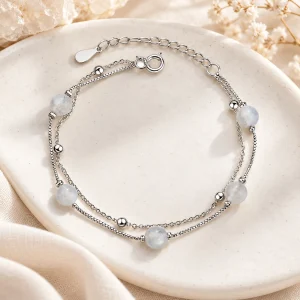
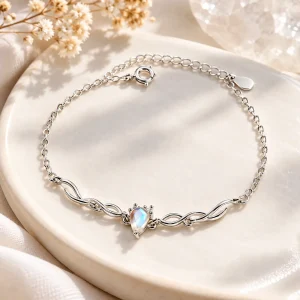
The bracelets, to give without knowing any size
Frequently asked questions
What is the birthstone for June?
June has three: pearl, moonstone and alexandrite. The pearl and moonstone have been on the list since 1912, alexandrite was added in 1952. Few months offer that much choice.
Is this list an ancient tradition?
No. It was settled in 1912 by the American jewellers to harmonize trade habits. The idea of matching a stone to a month is older and goes back to the breastplate described in Exodus, but none of the stones in that text can be identified with certainty.
Which of the three is the best to give?
Moonstone, in most cases. It is tougher than a pearl, far more affordable than alexandrite, it has a visible effect you can show, and it carries no marked gender code.
Is a thirty dollar alexandrite genuine?
Almost never. Natural alexandrite ranks among the most expensive gems per carat. At that price it is a synthetic or another colour-change stone. If you really want one, insist on a report from a named laboratory.
Should you follow the month or the star sign?
The month, for a birthday gift. The birthstone follows the calendar, from 1 to 30 June, whereas Cancer runs from 21 June to 22 July. Someone born on 5 June is a Gemini and still keeps the June stone.
Is the pearl a safe choice?
Less than people think. At 2.5 to 4 on the Mohs scale, with a very thin layer of nacre, it scratches permanently and fears perfume, hairspray and sweat. For someone who will not be careful, it is the most fragile of the three choices.
Can you give the same stone several years running?
Yes, and it is one of the advantages of this one: no two cabochons ever have the same veil, or the same position of the sheen on the dome. It is not a lazy option, it is a different piece every time.
Is moonstone also a wedding anniversary stone?
It generally appears at the thirteenth anniversary on the lists in circulation. Those lists are trade constructions of the twentieth century and vary from country to country: take them as a pleasant pretext, not as a rule.
Where to go next
This page deals with the calendar. For what comes next:
- Giving: giving a moonstone, moonstone or pearl, the engagement ring.
- The astrological side: moonstone and astrology, the gods and goddesses of the Moon.
- Choosing the stone: the colours and varieties, judging the quality, the price, where to buy it.
- Wearing it and keeping it: how to wear it, is it fragile, cleaning it.
- The whole picture: the complete guide.
What I make is in the shop, and every piece goes out wrapped ready to be given. A June birthday coming up and a hesitation between two models? Write to me.
My sources
The 1912 birthstone list and the addition of alexandrite in 1952 are facts documented by the American jewellery trade, which produced those lists. I present them as trade conventions, which is what they are, and not as an ancient tradition.
The hardnesses, the mineral natures and the behaviour of nacre follow the public files of the GIA, of Mindat and of the International Gem Society. The colour change of alexandrite and its rarity come from the same sources.
On the breastplate in Exodus, I flag the uncertainty over identifying the stones rather than repeating a correspondence that specialists do not endorse.
The gift advice comes from my own workshop and from talking with the people who buy pieces from me to give.
Last updated: 19 August 2026. If you find an error in this article, let me know: I correct it and I note it.
✦ À porter, à offrir
Découvrez mes créations