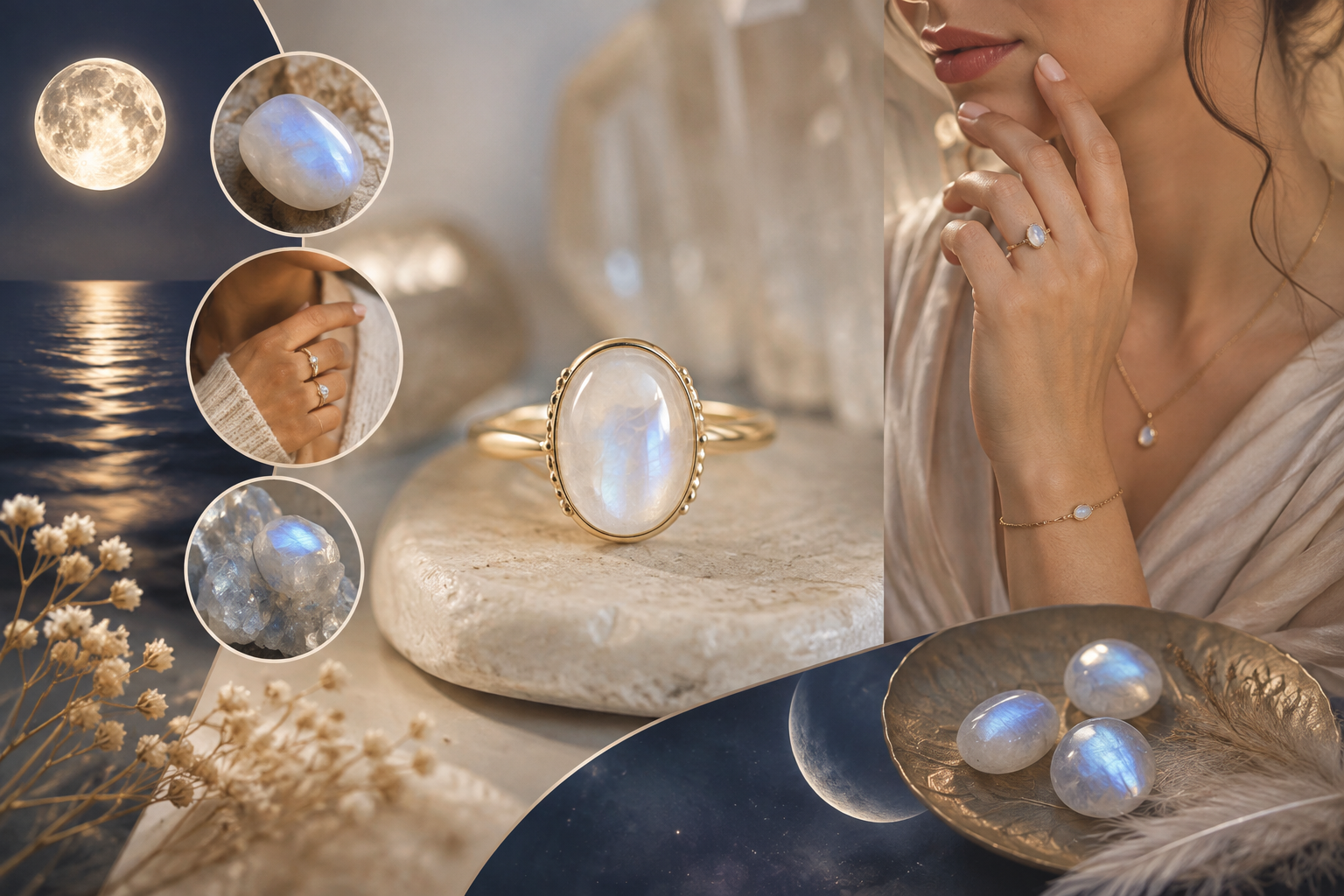
Moonstone ring meaning and how to wear it
A ring gets read. Depending on the finger and the hand, it says commitment, assertion or nothing at all, and you are not the one who decides what other people see in it. Here is what tradition assigns to this stone, what each finger is meant to say, the finger I recommend for entirely different reasons, and what a ring means when you give one.
This is the piece I get asked about more than any other, by a wide margin. A ring is the only jewel people look at while you talk to them, the only one with an established social code, and it is also the most exposed to knocks. Those three things pull in opposite directions, and this page tries to reconcile them honestly.
The short version, if you are in a hurry
- The meaning assigned to the stone comes down to three words: softness, intuition, new beginnings. These are recent attributions, not ancient knowledge.
- The finger speaks louder than the stone. A ring on the left ring finger reads as a commitment, whatever stone happens to sit on it.
- The vein said to link the ring finger to the heart does not exist. It is an old belief, a pretty one, and anatomically false.
- Left or right depends on the country, not on a universal rule. Several European countries wear the wedding band on the right.
- The finger I recommend is the ring finger or the little finger of the less active hand. The index finger of the dominant hand is the worst of all.
- Bezel setting and low dome, on every finger, no exceptions.
- If you are giving a ring with no intention of commitment, name the finger or switch to another kind of jewellery.
What a moonstone ring means
Three words come up in every source, and they should be taken for what they are: reported attributions, not properties.
Softness. Moonstone is credited with calming sharp reactions, as opposed to the stones described as driving. It is the most consistent attribution from one source to the next.
Intuition. The idea of feeling before reasoning, tied to the veiled quality of the stone: you see something move inside it without ever being able to fix it.
New beginnings. By analogy with the lunar phases, which wane and come back. That is why the stone turns up so often for moments of change, a move, a career shift, a separation.
On a ring, those three meanings take on an extra shade: the ring is the most visible piece in real situations. People see it when you shake a hand, when you sign, when you set down a cup. What the stone is meant to say, it says to someone else as much as to you, which is true of no other jewel.
The general meaning of the stone is covered in the meaning of moonstone.
How long that meaning has been attached to it
This site has made it a rule to date what it reports, so here goes.
The link between the stone and the Moon is old: it is in its name, it is in its use in India and Sri Lanka, and it has never been disputed.
The grid that ties the stone to intuition, to cycles and to the feminine, on the other hand, is far more recent. It settles into the crystal literature of the 1980s and 1990s, notably with Katrina Raphaell in 1985 and Melody in 1995, then spreads across the internet unchanged.
That does not invalidate it. A recent convention is still a convention, and it can mean something to whoever practices it. What I refuse is the phrase "the ancients attributed" placed in front of a grid that is forty years old. The same sorting is done in the myths and legends of moonstone.
The meaning assigned to each finger
Here is what common usage reports. Again, I am reporting: no authority fixes these correspondences, and they vary from one source to the next.
| Finger | Assigned meaning | Exposure to knocks |
|---|---|---|
| Thumb | Will, independence, self-assertion | High |
| Index finger | Authority, direction, ambition | The highest |
| Middle finger | Balance, responsibility, measure | Medium |
| Ring finger | Bond, commitment, creation | Low |
| Little finger | Intuition, speech, persuasion | The lowest |
Look at the last two columns together: they oppose each other almost perfectly. The finger tradition credits with the most power is the one that breaks the most stones, and the finger it credits with intuition, the little finger, is the quietest on the hand. I come back to this further down, because it is the real subject of this page.
The left ring finger and the vein that does not exist
This is the most copied story on the subject, and it is false.
An old belief, widely spread in Europe from the Renaissance onward, holds that a vein runs directly from the left ring finger to the heart. It even has a Latin name, the vena amoris, and it has been used for centuries to justify the wedding band on that finger.
That vein does not exist. Every finger is supplied the same way, by equivalent networks, and none of them has a privileged channel to the heart. This is not a recent discovery, nor a controversy: it is simply anatomy.
Does that mean giving up on the ring finger? No, and for two reasons with nothing mystical about them. The first is that the convention is real, even if its explanation is false: a ring on that finger will be read as a commitment, which is useful information when you choose where to put it. The second is that the ring finger is mechanically one of the quietest fingers on the hand, which suits a fragile stone perfectly.
In other words: right finger, wrong reason.
Left or right: it depends on the country
Here is a point that almost no page mentions, and it is enough on its own to show there is no universal rule.
In Australia, France, Italy, the United Kingdom and the United States, the wedding band is worn on the left ring finger. In Germany, Poland, Russia, Norway and Spain, it is traditionally worn on the right. In some countries the ring even moves from one hand to the other between the engagement and the wedding.
The conclusion is clear: the meaning of a ring is a local convention, not a truth. Nobody can tell you that you are wearing your ring on the wrong side, since the right side changes as soon as you cross a border.
What holds everywhere is what the people around you are going to read. If you live in Australia and you would rather not be read as engaged, stay off the left ring finger: that is a practical choice, not a superstition.
The finger I recommend, and why it contradicts tradition
Now for my own opinion, which comes from what I see coming back to the workshop.
Moonstone sits at 6 or 6.5 on the Mohs scale, which is decent, but above all it has perfect cleavage: it splits cleanly on impact, along internal planes. On a hand, the impacts come from repetition, not from accidents.
The worst finger is the index finger of the dominant hand. It is the one that hits door frames, that presses, that opens, that taps. It is also the one tradition credits with authority, which is why I am so often asked to set the stone there. I advise against it, plainly.
The thumb comes right after, for the same reasons, with an enormous contact surface on top of that whenever you grip something.
The two good fingers are the ring finger and the little finger, preferably on the less active hand. The little finger is the quietest of them all and takes a cabochon very well.
If the meaning you are after and the finger that protects the stone do not fall in the same place, make the trade knowingly. A broken ring has no meaning left at all, which settles the debate fairly quickly. The full ranking by kind of jewellery is in how to wear moonstone.
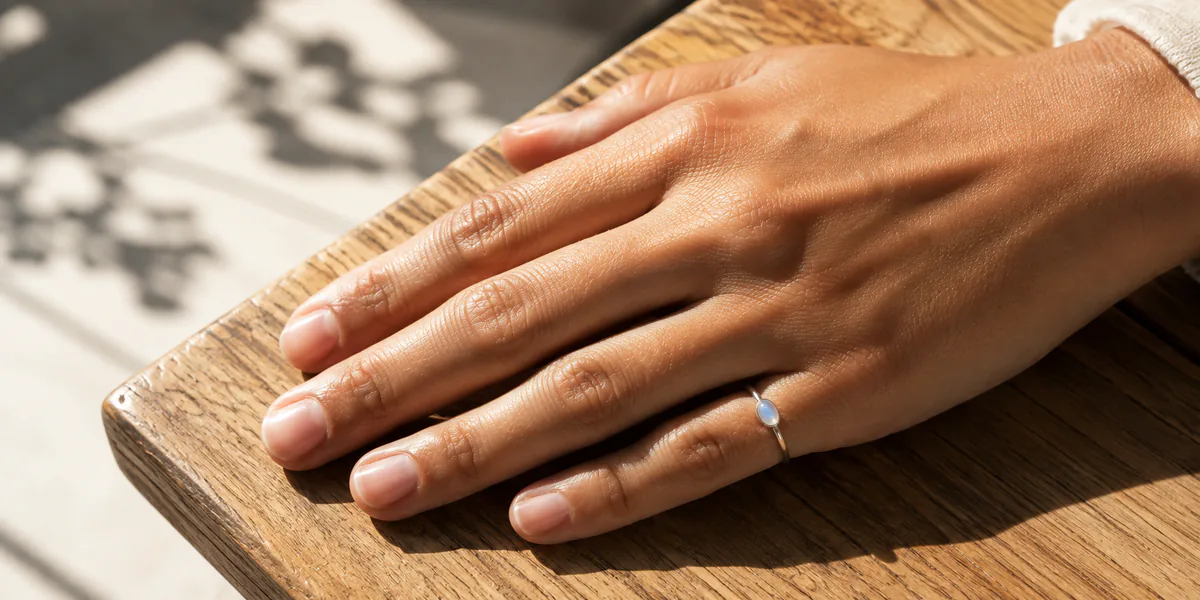
What a ring says when you give one
A ring is the only jewel that carries a message you do not entirely control. A bracelet or a pendant is received without a second thought; a ring is interpreted.
Three situations, and three ways to handle them.
You are giving one with no intention of commitment. Say so as you hand it over, or better, name the finger: "I could see this on your little finger" clears the ambiguity without having to explain what you did not mean. It is more elegant than a denial.
You are giving one with an intention. Then the finger carries the message, and it had better be chosen. In Australia, the left ring finger says what you mean, without a word.
You do not know how it will be received. Switch to another kind of jewellery. A moonstone bracelet or pendant carries the same attention without the social code of a ring. Occasions and wording are covered in giving moonstone as a gift.
One case stands apart, and it has its own page: the engagement ring. The question there is not symbolic but mechanical, since it is the one piece of jewellery that never comes off, and my answer is a qualified one. See is moonstone good for an engagement ring.
The setting changes with the finger
People rarely choose the setting to suit the finger, and that is a mistake.
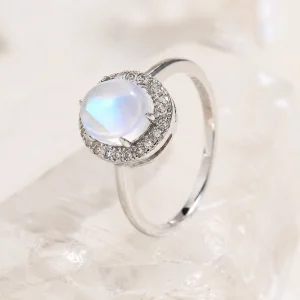
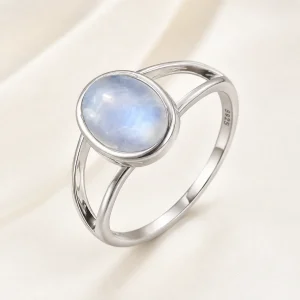
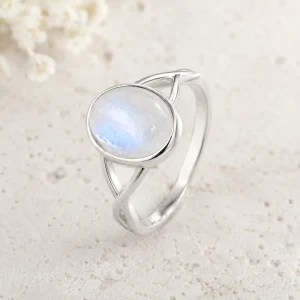
Bezel setting everywhere. A continuous ribbon of metal around the cabochon covers its girdle, exactly the edge where cleavage starts. Prongs leave that flank bare, apply point pressure and catch on clothing. The full comparison is in bezel or prong setting.
Low dome on the exposed fingers. A high dome gives a finer veil and stands further out from the plane of the hand. On the index, the thumb or the middle finger, it is the part that meets everything. On the little finger, you can allow yourself a more generous dome.
Wide band, half a size up. At equal size, a wide band grips more than a thin one. Past 6 millimetres of width, allow half a size more.
Closed back. It keeps the stone from flexing and blocks soapy water and dust from working their way under the cabochon.
Standard calibration. 8 x 6, 10 x 8, 12 x 10 millimetres. The day the stone breaks, it is replaced like for like without remaking the setting.
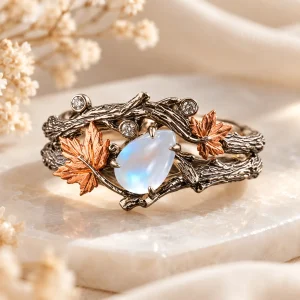
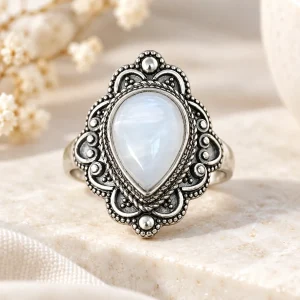
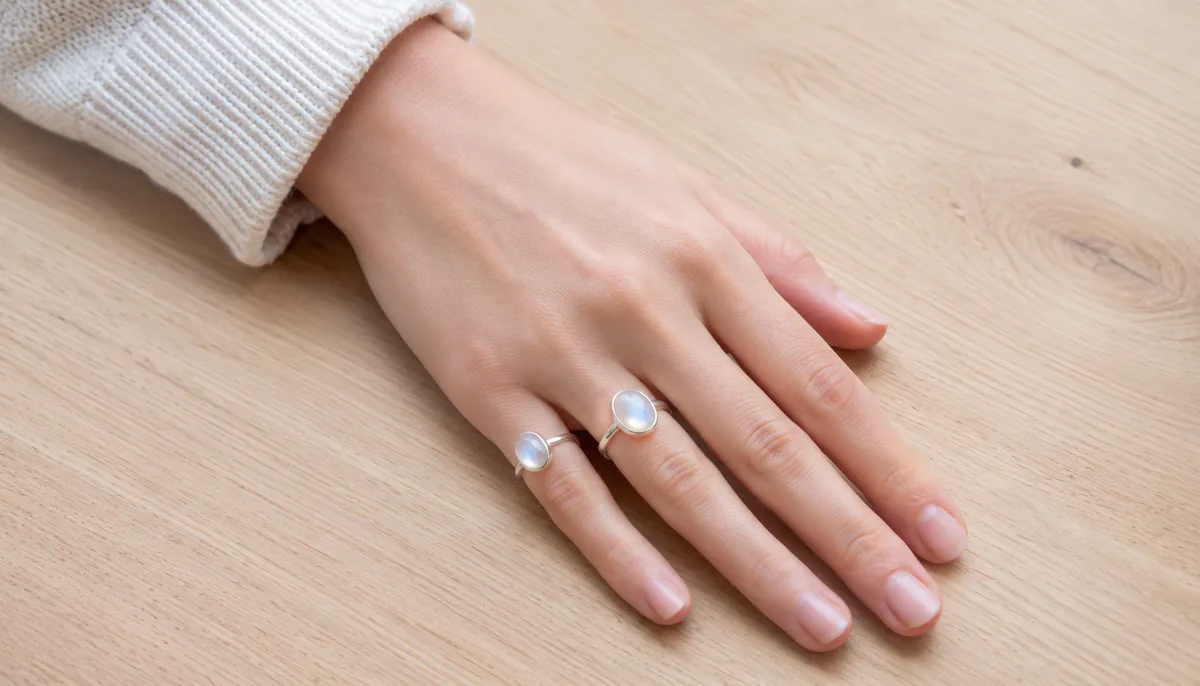
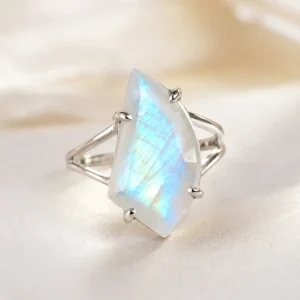
Bezel-set cabochons, mounted one by one
Finding your size, finger by finger
A ring does not have one size, it has as many sizes as you have fingers, and that accounts for a good share of returns.
Three useful facts. The dominant hand is generally a little larger, often half a size above the other. Fingers swell late in the day and in hot weather, and shrink in the cold. And the gap between the ring finger and the little finger can reach several sizes on the same hand.
The method: measure the exact finger that will carry the ring, on the exact hand, late in the day, at room temperature. A ring should pass the knuckle with slight resistance and should not spin freely once in place.
If you are giving one and cannot measure, there are two solutions. Quietly borrow a ring already worn on the same finger, which is the only valid comparison. Or choose an open band, which adapts to the finger with no size to state: that is what makes a ring given in secret possible.
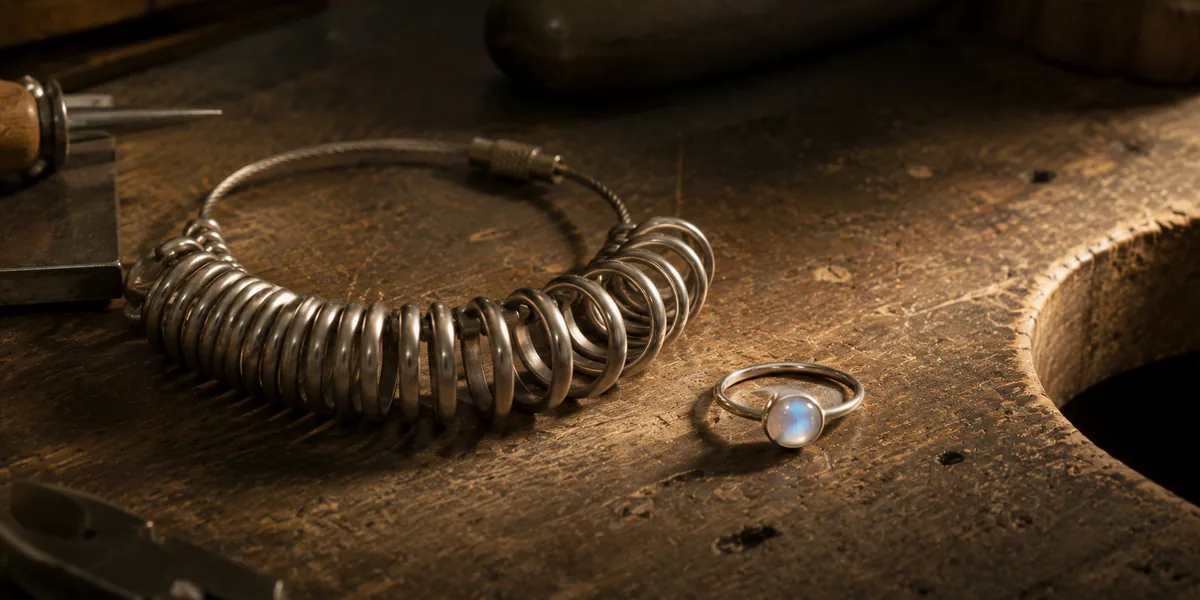
The whole collection, sizes 48 to 62 and two open bands




Stacking it with other rings
Stacking is in fashion and it is the second cause of dulled cabochons, after knocks. The principle is simple: what is harder scratches what is softer.
A ring set with diamonds, cubic zirconia or sapphires worn on the neighbouring finger, or worse on the same finger, wears out a moonstone cabochon in a few months. The same goes for a tungsten carbide or ceramic band, which sit around 8 or 9 on the Mohs scale.
A plain gold or silver band, on the other hand, scratches nothing: those metals sit around 2.5 or 3, well below feldspar. The risk then becomes mechanical rather than abrasive, and it is solved by lining the two rings up at the same height.
The practical rule fits in one sentence: nothing harder than moonstone should touch it. Separate the fingers, or slip a plain band in between. The subject is covered on the wrist side in which wrist to wear a moonstone bracelet on, and on the stone side in which stone to pair it with.
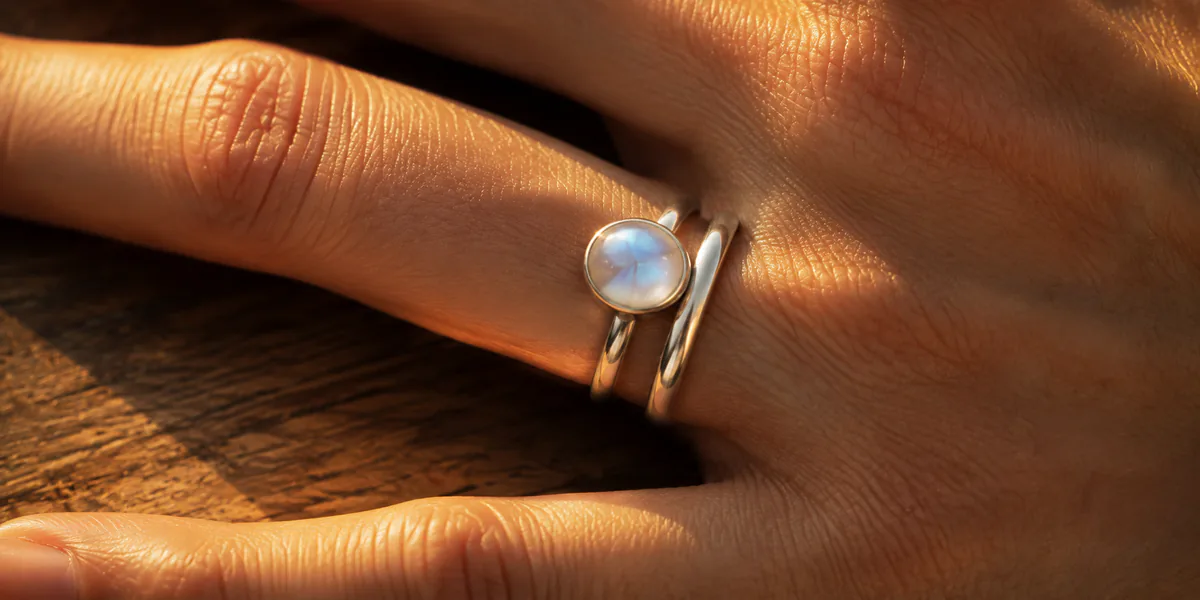
Making it last
Four habits, and they are enough.
Take it off often. Dishes, housework, gardening, sport, DIY, showers, pools and the sea. It sounds like a lot; in practice it becomes a reflex within a few weeks, and it is what separates a ring that lasts from a ring that breaks.
Last on, first off. The ring goes on after the cream, the perfume and the hairspray, and comes off before anything else. Alcohols and oils settle under the cabochon and dull the polish.
Never ultrasonic. No steam cleaner either, not even at a jeweller. Ultrasound propagates existing fractures along the cleavage planes. Lukewarm water, mild soap, a very soft brush.
Store it on its own. An individual pouch, not the bottom of a dish with the keys and the watch. The detail is in how to clean a moonstone jewel and is moonstone fragile.
The meanings reported on this page belong to crystal healing and folk tradition. They are not a medical claim and never replace the advice of a healthcare professional. Read the full disclaimer.
Frequently asked questions
What is the meaning of a moonstone ring?
Tradition credits it with softness, intuition and new beginnings, the last of the three by analogy with the lunar phases. These are attributions spread by the crystal healing literature of the 1980s and 1990s, not ancient knowledge. On a ring, the chosen finger adds a message of its own, often more legible than the one carried by the stone.
Which finger should a moonstone ring go on?
On the ring finger or the little finger of the less active hand. Those are the two least exposed to knocks, and tradition credits them with bond and intuition. Avoid the index finger of the dominant hand, which takes almost every impact.
Is it true that a vein links the ring finger to the heart?
No. The vena amoris is an old belief, widely spread in Europe from the Renaissance onward, but every finger is supplied the same way. The ring finger remains a good choice for other reasons: the social convention is real, and it is a barely exposed finger.
Left or right?
It depends on the country. Australia, France, Italy, the United Kingdom and the United States wear the wedding band on the left; Germany, Poland, Russia, Norway and Spain traditionally wear it on the right. For the stone, favour the less active hand, whichever one that is.
Can a moonstone ring be worn every day?
Yes, provided you take it off several times a day: dishes, sport, gardening, DIY, showers. The stone has perfect cleavage and splits on impact. If you know that reflex will not come, choose a pendant or a pair of earrings.
Can it be stacked with other rings?
With plain gold or silver bands, yes: those metals are far softer than the stone. With a ring set with diamonds, cubic zirconia or sapphires, no: they wear the cabochon out in a few months. The same goes for tungsten and ceramic.
How do I find my ring size?
Measure the exact finger that will carry it, on the exact hand, late in the day and at room temperature. The dominant hand is often half a size above, and the gap between the ring finger and the little finger can reach several sizes.
What if I want to give a ring without it being ambiguous?
Name the finger as you hand it over: pointing to the little finger clears the ambiguity without having to explain what you did not mean. If the doubt lingers, a bracelet or a pendant carries the same attention without the social code of a ring.
Where to go next
This page covers the ring. For the rest:
- Wearing and protecting: how to wear it day to day, bezel or prong setting, is it fragile, cleaning it.
- The other jewellery: the bracelet and the wrist, the necklace and the pendant, earrings.
- The gesture: giving moonstone as a gift, the engagement ring, moonstone for men.
- Choosing: colours and varieties, judging quality, the price, where to buy it.
- The meaning: the meaning of the stone, the myths and legends.
- The big picture: the complete guide.
The rings I make are in the ring collection, bezel set for the most part, sizes 48 to 62 and two open bands with no size at all. Unsure about the finger or about the measurement? Write to me, I answer myself.
My sources
The hardness of 6 to 6.5, the perfect cleavage and the cleaning prohibitions follow the public data sheets of the GIA, of Mindat and of the International Gem Society, as do the comparative hardnesses of the stones and metals cited.
The meanings assigned to the stone and to the fingers are reported from the most widely circulated crystal healing books and sites, with their dates where those are known: Crystal Enlightenment by Katrina Raphaell, 1985, and Love Is in the Earth by Melody, 1995. None of them has scientific validation and I do not present them as such.
The absence of the vena amoris is ordinary anatomy: no finger has a privileged vessel running to the heart. Left hand or right hand customs by country are widely documented cultural conventions, and they change.
The advice on fingers, settings, sizing and stacking comes from my workshop and from the pieces people bring me to repair.
Last updated: 19 August 2026. If you find an error in this article, let me know: I correct it and I note it.
✦ À porter, à offrir
Découvrez mes créations