What Crystals to Pair With Moonstone
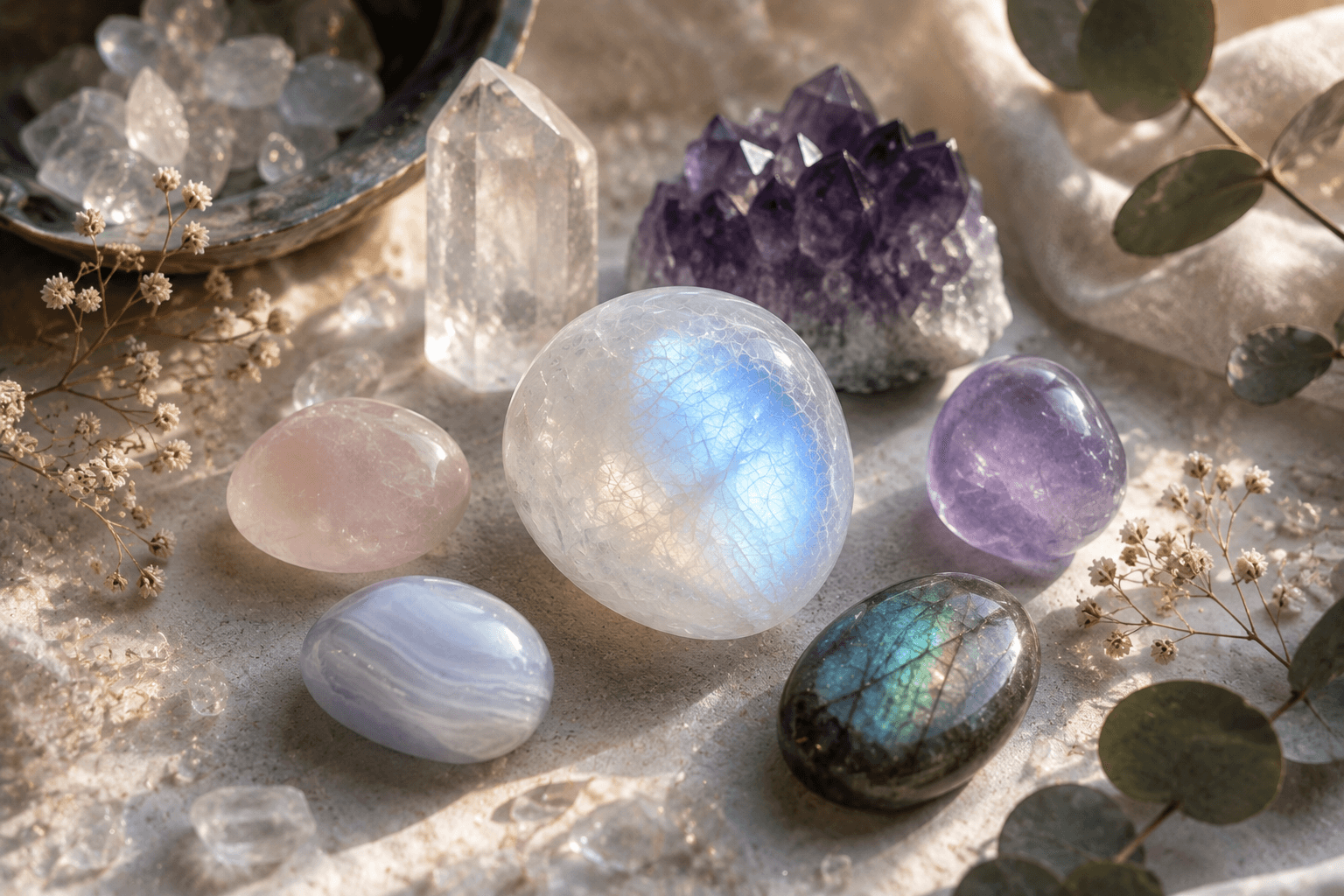
Amethyst, rose quartz, carnelian, malachite, labradorite, sunstone: here are the six most requested duos, what tradition says about each, and above all one thing nobody tells you. A great symbolic pairing can be a very bad pairing on a bracelet, and it comes down to hardness.
The question almost always reaches me in its symbolic form: which stone "goes with" moonstone. I answer that one, honestly. But I add a second, which matters more for your jewelry: which stone can share the same strand without damaging it. The two answers aren't the same, and only one of them can be checked.
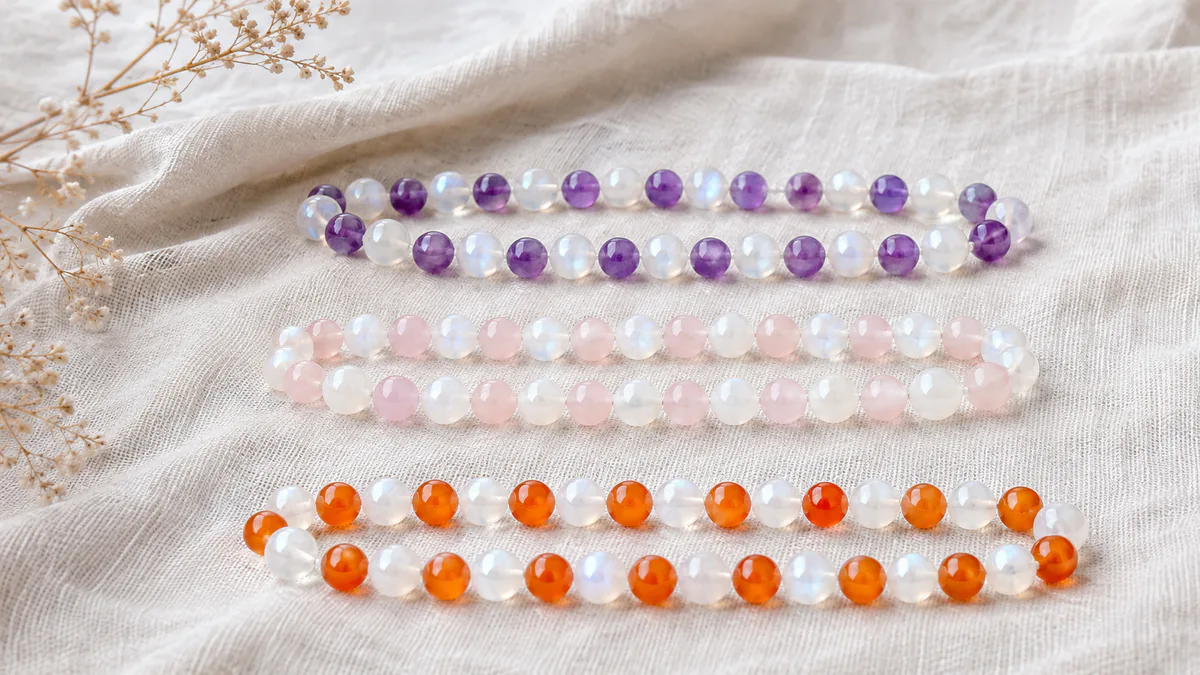
The essentials, if you're in a hurry
- Moonstone is soft and fragile: 6 to 6.5 on the Mohs scale, with perfect cleavage. It's the one that comes out worse in almost every pairing.
- Quartz crystals scratch it. Amethyst, rose quartz and carnelian sit at 7 or just under. On an elastic bracelet, the beads rub against each other all day long.
- Malachite is the opposite case: at 3.5 to 4, it's the one that gets scratched, and it hates water. The duo is possible, it just needs the most care.
- Sunstone and labradorite are the only two first cousins, same feldspars, same hardness, same care. These are the safest duos.
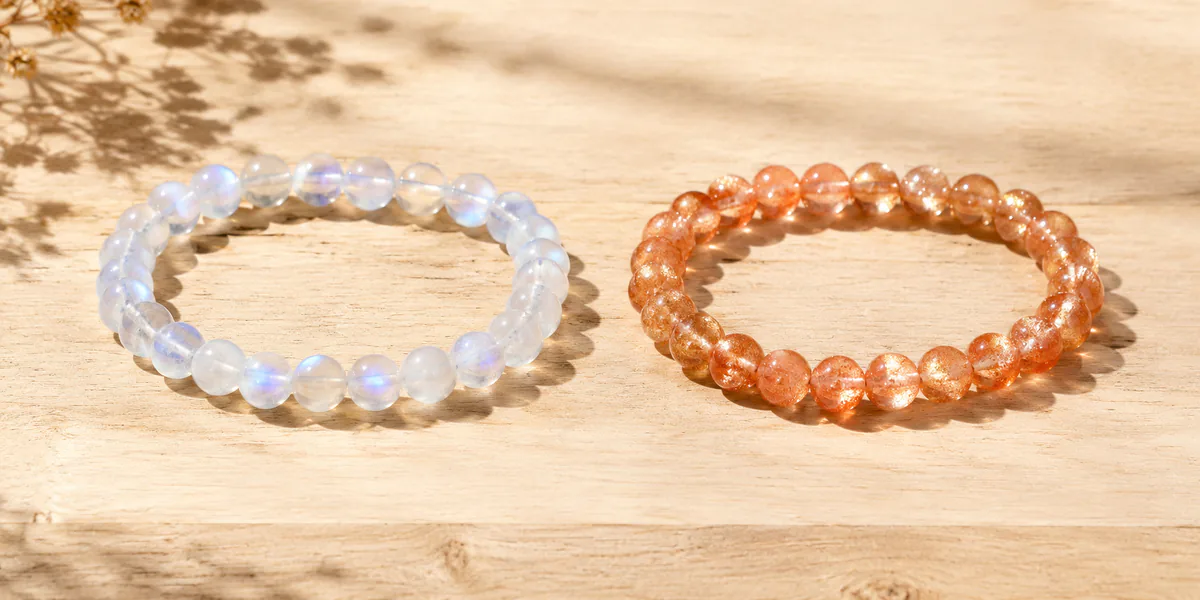
- The moon-and-sun duo is the only one that's perfect on both counts, symbolic and material. If you only remember one, make it this one.
- A duo complicates cleansing. Each stone has its own restrictions, and you have to find a method that suits both.
- No pairing has any proven effect. What I'm reporting here is tradition, never a promise.
Two questions people always mix up
When you search for what stones to pair with moonstone, you're actually asking two very different questions, and most sites only answer one.
The first is symbolic. Which stone has a meaning that pairs well with moonstone's? That's a question of correspondences, it belongs to tradition, it's written in the conditional, and it has no verifiable answer. I still cover it, because it's the one people ask me, and because refusing to answer would just leave the field to someone less careful than me.
The second is material. Which stone can spend eight hours a day pressed against moonstone without hurting it? That one has a clean answer, it's measurable, and I've never seen a shop raise it. And yet it's the one that decides what your bracelet looks like in two years.
What follows answers both, separately, duo by duo. And for the pairings to flat out avoid, there's a dedicated article: what stones not to pair with moonstone.
The hardness table nobody makes
Let's start with the fact, in the indicative, because it governs everything else.
The Mohs scale measures resistance to scratching. One stone scratches another if it's harder. Moonstone sits at 6 to 6.5, which is decent, but it also has perfect cleavage: internal planes along which the crystal splits cleanly. It doesn't scratch easily, it chips on impact. The nuance is spelled out in the properties of moonstone.
On a beaded bracelet, the stones touch, slide and knock against each other constantly. This isn't a lab hypothesis: it's what happens every time you rest a forearm on a table.
| Stone | Mohs hardness | Verdict |
|---|---|---|
| Moonstone | 6 to 6.5, perfect cleavage | Reference |
| Amethyst | 7 | It scratches |
| Rose quartz | 7 | It scratches |
| Carnelian | 6.5 to 7 | It scratches |
| Malachite | 3.5 to 4 | It gets scratched |
| Labradorite | 6 to 6.5, perfect cleavage | Evenly matched |
| Sunstone | 6 to 6.5, cleavage | Evenly matched |
Read the middle column and everything gets simple. Three of the six best-selling duos pair moonstone with a quartz, meaning a harder stone. Those bracelets exist, they look great, and I make them, but you should know what you're buying: after a few years, it's the moonstone beads that will have lost their shine, not the others.
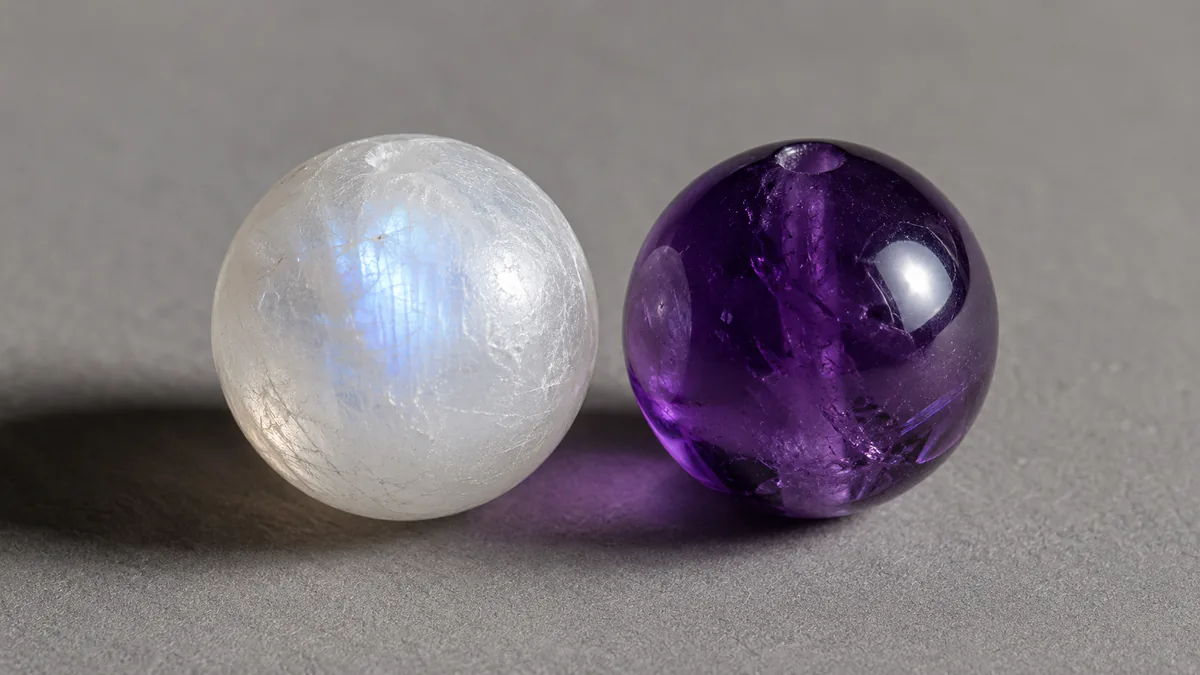
There's a second constraint, less visible and just as real: upkeep. Each stone has its own restrictions, and a duo only accepts methods that suit both. Moonstone rejects salt, prolonged water exposure and ultrasonic cleaners. Malachite rejects water altogether. A moonstone-and-malachite bracelet is therefore left with almost no wet cleansing method at all. The seven methods and their restrictions are in cleansing and recharging your crystals.
Amethyst: the most requested duo
This is by far the most searched-for pairing, and the one I get the most messages about.
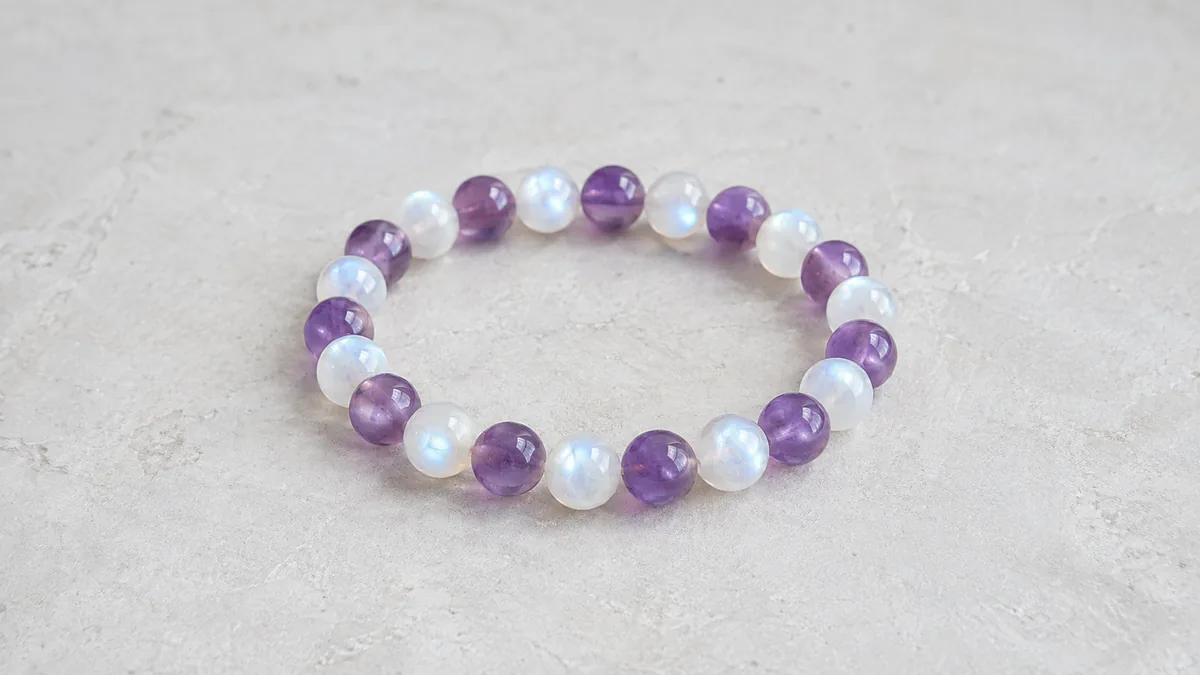
What tradition says. Amethyst is said to be a stone of calm and centering, often linked to the third eye, like moonstone. The duo is presented as coherent for that reason: two stones from the same family of correspondences, one violet and solar in temperament, the other lunar and diffuse. The pairing is logical within the system, and it's no older than the rest: the dating of these attributions is in the properties of moonstone.
What matter says. Amethyst is a quartz, at 7 on Mohs. It's decidedly harder. On a beaded bracelet, it will mark moonstone, slowly but surely. It is, on the other hand, stable, unaffected by water, and undemanding: it's moonstone that dictates the duo's precautions, not amethyst.
Visually, this is the most successful duo of the three quartz pairings. The cool violet and the bluish sheen sit in the same temperature family, and moonstone doesn't fade into the background next to it, which isn't a given with a colored stone.
Rose quartz: softness, and the same precaution
The second-highest volume duo in searches, and the most gifted.
What tradition says. Rose quartz is said to be the stone of tenderness and self-affection. Paired with moonstone, it's presented as a duo of softness, often given at a birth or a reconciliation. It's the duo whose symbolism is the most agreed-upon of the six.
What matter says. Exactly the same note as amethyst: it's a quartz, at 7, so harder. Nothing else to flag, it's stable and low-maintenance. One color note though: rose quartz fades in sunlight after long exposure, which isn't the case for moonstone. Don't leave this bracelet on a windowsill.
Visually, this is the softest and most understated duo. Two milky stones, two pale tones: the whole is very coherent, at the risk of being a little plain.
Carnelian: the warm contrast
Less requested than the previous two, and the most interesting to wear.
What tradition says. Carnelian is said to be a stone of drive and action, linked to energy and movement. The duo is therefore presented as a balance: moonstone would bring reflection, carnelian the push forward. It's the most contrasted pairing of the six in terms of correspondences, and that contrast is exactly what people ask for.
What matter says. Carnelian is a chalcedony, meaning a microcrystalline quartz, at 6.5 to 7. Same conclusion as the other two, with a slightly smaller gap. It's stable and holds up well to daily wear.
Visually, this is the boldest duo: a warm translucent orange against a cool bluish white. You have to like contrast, and it's better to alternate the beads regularly rather than grouping them into two blocks, or the bracelet reads as two bracelets glued together.
Malachite: the most demanding duo
This one deserves a frank warning, because it's the only one of the six where the two stones pull in opposite directions.
What tradition says. Malachite is said to be a stone of protection and absorption. Paired with moonstone, the duo is presented as a combination of protection and receptivity. It's one of the most requested duos of the group, on par with amethyst in volume.
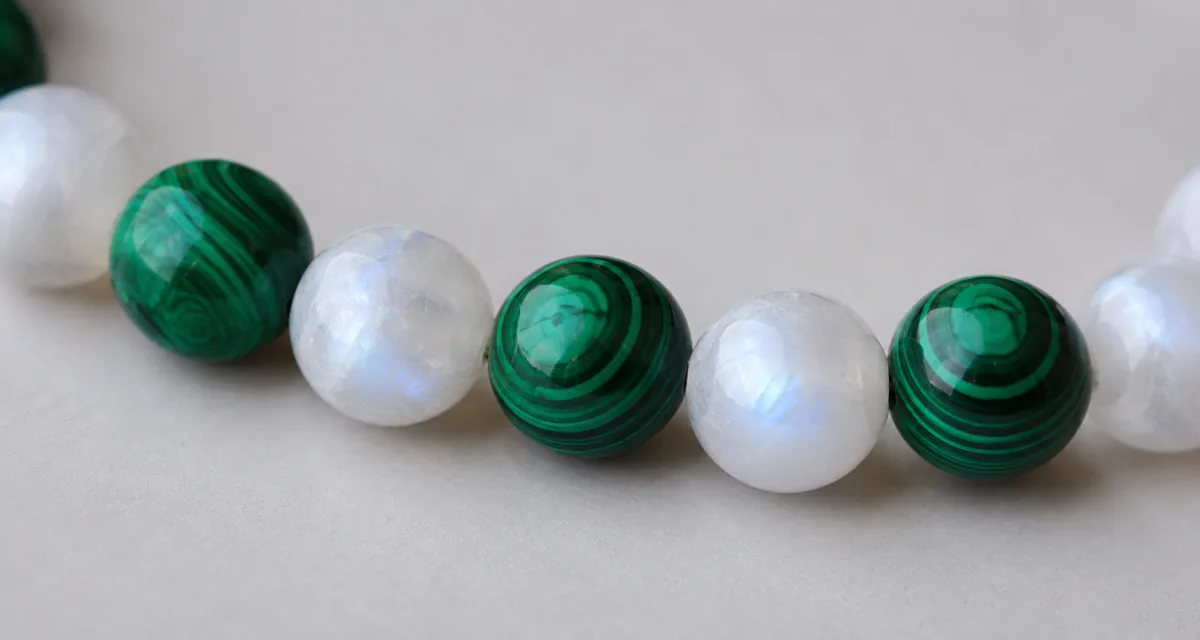
What matter says, and it's markedly more demanding. Malachite sits at 3.5 to 4 on Mohs: that's very soft, softer than moonstone, and it scratches against just about everything, including itself in a jewelry box. It's also sensitive to water and acids. Its dust shouldn't be inhaled, which concerns the lapidary more than you: a polished piece worn normally poses no such risk.
The practical result is this. A moon-and-malachite bracelet needs to come off for the shower, for sports and for doing dishes, be stored flat and separate from other jewelry, and it accepts almost no wet cleansing method at all. That's not a reason to give it up, it's a reason to know.
Labradorite: the first cousin
Here, the duo changes nature completely, and for a good reason.
What matter says first, since it's the main argument. Labradorite is a feldspar, just like moonstone. Same hardness, 6 to 6.5, same perfect cleavage, same care, same restrictions. Neither scratches the other. This is mechanically the most balanced duo alongside the one with sunstone.
One essential detail, because it's a fun one: if you already wear rainbow moonstone or black moonstone, you're already wearing labradorite. Both of those varieties are labradorite, and almost no shop says so. The full breakdown is in moonstone or labradorite.
What tradition says. Labradorite is said to be a stone of protection and filtering, which makes it the most commonly cited companion to moonstone in the guides. The duo is presented as a pairing of protection and intuition.
Visually, it's the subtlest of the six: two different plays of light on the same mineral family, one diffuse and bluish, the other bursting with color. It needs light to be appreciated, and it doesn't photograph well at all.
Sunstone: the only duo that's perfect on both counts
If you only remember one duo from this entire article, make it this one, and for once both answers agree.
On the material side, sunstone is also a feldspar, at 6 to 6.5, with cleavage. Same family, same hardness, same care as moonstone. Neither one mistreats the other.
On the symbolic side, this is the cleanest, most legible opposition in all of crystal lore: night and day, reflection and radiance, what receives and what emits. The duo is presented as a balance between the two, and it's the only one of the six whose logic holds up without needing a chart of correspondences.
The full comparison of the two stones, their exactly opposite optical mechanisms and how to wear them together are in moonstone and sunstone. It's the best topic in this whole set, and that's exactly why it has its own article.
These correspondences between stones belong to crystal healing, an approach rooted in tradition and belief. They do not constitute a medical claim and never replace the advice of a healthcare professional. Read the full disclaimer.
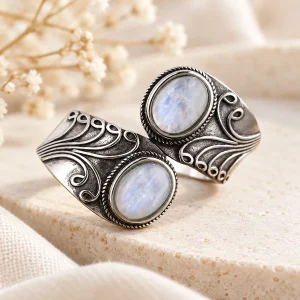
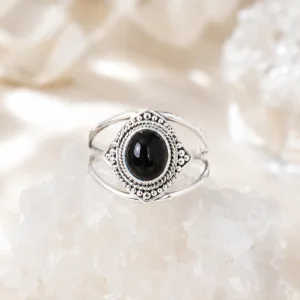
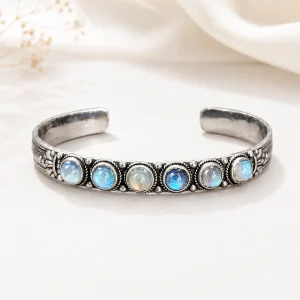
The studio's two duos, plus two single-stone bracelets
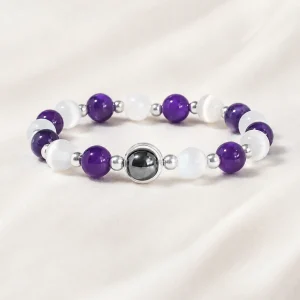
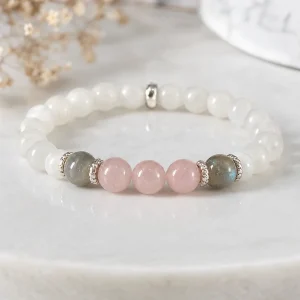
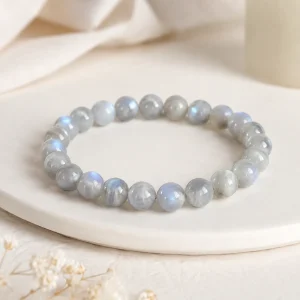
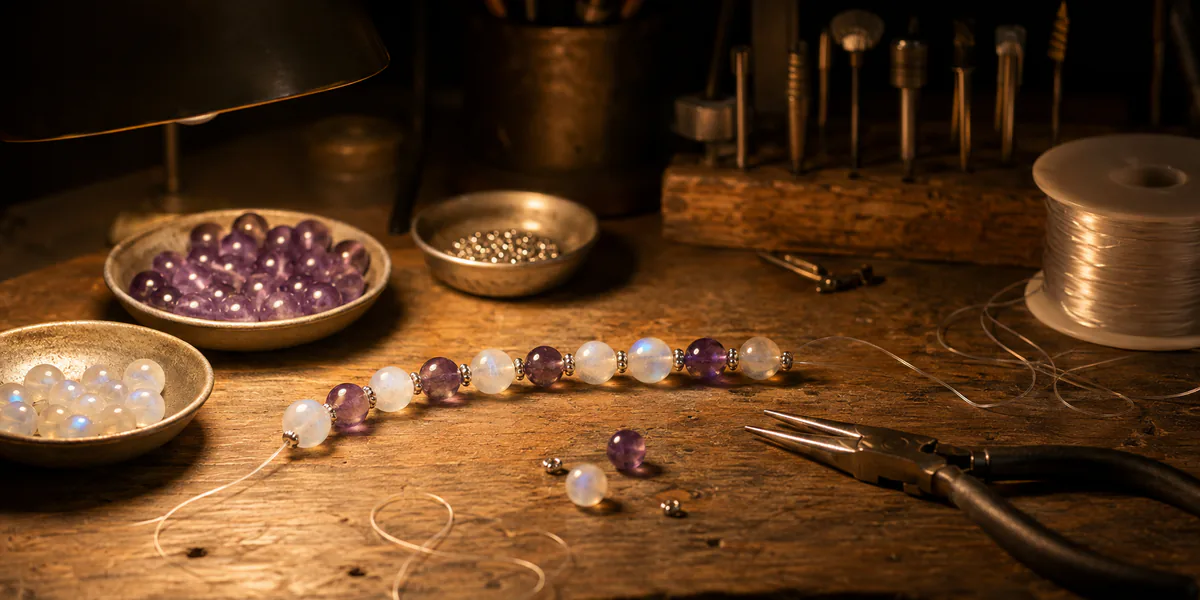
Setting up a duo without damaging moonstone
Let's get practical. Here's what actually changes the lifespan of a two-stone bracelet, and none of it is esoteric.
Alternate rather than group. A moonstone bead between two harder beads is better protected than a block of six moonstone beads strung together, which will rub against each other on top of everything else. It's counterintuitive, and yet it's the opposite of what most designs do.
Spacer beads actually do something. A small silver disc between two beads isn't just decorative: it adds distance and cushions contact. On a duo with a quartz, this is the single change that matters most.
The stringing material matters. Elastic lets the beads swing together and knock into each other with every wrist movement. Stringing on coated wire or knotted cord keeps the beads at a constant distance. It costs more to make, and it shows after three years.
Store separately. That's where the real damage happens, even more than during wear. A bracelet tossed into a dish with everything else spends the night against things harder than it is. One pouch per piece is enough.
Take it off for sports, cleaning and the shower. True for all moonstone jewelry, and doubly so for a duo with malachite. The breakdown by piece type is in how to wear moonstone and, for the wrist specifically, in which wrist to wear a bracelet on.
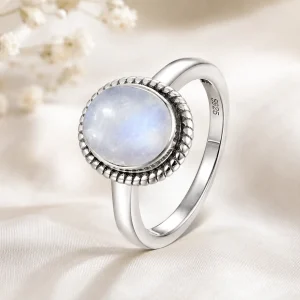
And if all this sounds like a lot of constraints for a bracelet, the simplest answer exists: a single stone, set in a closed bezel on a ring or a pendant. Nothing rubs against anything, and care only follows one rule instead of two. The stone's actual fragility is detailed in is moonstone fragile.
A single stone, bezel-set: nothing rubs against anything




What I won't tell you about pairings
Three things, and the first one is what decided me to write this article.
An amethyst-and-moonstone bracelet does not help you lose weight. That's a claim that circulates, with real search volume behind it, and it's sold as-is by some shops. No stone makes anyone lose weight. I will never offer this product, and I will never imply that this duo acts on the body in any way. It's a health promise with zero foundation, and making it amounts to false advertising.
I won't tell you a duo "amplifies" anything. The idea that two stones reinforce each other, or that one stone "activates" another, is a recent construction of correspondence guides. It's coherent within its own system and has no measurable reality. I can tell you what tradition says, not what two rocks actually do to each other.
I won't tell you a pairing is forbidden. You'll read everywhere that this or that stone "cancels out" moonstone or clashes with it. These lists contradict each other from one site to the next, which alone tells you how solid they are. The topic is tackled head-on, with what holds up and what doesn't, in what stones not to pair with moonstone.
What I can state, on the other hand, fits in the table up top: the hardness levels, the water sensitivities, and what rubs against what. Those are the only real incompatibilities between two stones.
Frequently asked questions
What crystals go with moonstone?
The six most requested duos are amethyst, rose quartz, carnelian, malachite, labradorite and sunstone. On the material side, the two best are labradorite and sunstone: they're feldspars, so same hardness and same care.
Does amethyst damage moonstone?
It can mark it, yes. Amethyst is a quartz at 7 on the Mohs scale, moonstone sits at 6 or 6.5. On a bracelet worn every day, it's moonstone that loses its polish. Spacer beads and a non-elastic design limit the problem a lot.
Can you wear moonstone and malachite together?
Yes, as long as you accept some constraints. Malachite is at 3.5 to 4, so very soft, and it fears water and acids. The bracelet comes off for the shower, sports and dishes, and it's stored flat, apart from other jewelry.
What's the sturdiest duo?
Moonstone and sunstone, or moonstone and labradorite. In both cases they're feldspars: same hardness, same cleavage, same care. Neither stone mistreats the other.
Does a two-stone bracelet cleanse normally?
No, you need to find a method that suits both. Moonstone rejects salt, prolonged water exposure and ultrasonic cleaners; malachite rejects water. A duo with malachite is therefore left with almost no wet method available. The seven methods are compared in cleansing and recharging your crystals.
How many stones can you pair on one bracelet?
On the material side, the fewer the better for moonstone: every extra stone adds a hardness and a care routine to reconcile. Two stones already means two sets of constraints. Past three, no single cleansing method suits everyone anymore.
Does an amethyst-and-moonstone bracelet help you lose weight?
No. No stone causes weight loss, and this claim has zero foundation. It circulates and it sells, which doesn't make it true. I will never offer this product under that promise.
Do two stones reinforce each other?
That's what correspondence guides claim, and nothing shows it. The idea of amplification is a recent construction, coherent within its own system and with no measurable reality. What's real is the difference in hardness and care.
Can I pair two varieties of moonstone?
Yes, and it's the easiest pairing there is: the same constraints on both sides. Just one thing to watch: rainbow and black moonstone are labradorite, which changes nothing about care but changes what you can write on the label.
Do I need a spacer between every bead?
Not necessarily between every one, but yes between a moonstone bead and a harder one. A silver disc adds distance and cushions contact. It's the single change that matters most on a duo with a quartz.
Where to go next
- The duos in detail: moonstone and sunstone, moonstone or labradorite.
- The flip side of this page: what stones not to pair, the contraindications.
- Caring for a multi-stone piece: the seven methods, the case of moonstone, cleaning a piece of jewelry, can it go in water.
- Wearing it: how to wear it, which wrist, is it fragile.
- Meaning and tradition: the properties, the meaning, the chakras, getting started in crystal healing.
- The full picture: the complete moonstone guide.
The bracelets are in the collection, and the rest is in the shop. If you want a duo that's not in the catalog, write to me: I'll tell you honestly whether the two stones hold up together.
My sources
The hardness values are from the Mohs scale, as given by the GIA and Mindat: 6 to 6.5 for feldspars, moonstone, labradorite and sunstone included; 7 for quartz, amethyst and rose quartz included; 6.5 to 7 for carnelian, a chalcedony; 3.5 to 4 for malachite. Malachite's sensitivity to water and acids, along with the precaution around its dust at the workbench, are documented in standard gemological references.
The perfect cleavage of moonstone and labradorite is a crystallographic property of feldspars, not a workshop observation. The gap between hardness and toughness is explained in detail in the properties of moonstone.
The traditional attributions of each stone come from contemporary crystal healing guides, whose origin and dating are detailed in the properties of moonstone. None of it is proven, and I report it as tradition.
What comes from the workshop, and which I flag as such: the notes on stringing, spacers, elastic cord and storage are craft observations and customer feedback, not published data. The compared photo of two beads from the same worn bracelet is worth more than any reference on this specific point.
Last updated: August 19, 2026. If you find an error in this article, let me know: I'll correct it and note it.
✦ À porter, à offrir
Découvrez mes créations