How moonstone forms
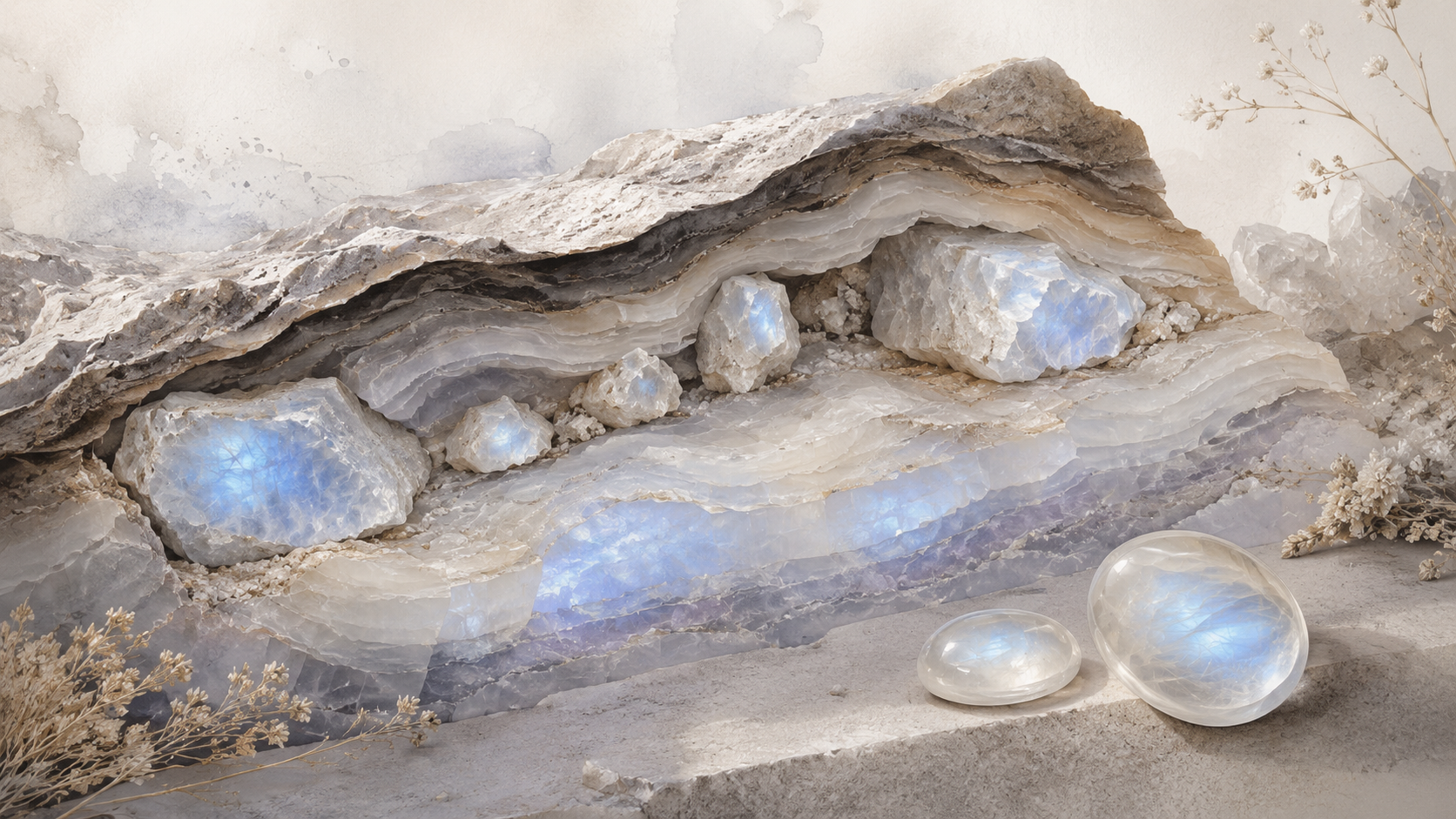
A moonstone is not born a moonstone. It is born an ordinary feldspar, in a magma that cools, and it only becomes one by separating into lamellae over thousands of years. That unmixing, called exsolution, is what manufactures the blue sheen. Here is the whole story, from molten rock to cabochon.
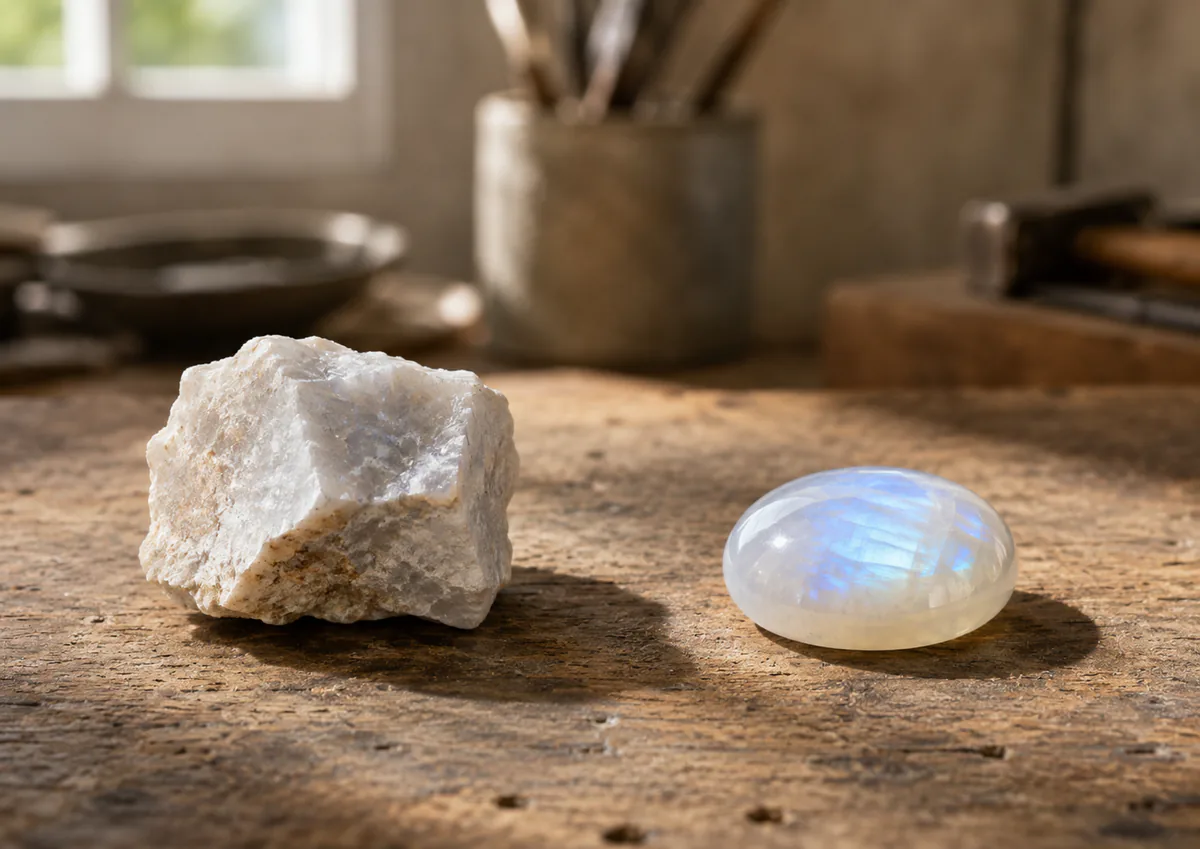
I set these stones, I do not mine them. But understanding how they form changes the way you choose them: it explains why blue costs more than white, why the sheen is sometimes off-centre, and why a lapidary is not free to cut a cabochon in any direction they please.
The short version, if you are in a hurry
- Moonstone is a feldspar, more precisely an orthoclase, an aluminium and potassium silicate.
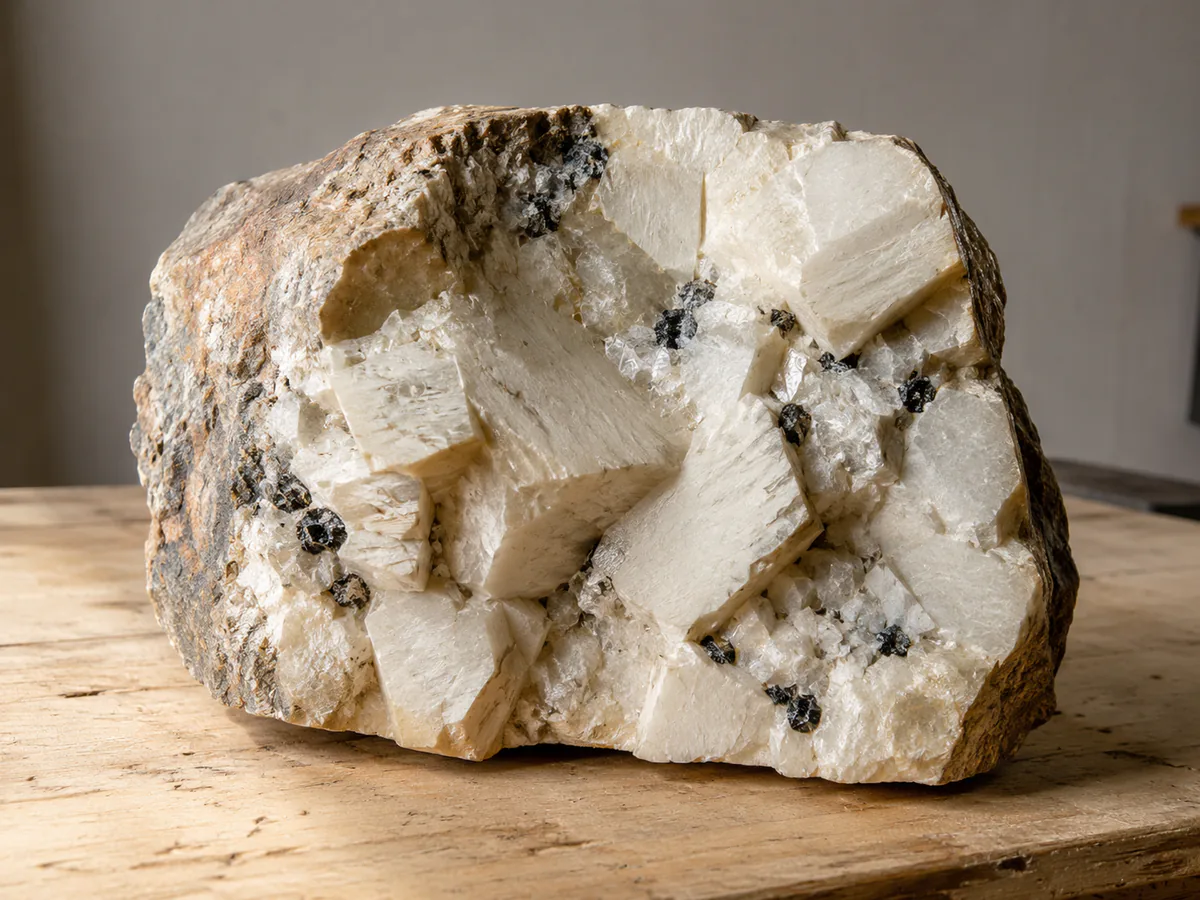
- It crystallises in a magma that cools slowly, usually in a pegmatite, a rock with very large crystals.
- The decisive moment is exsolution: as it cools, the single crystal separates into alternating lamellae of orthoclase and albite.
- The sheen comes from those lamellae. Light scatters inside them instead of passing through. It is not a colour, it is an optical phenomenon.
- Blue calls for very fine lamellae, therefore an even slower cooling. That is why it is rare and expensive.
- Slowness is the condition for everything. Fast cooling gives an ordinary feldspar, with no sheen at all.
- The sheen has a direction, set by the lamellae, and the lapidary has to obey it or ruin the cabochon.
What moonstone is, mineralogically
Before talking about formation, you need to know what is being talked about, because the trade name covers several different minerals.
Moonstone in the strict sense is an orthoclase, a potassium alkali feldspar, with the formula KAlSi3O8. Feldspars are by far the most abundant family of minerals in the earth's crust: they make up more than half of what lies under your feet.
In other words, the raw material is nothing exceptional. What is rare is the set of conditions that turns an ordinary feldspar into a gem with a sheen. Almost every feldspar in the world has no adularescence whatsoever.
A word on vocabulary: the gem variety of orthoclase is called adularia, after a Swiss massif, the Adula, in the Saint-Gotthard region, where the mineral was described. That is where the word adularescence comes from. The full mineral data sheet is in moonstone properties.
First step: crystallising in a magma
It all starts in molten rock, deep down.
A magma is a mixture of many chemical elements. As it cools it does not set in one block: the minerals crystallise one after another, in an order that depends on their formation temperature. Feldspars crystallise relatively late in that sequence, which leaves them room to grow large.
At this stage, the crystal that forms is homogeneous. It contains both potassium and sodium, mixed within a single structure, because at high temperature those two elements coexist in the crystal lattice without any trouble.
This matters for what follows: moonstone does not form at that moment. The crystal that comes out of the magma is an ordinary feldspar, with no sheen and no gemmological interest. Everything is decided while it cools.
Why it takes a pegmatite
Most gem moonstones come from pegmatites, and that is no accident.
A pegmatite is an igneous rock with very large crystals, formed during the last phases of cooling of a granitic massif. The residual liquid there is rich in water and in volatile elements, which makes the atoms highly mobile: they travel easily and settle onto crystals already growing rather than starting new ones.
The result: few crystals, but enormous ones. Feldspars several centimetres across are common there, sometimes several decimetres. That is the first condition for a gem: you need a zone large enough and clean enough to draw a cabochon from it.
The second condition is time. A massif of this kind cools over tens of thousands to millions of years, depending on its size and depth. That slowness is not decorative detail, it is what makes the next stage possible.
Exsolution, the decisive moment
Here is the stage almost no page spells out, and yet it is the one that manufactures moonstone.
Take the homogeneous crystal from a moment ago, containing potassium and sodium mixed together. At high temperature that coexistence is stable. As it cools, it stops being so: the two elements are not the same size and the crystal lattice can no longer accommodate them together.
The crystal then unmixes from the inside. Without melting, without breaking, the atoms migrate over very short distances and regroup: potassium on one side, sodium on the other. The single crystal becomes a stack of alternating lamellae, orthoclase and albite, parallel to one another and regularly spaced.
That phenomenon has a name: exsolution, or unmixing. It is a separation in the solid state, and it can only happen if the cooling is slow enough to give the atoms time to move.
Fast cooling freezes the mixture as it stands: you get a homogeneous feldspar, transparent or milky, with no sheen at all. That is what happens to the overwhelming majority of feldspars, and it is why moonstone is rare while its raw material is everywhere.
How those lamellae manufacture the sheen
On to the optics, because this is where the mineral becomes a gem.
Those alternating lamellae have slightly different refractive indices: light does not travel through them at quite the same speed. Each interface between two lamellae therefore sends back a small part of the light crossing it.
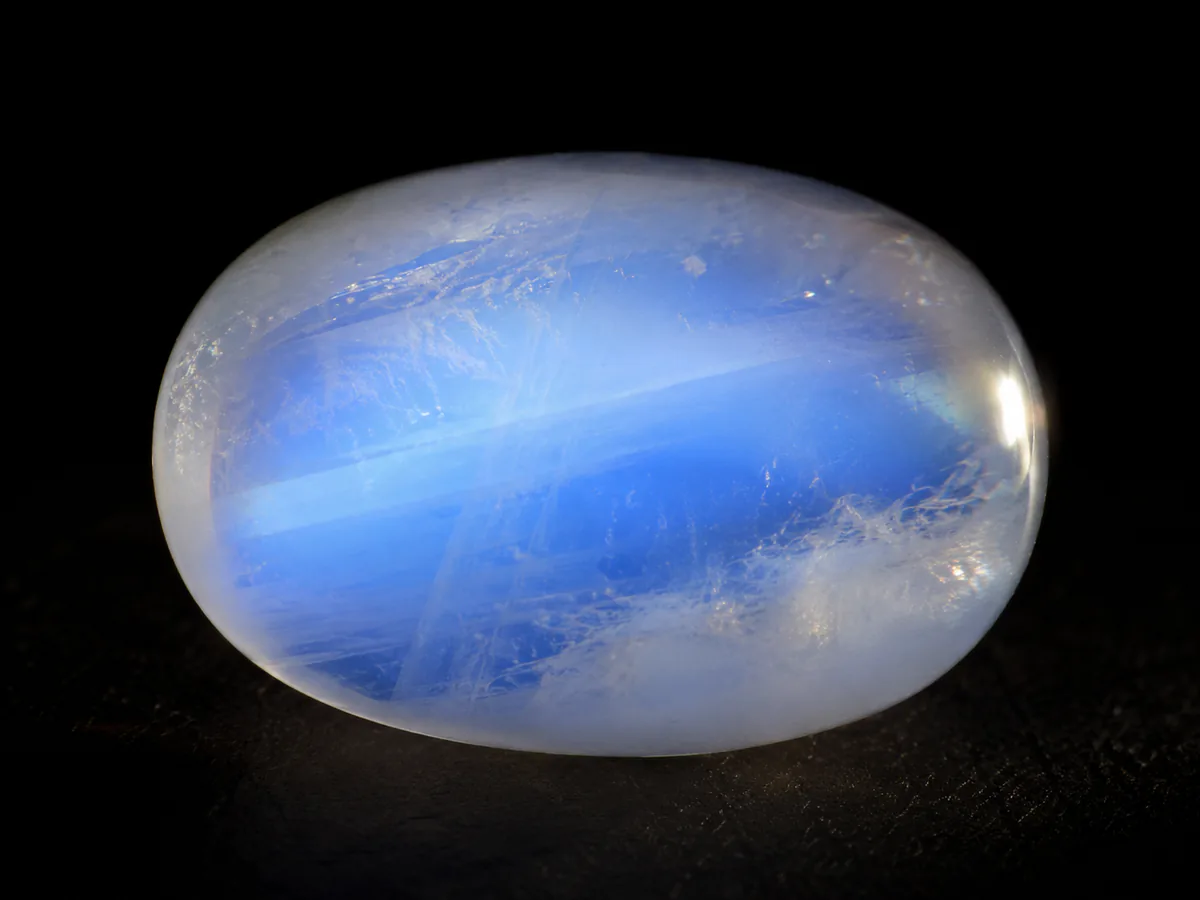
When the stack is regular and the lamellae are extremely fine, those countless reflections combine. Light is no longer simply transmitted through the stone, it is scattered from within, and it comes back out as a halo that seems to float below the surface.
Two practical consequences, and they explain everything you observe on a cabochon.
The sheen is not a colour. There is no pigment in a moonstone. Grind one up and you get a white powder: the blue disappears, because it only ever existed in the structure.
The sheen moves. Since it depends on the angle at which light enters and leaves, it travels across the dome when you tilt the stone. It is the simplest test for telling a real moonstone from an imitation, and it is covered in detail in how to recognise a real moonstone and adularescence, where the light in moonstone comes from.
Why blue is rarer than white
The question of price is settled here, and the answer is purely physical.
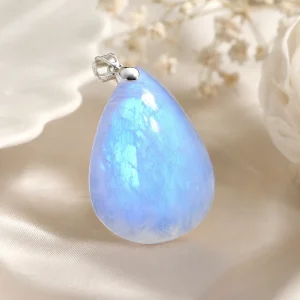
The colour of the sheen depends on the thickness of the lamellae. When they are extremely fine, finer than the wavelengths of visible light, scattering favours the short wavelengths: the sheen leans blue. When they are thicker, all wavelengths are scattered more or less equally and the sheen turns white or silvery.
It is the same principle that makes the sky blue: selective scattering, not a pigment.
Now, very fine and very regular lamellae call for even slower and more even cooling than average. The conditions are therefore rarer, the zones concerned smaller inside the crystal, and the yield of a parcel much lower.
Hence the conclusion that always surprises people: strong blue is not expensive because it is prettier, it is expensive because it demands a more demanding geology. The price criteria are covered in the price of moonstone and judging the quality of a moonstone.
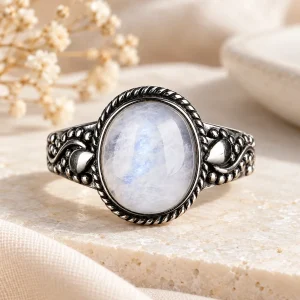
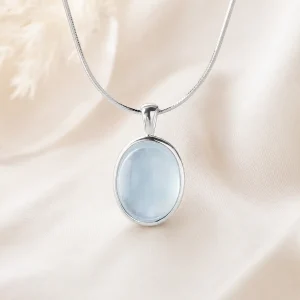
Blue and white, two cooling rates
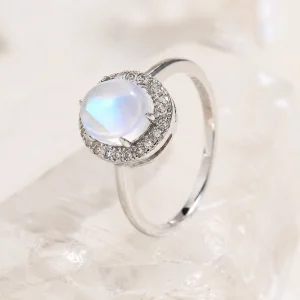
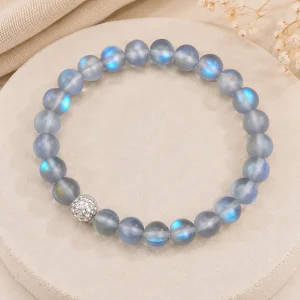
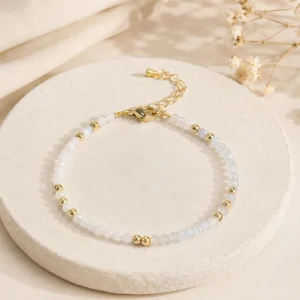
The other path: labradorite
Part of what is sold under the name moonstone did not follow that path, and it needs saying, because the formation there is different.
Labradorite is not an alkali feldspar but a plagioclase, a sodium-calcium feldspar. It forms in dark igneous rocks, rich in iron and magnesium, and not in granitic pegmatites.
It too undergoes exsolution as it cools, but between two plagioclases of different compositions, and the resulting stack produces a distinct phenomenon: labradorescence, a play of vivid colours, blue, green, gold, sharply contrasted, instead of the milky diffuse sheen of adularescence.
What the trade calls "rainbow moonstone" and "black moonstone" are, in the vast majority of cases, labradorites. These are not deceptions, they are trade names, and this site writes them in quotation marks while naming the species. The detail is in moonstone or labradorite and colours and varieties.
From vein to gravel: the second journey
The stone is formed, but it is still several kilometres below the surface. It has a long way to go, and that journey has consequences for what is found today.
The massif rises slowly, carried by tectonics, while erosion strips away what covers it. Once in the open air, the rock breaks down: the fragile minerals disappear, the more resistant ones are carried off by rivers.
The feldspars then end up in alluvial deposits, mixed in with the gravel. That journey acts as a natural sorting: cracked crystals break along the way, and the ones that arrive whole are statistically the soundest.
In Sri Lanka, that gem-bearing gravel has a name, illam, a layer buried under a few metres of sediment that miners reach through narrow shafts. Many of the moonstones on the market come from there, and not from a directly worked vein.
Consequence for the buyer: a gravel moonstone arrives with no matrix, tumbled, with no indication of origin beyond what the trade says. It is one of the reasons provenance is asked of the seller rather than read off the stone. See the moonstone deposits.
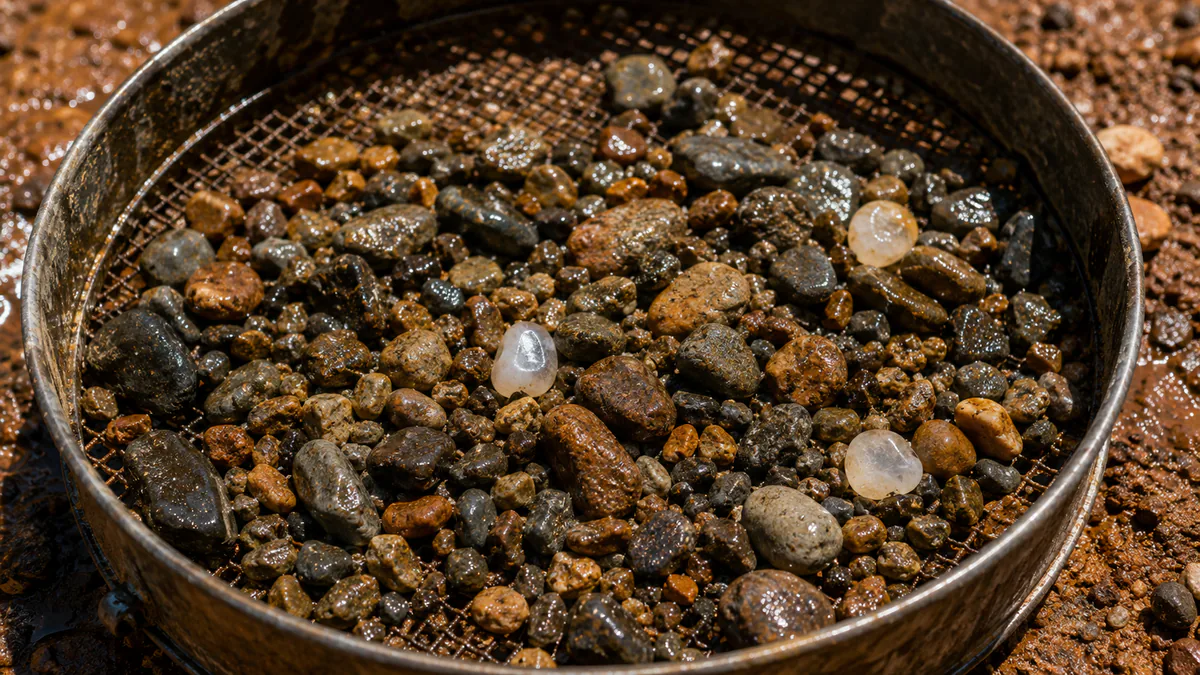
Where these conditions come together
So you need a pegmatite or an equivalent massif, very slow cooling, and an uplift that makes the whole thing reachable. Few places tick all three boxes.
| Origin | Setting | What is found there |
|---|---|---|
| Sri Lanka | Gem-bearing gravel, illam | The most celebrated blues, very transparent body |
| India, Tamil Nadu and Bihar | Pegmatites and alluvium | White, grey, peach, in large volumes |
| Madagascar | Dark plagioclase-bearing rocks | Mostly labradorites, including the "blacks" |
| Tanzania | Pegmatites | Varied material, arrived more recently |
| Myanmar | Historical alluvium | Old and irregular production |
The case of Sri Lanka deserves a qualification, and it is handled separately: the historical zones yield less than they did, which weighs on the price of strong blues. See Sri Lankan moonstone, a deposit running dry.
What the formation leaves visible in the stone
Good news: everything above can be checked with the naked eye or a loupe. A stone carries the traces of how it was made.
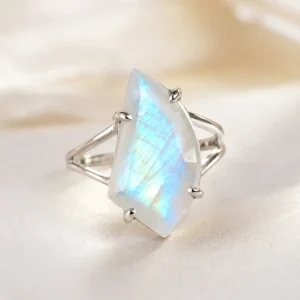
The sheen has a direction. It does not go off in all directions: it forms an oriented sheet, because the lamellae are parallel to one another. On a well cut cabochon, that sheet is centred on the dome.
Centipede inclusions. This is the best known signature of the stone: fine tension fissures arranged in a herringbone, which look like a centipede under a loupe. They arise from the internal stresses of the unmixing, and a glass imitation never shows any.
The translucent, slightly milky body. It comes from the lamellar structure itself, which scatters part of the light instead of letting it pass straight through.
The cleavage. The crystal splits cleanly along two directions at right angles, and those planes are inherited from the structure. That is what makes the stone fragile on impact, and it is explained in is moonstone fragile.
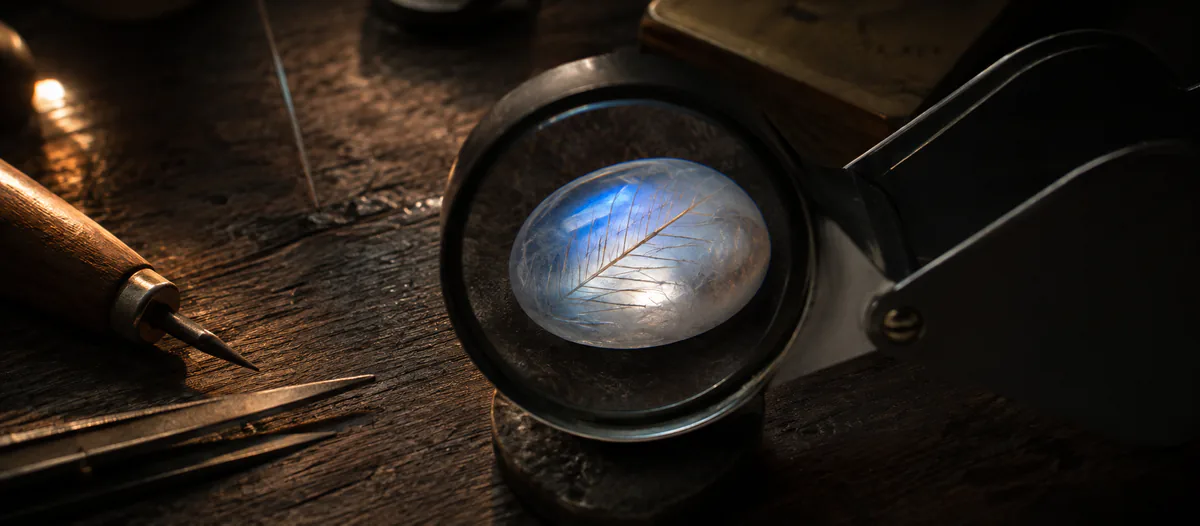
Cabochons where the inclusions show under a loupe




Why the lapidary has to obey the formation
One last point, and it is the one that ties the geology to what you wear on your finger.
Since the lamellae are parallel to one another, the sheen only appears in one precise orientation. The lapidary therefore has to set the flat base of the cabochon parallel to the plane of the lamellae. Stray from it, even by a few degrees, and the sheen slides onto the side of the dome instead of floating at the centre, or disappears almost entirely.
Which means a moonstone is not cut in the direction that yields the biggest stone, but in the direction its structure dictates. That is lost yield, and it is part of the price of a fine cabochon.
There is one further consequence, less pleasant: the plane of the lamellae runs parallel to one of the cleavage directions. The plane of least resistance therefore ends up horizontal, just below the polished surface, exactly perpendicular to the knocks a ring takes. The formation of the stone explains both its beauty and its fragility, and one does not come without the other.
The practical consequences are in bezel or prong setting and how to wear moonstone.
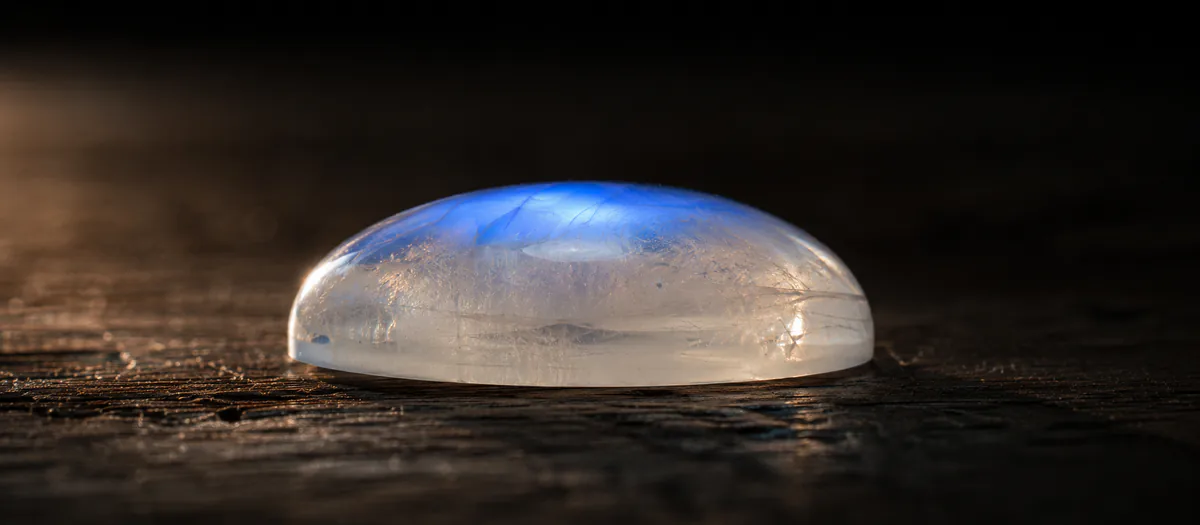
Frequently asked questions
How is moonstone formed?
It first crystallises as a homogeneous feldspar in a magma that cools slowly, usually in a pegmatite. Then, as it cools further, the crystal unmixes from the inside into alternating lamellae of orthoclase and albite. It is those lamellae that scatter the light and produce the sheen.
What is exsolution?
It is an unmixing in the solid state. At high temperature, potassium and sodium coexist within a single crystal; as it cools, that coexistence becomes unstable and the atoms regroup into separate lamellae, without the stone melting or breaking. It calls for very slow cooling.
How long does it take to form a moonstone?
The cooling of a massif of this kind spreads over tens of thousands to millions of years depending on its size and depth, and the rise towards the surface takes far longer still. There is no single duration: what counts is the slowness, not the figure.
Why is the sheen blue on some stones and white on others?
Because the thickness of the lamellae differs. Very fine, they scatter mostly the short wavelengths and the sheen leans blue; thicker, they scatter everything equally and the sheen turns white or silvery. Blue calls for even slower cooling, so it is rarer.
Is moonstone a rare stone?
The raw material is not rare at all: feldspars make up more than half of the earth's crust. What is rare is the combination of conditions that produces a regular lamellar structure, and rarer still the one that gives a strong blue sheen.
Can moonstone be made in a laboratory?
That is not what you meet on the market. What you find in its place is opalite, an opal glass with no mineralogical relation at all, which imitates the halo but whose glow does not travel when you tilt the stone. See the page devoted to that confusion.
What is a centipede inclusion?
Fine tension fissures arranged in a herringbone, which recall the outline of a centipede under a loupe. They arise from the internal stresses created by the unmixing. It is a signature of natural moonstone, and no glass imitation shows any.
Does rainbow moonstone form the same way?
No. It is a labradorite, a plagioclase, formed in dark igneous rocks and not in a granitic pegmatite. Its exsolution produces a contrasted play of colours, labradorescence, and not the milky sheen of adularescence.
Where to go next
This page tells the story of the formation. For what comes next:
- The material: the mineral data sheet, adularescence, the glossary.
- The varieties: colours and varieties, moonstone or labradorite, moonstone and sunstone.
- The origins: the deposits, the case of Sri Lanka.
- Judging a stone: judging quality, recognising a real stone, is it treated, the price.
- The big picture: the complete guide.
The cabochons I set are chosen one by one on what the formation gave them: the sharpness of the sheen and where it sits on the dome. Everything is in the shop, and a question about geology never bothers me: write to me.
My sources
The nature of orthoclase and of the plagioclases, exsolution into lamellae, the optical mechanism of adularescence and the effect of lamella thickness on the colour of the sheen follow the public data sheets of the GIA, of Mindat and of the International Gem Society, along with standard descriptive mineralogy. The distinction between adularescence and labradorescence comes from the same sources.
The pegmatite setting, the role of slow cooling and the transport into alluvial deposits belong to ordinary petrography. The durations given are orders of magnitude, not measurements: they vary enormously from one massif to another, and I would rather say so than put forward a single figure.
Centipede inclusions are a classic identification criterion, described by gemmological laboratories. The observations on cutting orientation and its consequences come from my workshop and from the cabochons I sort.
Last updated: 19 August 2026. If you find an error in this article, let me know: I correct it and I note it.
✦ À porter, à offrir
Découvrez mes créations