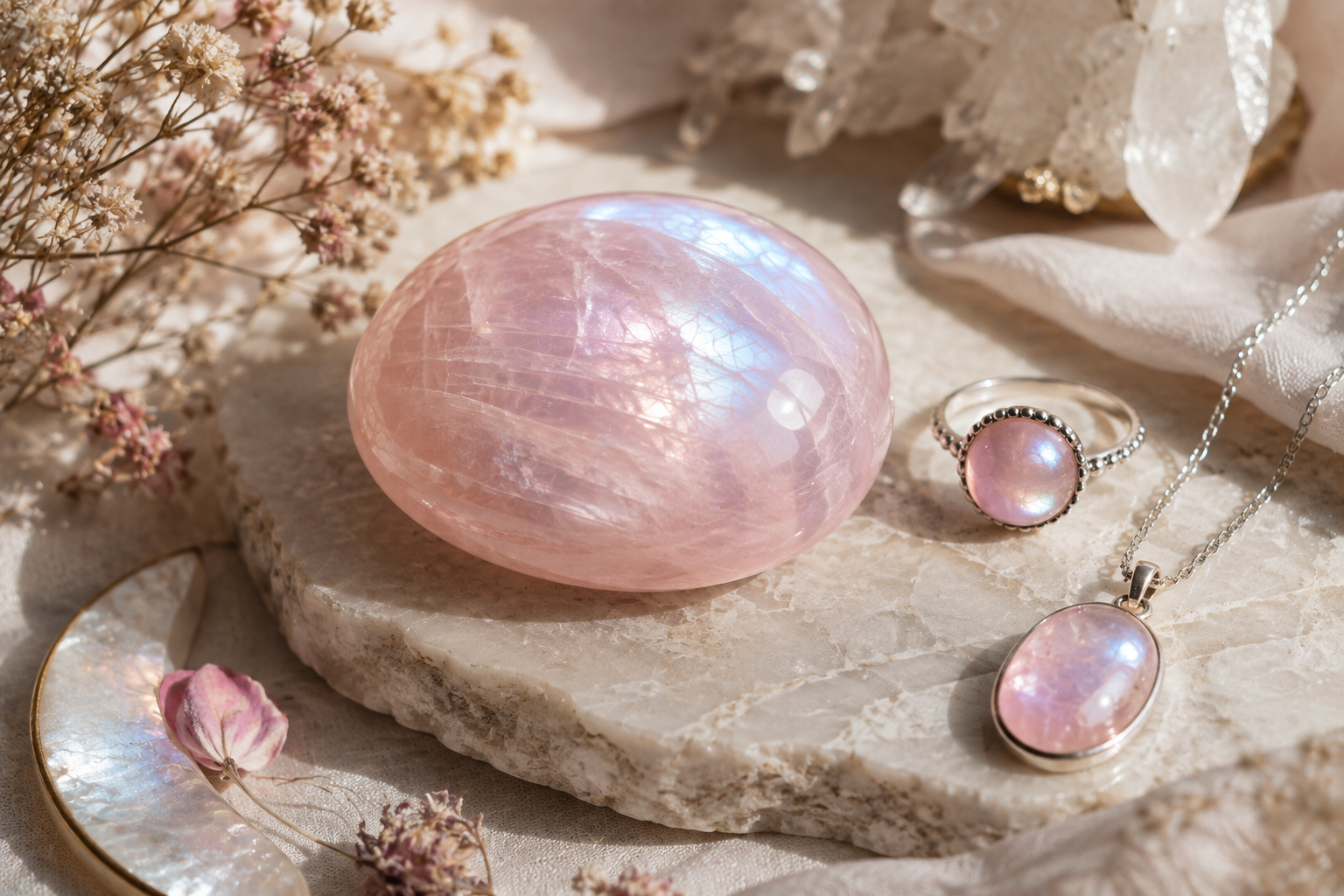
Pink moonstone
Its colour does not come from the sheen but from the body of the stone, tinted by iron oxides. The same thing, in larger quantity, makes the glitter of sunstone. Here is why its sheen is quieter than the white one, where the border with peach runs, how to spot dyes, and what tradition attributes to it.
This is the variety I sell the least and am most often asked to comment on, because it throws people: you expect a clear blue sheen and you find a warm, almost understated stone. That is normal, and this page explains why.
The short version, if you are in a hurry
- The colour comes from the body of the stone, tinted by iron oxides, and not from the sheen. These are two independent phenomena.
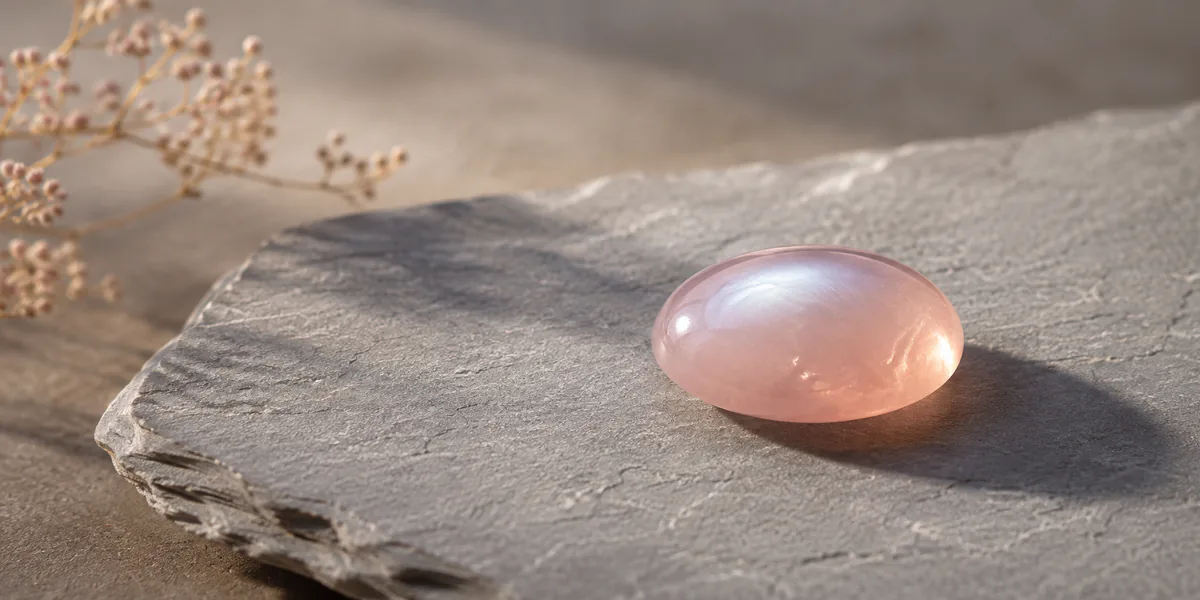
- The sheen is quieter than on a white stone, and white or silver rather than blue. That is not a flaw, it is mechanical.
- Pink and peach describe a continuum, not two species. The trade uses both words for the same material.
- It really is moonstone in the vast majority of cases: an orthoclase, like the white one.
- The same iron, in larger quantity, gives sunstone. The two varieties are neighbours.
- Be wary of dyes: a colour that is too vivid and perfectly uniform is not natural.
- It costs far less than the blue one, and it is a good way in.
Where its colour comes from
You first have to understand that in a moonstone, colour and sheen are two completely separate things.
The sheen, adularescence, contains no pigment at all. It comes from an internal layered structure that scatters light. On a white moonstone, the whole effect comes from there, and the body of the stone is colourless. The full mechanism is in how moonstone forms.
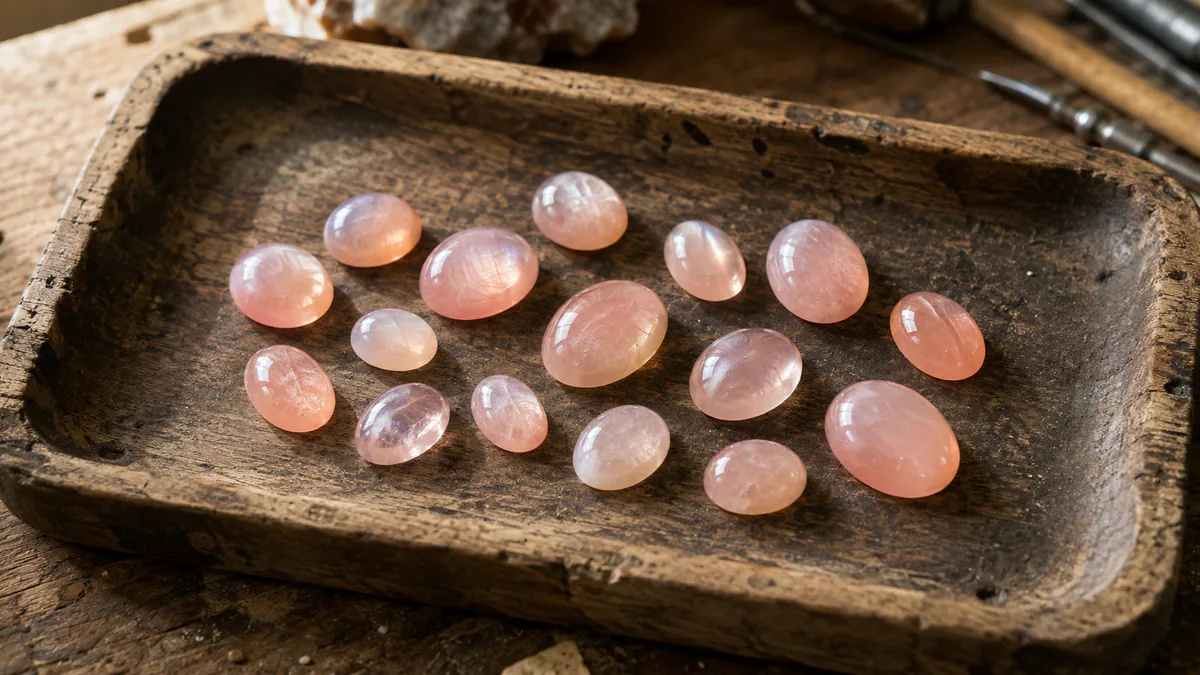
The body colour, on the other hand, comes from something else: the presence of iron in the feldspar, as finely dispersed oxides. Depending on the quantity and the size of those particles, the stone leans towards pale pink, peach, apricot or orange.
In other words, a pink moonstone is an ordinary moonstone to which geology has added a tint. The sheen is still there, it simply floats above a coloured ground instead of a colourless one.
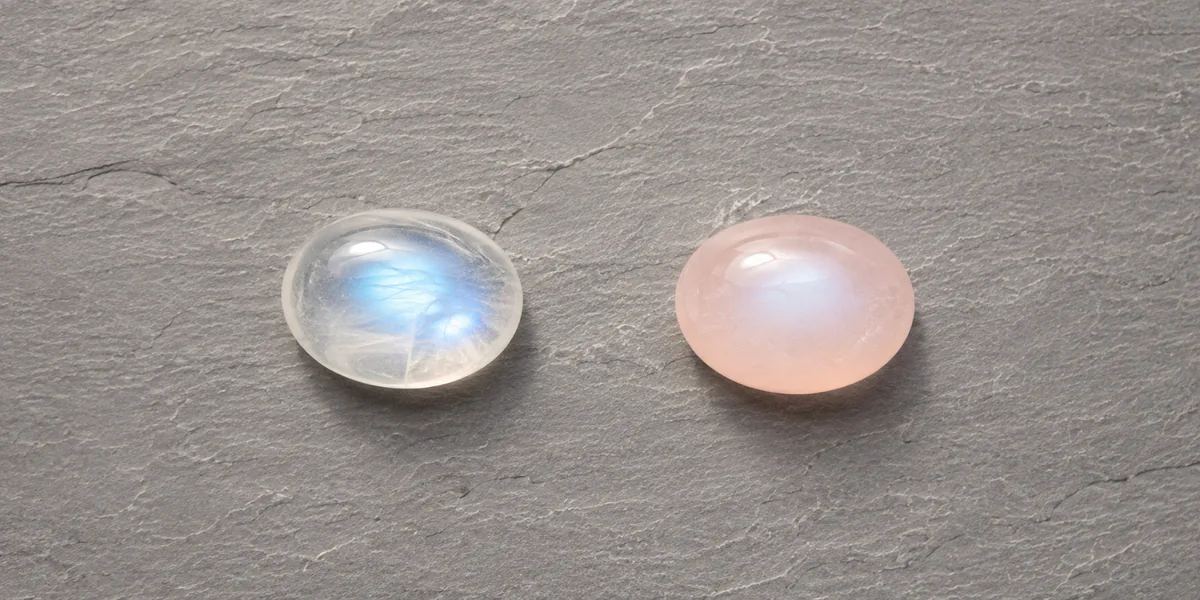
That is what explains the difference in appearance: the white one has sharp contrast, a bright halo on a neutral ground; the pink one has a softer light, because halo and ground are closer in brightness.
Pink or peach: where the border runs
Nowhere, and it is worth knowing before you compare two listings.
The trade uses pink, peach and sometimes apricot for the same family of material, whose tint forms a continuum from very pale pink to deep orange. There is no standardized limit between those words, and two sellers can describe the same stone differently without either of them lying.
The practical rule I apply: when pink dominates and the stone looks cool despite its colour, we call it pink; when warmth dominates and the stone leans towards apricot, we call it peach or orange. This page covers the first case, the other end of the continuum has its own page: orange and peach moonstone.
What this means when buying: never order a shade on the strength of a word. Ask for a photo of the exact stone, from two angles and in daylight. The vocabulary will tell you nothing, the image will. The other buying criteria are in where to buy moonstone jewellery.
Why its sheen is quieter
This is the most common disappointment, and it comes from a badly calibrated expectation.
On a pink moonstone, the sheen is almost always quieter and rather white or silver than clear blue. Two reasons stack up.
Contrast drops. A bright halo stands out clearly on a colourless ground; on a coloured ground, it partly merges with it. The phenomenon is the same, it simply shows less.
Inclusions disturb the structure. The iron particles that give the colour sit in the very material that carries the layers responsible for the sheen. The more loaded the body, the less regular the stacking, and the more the sheen fades and shifts towards white.
There are exceptions, and I set one: on very pale material, pinkish rather than peach, a bluish glow can survive. But that is precisely when the colour is weak.
The rule to remember fits in one sentence: the stronger the pink, the weaker the sheen. You cannot have both at maximum, and a seller who promises you a very pink stone with a blazing blue is describing something that does not exist.
Is it really moonstone?
A fair question, since this site spends its time denouncing misleading trade names. Here, the answer is rather reassuring.
The vast majority of material sold as pink or peach moonstone really is an orthoclase, exactly the same species as the white one, with iron added. This is not a case comparable to rainbow moonstone or the black one, which are labradorites, and therefore another branch of the feldspars. See moonstone or labradorite.
One note of caution all the same: part of the peach material in the trade belongs to the plagioclases rather than the alkali feldspars, which is why you find contradictory pages from one site to the next. It changes nothing for the buyer, since hardness and precautions are identical, but it explains the disagreements.
The real check is the same as for every variety: the sheen must move when you tilt the stone. A colour that does not move and a fixed halo signal something other than a feldspar. The methods are in how to recognise genuine moonstone.
The link with sunstone
Here is the point that makes this variety interesting, and that no French page makes.
The iron that colours a pink moonstone is the same element as the one that produces the effect of sunstone. The difference lies in the quantity and the size of the particles.
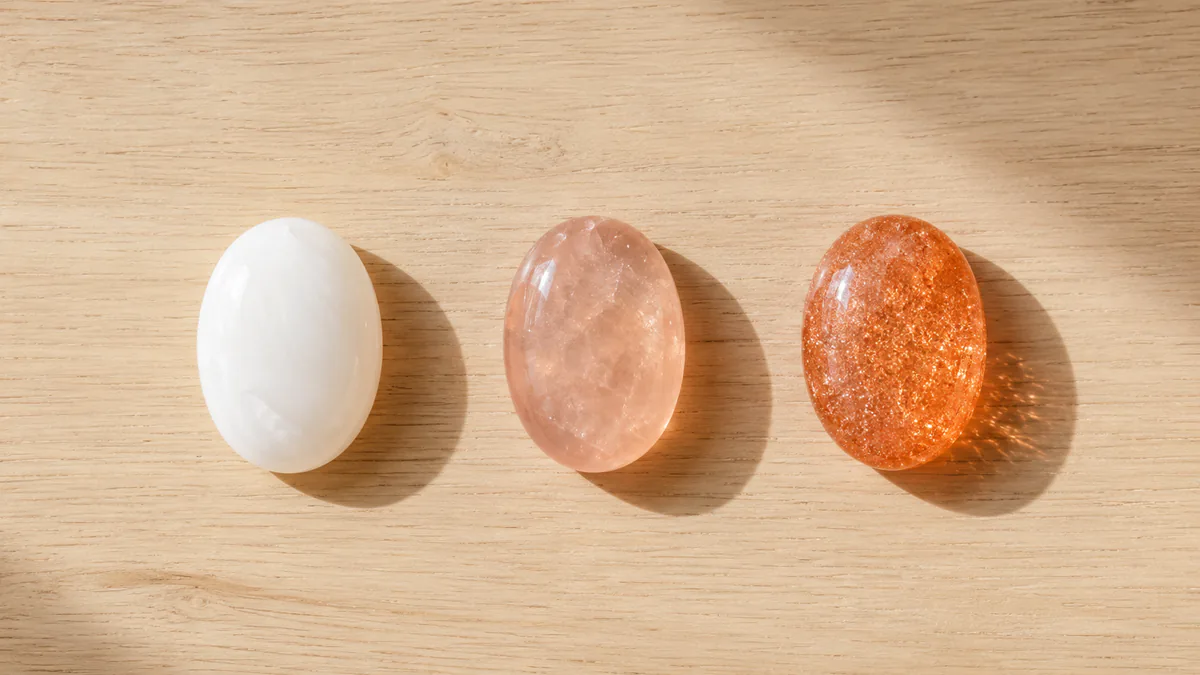
As very fine dispersed particles, iron tints the stone: you get a pink or peach body, and the sheen survives. As larger and more numerous platelets, it reflects light in distinct bright points: that is aventurescence, the glitter that makes sunstone.
In other words, pink moonstone sits on a continuous path between white moonstone and sunstone. All three belong to the same feldspar family, and it is the same atoms that make the whole difference. The subject has its own page: moonstone and sunstone, two faces of one mineral.
Where it comes from
Most of the pink and peach material on the market comes from India, where gem feldspars have been mined and worked for a very long time, and where coloured material is abundant.
That is a notable difference from the clear blues, whose most celebrated stones come from Sri Lanka, a tighter and more expensive supply. The detail of the origins is in moonstone deposits.
This origin explains two things. The first is the price, far more affordable. The second is the format: calibrated beads and cabochons of decent size are easy to find, which is rarer in clear blue.
Imitations and dyes
Colour attracts manipulation, and this variety suffers more of it than the white one.
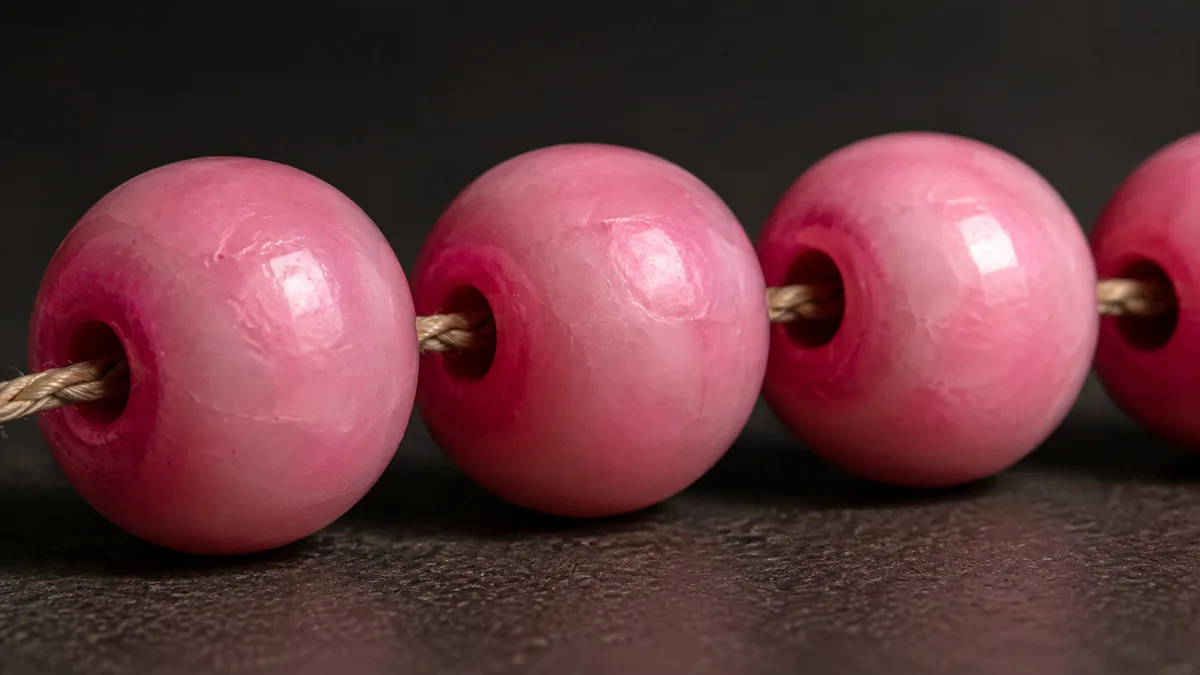
Dyeing. This is the main problem. Pale or dull material can be dyed to obtain a clear, saleable pink. Two signs: a colour that is too uniform, identical from one bead to the next to the millimetre, and a tint that looks laid on the surface rather than diffused through the mass. Look at the areas around the drill hole on a bracelet: a build-up of colour there often gives away a bath.
Dyed quartzite. Sold as beads under the name pink moonstone, with no moving sheen at all. The tilt test unmasks it immediately.
Rose quartz. A confusion of names more than a deception: it is a common, inexpensive stone, a uniform milky pink, with no adularescence at all.
Opalite. An opal glass, sometimes tinted. It imitates the halo but its glow does not move. The subject has its own page: moonstone or opalite.
The single check that eliminates all of them: tilt the stone under a point light source. If nothing moves, it is not a feldspar with adularescence.
How to judge a pink moonstone
The criteria are not the same as for a white one, and that is the second source of misunderstandings.
Evenness of colour. A uniform distribution of the tint, with no brown zone and no concentrated patch. Careful: even does not mean identical from one stone to the next, which would on the contrary be suspicious.
The presence of a sheen, however quiet. It must exist and it must move. A completely matte pink stone holds no particular gemmological interest.
Transparency of the body. The best ones are translucent, with visible depth; the poorer ones are milky and opaque.
The polish. As on every variety, the sheen is read through the surface: a dull dome kills the little reflection a coloured stone has to spare. The six general criteria are in judging the quality of a moonstone.
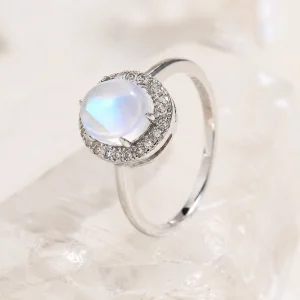
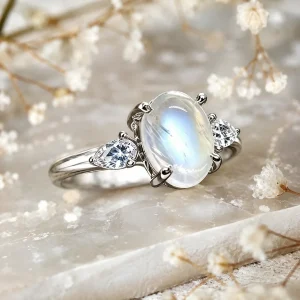
The workshop pink, and three other varieties to compare
What it is worth
Far less than the blue one, and that makes sense.
A clear blue moonstone demands very fine and very regular layers, therefore an exceptionally slow geological cooling, therefore rare material. The pink one has no such constraint: its value rests on tint and transparency, two far more widespread qualities.
That is what makes it a good way in. On a modest budget, you get a natural stone, a true feldspar, with a real sheen even if it is quiet. For the same money, a blue of comparable quality would be out of reach.
The only price trap is that of dyes: a vivid pink at a knockdown price is almost always treated material. The benchmarks are in the price of moonstone and is moonstone treated.
How to wear it, and with what
It is the easiest variety of all to match, for a simple reason: it is warm.
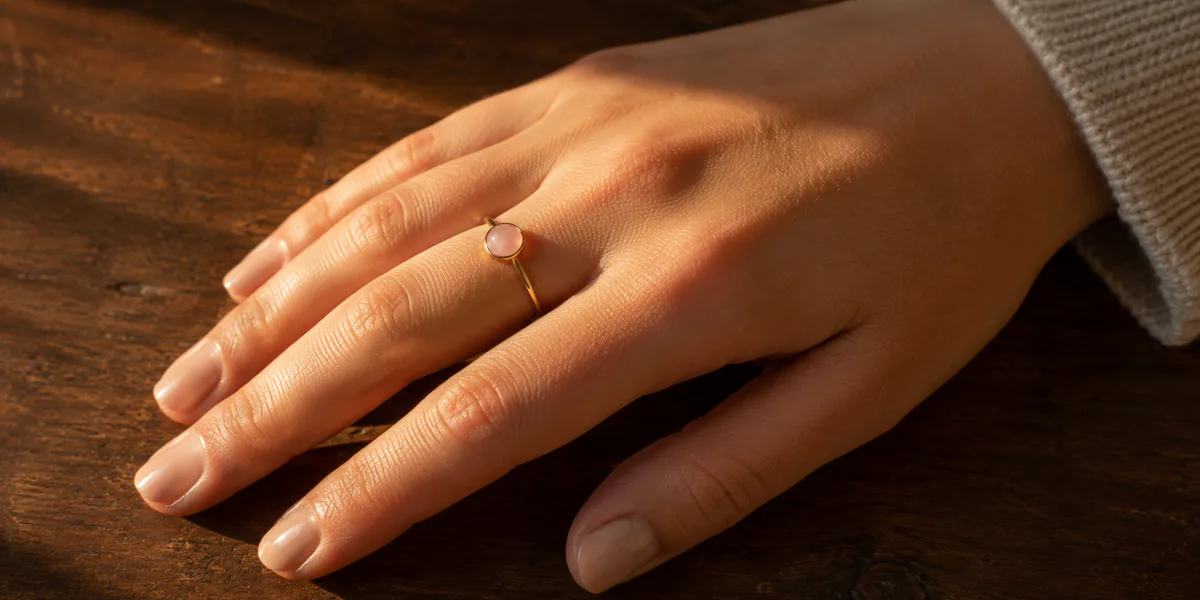
With which metal. Yellow gold and rose gold show it off better than silver, because they carry on its colour temperature. Silver works, but it emphasizes the cool side and makes the stone look paler.
With which stones. It goes naturally with carnelian, sunstone and warm tones. One caveat: carnelian is a chalcedony, at 6.5 or 7 on the Mohs scale, and it scratches. Slip soft metal between them, as explained in which stone not to pair with moonstone.
Under which light. It is the variety that best withstands warm artificial light, where a blue one goes out indoors in the evening. If you mostly wear your jewellery at the end of the day, it is a sensible choice.
The precautions are identical to those for every moonstone: 6 to 6.5 on the Mohs scale, perfect cleavage, no ultrasonics, no hot water, no knocks. See how to wear moonstone.
The workshop rings, one colour per piece




What tradition attributes to it
I report, I do not endorse, and I date.
Crystal healing attributes to moonstone in general softness, intuition and new beginnings. For the pink variety, it usually adds a nuance tied to the colour: tenderness, kindness towards oneself, the calming of close relationships. It is often brought close to rose quartz for that reason.
Two honest remarks. First, this attribution does not come from the stone but from its tint: in these systems, pink carries the same values everywhere, whatever the mineral species. Second, the distinction between varieties of one species is recent, more recent still than the general systems, which settle into the literature in the 1980s and 1990s.
What is true without belief, on the other hand: it is a warm stone and a gentle one to look at, and that is already reason enough to wear it. The general meaning is in the meaning of moonstone and the reported properties in properties and benefits.
These correspondences belong to crystal healing, an approach founded on traditions and beliefs. They are not a medical claim and never replace the advice of a health professional. Read the full disclaimer.
Frequently asked questions
What is pink moonstone?
A moonstone whose body is tinted by finely dispersed iron oxides, which gives it a colour running from pale pink to peach. It is the same mineral species as the white one, an orthoclase, with iron added. The sheen, for its part, comes from a completely different mechanism.
Why is its sheen less visible than on a white one?
Because the halo stands out less on a coloured ground than on a colourless one, and because the iron particles disturb the regularity of the layers that produce the sheen. The stronger the pink, the weaker the sheen: you cannot have both at maximum.
What is the difference between pink and peach moonstone?
No difference in species: the two words describe a continuum of shades, from pale pink to apricot. There is no standardized limit between them, and two sellers can describe the same stone differently. Always ask for a photo rather than trusting the word.
Is it dyed?
Not necessarily, but it happens. Two warning signs: a colour too uniform from one bead to the next, and a tint that looks laid on the surface, often built up around the drill hole. A natural colour varies slightly from one stone to another.
What is the connection with sunstone?
The same element, iron, in different quantities. Finely dispersed it tints the stone and gives the pink or the peach; as larger platelets it reflects light in bright points and gives the glitter of sunstone. Both belong to the same feldspar family.
Does it cost more than the white one?
No, it is generally more affordable than white stones with a fine blue sheen, which demand far rarer geology. That is what makes it a good way in: a natural stone, a true feldspar, with a real sheen although a quiet one.
Which metal should it be worn with?
Yellow gold and rose gold show it off best, because they carry on its colour temperature. Silver works too but emphasizes the cool contrast and makes the stone look paler than it is.
Does it call for particular precautions?
The same as every moonstone: 6 to 6.5 on the Mohs scale, perfect cleavage, therefore no ultrasonics, no hot water, no knocks, and storage away from harder stones. Colour changes nothing about fragility.
Where to go next
This page covers the pink variety. For the rest:
- The other varieties: colours and varieties, orange and peach moonstone, blue moonstone.
- The feldspar family: moonstone and sunstone, moonstone or labradorite, how it forms.
- Checking and buying: recognising a genuine stone, moonstone or opalite, is it treated, judging quality, the price.
- Wearing and pairing: how to wear it, which stone not to pair, cleaning it.
- The whole picture: the complete guide.
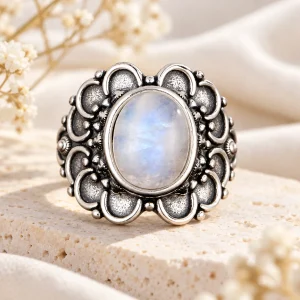
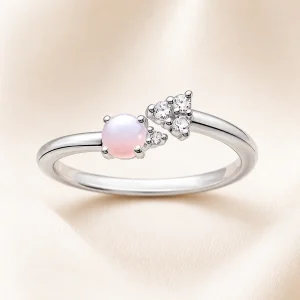
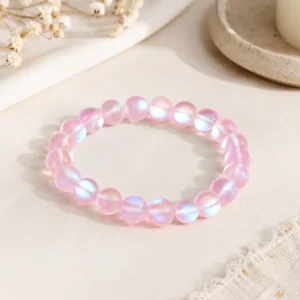
I set only one ring and one bracelet in this shade, because I pick my cabochons one by one and pink convinces me less often than white. They are in the rings collection and the bracelets collection. A question about a shade you hesitate to order elsewhere? Send me the photo.
My sources
The origin of the colour in iron, the distinction between body colour and adularescence, and the kinship with sunstone follow the public pages of the GIA, Mindat and the International Gem Society, as well as the descriptive mineralogy of the feldspars.
The nuance on the species, orthoclase in the vast majority of cases but plagioclase for part of the peach material in the trade, explains the contradictory pages found online. I flag it rather than settle it, because it changes nothing about the precautions.
The benchmarks on dyes, evenness of colour and drill hole zones come from my workshop and from the parcels I sort. They are professional observations, not statistics.
The symbolic attributions are reported from the most widely circulated crystal healing sources, with their dating where it is known. None has any scientific validation.
Last updated: 19 August 2026. If you find an error in this article, let me know: I correct it and I note it.
✦ À porter, à offrir
Découvrez mes créations