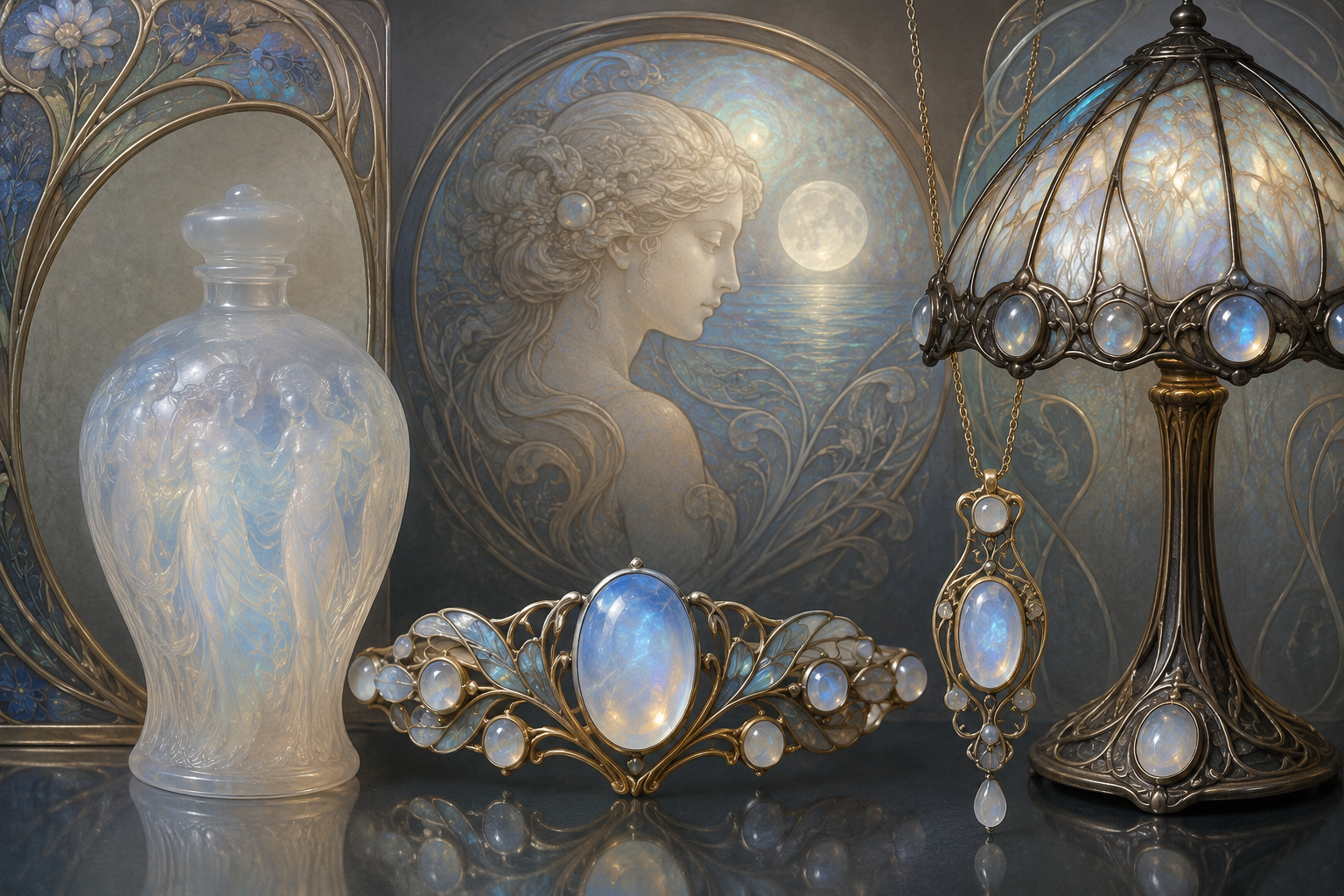
Moonstone in Art Nouveau: Lalique, Tiffany, Jensen
Between 1890 and 1910, a generation of jewellers decided that the worth of a piece lay in its design and not in the price of its stone. Moonstone gained thirty years of glory out of it: at Lalique in Paris, at Tiffany in New York, at Jensen in Copenhagen. It is the only moment in its history when it was a front-rank stone.
The subject is oddly served online: plenty of auction listings, very little that explains what actually happened. Which is strange, because the pieces exist, they sit in museums you can walk into, and they explain why this stone still looks the way it does today. I have gathered here what can be checked in public collections, and I say at the end of the article what I could not verify.
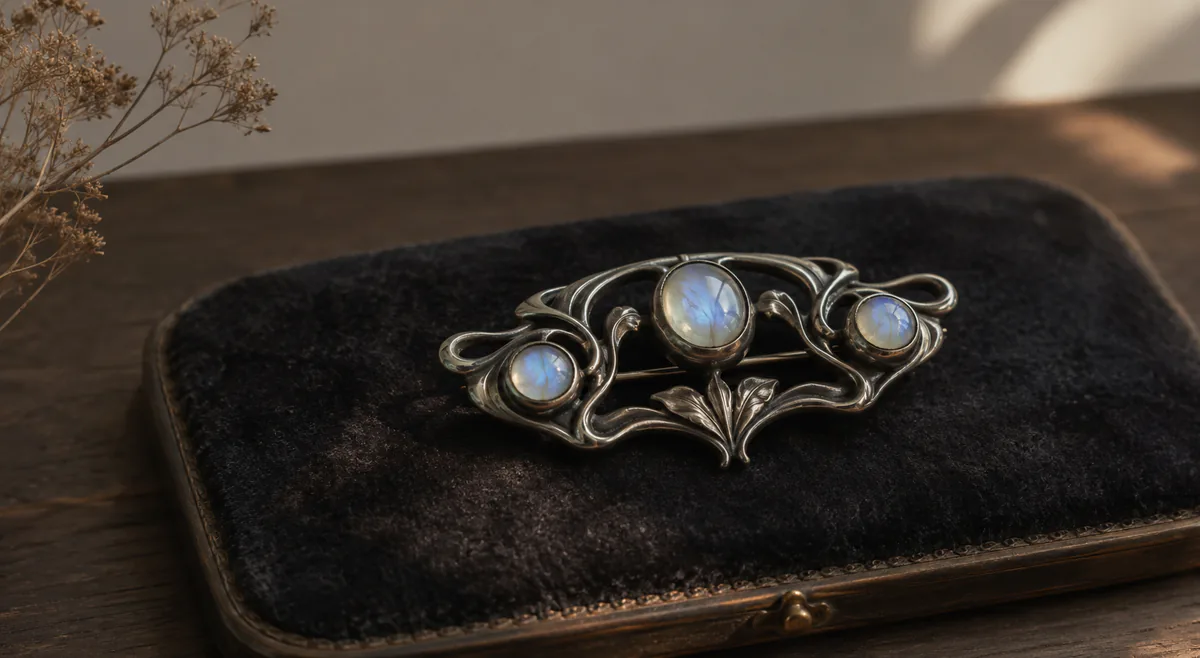
The short version, if you are in a hurry
- Art Nouveau reversed the hierarchy: the design and the workmanship first, the value of the stone second. That is what opened the door to moonstone.
- René Lalique is the one who set out that reversal and made it stick, in Paris, from the 1890s on.
- Louis Comfort Tiffany took the same direction in New York, against the grain of the diamond house his father had founded.
- Georg Jensen, in Copenhagen from 1904, made it his signature: silver and moonstone, to this day.
- In England, Liberty and the Arts and Crafts movement used it on a large scale, often in hammered silver.
- The reason is aesthetic: a soft light, which goes with silver and the cabochon, and not with platinum and the faceted cut.
- These pieces can be seen in Lisbon, Paris, Copenhagen, London and New York, in public collections.
The break of 1890
To understand how a modest stone ended up at the top, you have to see where the jewellery of the 19th century was coming from.
In France, under the Second Empire and then under the Third Republic, luxury jewellery is a matter of carats. A parure is judged by the weight of its diamonds, by the clarity of its stones, by the intrinsic value of its metal. The jeweller's work is real, but it serves the stone: the setting has to disappear so that light can get in and out. Platinum, arriving at the end of the century, pushes that logic all the way by making the claws almost invisible.
A generation of artists finds that thin. Their objection is not moral, it is aesthetic: a piece that is worth something because of its material does not need to be designed. Two diamond necklaces of the same weight are worth the same, whoever made them. What is at stake there is the same argument being had across the decorative arts of the period, against industrial production and the copying of old styles.
Their answer comes down to one reversal: it is the design that makes the value. From then on a piece can be made of horn, of glass, of enamel, of copper, and can set stones that no jeweller on the Place Vendôme would have looked at. Opal, agate, amethyst, turquoise, and moonstone.
Why this stone, and not another
Being cheap does not explain it: there were plenty of cheap stones. What made this one succeed comes down to four traits, and they hold together.
It gives light, not sparkle. Art Nouveau is an art of the curve, of the gradient, of the transition. A faceted stone cuts light into sharp flashes, and that is exactly what these artists did not want. The veil of a moonstone slides and shifts without an edge. The mechanism is explained in adularescence.
It cuts as a cabochon. A smooth dome, then, a shape that follows a plant line instead of contradicting it. And the cabochon calls for the bezel setting, a ribbon of metal that runs around the stone and becomes an element of the design itself. See bezel or prong setting.
It goes with silver. This may be the decisive point. The grey-white of silver and the blue-white of the veil belong to the same family of tones, whereas yellow gold pulls the stone towards dullness. And silver was the metal of that generation: cheaper, easier to work by hand, and without the symbolic weight of gold.
It carries the imagery of the period. Night, dream, water, woman, reverie: that is the iconographic repertoire of Art Nouveau, and a stone named after the moon takes its place in it without effort. What tradition ascribes to it is set out in the meaning of moonstone, and the old stories in the myths and legends.
Lalique, and the end of the compulsory diamond
René Lalique (1860-1945) is the name that always comes back, and rightly so: he is the one who made the thing respectable.
Trained in Paris and in London, working on his own account from the 1880s, he supplies the great houses before exhibiting under his own name. His public consecration comes at the 1900 Paris Exposition Universelle, where his jewellery causes a sensation. What he shows is not a cheaper piece of jewellery: it is a piece whose price cannot be calculated from its material.
His range of materials is a sculptor's, not a jeweller's: horn, ivory, moulded glass, translucent enamel set without a backing, what is called plique-à-jour and what gives the effect of a miniature stained-glass window. Hard stones enter as touches of colour, chosen for their tone and not for their rank.
Moonstone has a precise role there: that of cold light. It serves as the moon in nocturnal compositions, as a drop of water, a bead of dew, a point of light at the centre of a corolla. It is not filler ornament, it is a function in the design.
The most interesting point is what that cost. Lalique did not make jewellery cheaper, he made it more expensive: his pieces sold at the price of diamond parures, because the market had agreed to pay for the work. That is the complete reversal, and it held.
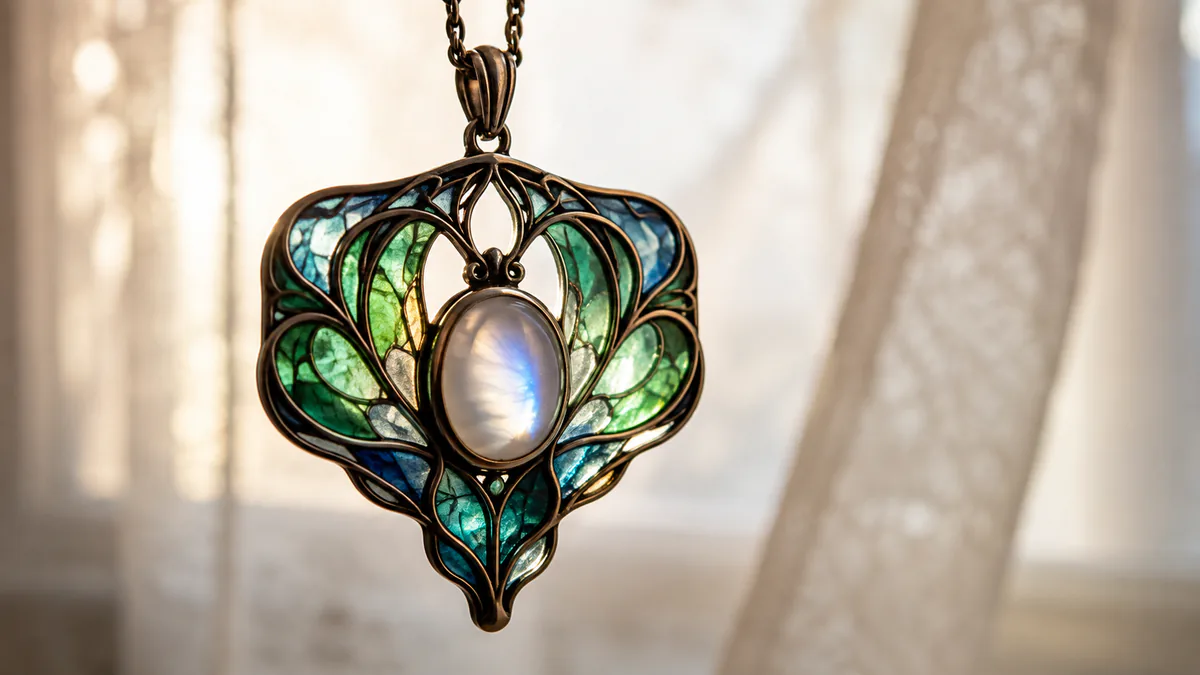
Tiffany, and the son who disobeyed
The American story has the same shape, with a family tension on top.
Charles Lewis Tiffany founds the house in New York in 1837 and turns it into a diamond power. His son, Louis Comfort Tiffany (1848-1933), starts out in painting and then devotes himself to glass, where he becomes the master of favrile, an iridescent glass, and of the windows that carry his name.
When he comes back to jewellery, in the early 1900s, at the head of the artistic jewellery department of his father's house, he applies to metal what he had learned from glass: what counts is how the light passes through. His palette therefore favours the materials that diffuse over the ones that refract. Opals, tourmalines, American stones, enamels, and moonstone.
The tension is plain: the Tiffany house was selling diamonds on one floor while Louis Comfort was setting cabochons on the floor above. The two logics coexisted, and it is the father's that survived commercially. But it is the son's pieces that are in the museums today.
Jensen, or moonstone as a signature
If a single house had to stay attached to this stone, it is that one.
Georg Jensen (1866-1935), a Danish silversmith, opens his workshop in Copenhagen in 1904. His style, within the Nordic strain of Art Nouveau that Denmark calls Skønvirke, rests on three constant elements: silver worked in matte, lightly hammered surfaces, stylised plant motifs of which the grape clusters are the trademark, and cabochons of soft stones set like fruit.
Among those stones, moonstone comes back so often that it became a house signature. The reason is the same as everywhere else, but pushed further: Jensen's matte silver and the bluish veil are so close in value that the stone seems to come out of the metal rather than sit on top of it.
And the house is still there. That is the difference with Lalique, who became a house of glass and perfume, and with Tiffany, which went back to the diamond: at Jensen, the silver and moonstone models stayed in the catalogue right through the 20th century. It is the longest line of continuity there is, and it is why a Georg Jensen moonstone ring is one of the very few period signatures you can still look up by name.
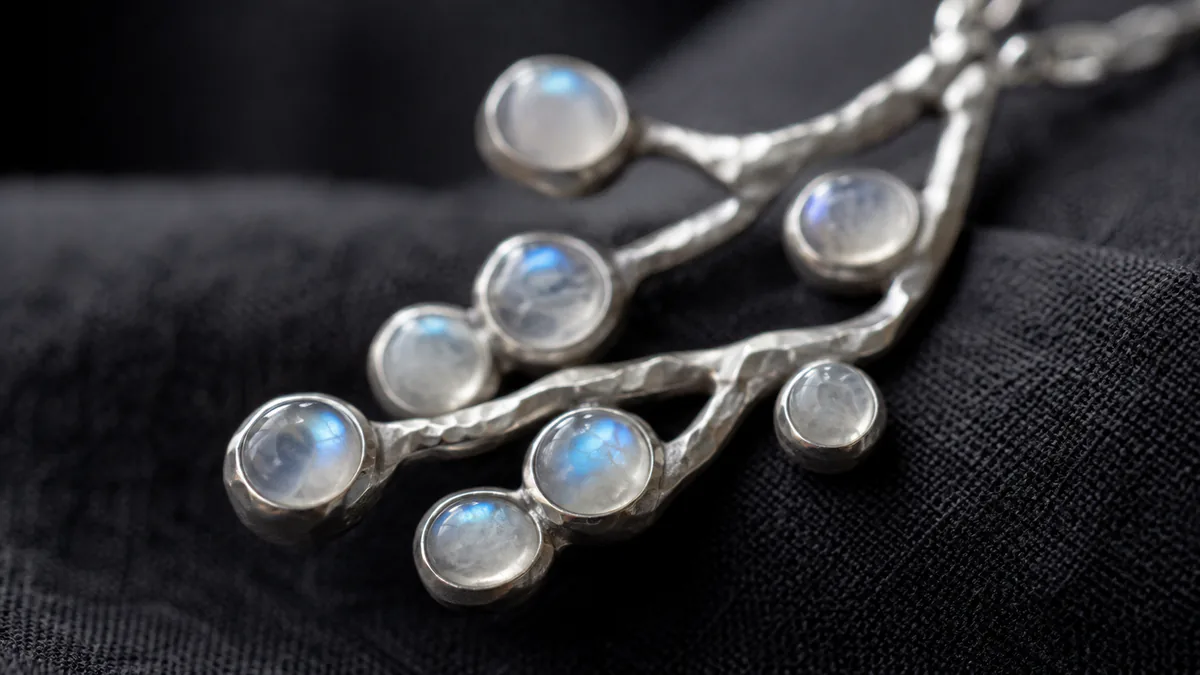
Liberty, Knox and Ashbee, the other centre
The British side is often forgotten, and yet it is the one that consumed the most of it.
The Arts and Crafts movement, born in England before continental Art Nouveau, shares the same refusal of industrial production but with a different emphasis: a return to the work of the hand, to the workshop, to the object made from one end to the other by a single person. Its jewellery is deliberately modest in material and visible in workmanship: you can see the hammer marks, you can see the solder.
Moonstone was everywhere in it, for a very practical reason: it cost little, it arrived in whole parcels from Ceylon, then a British colony, and it suited the bezel setting these workshops practised. The colonial link is covered in the Sri Lankan deposit and in the moonstone deposits.
Three names to remember. Charles Robert Ashbee, founder of the Guild of Handicraft, whose silver peacock pendants are among the best known pieces of the movement. Archibald Knox, a designer from the Isle of Man, author of the Cymric and Tudric lines for the London shop Liberty, where the Celtic interlace replaces the plant scroll. And Liberty itself, which distributed these objects on a far wider scale than the Paris workshops did.
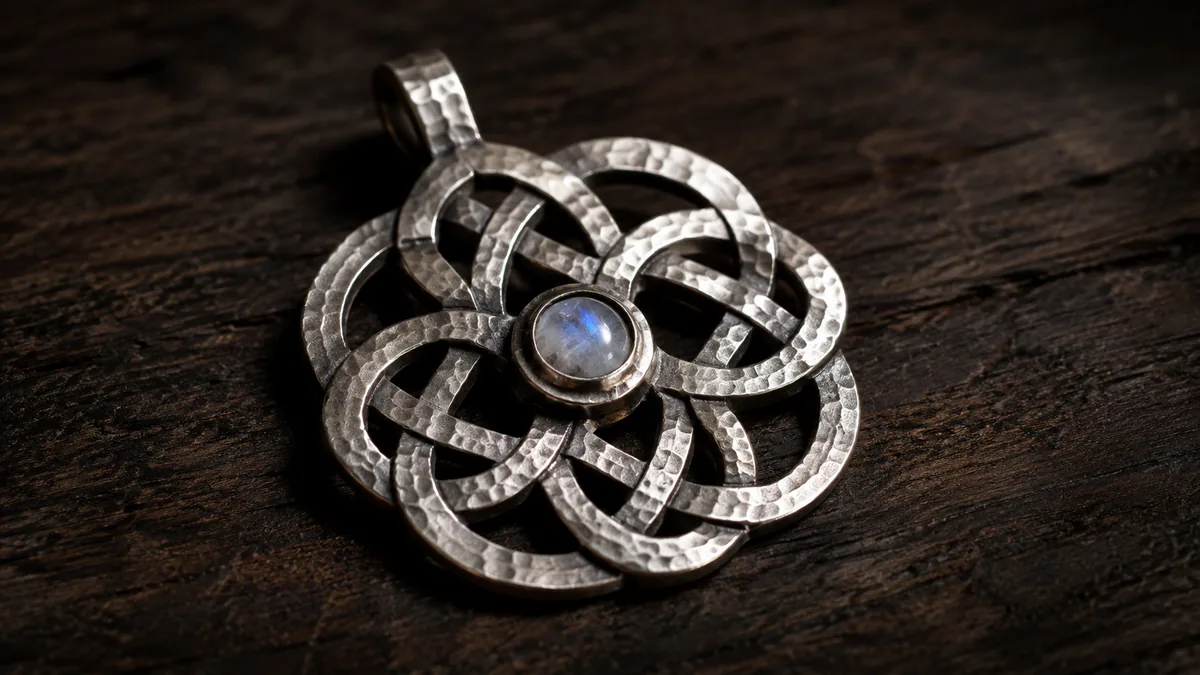
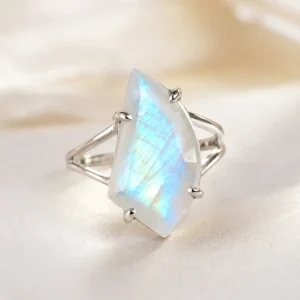
Settings that pick up the grammar of the period
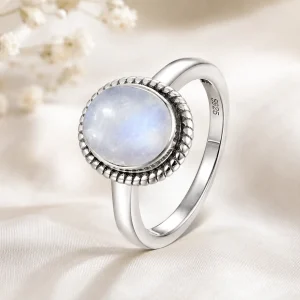
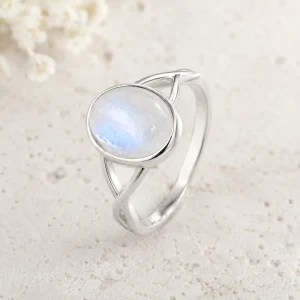
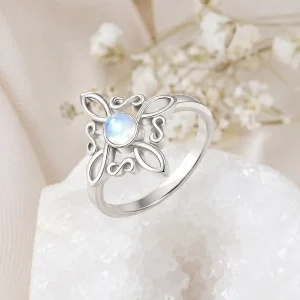
Where to see these pieces
The best argument in this article is that it can be checked. These objects are on view, and here is where to look.
| Institution | City | What to look for |
|---|---|---|
| Calouste Gulbenkian Museum | Lisbon | Lalique, a major holding |
| Musée des Arts Décoratifs | Paris | French Art Nouveau |
| Musée Lalique | Wingen-sur-Moder | Lalique, glass and jewellery |
| Victoria and Albert Museum | London | Arts and Crafts, Liberty |
| Designmuseum Danmark | Copenhagen | Jensen and Skønvirke |
| Metropolitan Museum of Art | New York | Tiffany, decorative arts |
| Museum of Fine Arts | Boston | Art Nouveau and Arts and Crafts |
One tip for the visit. Jewellery is almost always in the decorative arts departments and not in the painting galleries, often in small, badly lit cases at the end of the route. And many of these institutions have put their collections online with high-resolution photographs, which lets you see the settings far closer than you can in the gallery.
What is left of it today
The parenthesis closed quickly. Three reasons, in order.
The war of 1914. It interrupts everything: the workshops, the markets, the customers. What starts up again after it is no longer in the same mood.
Art Deco. In the 1920s, fashion moves to the straight line, to geometry, to sharp contrast. Platinum comes back, the diamond with it, and a stone with a blurred reflection no longer has a place in that vocabulary.
Becoming ordinary. From being used by everyone, moonstone became a common stone, then a stone for mass-produced jewellery, then an esoteric stone in the second half of the century. It never came back to the rank it had held.
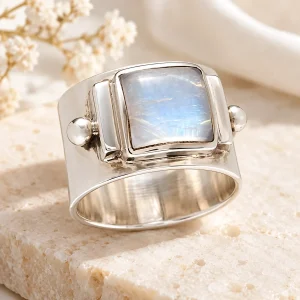
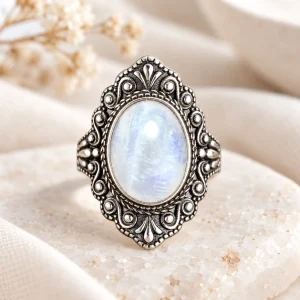
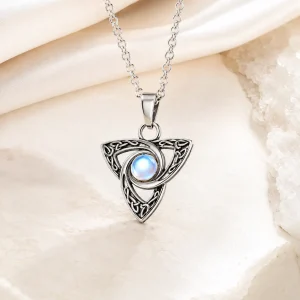
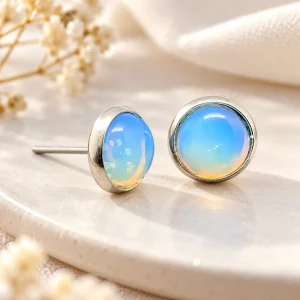
What survived is the form. Look at a moonstone piece sold today, mine included: cabochon, bezel setting, silver, a supple line. That grammar was fixed between 1890 and 1910 and nobody has seriously revised it since. We still set these stones the way Jensen set them, because the solution was a good one.
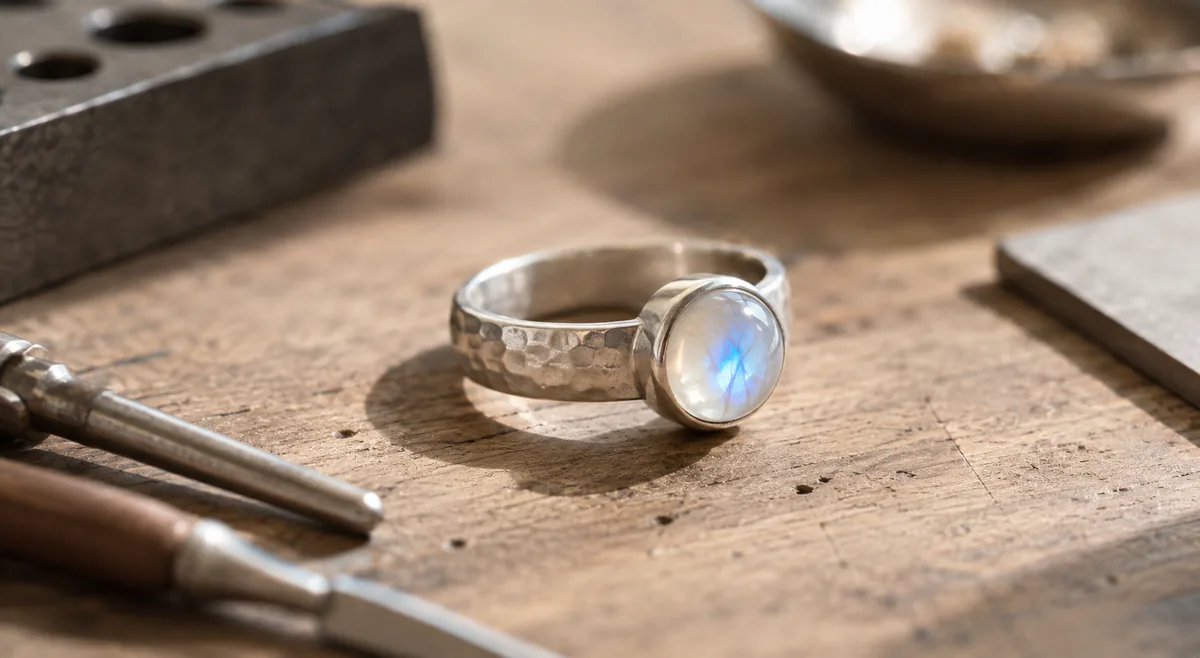
Buying period, or borrowing from it
Two routes, and they do not cost the same.
Buying a period piece. It is possible and it is not out of reach, provided you aim at the right segment. A piece signed Lalique belongs to the art market and runs into tens of thousands of dollars. An unsigned English Arts and Crafts piece, in silver, is a flea-market and ordinary-auction object, at far more accessible levels. That second segment is where most of what gets listed as an antique moonstone ring or a vintage moonstone ring actually comes from.
Three precautions if you take the risk. The signature or the hallmark first: British pieces carry datable assay marks, which is a considerable advantage. The state of the setting next: an old bezel has often worked loose over a hundred years and the stone moves, which can be repaired but should be negotiated. And the stone itself last, which may have been replaced by a modern cabochon, sometimes by a doublet or by something other than what you are told, a subject covered in how to recognise a real moonstone.
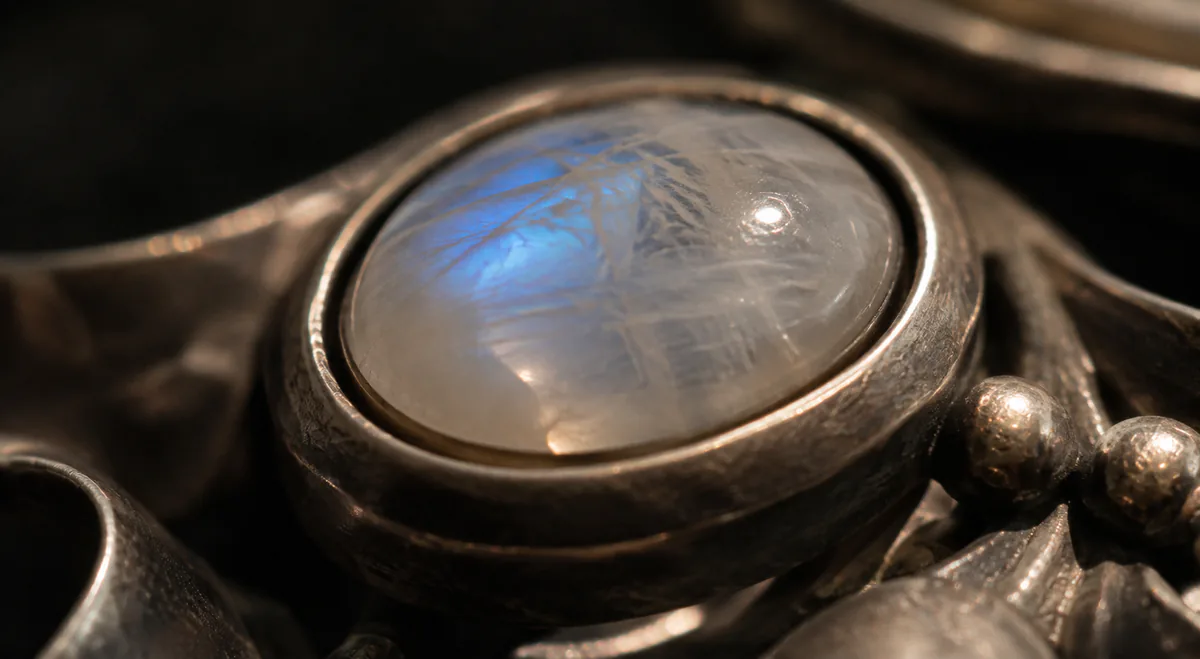
Borrowing from it. That is what I do, without pretending otherwise: silver settings, bezels, simple lines. If you are after that kind of look, the criteria for choosing are in judging the quality of a moonstone and in how to wear moonstone.
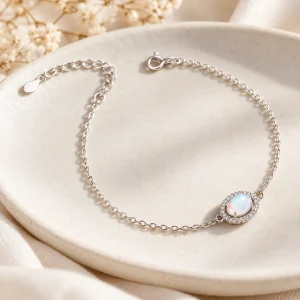
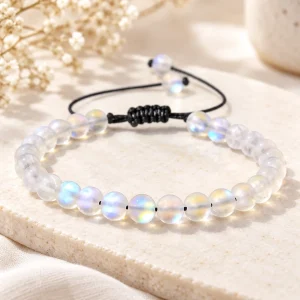
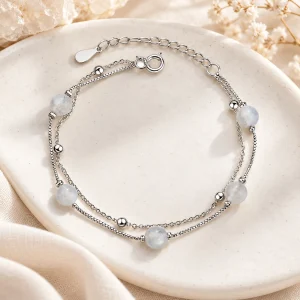
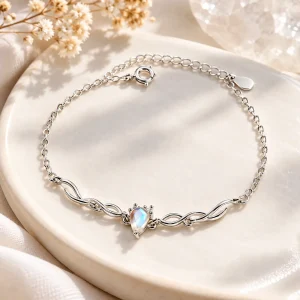
The bracelets, in silver and bezel settings
Frequently asked questions
Why was moonstone so present in Art Nouveau?
Because the movement valued the design over the price of the stone, and because this stone gives a soft light that goes with silver, with the cabochon and with the curved line. It was also abundant and cheap, arriving in parcels from Ceylon.
Did Lalique really use moonstone?
Yes, within a very wide palette that also included horn, glass, translucent enamel and many hard stones. It played the part of cold light there: a moon, a drop of water, a point of light at the centre of a composition.
Which house is most associated with this stone?
Georg Jensen, in Copenhagen from 1904. The pairing of matte silver and moonstone became a house signature there, and it stayed in the catalogue right through the 20th century, which is true of no other house.
What is the difference between Art Nouveau and Arts and Crafts?
The second was born in England and puts the emphasis on the work of the hand and on the workshop, with objects deliberately modest in material. The first, continental, is more decorative and more curved. Both use the same stone, for closely related reasons.
Can you buy an Art Nouveau moonstone piece?
Yes, provided you aim at the right segment. A signed piece belongs to the art market, but an unsigned British piece in silver is still an ordinary sale item. Check the hallmark, the state of the setting and the stone itself.
Where can I see these pieces from Australia?
The collections listed in the table are all in Europe and in the United States, and I know of no Australian holding I could point you to with any confidence. The practical route from here is the online catalogues, which several of these institutions have photographed in high resolution. When you do get in front of a case, look on the side of the decorative arts departments, where these objects are classified.
Why silver and not gold?
Because the grey-white of silver and the blue-white of the veil belong to the same family of tones, whereas yellow gold pulls the stone towards dullness. Silver was also cheaper and easier to work by hand, which suited these workshops.
Why did the fashion stop?
The war of 1914 interrupted the workshops and the markets, and then the Art Deco of the 1920s imposed the straight line, platinum and the diamond. A stone with a blurred reflection no longer had a place in that vocabulary.
Do the pieces made today descend from it?
Directly. Cabochon, bezel setting, silver, a supple line: that grammar was fixed between 1890 and 1910 and nobody has seriously revised it since, because the solution was a good one.
Does Tiffany still sell moonstone jewellery?
The house went back to the diamond after the time of Louis Comfort Tiffany, and it is no longer its ground at all. It is his pieces from the 1900-1920 period that are in the American museums today.
Where to go next
- The history and the stories: myths and legends, a piece of the moon, where it really comes from, gods and goddesses of the moon.
- The sheen and the material: adularescence, the mineral file, the colours.
- The jewellery: bezel or prong setting, judging the quality, how to wear it.
- The provenance: the deposits, Sri Lanka.
- The whole picture: the complete moonstone guide.
The workshop pieces are in the shop, and in particular the rings and the bracelets. If you have inherited an old piece and want an opinion before having it reset, write to me.
My sources
For the chronology and the figures: the object records of the institutions listed in the table, in particular the Calouste Gulbenkian Museum in Lisbon for Lalique, the Victoria and Albert Museum for the Arts and Crafts movement and for Liberty, and the Designmuseum Danmark for Georg Jensen. All three have put object records and documentary files online, and they can be consulted.
For the context of the 1890 break, the general literature on the decorative arts of the period, and for the 1900 Exposition Universelle, the contemporary accounts widely reproduced ever since.
Two limits I flag plainly. First, what I describe here are tendencies of houses and of movements, not individual pieces: I give no inventory numbers, because I have not checked object by object and I do not want to claim a precision I do not have. If you are after one particular piece, go through the institution's own online catalogue.
Second, the real proportion of moonstone in each house's output is not quantified anywhere that I know of. Saying that Jensen used a great deal of it is solid and documented; saying that it accounted for such and such a percentage of his catalogue would not be, so I do not say it.
Last updated: 19 August 2026. If you know this field better than I do, and in particular if you can attach these observations to dated pieces, write to me: I correct, and I credit.
✦ À porter, à offrir
Découvrez mes créations