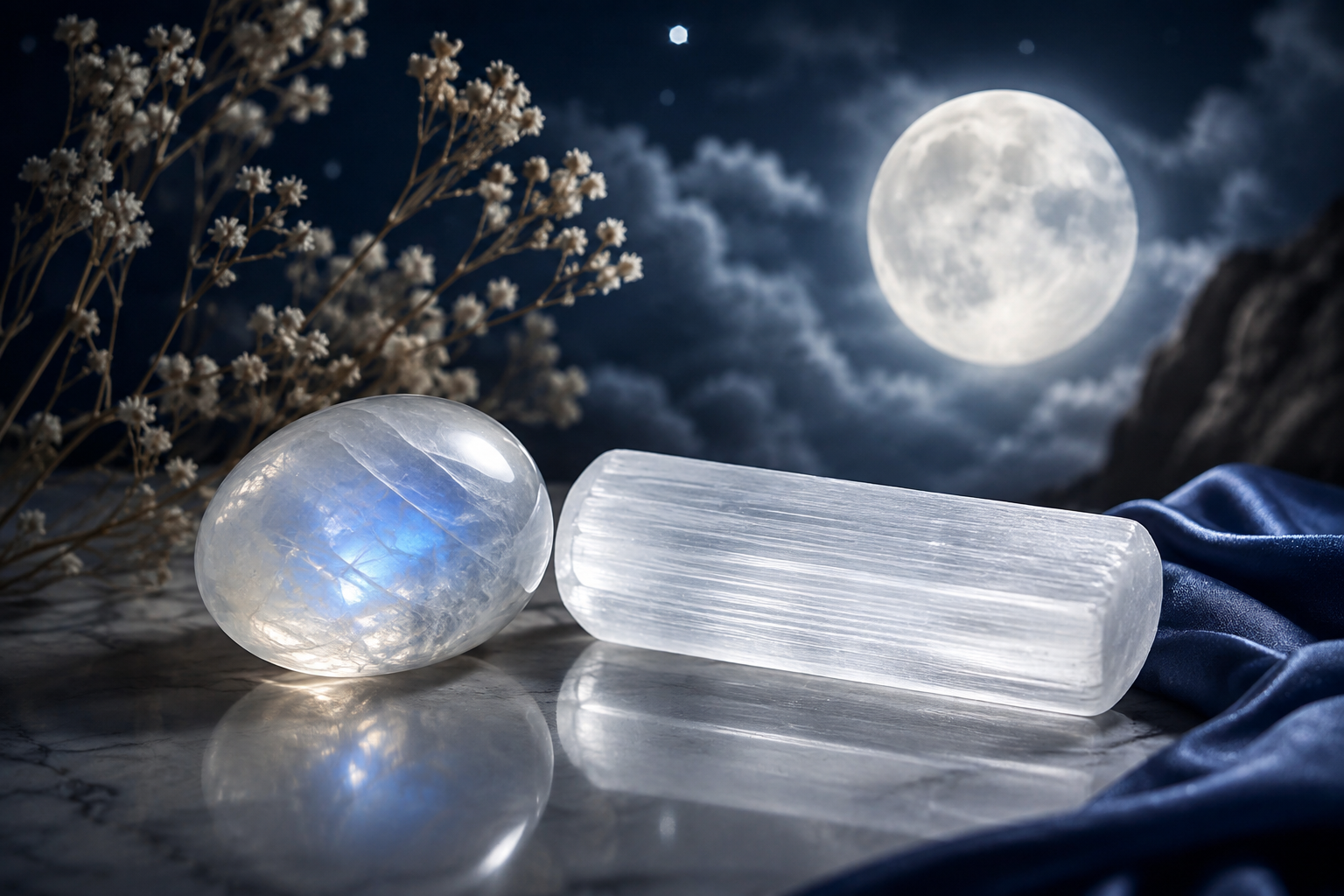
Moonstone or Selenite: Two Moon Stones
Both are named after Selene, the Greek Moon, and they are two minerals with nothing whatsoever in common. One is a feldspar at 6.5 on the Mohs scale, the other a gypsum at 2, which a fingernail scratches and water ruins. Here is how to tell them apart in five seconds, and why the confusion is nearly two thousand years old.
It is the most elegant confusion on the subject, because it does not come from any commercial deception but from a coincidence of vocabulary. Two pale stones, two kinds of shine that recall moonlight, two names built on the same deity, and a difference in hardness that changes absolutely everything you can do with them.
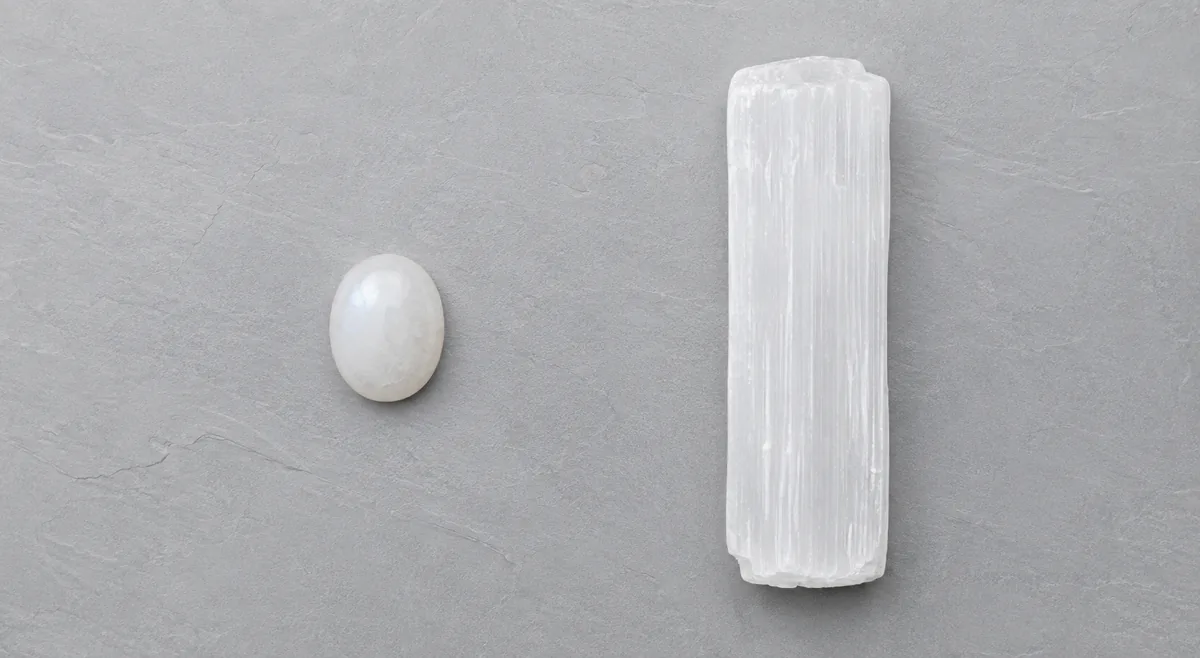
The short version, if you are in a hurry
- They are two unrelated species. Moonstone is a feldspar, selenite a gypsum.
- The fingernail test settles it in five seconds. Selenite scratches with a fingernail, moonstone does not.
- Gypsum is the reference for 2 on the Mohs scale. It is what defines the level; you cannot get softer among common minerals.
- Selenite is ruined by water. Never wash it, never set it down on a damp surface.
- The two kinds of shine look nothing alike: a veil that floats across the dome on one side, a silky band running along the fibers on the other.
- Selenite is not set in jewelry that gets worn, except as a brooch or a display piece. A ring is destroyed within weeks.
- The confusion is two thousand years old: Pliny the Elder already described a selenitis nobody can identify with certainty.
Two stones, one Greek name
Let us start with the most entertaining point on the subject.
Selenite means moonstone. The word comes from the Greek selēnē, the Moon, and lithos, stone. In other words, the two minerals literally bear the same name, one in Greek and the other in English.
The reason is the same in both cases: their shine. A plate of translucent gypsum sends back a soft white light, a feldspar cabochon lets a milky halo float. Two different ways of recalling moonlight, two independent christenings.
The confusion is old. In the first century, Pliny the Elder describes a stone named selenitis, white and translucent, whose brightness was said to wax and wane with the Moon. Specialists still debate whether he was talking about gypsum or a feldspar. Two thousand years later we are still mixing the two, which is at least consistent. The deities involved are in the gods and goddesses of the Moon.
What these two minerals really are
On to the mineralogy, because that is where everything separates.
Moonstone is an orthoclase, a potassium alkali feldspar. It forms in igneous rocks that cool slowly, and its veil comes from an internal structure of lamellae. Its hardness is 6 to 6.5, its density about 2.56. The detail is in how moonstone forms.
Selenite is a variety of gypsum, a hydrated calcium sulfate. It forms by evaporation: salt-laden water evaporates in a closed basin, and the gypsum crystallizes. Nothing to do with magma, nothing to do with lamellae.
Two opposite modes of formation, two different chemical families, two hardnesses with no relation at all. The only thing they share is a Greek word.
The table that settles everything
If you only keep one block from this page, take this one.
| Criterion | Moonstone | Selenite |
|---|---|---|
| Species | Orthoclase, a feldspar | Gypsum, a sulfate |
| Hardness (Mohs) | 6 to 6.5 | 2 |
| Scratched by a fingernail | No | Yes |
| Density | About 2.56 | About 2.3 |
| Formation | Cooling of a magma | Evaporation of salt water |
| Optical phenomenon | Adularescence, a floating veil | Silky shine along the fibers |
| Water | Best avoided, no immediate danger | Forbidden, it degrades |
| Common use | Cabochons, jewelry that gets worn | Wands, plates, decorative pieces |
| Sold | By the carat | By weight, as whole pieces |
Look at the hardness row. Four and a half points apart on a scale that only goes to ten, and that scale is not linear: the real gap is even wider than the figure suggests.
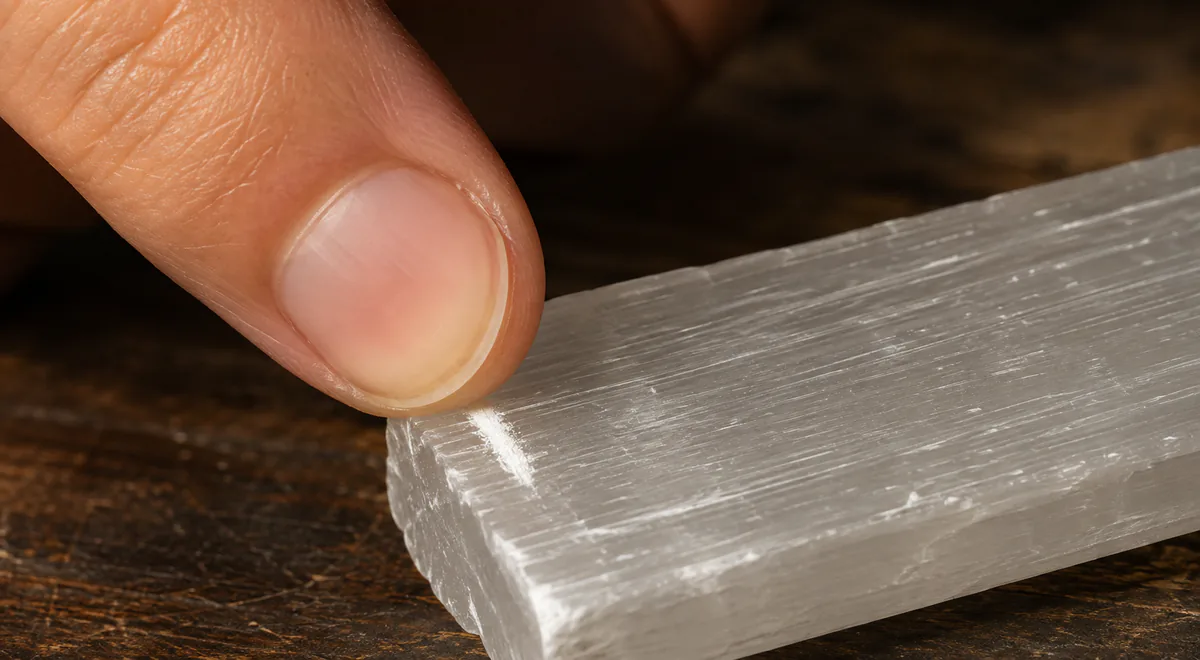
The fingernail test, five seconds
Here is the decisive test, and it calls for no tool at all.
A human fingernail sits around 2.5 on the Mohs scale. Selenite is at 2, so a fingernail scratches it, plainly, leaving a visible white mark. Moonstone is at 6 or 6.5: nothing happens.
Do it on a discreet area, an edge or the back, and press normally. If the surface marks, you are holding gypsum. If it resists, it is not selenite.
One point worth making: gypsum is the reference mineral for level 2 of the Mohs scale. It is not a stone that happens to be "a bit soft", it is the one used to define what a soft mineral is. There is practically nothing more fragile among the minerals you will be sold in a shop.
Weight, the second test
The second reflex is subtler but it works very well once you have compared the two just once.
Moonstone has a density of about 2.56, selenite about 2.3. At equal volume, selenite is therefore noticeably lighter, and that difference can be felt in the hand.
On the objects actually sold, the gap is starker still, because selenite is almost always offered in large volumes, wands or plates, which look heavy and turn out surprisingly light. Plenty of people describe the object as hollow the first time they pick it up.
Moonstone arrives as small cabochons, and the contrast runs the other way: a modest volume that weighs more than expected.
Two kinds of shine with nothing in common
This is the visual criterion, and it settles the question on its own once you know what to look at.
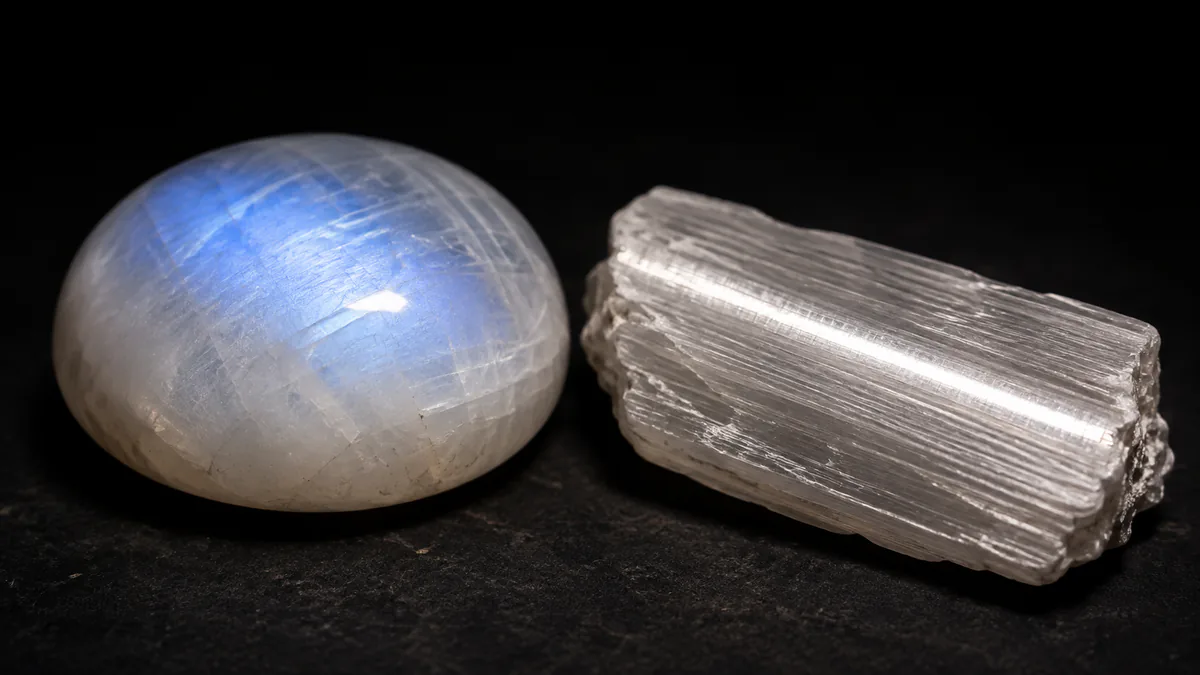
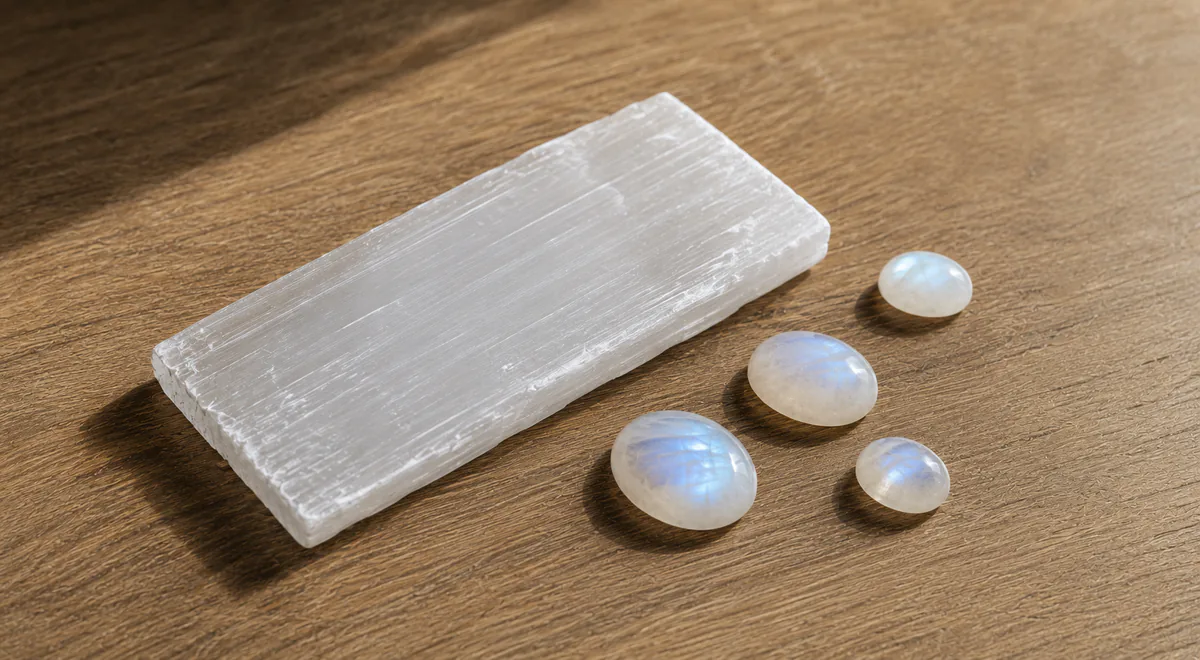
Moonstone produces a veil that floats. Adularescence is a milky or bluish sheet that seems to sit below the surface, and that travels across the dome when you tilt the stone. It has no apparent direction, it glides.
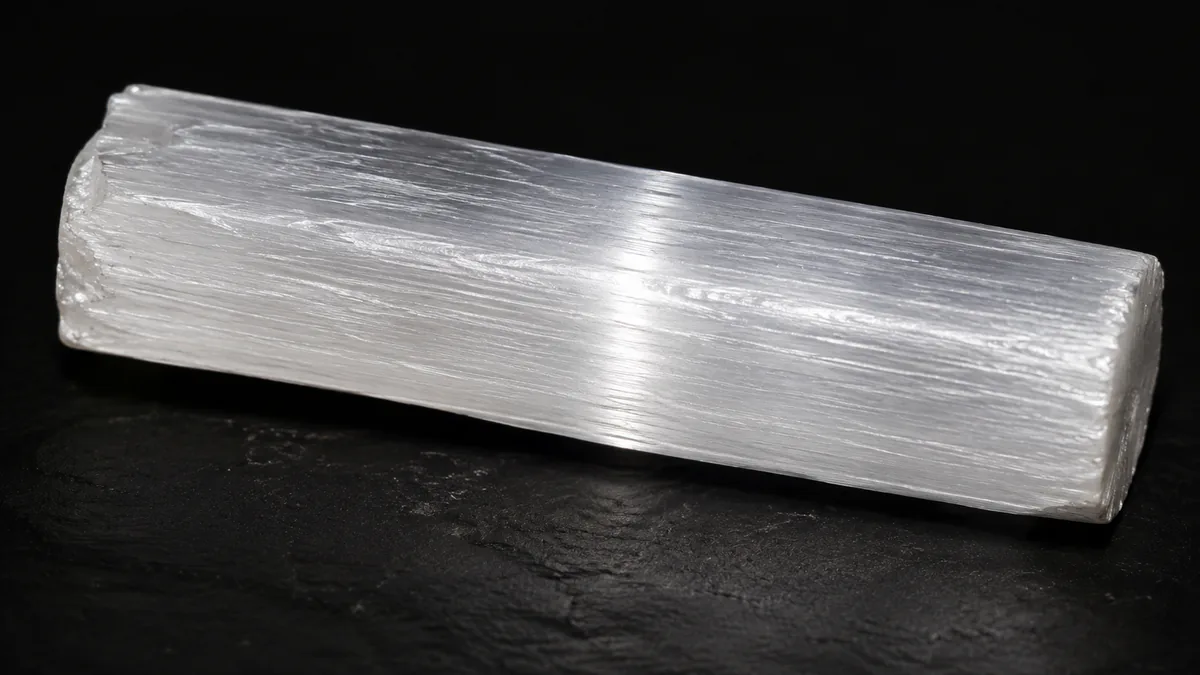
Selenite produces a silky shine that runs. In its fibrous form, light reflects along the parallel fibers and gives a bright band, rather as on silk or on a cat's eye. That band is oriented: it always follows the direction of the fibers, and it moves perpendicular to them.
The summary fits in two words. Moonstone, a halo. Selenite, a band. Once you have seen the two side by side, you will never confuse them again. The mechanism of the veil is covered in detail in adularescence.
What you are actually sold as selenite
A point of vocabulary worth its weight in white wands.
Selenite in the strict sense means gypsum in transparent, flat crystals, sometimes very large. What you buy in a shop under that name is, in the vast majority of cases, satin spar: the fibrous variety of the same gypsum, white, silky, the one the wands and plates are made of.
It is not a deception, it is a settled trade usage: the same mineral species, another form of crystallization. But if you are trying to compare, be aware that the "selenite" of the trade and the transparent crystals of collections look nothing alike.
Alongside those, the same species also gives the desert rose, formed in desert conditions. Three appearances, one single mineral, which is exactly the reverse of the moonstone situation, where several different minerals hide behind one trade name. See moonstone or labradorite.
Water, the difference that costs money
Here is the most important practical consequence on this whole page.
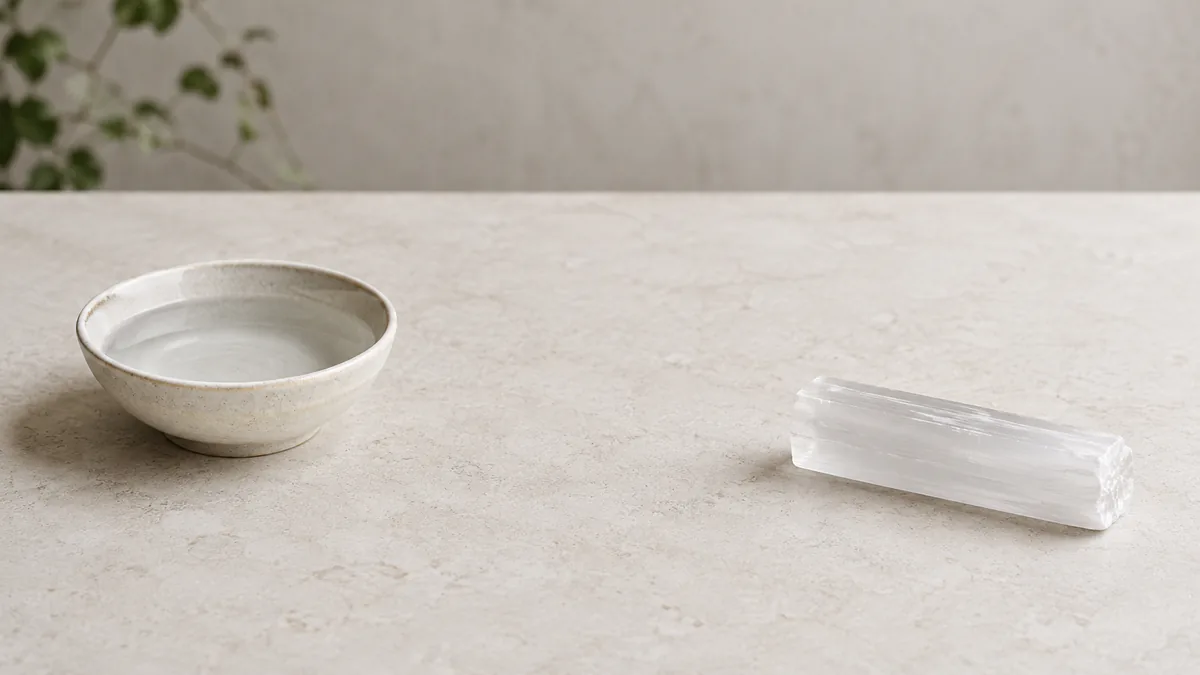
Gypsum is a hydrated calcium sulfate, and it is slightly soluble in water. A selenite washed under the tap loses its polish, turns matte and chalky, and breaks down at the surface. Left in water, it degrades outright. A plate set on a damp countertop marks permanently.
Never wash a selenite. Never set it down on a wet surface. A dry or barely damp cloth, and nothing else.
Moonstone is more tolerant, but it does not like water either, for other reasons: thermal shock, soaps that settle under the cabochon, salt and chlorine that work into the microfractures. It does not dissolve, it dulls. The detail is in can moonstone go in water.
In other words: two prohibitions that look identical, two completely different mechanisms. One fears water because it degrades in it, the other because it gets clogged by it.
Why selenite is not set in jewelry
A question I get regularly, and the answer is categorical.
At 2 on the Mohs scale, selenite is scratched by everything: a fingernail, a key, a speck of dust, a fabric carrying particles. A selenite ring worn normally is matte within weeks and ruined within months.
It also has perfect cleavage, like moonstone, but with four points of hardness less: it flakes apart under light pressure.
The only workable uses are those where the stone does not rub: a brooch, a pendant worn over clothing and taken off often, or a decorative piece. Anything that touches the hand is out.
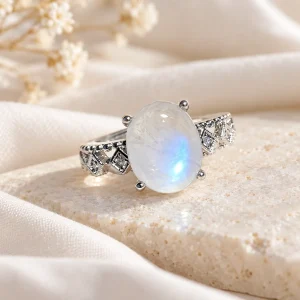
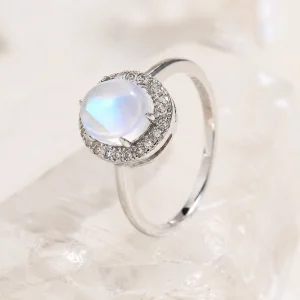
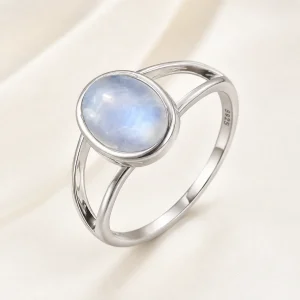
Moonstone, at 6 or 6.5, is already considered delicate for a ring worn every day, and I say so plainly in a moonstone engagement ring. So a gem at 2 is not even up for discussion.
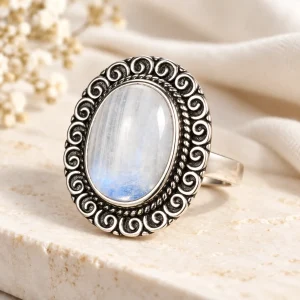
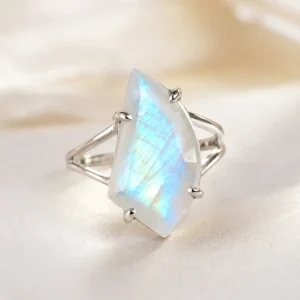
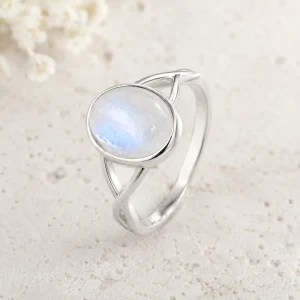
What can be set and worn: feldspar cabochons
The charging plates
This is the main commercial use of selenite today, and it deserves two separate remarks.
On the claimed effect. Selenite plates are commonly presented as able to cleanse or recharge other stones placed on them. That is a belief spread by modern crystal healing. No effect of that kind has been demonstrated, and I will not present it as a fact. The methods and the lunar calendar are gathered, with the same caution, in cleaning, cleansing and recharging your stones.
On the practice, however, there is a real warning. If you use a plate, never set a damp or freshly rinsed stone on it: water attacks the gypsum and leaves a permanent mark. And never clean the plate itself with water, which is nevertheless the first reflex when it gets dirty.
There is an irony worth flagging: the material sold to cleanse other stones is precisely the one that cannot be cleaned.
These uses belong to crystal healing, an approach founded on traditions and beliefs. They are not a medical claim and never replace the advice of a healthcare professional. Read the full disclaimer.
Two markets with nothing in common
One last criterion, and it is decisive if you are hesitating over a listing.
Selenite is a very abundant mineral. Gypsum is quarried on an industrial scale, it is used to make plaster, and decorative pieces sell by weight, for modest sums even in large sizes. A wand several centimeters long costs about what lunch costs.
Moonstone sells by the carat, and its price depends on the sharpness of the veil, its color and where it sits on the dome. A fine blue cabochon is another order of magnitude. The criteria are in the price of moonstone and judging quality.
The common-sense rule that follows: a large white piece sold very cheaply is not moonstone. It will be selenite, or glass. The other common confusions are in moonstone or opalite and how to recognize a real moonstone.
The workshop rings, species named on every listing




Frequently asked questions
Are selenite and moonstone the same stone?
No, they are two mineral species with no relation at all. Moonstone is an orthoclase, a feldspar formed in a magma. Selenite is a variety of gypsum, a sulfate formed by evaporation. Only their names meet, both built on Selene, the Greek Moon.
How do I tell them apart quickly?
By the fingernail test. A fingernail sits around 2.5 on the Mohs scale, selenite at 2: the nail scratches it and leaves a white mark. Moonstone is at 6 or 6.5, nothing happens. Five seconds is enough, on a discreet area.
Why is selenite called that?
Because selēnē means the Moon in Greek: selenite literally means moonstone. The name comes from its soft white shine. Pliny the Elder was already describing a selenitis in the first century, and it is still debated whether he meant gypsum or a feldspar.
Can selenite be worn as jewelry?
Not as jewelry on the hand. At 2 on the Mohs scale it is scratched by a fingernail, a key, and even the dust in the air, and its perfect cleavage makes it flake apart. A brooch or a pendant worn over clothing remain possible, a ring does not.
Can selenite go in water?
No, never. Gypsum is slightly soluble: the stone loses its polish, turns matte and chalky, then breaks down at the surface. A dry or barely damp cloth, and nothing else. Do not set a plate on a wet countertop either.
What is satin spar?
The fibrous variety of gypsum, white and silky: it is what gets sold as wands and plates under the name selenite. Selenite in the strict sense means the transparent, flat crystals. Same species, two forms of crystallization that look very different.
Do selenite plates recharge stones?
That is a belief spread by modern crystal healing, and no effect of that kind is demonstrated. The only useful warning is practical: never set a damp stone on a plate, water attacks the gypsum and leaves a permanent mark.
Can a large cheap white stone be a moonstone?
It is very unlikely. Gypsum is abundant and sells by weight, moonstone sells by the carat. A large white piece at a modest price is almost always selenite, sometimes opal glass sold under the name opalite.
Where to go next
This page covers one confusion of names. The others:
- The common confusions: moonstone or opalite, moonstone or labradorite, moonstone or opal, moonstone and sunstone.
- Checking a stone: recognizing a real stone, judging quality, where to buy it.
- The material: the mineral data sheet, how it forms, adularescence, the glossary.
- Care: moonstone in water, cleaning it, cleansing and recharging your stones.
- The big picture: the complete guide.
I do not sell selenite, and that is not a judgment on the stone: it is simply that at 2 on the Mohs scale it has no place in jewelry that gets worn. What I make is in the shop. Unsure about a white piece bought elsewhere? Send me a photo.
My sources
The compositions, hardnesses, densities, cleavages and modes of formation of the two minerals follow the public data sheets of the GIA, of Mindat and of the International Gem Society. Gypsum as the reference mineral for level 2 of the Mohs scale belongs to the very definition of that scale.
The solubility of gypsum in water and its consequences for the polish belong to ordinary mineral chemistry. The distinction between selenite in the strict sense and satin spar is a trade usage that I flag as such.
The mention of selenitis comes from the Natural History of Pliny the Elder, first century. Its identification is disputed, and I would rather say so than settle it in his place.
The crystal healing uses tied to the plates are reported as beliefs, without crediting them with any effect.
Last updated: August 19, 2026. If you find an error in this article, let me know: I correct it and I note it.
✦ À porter, à offrir
Découvrez mes créations