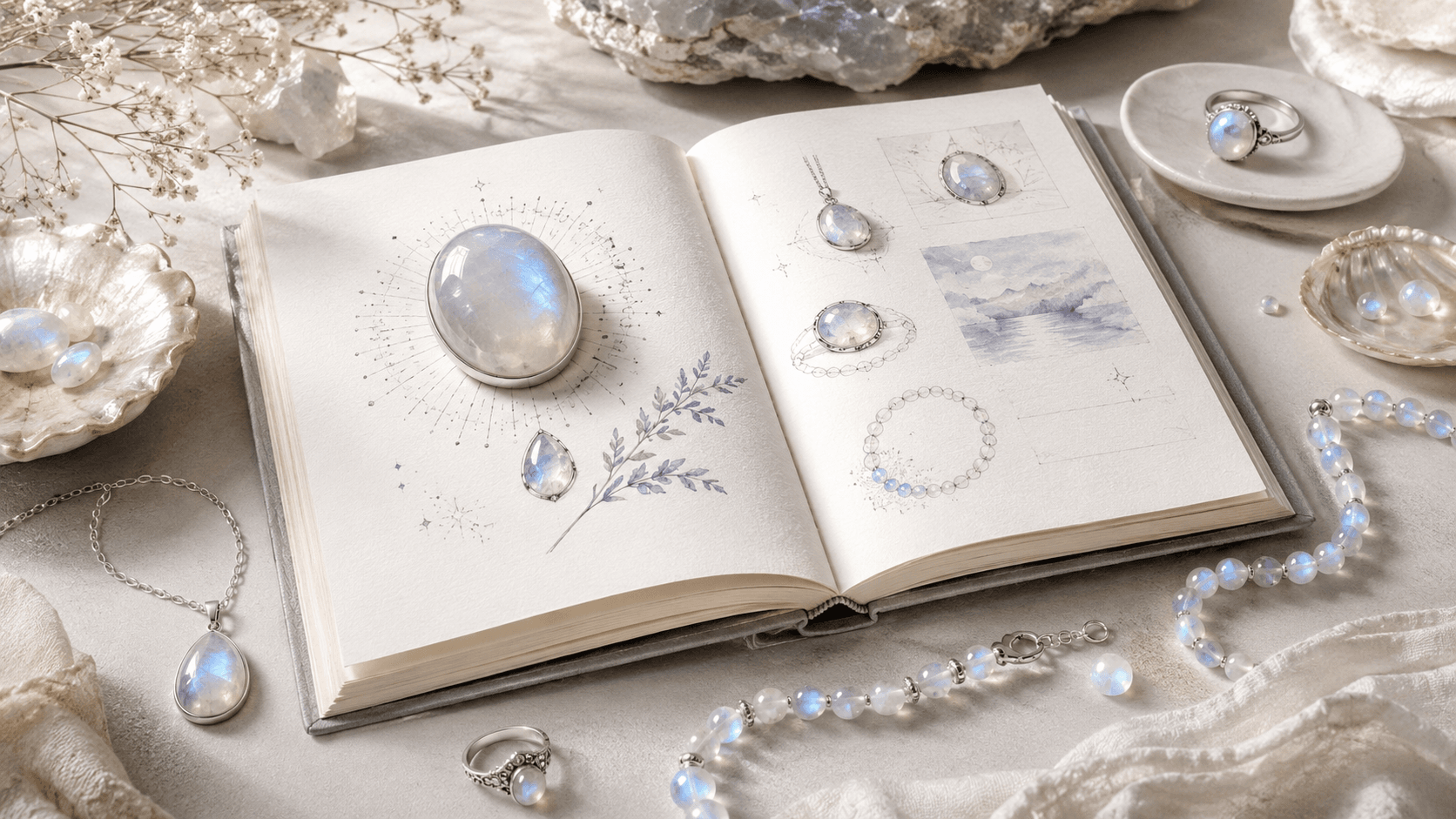
Moonstone: the complete guide
Moonstone is a feldspar, and that bluish veil sliding across its surface when you move it has a name: adularescence. Here is what the stone really is, what tradition attributes to it, what it costs, and how to tell a genuine stone from a glass imitation. This is the guide I wish I had found when I started.
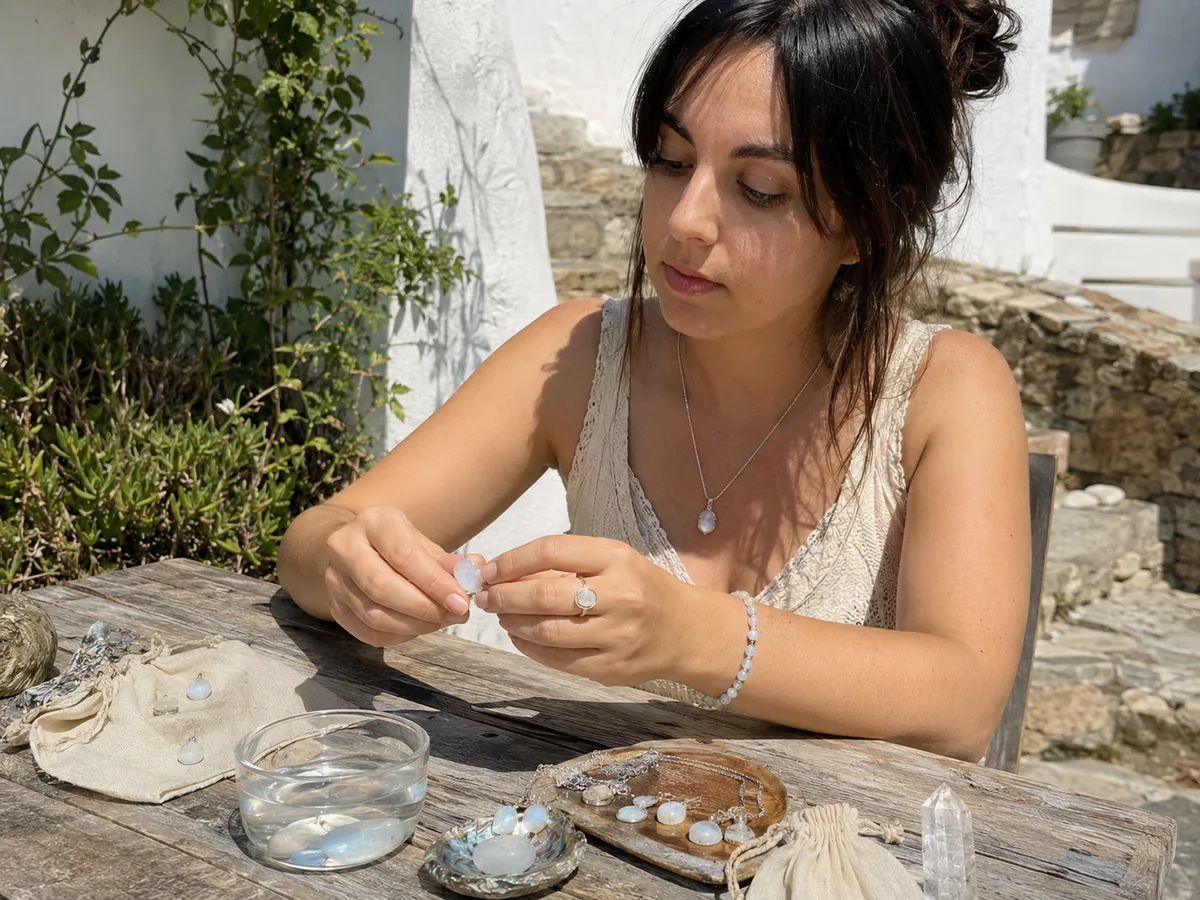
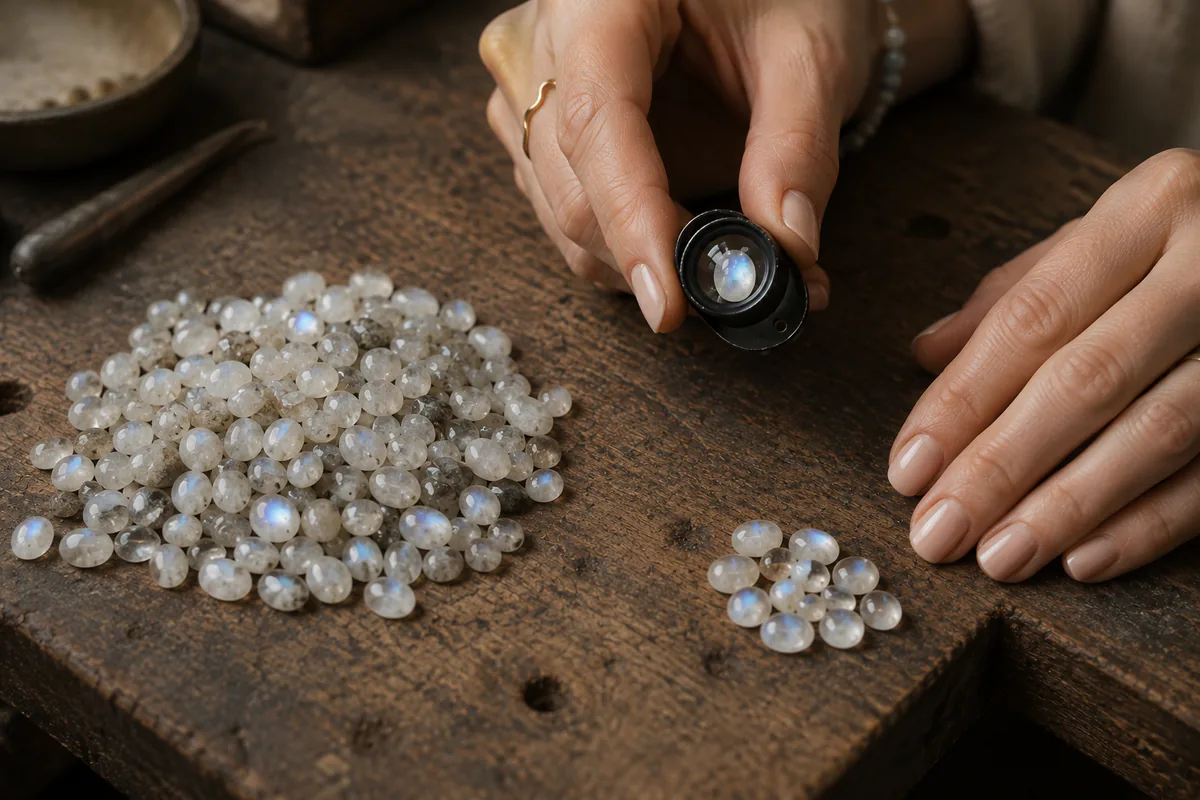
I set moonstone jewellery in my workshop in Tallinn. I pick the cabochons one by one, and I set aside five or six for every one I keep. What follows comes from that, and from what gemmology knows about this stone. When a claim comes from somewhere else, I say so.
The short version, if you are in a hurry
- What it is. A feldspar, most often an orthoclase called adularia. Not a mineral species of its own, a trade name.
- Its signature. Adularescence: a bluish veil that seems to float below the surface and that moves when you tilt the stone.
- Its hardness. 6 to 6.5 on the Mohs scale. But the number that matters is elsewhere: its cleavage is perfect, so it splits on impact.
- The trap. Opalite, sold everywhere as moonstone, is glass. Its sheen does not move.
- Its price. From a few cents per carat for an opaque milky stone to several hundred euros for a transparent blue from Sri Lanka.
- What you must never do. No ultrasonic cleaner, no salt, no hot water.
What moonstone actually is
Moonstone is not a mineral species of its own. It is a trade name given to certain feldspars, the most common mineral family in the earth crust, when they show that particular floating sheen.
Classic moonstone is an orthoclase, also called adularia, after the Adula massif in the Swiss Alps where it was first described. Its hardness is 6 to 6.5 on the Mohs scale. That is respectable, comparable to an opal, but well below a sapphire or a diamond.
Yet that is not the number that counts. Moonstone has perfect cleavage: it has internal planes of weakness along which the crystal separates cleanly. It does not scratch easily, it splits on impact. That is the whole difference between a hard stone and a tough stone, and it governs how the stone must be set and worn. I come back to this below.
A word on the most common confusion, because it comes up in almost every message I get: moonstone is neither selenite, nor opal, nor mother of pearl. Selenite is a gypsum, soft enough to be scratched with a fingernail. Opal is a hydrated silica whose colours come from an entirely different mechanism. Mother of pearl is organic. All three comparisons are covered in moonstone or selenite, moonstone or opal and moonstone or pearl.
The full mineral data sheet, with density, refractive indices and crystal system, is in the properties of moonstone. Its geological formation is told in how moonstone forms.
Adularescence, the light that moves
This is the phenomenon that makes the stone, and almost nobody explains it correctly.
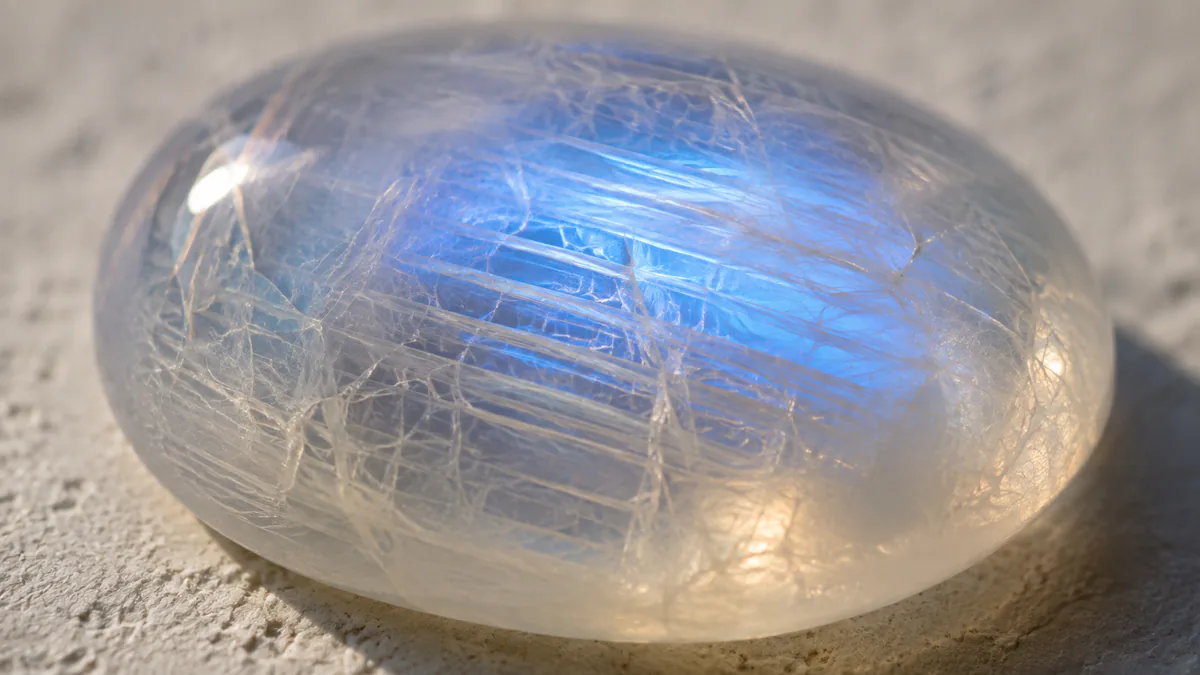
As magma cools slowly, the feldspar separates into alternating microscopic lamellae of slightly different compositions. That unmixing is called exsolution. The lamellae are a few hundred nanometres thick, roughly the wavelength of blue light. Light entering the stone scatters and comes back out as a diffuse bluish veil that seems to float beneath the surface rather than on it.
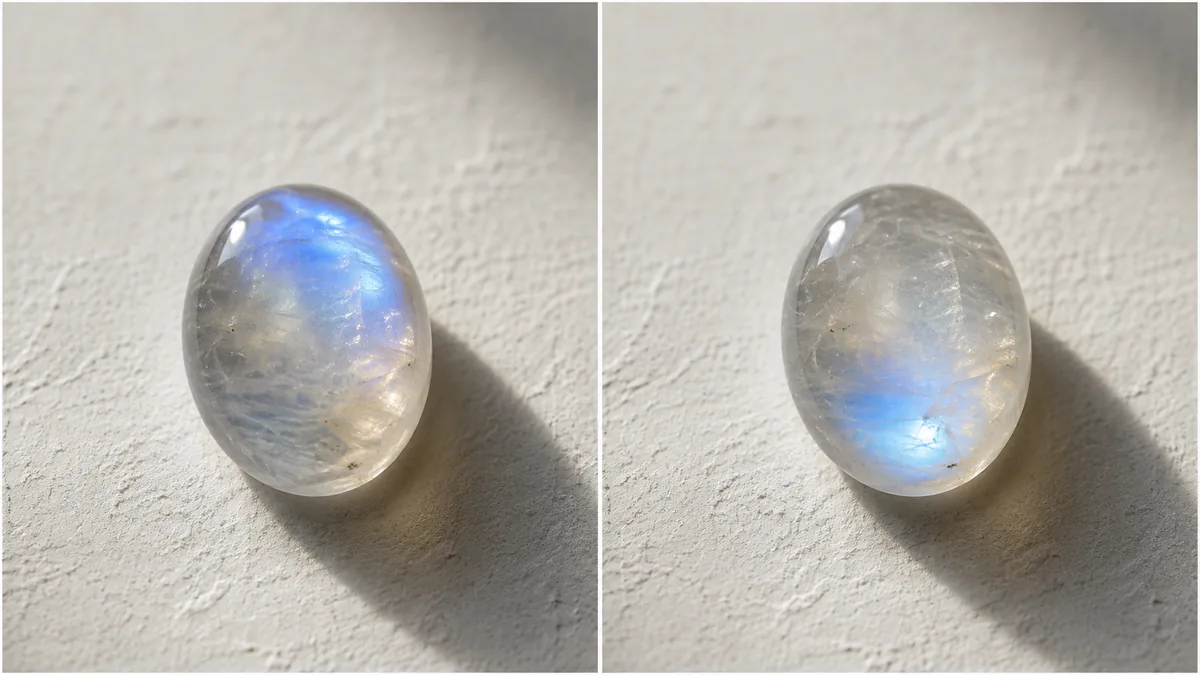
Two practical consequences. First, the sheen moves when you tilt the stone, because it depends on the angle at which light crosses the lamellae. Second, no imitation can reproduce that: opalescent glass returns a fixed brightness, stuck to the surface, that does not travel with your hand.
One detail sellers never mention: the orientation of the cut decides everything. The lamellae have a direction, and the lapidary must orient the cabochon so the sheen rises at the centre of the dome. Badly oriented, the same rough gives a dull stone with the veil escaping over one edge. That is why two cabochons cut from the same pebble can be worth ten times less than one another. The material is not everything, the hand counts just as much.
It is also why I always photograph my cabochons from two angles. A single photograph cannot show a phenomenon that only exists in movement. The mechanism is detailed in the article devoted to adularescence.
The colours, and two stubborn misunderstandings
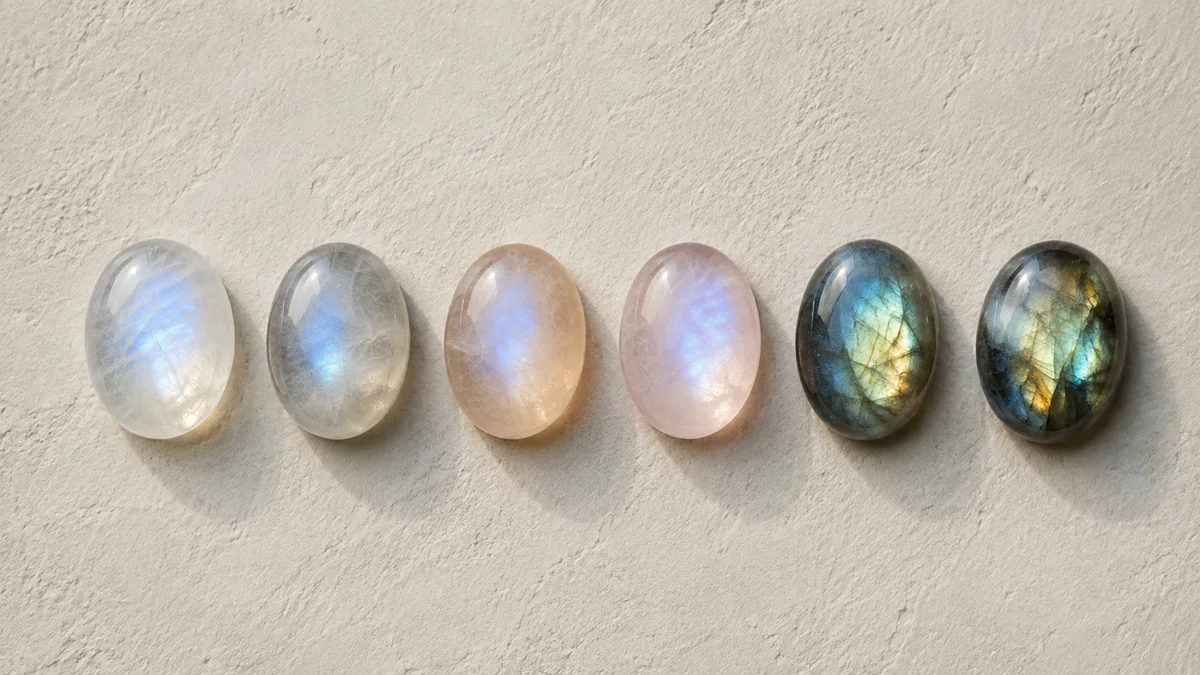
Moonstone comes in milky white, grey, peach, pink, orange, blue, rainbow and black. They are not all the same mineral, and that is where most shops get it wrong.
White, the classic
A translucent, almost colourless body, with a blue veil running across it. This is adularia, the orthoclase I mentioned above. It is the one that gave its name to all the others, and the most sought after when the sheen is strong and well centred. The matching jewellery is gathered in the white moonstone collection.
Rainbow and black, which are not adularia
Here is the point I want in writing: rainbow moonstone and black moonstone are labradorites, plagioclase feldspars. They are cousins of adularia, not the same species. Their play of colour is labradorescence, a neighboring but distinct phenomenon: where adularescence gives a diffuse blue veil, labradorescence gives broader, more colourful flashes that light up in patches.
That is not deception in itself: the name is standard in the gem trade. It becomes deception when a buyer is allowed to believe he is buying adularia. Here, the product page says so. The difference between the two is detailed in moonstone or labradorite, and the pieces concerned are in the rainbow collection and the black collection.
Blue, the most expensive of all
A perfectly colourless body, transparent as water, crossed by a deep blue that rises at the centre of the dome. It is the top of the range, and it has become rare: the Sri Lankan deposit that historically supplied it is running out. A fine blue above five carats is a collector piece today. The detail is in blue moonstone.
The softer colours
Peach and orange take their warm tint from iron oxide inclusions, and their sheen is often silvery rather than blue. Pink is gentler, between the two. Grey and green exist, in very small quantities. These varieties come at far more accessible prices than blue, which makes them good first stones. See orange and pink.
The full survey is in the colours and varieties of moonstone.
Where it comes from
Sri Lanka has historically supplied the finest blues, in particular the Meetiyagoda deposit, worked for more than a century. India produces most of the rainbow and coloured varieties. Madagascar, Tanzania, Myanmar and the United States also supply it.
Origin changes the price, because it changes the average quality of the sheen. A fine Sri Lankan blue commonly costs a third to a half more than a comparable stone from elsewhere, and the gap widens as the deposit thins out.
One point where I cannot be as categorical as I would like: traceability. Moonstone passes through trading circuits where parcels get mixed, and a seller who certifies a precise origin on a thirty euro stone is usually telling you a story. I buy from two suppliers I know, I know which region they work in, and I stop there. I would rather say that than embroider.
The map of the deposits is in the article devoted to them, and the history of the Sri Lankan deposit in moonstone from Sri Lanka.
What tradition attributes to it
What follows changes register. Everything above is measurable, verifiable, and written in the indicative. What follows belongs to crystal healing, a wellbeing approach founded on traditions and beliefs. I therefore write it in the conditional, and I never mix the two.
Moonstone is said, according to tradition, to be associated with intuition, emotional balance, the feminine and cycles. In India it has long been linked to the lunar god Chandra, and it remains a wedding gift stone there. In Rome it was connected to Diana. In Europe, Art Nouveau brought it back into fashion around 1900, at Lalique in particular, for its milky light that suited the plant lines of the period. These are historical and cultural facts, not properties of the stone.
It is also credited with a role in accompanying periods of change, and a place near the sacral chakra and the third eye in the traditions that use that system. It is moreover one of the June birthstones, alongside pearl and alexandrite.
I have developed these attributions, and where they come from, in the benefits of moonstone, in its meaning, in the associated chakras and in its myths and legends. Pairings with other stones are covered in which stone to pair it with and, for the combinations to avoid, in those that sit badly together.
These correspondences belong to crystal healing, an approach founded on traditions and beliefs. They are not a medical claim and never replace the advice of a health professional. Read the full disclaimer.
Recognising a genuine stone
This is the question I am asked most often, and it is a fair one: the most widespread imitation is called opalite, and it is glass. Not a treated stone, not a lower quality stone. Glass.
The three signs that are almost always enough
The sheen moves, or it does not. Tilt the stone slowly under a point light source. On a real one, the blue veil glides and changes intensity. On opalite, the brightness stays in the same place. It is the most reliable test, and it costs nothing.
The body is translucent, not uniformly milky. Moonstone lets light through with irregularities, often fine internal ladder like fissures that gemmologists sometimes call centipede inclusions. Glass is homogeneous, too clean. If it contains round bubbles, the matter is settled: no mineral forms spherical bubbles.
The price. A good sized colourless cabochon with a centred blue sheen does not cost three euros. When the price is too good, it is usually telling the truth about the material.
Two false leads that circulate everywhere
The cold test proves nothing. You often read that a real stone stays cold to the touch. So does glass. So does ceramic. That test only separates plastics, and barely. Do not base a purchase on it.
The doublet, on the other hand, is a real risk. It consists of gluing a thin slice of genuine moonstone onto a worthless backing, then bezel setting the whole thing to hide the edge. Seen from above, the stone is authentic. It is two tenths of a millimetre thick. On a piece of any real value, the only protection is to look at the edge, so to ask for a profile photograph, or to buy from someone who supplies one without being asked.
The six detailed tests, including those that need a little equipment, are in how to recognise genuine moonstone, the imitation case in moonstone or opalite, and the question of treatments in treated moonstone.
What it costs, and why
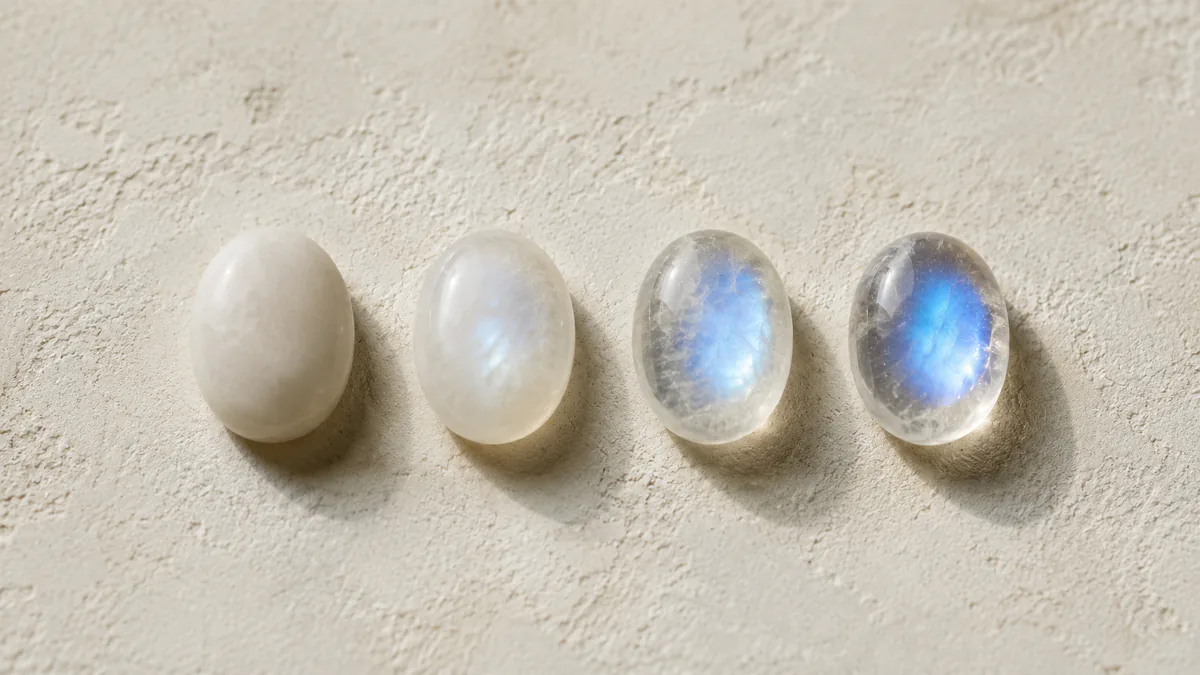
The price of a moonstone rests on five criteria: the transparency of the body, which should tend towards colourless; the intensity of the sheen; its position, which should be centred on the dome rather than pushed to an edge; the size of the cabochon; and the cleanliness of the inclusions.
The orders of magnitude below are the ones I see when buying, on loose stones, before setting. They move from year to year and are not a price list.
| Level | What you see | Price per carat |
|---|---|---|
| Milky | Opaque body, whitish and blurred sheen | under €2 |
| Decent | Translucent, blue sheen visible but off centre | €4 to €15 |
| Fine | Well translucent, clear and centred blue | €20 to €80 |
| Gem quality | Colourless, deep blue, no visible inclusion | €100 to €500 |
Two effects worth knowing. Price per carat is not linear: a ten carat gem quality stone is not worth ten times a one carat stone, it is worth considerably more, because large clean crystals are rare. And above roughly three hundred euros, a laboratory certificate becomes a reasonable investment; below that it often costs more than what it guarantees.
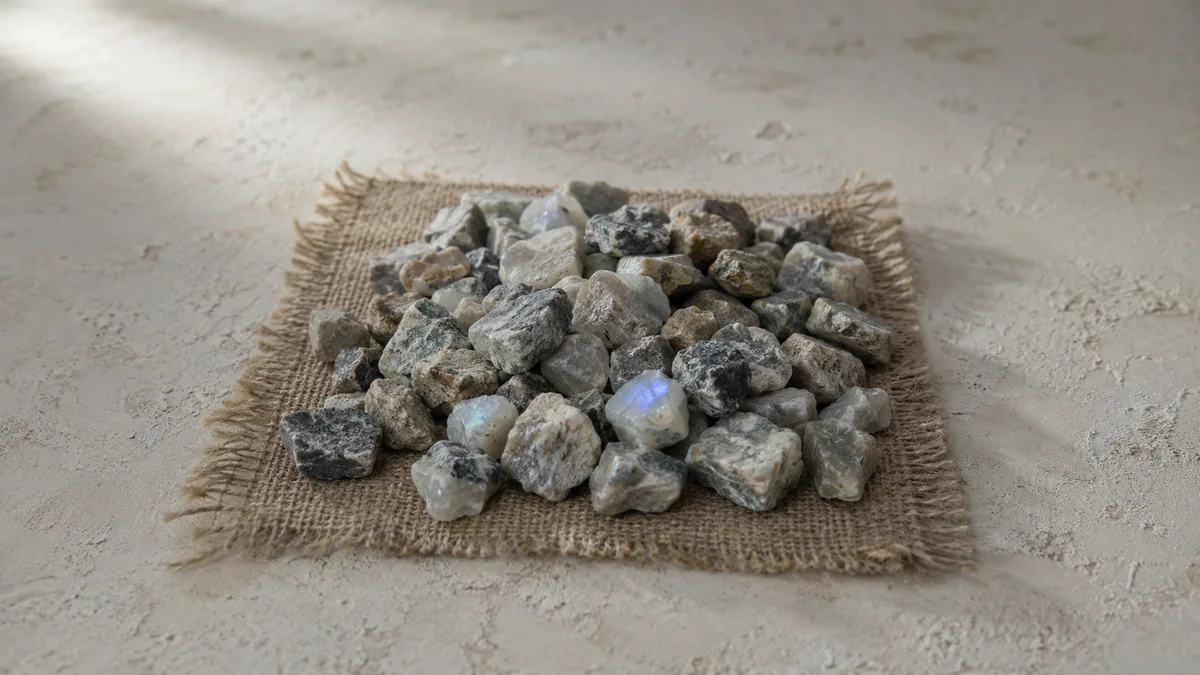
The full reading grid is in judging the quality of a moonstone, and the per carat detail in the price of moonstone. If you are starting from the rough, see raw moonstone.
Choosing yours
If you buy only one moonstone, here is the order in which I would look, at a given budget.
- The sheen before the size. A small cabochon with a clear centred blue makes more impression than a large stone with an escaping veil. Light is the subject, not volume.
- The dome before the flat. Adularescence needs thickness to rise. A cabochon cut too flat, to save material, puts the stone out.
- Two photographs before one. Always ask for a second view, from another angle. A seller who offers only one, always the same, under the same lighting, may simply be hiding a sheen that does not move.
- The setting before the promise. A bezel setting on a decent stone will last longer than a prong setting on a fine one.
On choosing the piece itself, depending on who will wear it and for what occasion, I have written giving moonstone as a gift, moonstone for men and where to buy moonstone jewellery. For finger size, everything is in the size guide.
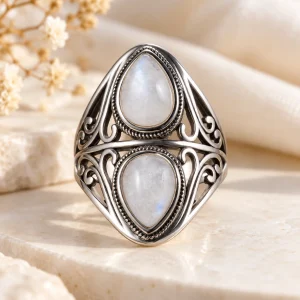
Rings from the workshop




Wearing it without breaking it
Back to that perfect cleavage, because it decides everything.
Moonstone is not especially afraid of scratches. It is afraid of impacts, which split it cleanly along its internal planes. The hand being the part of the body that bumps into things most, a moonstone ring is not a band you never take off: it is a ring you remove for washing up, sport and gardening.
That is also why I set most of my pieces in a bezel, that continuous rim of metal which surrounds the stone and takes lateral impacts in its place. Prongs show the cabochon better, but they expose it more. That trade off is detailed in bezel or prong setting, and the question of fragility in is moonstone fragile.
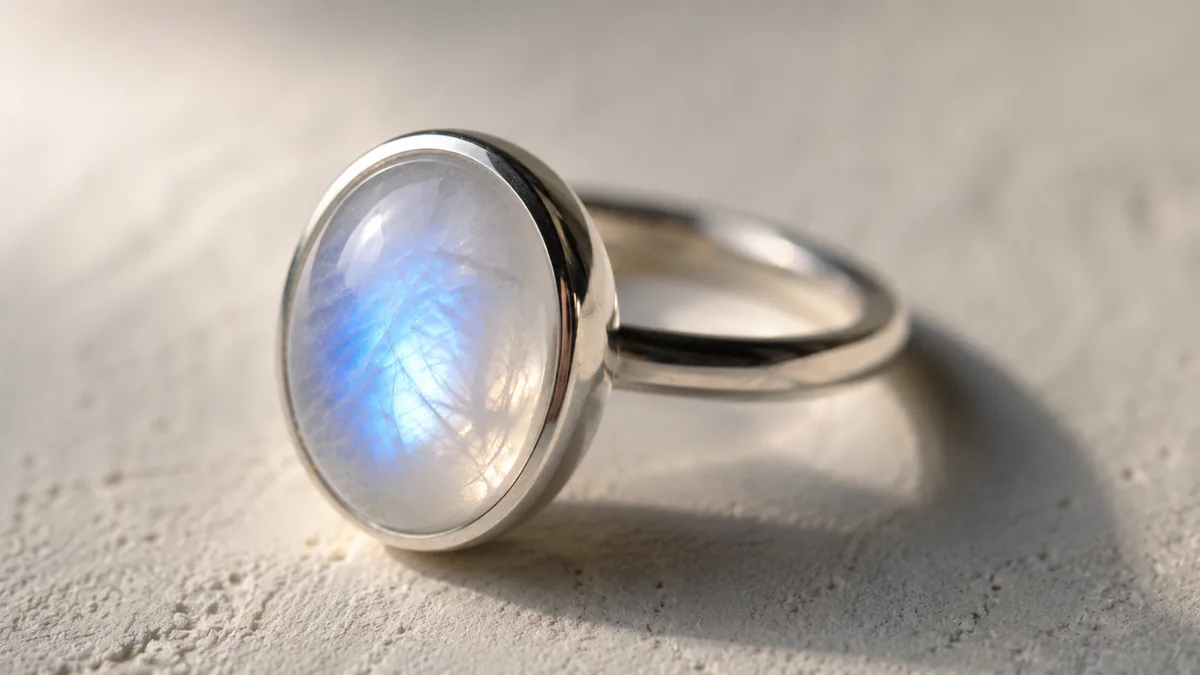
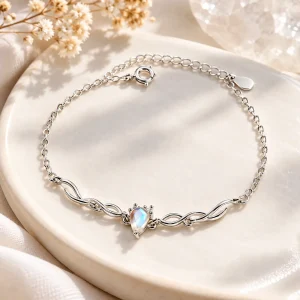
The other settings are less exposed. A pendant or a pair of earrings hardly bumps into anything. A bracelet is best worn on the less active hand, which is detailed in which wrist to wear it on. What to wear when is in how to wear moonstone, and the question of sleep in sleeping with your moonstone.
Bracelets, the least exposed setting
Cleaning and charging it
Three prohibitions, and they admit no exception.
Never ultrasonic cleaning. The vibrations find the cleavage planes and the stone opens. It is the fastest way to destroy a cabochon, and many jewelers offer it out of habit.
Never salt. Yet it is the most widespread cleansing method in crystal healing guides. Salt attacks the surface and works its way into the microfissures.
Never hot water, nor thermal shock in general.
What works: lukewarm water, a soft cloth, and nothing else. Take the piece off before the shower, the pool and the sea, and store it separately rather than loose with the rest, where harder stones would scratch it. The question of water, which comes up often, is covered in moonstone in water, and the method by type of piece in how to clean moonstone jewellery.
For cleansing and charging in the crystal healing sense, always in the conditional, see cleansing and charging your moonstone, the seven methods applied to all stones, and the lunar calendar for charging.
What I refuse to do
This section is not a flourish. It is what lets you judge all the rest.
I do not sell opalite. Not as an entry level option, not under another name. It is glass.
I do not sell white labradorite passed off as adularia. When a piece carries a labradorite, rainbow and black included, the product page says so.
I promise nothing about fertility, nor about any health matter. Tradition associates this stone with the feminine and with cycles, I report that as a tradition, and I stop there. The usual precautions are gathered in the side effects.
I never clean with ultrasound, even when asked to.
I do not sell doublets, and I supply a profile photograph on request, on any piece.
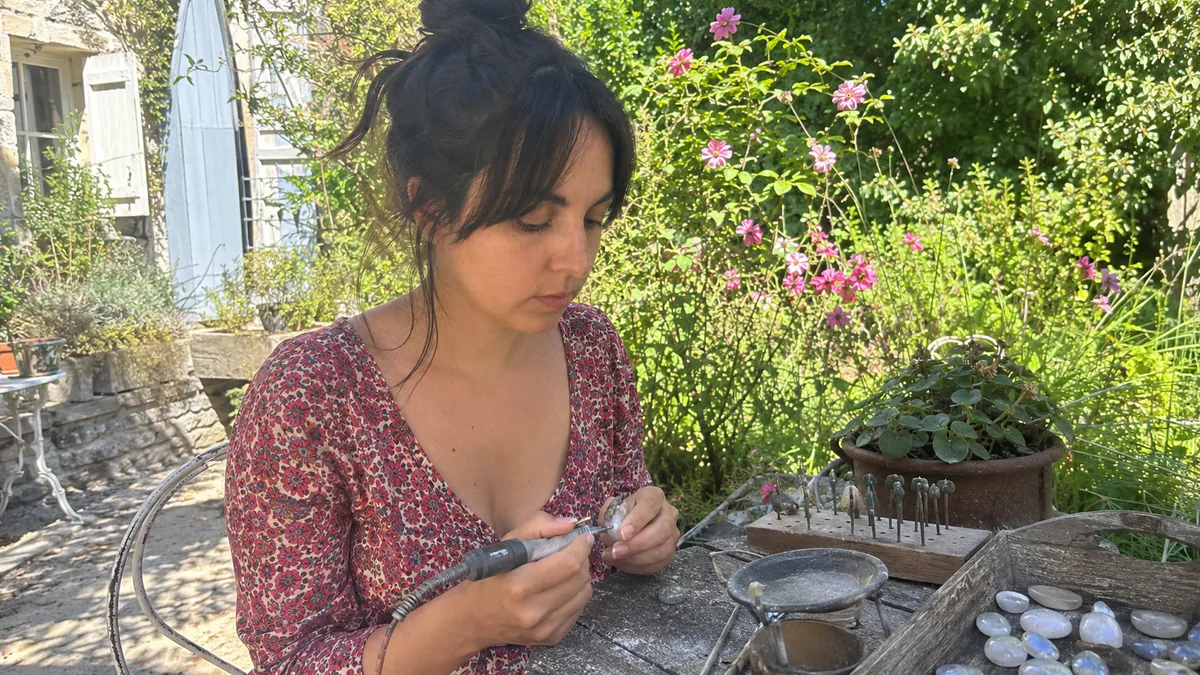
If you want to know where I come from and how I work, the workshop page tells the story.
Frequently asked questions
What is the difference between moonstone and white labradorite?
Classic moonstone is an orthoclase, white labradorite a plagioclase. They are two different feldspars. To the eye, adularia gives a diffuse blue veil that seems to float in depth, labradorite broader and more colourful flashes that light up in patches. Many sellers use the two names interchangeably. Everything is in the dedicated article.
How do I know if my moonstone is real?
Tilt it slowly under a point light source. If the sheen moves, that is a good sign. If it stays fixed in the same place, it is most probably opalite, so glass. Look too for fine internal fissures: glass is too clean, and round bubbles give it away immediately.
Can moonstone go in water?
Lukewarm water for a few moments, yes. A long soak, hot water, salt water or pool water, no. The stone has perfect cleavage and microfissures where water and salt settle in. So take your jewellery off before the shower, the sea and the pool.
Can you sleep wearing moonstone jewellery?
Nothing forbids it, but it is the best way to damage the stone: a ring rubbing against a headboard or catching in a sheet takes exactly the kind of impact that splits it. I advise taking it off at night. The subject is developed in sleeping with your moonstone.
Does moonstone change with the phases of the Moon?
No. Its sheen depends on the angle of the light and on its internal structure, not on the lunar calendar. What tradition says about charging at full moon belongs to crystal healing, not to any physical change in the stone.
On which hand should you wear a moonstone ring?
Practically speaking, the less active hand, because it is the one that bumps into things least. Symbolically, tradition leans towards the left, associated with receiving. The first reason strikes me as more useful than the second.
What is the price of a real moonstone?
From under two euros per carat for an opaque milky stone to several hundred euros for a transparent blue. On a finished piece, count the stone, the metal and the work: a silver ring with a decent cabochon most often sits between forty and eighty euros. The detail is in the price of moonstone.
Is moonstone fragile?
It is moderately hard, 6 to 6.5 on the Mohs scale, but above all it has perfect cleavage: it splits on impact rather than scratching. That is what justifies the bezel setting and taking it off for everyday tasks.
Is it a birthstone?
Yes, moonstone is one of the three birthstones for the month of June, with pearl and alexandrite. See the June birthstone and moonstone in astrology.
Is it suitable for an engagement ring?
It is beautiful and it has a genuine history as a wedding gift in India. But an engagement ring is worn every day, for decades, and that is exactly the use that breaks a stone with perfect cleavage. If you are set on it, choose a bezel setting and accept the idea of having the stone replaced one day. I say so plainly in moonstone engagement ring.
Where to go next
This guide is the starting point of the journal. Depending on what you are looking for:
- Understanding the stone: adularescence, the mineral data sheet, the colours, the glossary.
- What tradition says about it: the benefits, the meaning, starting out in crystal healing.
- Buying without making a mistake: recognising a genuine stone, judging quality, the price.
- Caring for it: cleansing and charging, cleaning a piece.
And if you simply want to see what it looks like set, everything is gathered in the shop. A question about a particular stone? Write to me, I answer myself within 48 working hours, and the answers often end up becoming an article.
My sources
The mineralogical data in this article, hardness, cleavage, composition and the mechanism of adularescence, follow the public data sheets of the GIA, Mindat and the International Gem Society. The price ranges come from my own purchases and from readings on the trading places, not from an official price list: none exists for this stone. Historical and cultural elements are given as such, and never presented as properties of the mineral.
Last updated: 18 August 2026. If you find a mistake in this article, tell me about it: I correct it and I note it.
✦ À porter, à offrir
Découvrez mes créations