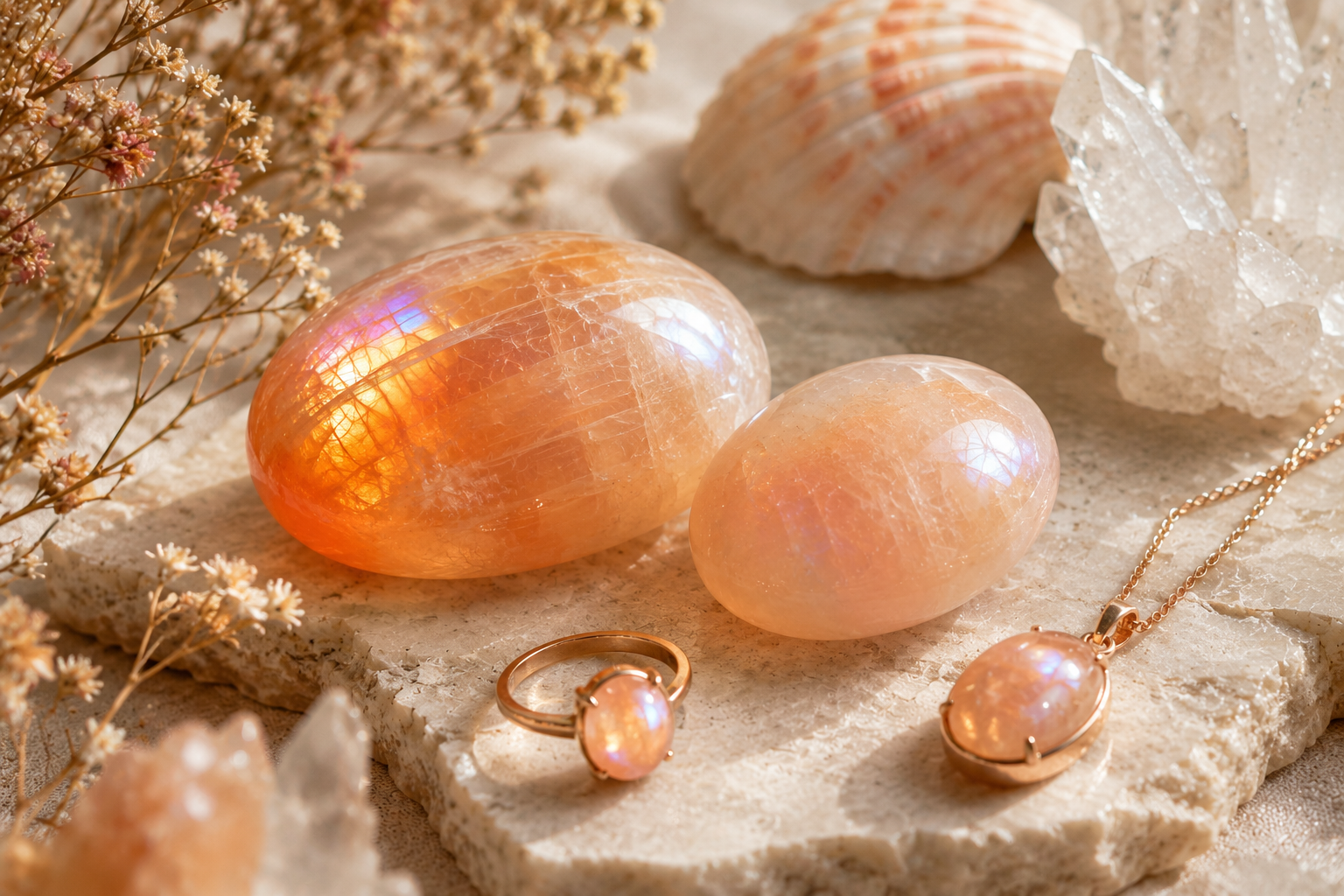
Peach moonstone
A warm body colour, a soft silver sheen, and the best value in the whole family: $3 to $22 a carat when a blue one starts at $75. Here is where the colour comes from, what separates peach from orange and pink, and why these are the only stones whose sheen barely shows up in a photo.
These are the varieties people talk about least, and unfairly so: they carry a light the white one does not have, and they suit skin tones that blue does not. The overview of all eight colours is in the colours and varieties of moonstone.
The short version, if you are in a hurry
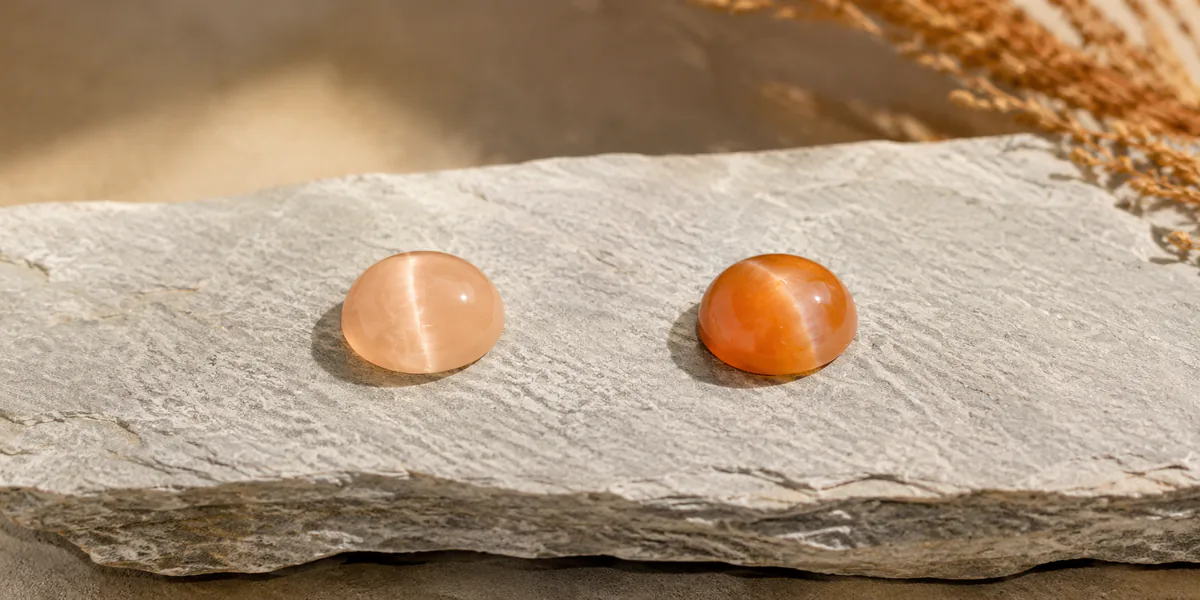
- The colour comes from iron, not from the sheen. It is the body of the stone that is tinted, unlike the blue one.
- The sheen itself stays silver or soft white. A peach stone almost never has a peach sheen.
- Peach, orange and pink are a continuum, with no sharp border. The names vary from one seller to the next.
- This is adularia, like the white and the blue. No labradorite here, unlike rainbow and black.
- $3 to $22 a carat, the bottom of the range, and by far the best value for money.
- They photograph badly. Their soft sheen disappears in an image, which explains how little known they are.
- They suit warm skin tones and rose gold, where the white and the blue call for a cool metal.
Where the body colour comes from
A difference in kind from the blue one, and it explains everything that follows.
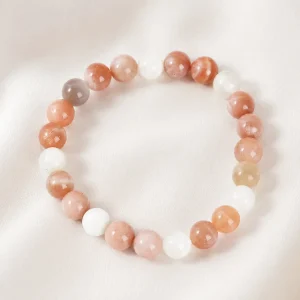
On a blue moonstone the body is colourless: the blue is an optical phenomenon produced by internal layers, and it disappears at certain angles. On a peach or an orange it is the reverse: it is the body itself that is tinted, and that tint stays visible at any angle, even in the dark under a lamp.
The colouring comes from traces of iron in the crystal lattice of the feldspar. Depending on their quantity and their oxidation state, the tint runs from a very pale cream to a deep brownish orange, taking in every peach and every apricot on the way.
In other words: a peach moonstone has two things to show, a body colour and a sheen, and the two are independent. That is what makes these varieties harder to judge than the white one, where there is only the sheen to look at.
The full mineral profile, density and refractive indices included, is in the properties of moonstone.
The silver sheen, and why it is not peach
This is the question I am asked most about these varieties, and the answer is often a disappointment.
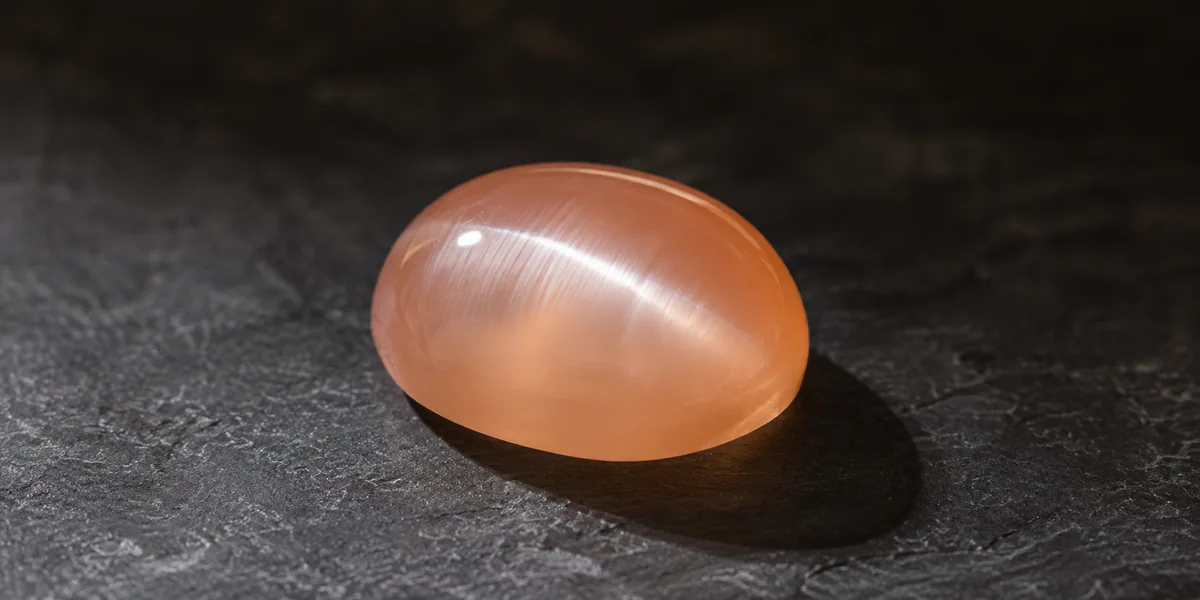
The sheen of a peach moonstone is not peach. It is silver, soft white, sometimes very slightly golden. It does not take on the colour of the body, and it cannot.
The reason lies in the mechanism. The sheen is born of internal layers that scatter light, and that scattering favours the short wavelengths. On a stone with very fine layers it gives blue; on thicker layers, white. The body colour takes no part in that phenomenon: it merely filters the light passing through, which softens and slightly warms the whole.
Hence a particular visual effect, and quite a beautiful one: a pale sheen sliding over a warm ground. It is less spectacular than a clear blue, it is softer, and it shows above all in movement. The full mechanism is in adularescence.
A useful suspicion. If a seller shows you a peach stone with a distinctly peach or bright uniform golden sheen, be wary: that is the behaviour of a quartz coated with an iridescent film, covered in is moonstone treated.
Peach, orange, pink: where the limits run
Nowhere, and that is worth knowing before you buy.
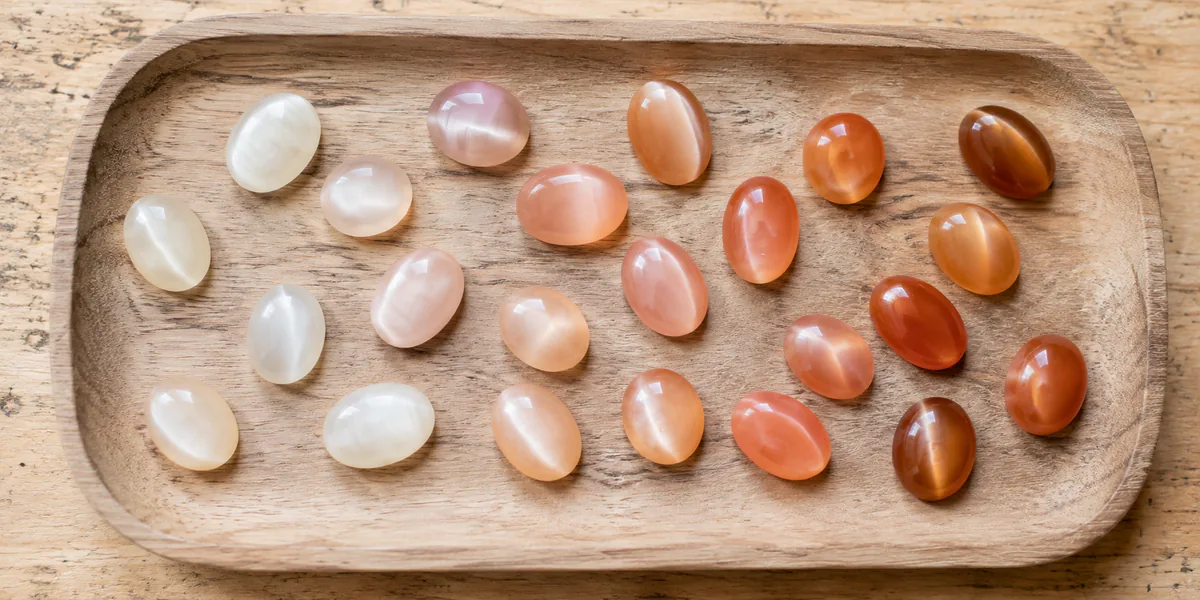
These three names describe a continuum of tints produced by the same mechanism, with more or less iron. There is no official definition, no threshold, no standard. The same stone can be sold as peach by one seller and as pink by another, without either of them lying.
| Name | What it most often means | Price per carat |
|---|---|---|
| Peach | Pinkish cream to pale apricot, very soft | $3 to $22 |
| Orange | Apricot to clear orange, deeper | $3 to $18 |
| Pink | Pale pink, with no yellow | $3 to $22 |
| Brown | Dark orange, often opaque | $3 to $12 |
The practical consequence: do not order these varieties on the name alone. Ask for a photo taken in daylight on a neutral background, and judge the tint yourself. This is the one area of moonstone where the vocabulary gives you no protection at all.
Pink has its own article, pink moonstone, because it carries a search volume of its own.
India, and why it matters
Almost entirely from India, and that fact explains the price.
The Indian deposits, scattered from Bihar to Tamil Nadu and Karnataka, produce most of the coloured varieties on the market, along with nearly all the rainbow material. Tamil Nadu in particular yields distinctly brown or russet stones. Sri Lanka, for its part, concentrates on whites and blues.
The volume is therefore considerable, on a completely different scale from fine blues. Abundant material, mined by hand, cut in large batches in Jaipur: every ingredient of a low price is present, and that is good news for the buyer.
The full map of the deposits is in moonstone deposits.
The price, and why it is so low
From $3 to $22 a carat for a peach, $3 to $18 for an orange. That is the floor of the family, and the gap with a blue is a factor of fifty at the very least.
Three reasons stack up, and not one of them concerns the intrinsic quality of the stone.
Abundance. India produces a great deal of it, and demand does not keep up.
The sheen. It is the number one price factor on this stone, and a soft silver sheen fetches far less than a clear blue. The full ranking is in the price of moonstone.
Fashion. The crystal market has fixed the image of moonstone on bluish white. A warm stone does not match the expectation, so it sells less, so it is worth less.
What that means for you. It is the best value in the whole catalogue. For the same money you get a stone that is markedly larger, cleaner and better cut in peach than in blue. On an everyday ring, that is a trade-off I genuinely recommend, and one that earns me nothing extra.
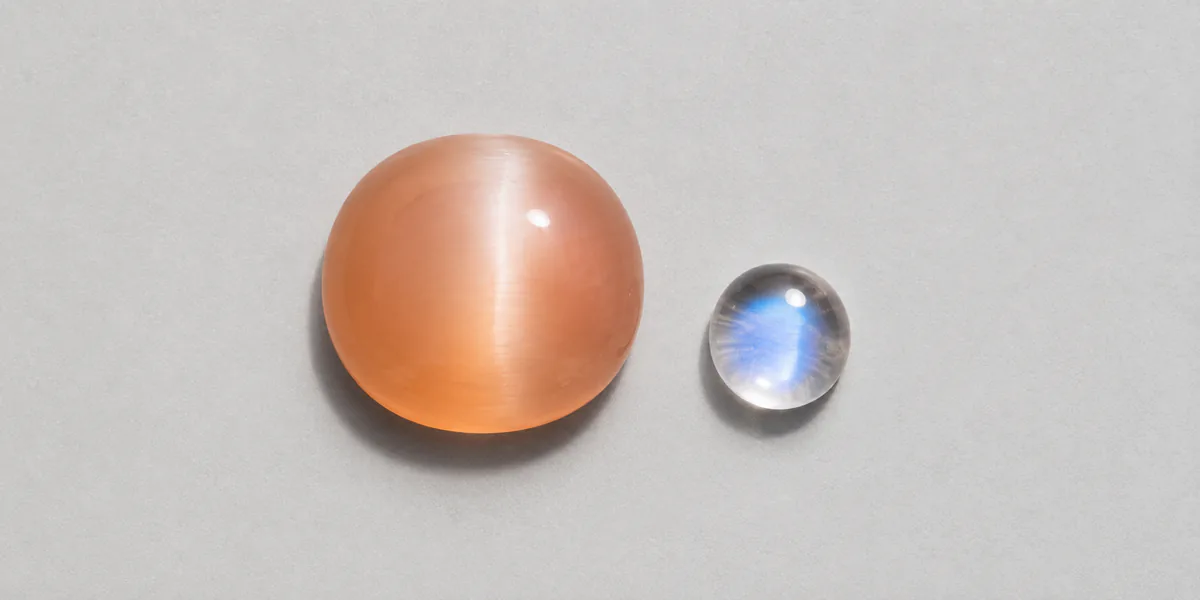
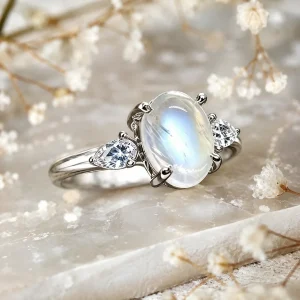
Warm stones and cool stones, your call
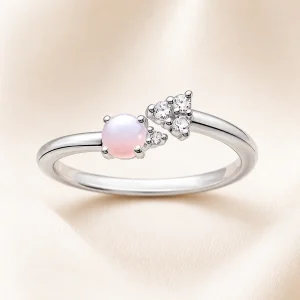
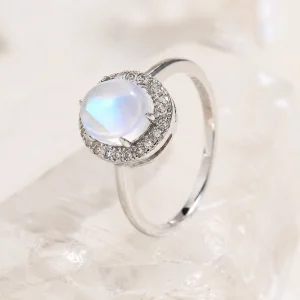
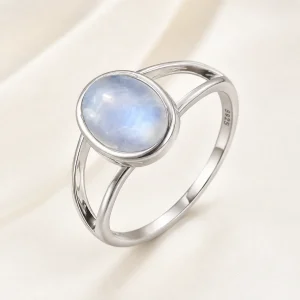
The photography problem
Here is the most useful explanation in this article, and it also accounts for how little known these varieties are.
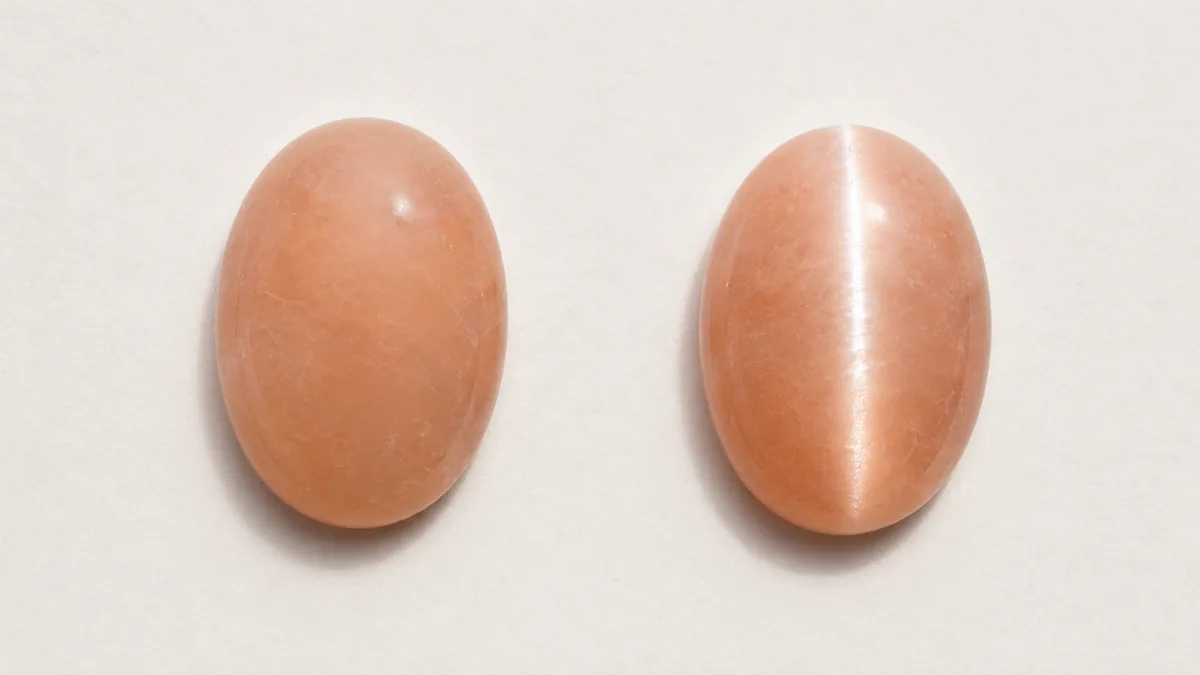
A peach moonstone photographs badly. Its sheen is soft, pale, low in contrast, and it is lost entirely in a still image, especially on a light background. What is left in the photo is a slightly dull orange stone with nothing remarkable about it.
A blue one, by contrast, photographs very well: a saturated sheen on a transparent body, laid on black velvet, gives a spectacular image. That is part of the reason the online market has fixed the image of moonstone on blue.
The concrete consequence for a buyer. These varieties are always better in hand than in a photo, which is the exact opposite of most online purchases. If a peach looks decent to you in an image, it will most likely be pretty when it arrives.
And for the seller, it has to be said: they call for directional light and a mid-tone background, neither white nor black, and a video rather than a photo. That is more work for a product that brings in less, which also explains why few shops bother.
Who they suit, and with which metal
This is where they take the lead again, and the argument is purely aesthetic.
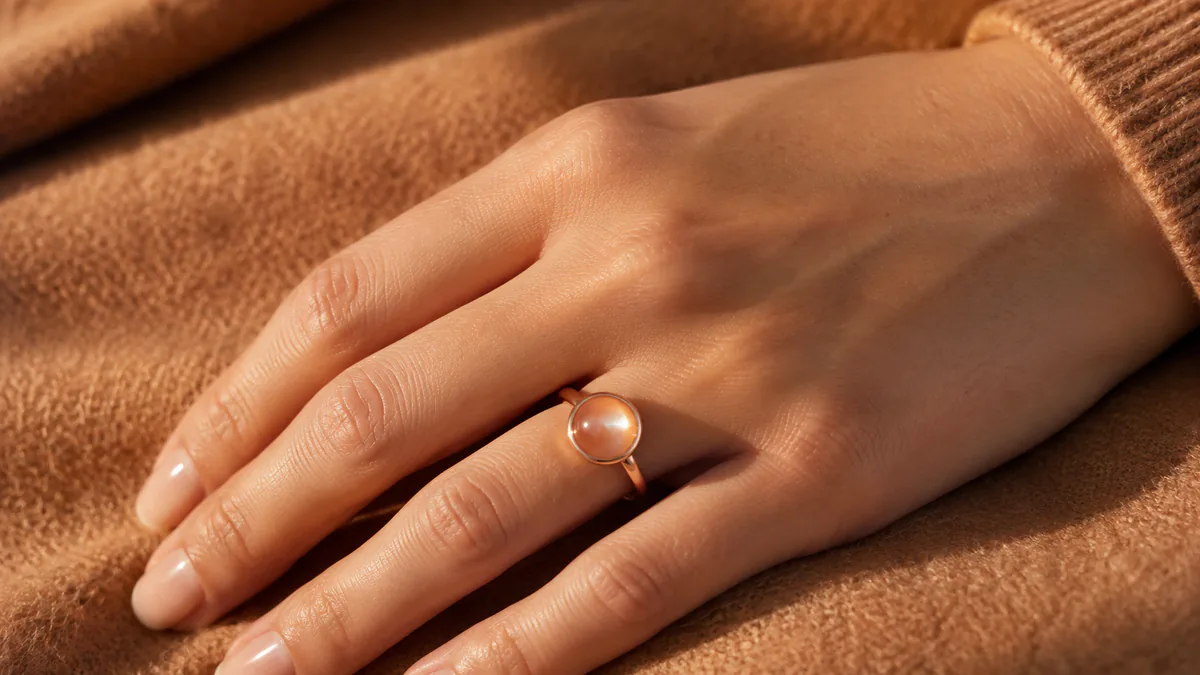
Warm skin tones. On golden, olive or tanned skin, a bluish white can look cold and a little clinical. A peach blends in beautifully, and it is the one moonstone variety I would say genuinely flatters a complexion.
Rose gold and gold plate. That is the obvious match. The warm metal carries on the body colour instead of fighting it, and the silver sheen creates the contrast that keeps the whole from being monotonous. A blue set in yellow gold, by contrast, loses part of its blue.
Silver, all the same. It works too, differently: the cool white of the metal brings out the warmth of the stone by contrast. It is less consensual, and more graphic.
A seasonal remark, which may sound frivolous but keeps coming up in my inbox: these are the varieties people happily wear in autumn, when a cold blue stone sits badly with the clothes. Wearing is covered in how to wear moonstone.
What tradition attributes to warm colours
A change of register, and I am flagging it. What precedes can be measured; what follows belongs to crystal healing, an approach founded on traditions and beliefs, and is written in the conditional.
These varieties have no old attribution of their own. They inherit what is attributed to moonstone in general, whose formation I have dated in the properties of moonstone.
Contemporary manuals add gentleness and kindness towards oneself, sometimes creativity. And it is worth knowing where that comes from: it is a rule of colour. In crystal healing, warm orange tints mechanically call up the sacral chakra, drive and creativity, whatever the stone, and that is exactly what is said of carnelian, which has nothing to do with it. I developed this mechanism of inheritance by colour in the properties and meaning of black moonstone.
One further piece of honesty: in the case of peach, these attributions are among the least stable in all of crystal healing. The sources plainly contradict one another, as the colour table in the meaning of moonstone shows.
These correspondences belong to crystal healing, an approach founded on traditions and beliefs. They are not a medical claim and never replace the advice of a health professional. Read the full disclaimer.
The workshop rings, some cool and some warm




Frequently asked questions
What is a peach moonstone?
An adularia whose body is tinted peach or apricot by traces of iron, and whose sheen stays silver. It is the same species as the white and the blue, with a body colour added.
Why does my peach stone not have a peach sheen?
Because the sheen never takes on the colour of the body. It is born of internal layers that scatter mostly the short wavelengths, which gives white or blue. A distinctly peach and uniform sheen is the sign of a coated quartz.
What is the difference between peach, orange and pink?
No official definition: it is a continuum of tints produced by more or less iron. The same stone can be sold under two of those names without anyone lying. Judge on a photo, not on the name.
Why are they so cheap?
Three reasons together: India produces a great deal of them, their soft sheen fetches less than a clear blue, and the market has fixed the image of moonstone on bluish white. None of that concerns their quality.
Are they lower quality?
No, they are other varieties of the same species. For the same money you get a stone that is larger, cleaner and better cut in peach than in blue. It is the best value in the family.
Why do they look dull in photos?
Their sheen is soft and low in contrast, and it is lost in a still image. These varieties are always better in hand than in a photo, which is the opposite of most online purchases.
Which metal suits them?
Rose gold and gold plate carry on the warmth of the body, which is the most obvious match. Silver works too, by contrast, giving a more graphic result.
Are they more fragile than the others?
No, exactly the same: 6 to 6.5 on the Mohs scale and two directions of cleavage. The precautions are identical and they are in is moonstone fragile.
Where do they come from?
Almost entirely from India, where the deposits of Bihar, Tamil Nadu and Karnataka produce most of the coloured varieties. Sri Lanka, for its part, concentrates on whites and blues.
What does tradition attribute to them?
Gentleness and kindness towards oneself, sometimes creativity. But that is a rule of colour, not an observation: in crystal healing every warm tint receives those attributions. They are also among the least stable in the field.
Where to go next
- The other varieties: colours and varieties, the pink, the blue, moonstone or labradorite.
- Understanding the sheen: adularescence, the mineral profile, the glossary.
- Buying: the price, the six quality criteria, treated stones, the deposits.
- Wearing: how to wear it, bezel or prongs, is it fragile.
- The whole picture: the complete guide to moonstone.
The jewellery is in the shop. If you are torn between a generous peach and a smaller blue at the same price, write to me: I will send you a video of both, and that is the only honest way to settle it.
My sources
For the colouring: the warm tints of feldspars are attributed to traces of iron in the crystal lattice, depending on their quantity and their oxidation state. Source: Mindat and the gemmological pages of the GIA.
For the mechanism of the sheen and its independence from the body colour, the same body of work, developed in adularescence.
For the Indian origin of the coloured varieties, the localities recorded on Mindat in Bihar, Tamil Nadu and Karnataka, taken up in moonstone deposits.
Two limits I want to flag. The price ranges are orders of magnitude observed on the cabochon market, not a rating: this stone has none. And the remarks on photography, on skin tones and on seasons come from the workshop and from customer feedback, not from a published source. I give them for what they are worth, which is the experience of one person who handles these stones and reads her messages.
Last updated: 19 August 2026. If you find an error in this article, let me know: I correct it and I note it.
✦ À porter, à offrir
Découvrez mes créations